Hawaii Nonresident Hunting License Cost
Navigating the world of hunting licenses can feel like cracking a secret code, and for nonresidents looking to hunt in Hawaii, it often brings up questions about exactly what it's going to cost. It's not always as straightforward as a single fee, and many hunters get frustrated by hidden costs and separate stamps. This guide is here to break down the current nonresident hunting license costs, explain the essential add-ons, and help you budget for your incredible Hawaii hunting adventure.
Understanding the Base Nonresident Hunting License Cost in Hawaii
When you first start looking into hunting in Hawaii as an outsider, the initial license fee is what you'll usually see advertised. But it’s crucial to understand what this foundational cost actually covers and, perhaps more importantly, what it doesn't. Think of it as your entry ticket to the general hunting scene in the islands, but not your all-access pass.
The Annual Fee Structure for Nonresidents
Currently, a Hawaii nonresident hunting license will run you about $100. This is an annual fee, meaning it's valid for a full hunting year from July 1st to June 30th of the following year, regardless of when you purchase it within that period. While it might seem a bit steep compared to some mainland states, it’s an investment in accessing some truly unique hunting opportunities. It’s significantly higher than the resident license, which is a common practice across states to help manage wildlife resources and ensure local funds contribute directly to conservation efforts.
This base license establishes your legal right to pursue game in Hawaii's public hunting units, provided you also have the necessary permits and adhere to all other regulations. It’s your official acknowledgment that you're a legitimate hunter in the Aloha State. However, it's just the first step in assembling your complete hunting credentials.
This fee goes directly to the state's Division of Forestry and Wildlife (DOFAW), supporting their critical work in managing Hawaii's diverse ecosystems. From monitoring game populations to maintaining public access roads and enforcing regulations, your license fee helps sustain the very opportunities you're seeking.
What the Base License Doesn't Cover
Here's where many first-time nonresident hunters can get caught off guard. That $100 base license is essential, but it is not a standalone permit to hunt any animal you desire. In Hawaii, the system is layered, and you’ll almost certainly need additional stamps and permit-tags depending on what species you plan to hunt and where. It’s not like buying a fishing license that typically covers all fish species within season.
For instance, if your dream is to hunt the elusive Axis deer on Maui or a Mouflon ram on Mauna Kea, that base license won't cut it on its own. You'll need specific tags for those animals. The same goes for chasing feral pigs in a rainforest gulch or pheasants in the dry uplands – different species require different permissions. This tiered approach allows DOFAW to manage specific game populations more effectively and ensures that revenue generated from particular hunts goes back into managing those specific animals and their habitats.
Understanding this distinction upfront is key to accurate budgeting and avoiding disappointment. It ensures you don't arrive in Hawaii thinking you're fully ready, only to find out you're missing crucial components for your planned hunt. We'll dive into these additional, often more costly, requirements next.
Essential Add-on Stamps and Permits for Nonresident Hunters
Once you've got your base nonresident hunting license sorted, you’re ready for the next layer of requirements. These additional stamps and permit-tags are critical, and they’re where the bulk of your nonresident hunting costs for specific species will come into play. Ignoring them isn't an option, as they are mandatory for almost all types of hunting in Hawaii.
The Wildlife Conservation Stamp
Every hunter in Hawaii, resident or nonresident, is required to purchase a Hawaii Wildlife Conservation Stamp. This stamp is an additional fee, typically around $10 for all hunters. Its purpose is exactly what it sounds like: to fund vital conservation programs across the islands. This isn't tied to a specific game species but rather contributes to the broader health of Hawaii's unique and often fragile ecosystems.
Whether you're after a big Axis buck, a feral pig, or even just planning a game bird hunt, this stamp is a non-negotiable part of your hunting credentials. It’s a small but mighty contribution to maintaining the natural resources that make hunting in Hawaii so special. You'll usually add this to your cart right after your base hunting license when you're purchasing everything online through the official DOFAW portal or through the convenient GoHunt Hawaii platform.
The funds from this stamp might go towards efforts like invasive species control, habitat restoration projects, or research into endangered native birds that share the same forests and uplands as the game animals we pursue. It's a way for every hunter to give back to the land they're enjoying.
The Game Bird Stamp
If your hunting ambitions include any of Hawaii's vibrant game birds—from Chukar to Francolin, Pheasant, or the various Dove species—then you'll need to add a Game Bird Stamp to your purchase. This stamp, typically costing around $10 for both residents and nonresidents, is specifically dedicated to the management and conservation of game bird populations and their habitats. If your plan is purely focused on big game mammals like pigs, goats, or deer, then you can skip this one.
But for those who love the challenge of upland bird hunting or the fast-paced action of a dove shoot, this stamp is mandatory. It ensures that specific funds are earmarked for projects like creating and maintaining bird habitat, conducting population surveys, and opening up access to bird hunting areas. You can find detailed information on the specific seasons and bag limits for these birds by checking the "Hawaii Game Bird Seasons and Bag Limits" section of the official DOFAW regulations.
For example, if you're planning on Hunting Erckel's Francolin in Tall Grass on the Big Island or Dove Hunting on Hawaii Farm Ground, this stamp is absolutely essential. It's a small fee that directly supports the future of Hawaii's diverse game bird hunting opportunities.
Species-Specific Permit-Tags
This is where the costs for big game hunting truly escalate for nonresidents. For most game mammals in Hawaii, particularly those found in specific management areas or on certain islands, you'll need to acquire species-specific permit-tags in addition to your base hunting license and conservation stamp. These tags are often substantially more expensive for nonresidents than for residents, reflecting the demand and the value of these unique hunting experiences. You can learn more about this system in our guide on "How Hawaii's Permit-Tag System Works."
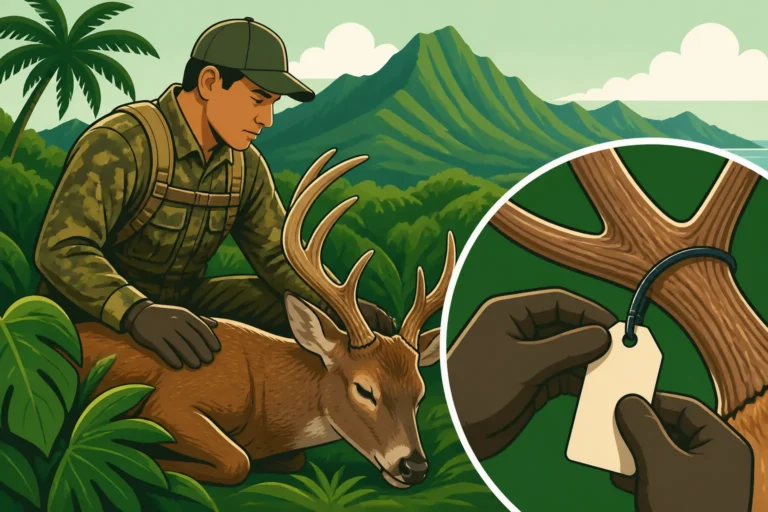
Take Axis deer, for example. While the base hunting license gets you in the door, an Axis deer tag for a nonresident can cost several hundred dollars. For instance, a nonresident Lanai Axis Deer Tag Cost for Residents is significantly lower than what an out-of-state hunter will pay for the same tag, often upwards of $1000 or more. These tags are not always over-the-counter either; some hunts, especially for prime areas like Lanai's Axis deer or certain Mouflon Sheep hunts on Hawaii Island, operate on a drawn hunt or lottery system. If you're successful in a draw, then you pay the tag fee.
Mouflon sheep tags on the Big Island can also be a significant expense, often in the realm of several hundred dollars for nonresidents, depending on the unit and the specific season. For feral pigs and goats on some islands, the tag fees might be less, or in some public units, they might not require a specific tag beyond your base license and conservation stamp, but this varies by island and unit. Always consult the specific unit regulations on the DOFAW website or the GoHunt portal for clarity.
This tiered pricing and permit system reflects the high demand for Hawaii's unique big game and helps fund intensive management efforts, especially given that many of these species are introduced and can impact native ecosystems if not properly managed.
Navigating the Purchase Process and Total Estimated Costs
Once you have a clear picture of the various fees, the next step is actually acquiring your license, stamps, and tags. The process is relatively straightforward, but it requires attention to detail, especially for nonresidents.
Where to Buy Your Hawaii Hunting License and Permits
The primary and most convenient way to purchase your Hawaii hunting license and associated permits is online through the official Hawaii Division of Forestry and Wildlife (DOFAW) portal, or through their integrated GoHunt Hawaii system. This platform is designed to streamline the process, allowing you to handle everything from the comfort of your home.
Here's a general step-by-step for nonresidents:
- Create an Account: You'll need to register on the GoHunt platform or the DOFAW licensing system. This usually involves providing personal details, including your date of birth and contact information.
- Verify Hunter Education: As a nonresident, you'll need to demonstrate proof of hunter education completion from your home state or another approved jurisdiction. This typically means uploading a copy of your hunter education card or certificate. Hawaii will review this, and upon approval, you'll receive a "Nonresident Letter of Exemption," which is crucial. It's vital to do this well in advance of your trip, as verification can take some time.
- Select Your License and Stamps: Once your hunter education is verified, you can proceed to select the annual Nonresident Hunting License. Then, add the mandatory Wildlife Conservation Stamp. If you plan to hunt birds, don't forget the Game Bird Stamp.
- Add Species-Specific Tags: Depending on your target animal and chosen hunting unit, you'll then select and purchase the appropriate permit-tags, such as an Axis deer tag or a Mouflon tag. Remember, some of these might be acquired via a lottery draw first, so be aware of application deadlines if you're targeting those specific hunts.
- Checkout and Print: After adding all necessary items to your cart, proceed to checkout. Once purchased, you should be able to print your license and tags immediately. Always carry physical copies, or have them readily accessible on your mobile device (like through the OuterSpatial app if Hawaii uses it for check-ins) when in the field.
It's highly recommended to handle all these purchases several weeks, if not months, before your planned hunt, especially given the hunter education verification process for nonresidents. Don't wait until the last minute!
Estimating Your Total Hunting Expense as a Nonresident
The total cost can vary significantly based on your hunting aspirations. Let's look at a couple of hypothetical scenarios to give you a clearer picture.
Scenario 1: A focused Axis Deer Hunt on Maui (Private Land/Non-Draw Public Unit)
For a nonresident looking to hunt Axis deer on Maui, either on private land or a public unit where tags might be available over-the-counter (if not a drawn hunt unit), the costs could look something like this:
| Item | Estimated Nonresident Cost |
|---|---|
| Annual Nonresident Hunting License | $100 |
| Wildlife Conservation Stamp | $10 |
| Axis Deer Permit-Tag | $500 – $1,500 (highly variable by island/unit/outfitter) |
| Subtotal (Base hunt) | $610 – $1,610 |
| Optional: Game Bird Stamp | $10 |
| Total with Bird Stamp | $620 – $1,620 |
Note: The Axis deer tag cost is highly variable. Private land hunts with outfitters will include this tag fee in their package pricing, often leading to a much higher overall cost. Public land tags, when available, are usually less expensive but are not always guaranteed or available over-the-counter.
Scenario 2: A Multi-Species Hunt (Pigs, Goats, Birds)
For a more ambitious nonresident hunter aiming for a combination hunt on an island like the Big Island, pursuing feral pigs and goats (which often do not require a separate tag beyond the base license in many public units, though always check specific unit rules), plus some game birds:
| Item | Estimated Nonresident Cost |
|---|---|
| Annual Nonresident Hunting License | $100 |
| Wildlife Conservation Stamp | $10 |
| Game Bird Stamp | $10 |
| Feral Pig/Goat Tag | $0 – $50 (often no additional fee beyond license in public units, but confirm) |
| Total Estimated Cost | $120 – $170 |
As you can see, the biggest variable is often the species-specific permit-tag, especially for highly sought-after animals like Axis deer or Mouflon. Always cross-reference the current Hawaii Game Mammal Seasons and Hawaii Game Bird Seasons with the official DOFAW website or the GoHunt portal just before your trip for the most up-to-date pricing and requirements. Remember, this doesn't include travel, lodging, gear, or potential guide fees, which can add thousands more to your overall trip cost. Knowing What a Hawaii Guided Hunt Costs can help you budget for a fully outfitted experience.
Important Considerations Beyond Just the License Fee
Understanding the direct costs of your Hawaii hunting license and tags is a huge step, but there are other critical factors nonresidents need to consider that impact not just your wallet, but your ability to hunt legally and successfully.
Hunter Education Requirements and Proof
For nonresidents, simply having your hunting license from your home state isn't enough to satisfy Hawaii's hunter education requirements. You must be able to prove successful completion of a hunter education course that meets the standards of your home state or another jurisdiction. This is a non-negotiable step to hunt in Hawaii. If you've hunted for years but somehow never got certified, now's the time.
The process involves obtaining a "Nonresident Letter of Exemption" from the Hawaii Division of Forestry and Wildlife (DOFAW). This typically means you'll submit documentation of your hunter education certificate online when you apply for your license. DOFAW will review this and, upon approval, issue the letter. It's absolutely crucial to complete this process well in advance of your planned hunt, as it can take time for DOFAW staff to verify your credentials. Without this exemption, you simply won't be able to purchase your Hawaii hunting license, regardless of how much money you're willing to spend. Our dedicated guide on "The Nonresident Letter of Exemption" has all the details you'll need.
It's important to remember that this process is in place for safety. Hawaii's terrain, weather, and hunting regulations can be very different from mainland experiences, and ensuring all hunters have a baseline of safety knowledge is paramount.
Why Costs Fluctuate and Where to Find Up-to-Date Information
Like many state agencies, DOFAW's fees and regulations are subject to change. Economic factors, conservation needs, and legislative updates can all influence the cost of licenses and tags. What was true last year might be slightly different this year. This can be frustrating for hunters trying to plan a trip months or even a year in advance, but it's part of ensuring the sustainability of Hawaii's hunting opportunities.
Because of this, always make it a habit to check the most current information directly from the source. The official Hawaii Department of Land and Natural Resources (DLNR) website, specifically the Division of Forestry and Wildlife (DOFAW) section, is your ultimate authority. The GoHunt Hawaii platform, where you'll likely make your purchases, is also an excellent resource for current pricing and regulations. These sites are regularly updated with season dates, bag limits, and any changes to license or tag fees.
Beyond official channels, online hunting forums focused on Hawaii hunting can be invaluable. Fellow hunters often share real-time updates, clarify regulations, and offer tips based on their recent experiences. However, always double-check any information from forums with the official DOFAW site to ensure accuracy. Being proactive and checking these sources close to your hunt date will prevent any unwelcome surprises once you're on the islands.
Disclaimer
Please be aware that hunting regulations and fees in Hawaii are subject to change. While this guide provides current estimates and information, it is always your responsibility to consult the official Hawaii Department of Land and Natural Resources (DLNR) Division of Forestry and Wildlife (DOFAW) website or the GoHunt Hawaii platform for the most up-to-date and accurate rules and costs before planning or undertaking any hunting activity.