Hunting Hawaii’s Fenced Conservation Boundaries
It's incredibly frustrating, isn't it? You've spent hours scouting, poured over maps, and finally found that perfect spot in a Hawaii hunting unit, only to come face-to-face with a sturdy fence, often with "No Trespassing" signs that leave you wondering where you actually stand. Navigating these boundaries, especially those protecting Hawaii's sensitive conservation lands, can be confusing and lead to anxiety about accidentally breaking the rules. This guide is here to clear up the confusion, explaining why these fences exist, how to identify them, and how to hunt ethically and legally around Hawaii's fenced conservation boundaries.
Understanding the "Why" Behind Hawaii's Fences
When you encounter a fence snaking across the landscape in Hawaii, especially in what feels like prime hunting country, it's easy to feel a pang of frustration. Your mind might immediately jump to thoughts of restricted access or a missed opportunity. However, these fences aren't just arbitrary lines in the sand; they're critical tools in a much larger, ongoing battle to protect Hawaii's unique and incredibly fragile natural heritage. Understanding the deep-seated reasons behind their existence can shift your perspective from frustration to a shared sense of responsibility.
The Ecological Imperative: Protecting Native Ecosystems
Hawaii's native ecosystems are some of the most unique and endangered on Earth. Millions of years of isolation led to the evolution of plants and animals found nowhere else, like the iconic ʻōhiʻa lehua tree, ancient fern forests, and a host of rare birds and insects. These species evolved without the presence of large, browsing or rooting mammals, making them incredibly vulnerable. When pigs, goats, sheep, and deer were introduced, they became ecological wrecking balls, rapidly devouring native vegetation, disturbing delicate soil structures, and creating conditions ripe for invasive plant takeover.
Imagine a pristine patch of native forest, a true "kipuka" of biological diversity, slowly being nibbled away by hungry goats or rooted up by feral pigs. This isn't just about losing a few plants; it's about the collapse of an entire interdependent system. Native insects and birds rely on specific native plants for food and shelter. When those plants disappear, the entire food web unravels. These fenced conservation areas are often the last strongholds for these endemic species, serving as critical refuges where they can survive and hopefully thrive, free from the relentless pressure of ungulates. It’s an urgent effort to preserve what little remains of Hawaii’s original wildness.
Managing Invasive Ungulates
While we as hunters value the game animals in Hawaii, the reality for conservation managers is that species like feral pigs, goats, and Axis deer are highly destructive invasive species in many contexts. They reproduce quickly, spread rapidly, and their populations, unchecked, can decimate large swaths of critical habitat. The fences are a direct response to this challenge. They create physical barriers, effectively dividing the landscape into zones where ungulates are managed for hunting (often outside the fences, or in managed units that allow hunting) and zones where they are actively excluded or removed to protect native flora and fauna.
This management isn't just about keeping animals out of protected areas; it's also about preventing them from spreading diseases to native wildlife or even to agricultural areas. For example, feral pigs can carry leptospirosis, a bacterial disease that can affect humans and other animals. By containing and managing populations, these fences play a role in broader public health and agricultural interests too. It's a complex balance, and the fences are a clear line drawn to give threatened ecosystems a fighting chance. While hunters appreciate the challenge and opportunity these animals provide, understanding their impact is key to comprehending the necessity of these boundaries.
Historical Context of Fencing Efforts
The idea of fencing off areas to protect Hawaii's unique environment isn't new, but the scale and intensity have grown significantly over the past few decades. Early conservation efforts often focused on localized control measures, but as scientific understanding of ungulate impacts deepened, and as native species continued to decline, larger, more robust fencing projects became necessary. These aren't cheap or easy undertakings; they involve significant investment in materials, labor, and ongoing maintenance. Organizations like the Department of Land and Natural Resources (DLNR), through its Division of Forestry and Wildlife (DOFAW), along with numerous private conservation groups, have invested millions of dollars and countless hours into erecting and maintaining these barriers.
Many of these fences encircle critical watershed areas, which are vital for Hawaii's freshwater supply. By protecting these forests from ungulate damage, the fences indirectly help ensure clean, reliable water for the islands' communities. In a very real sense, these fences represent a long-term commitment to the health and sustainability of Hawaii, not just for its wildlife, but for its people. They stand as physical markers of a society's choice to actively defend its irreplaceable natural heritage, a testament to decades of scientific research and public advocacy for conservation.
Identifying Fenced Boundaries in the Field
Knowing why fences are there is one thing, but actually seeing and understanding them in the dense, often challenging terrain of Hawaii is another entirely. It's easy to get disoriented, especially when the vegetation is thick or the weather turns. Successfully hunting near these boundaries means being hyper-aware of your surroundings and using every tool at your disposal to stay on the right side of the law and respect conservation efforts.
Types of Fences You'll Encounter
The fences you'll come across in Hawaii's hunting units can vary wildly in appearance and construction, reflecting different eras of management, funding levels, and the specific animals they're designed to deter. You might encounter old, rusty barbed wire fences, barely visible through the undergrowth, which served as historical property lines or early attempts at containing cattle. These can be easy to miss, especially in low light or heavy rain, and might not even be actively maintained.
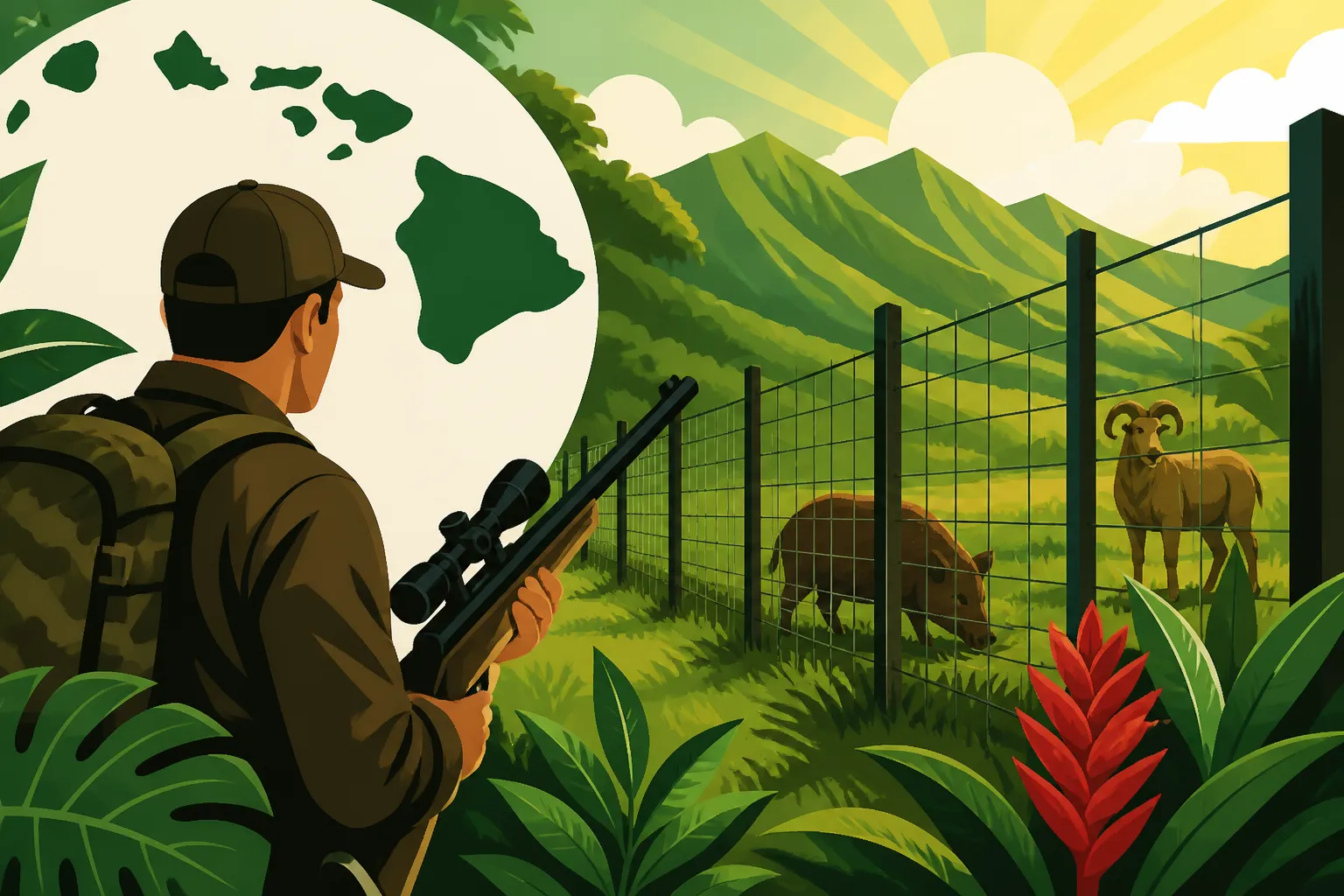
More commonly, around conservation areas, you'll see much more robust structures. These can include woven wire or hog panel fences, often 6-8 feet tall, specifically designed to be "pig-proof" or "goat-proof." They might be topped with smooth wire or even electric strands to prevent animals from jumping or climbing over. Newer fences often utilize durable, synthetic materials that are less prone to rust and degradation in Hawaii's humid environment. These will usually be well-maintained, clear-cut along their perimeter, and have prominent signage. Regardless of the type, treat every fence as an active boundary until you can confirm otherwise. Even old, dilapidated fences can still delineate private property or unhuntable areas.
Using Maps and GPS for Boundary Awareness
In Hawaii, relying solely on visual cues for boundaries is a recipe for disaster. The terrain can be deceptive, and even the most obvious fence line can disappear into a thick gulch or dense kiawe forest. This is where modern navigation tools become your best friend. Always carry a reliable GPS device, whether it's a dedicated handheld unit or a smartphone app, with up-to-date topographical maps and unit boundary overlays. Platforms like Using the OuterSpatial App to Check In or GoHunt are invaluable for pre-hunt scouting and real-time navigation in the field. They allow you to see precisely where the public hunting unit ends and where a conservation area or private land begins, even if there isn't a physical fence on the ground (though there usually is for conservation zones).
Before you even step foot in the unit, download maps for offline use, as cell service is often non-existent in remote Hawaiian hunting areas. Mark potential fence lines, check stations, and any known access points on your digital map. When in the field, constantly cross-reference your position with the boundary lines on your GPS. This proactive approach will help you avoid uncomfortable encounters and ensure you're always aware of your position relative to these critical conservation boundaries.
Recognizing "No Trespass" Signage
While fences are a clear physical barrier, accompanying signage provides the legal directive. Conservation fences, particularly those around Natural Area Reserves or watershed protection zones, will almost always be clearly marked with "No Trespassing," "Conservation Area," "DLNR," or similar signs. These signs are not merely suggestions; they are explicit legal warnings. Pay attention to the color, size, and frequency of these signs. Red or yellow signs often indicate danger or restricted access.
Sometimes, you might encounter fences that lack explicit "No Trespassing" signs but are clearly well-maintained and appear to separate a designated hunting unit from an untouched, dense forest. In such cases, your maps and GPS are paramount. If your map shows a conservation boundary, assume the area beyond the fence is off-limits, even without visible signs. If in doubt, err on the side of caution. Remember, ignorance of the boundary is rarely an acceptable excuse for trespass. A quick check on your device, or simply backing out and finding a different approach, can save you a lot of grief.
Legalities and Hunter Responsibilities Near Fences
Hunting near any boundary requires diligence, but adjacent to Hawaii's conservation fences, the stakes are particularly high. Not only are you dealing with state law, but you're also operating in areas often managed with federal funding and under strict environmental protection mandates. Understanding the legal framework and your responsibilities is paramount to being a respectful and responsible hunter in Hawaii.
What the Law Says About Hunting Adjacent to Fences
Hawaii's hunting regulations and trespass laws are serious. Entering a fenced conservation area without explicit authorization is illegal and can carry significant penalties, including fines and revocation of hunting privileges. These areas are established to protect highly sensitive ecosystems, and any disturbance, even unintentional, can have lasting negative impacts. The law is clear: if an area is fenced and designated as a conservation boundary, you are not permitted to cross it, pursue game into it, or retrieve game from it without prior approval from DOFAW or the managing agency.
This isn't just about avoiding a ticket; it's about upholding the integrity of conservation efforts. Think of it this way: when you purchase your Hawaii hunting license and any necessary permits, you're agreeing to abide by these rules. Disregarding a fence line isn't just a minor infraction; it undermines the very system that allows public hunting to exist alongside critical environmental protection. Always consult the latest Hawaii Administrative Rules (HAR) and any specific unit regulations for the area you're hunting to ensure you are fully compliant.
Retrieving Game That Crosses a Boundary
This is one of the most frustrating and challenging scenarios a hunter can face. You've made a good shot, but the animal, perhaps adrenaline-fueled, manages to leap over a conservation fence before expiring. Your heart sinks. Your instinct is to pursue, to recover your hard-won game, and to ensure the meat doesn't go to waste. However, under Hawaii law, you cannot cross that fence into a restricted conservation area, even to retrieve a downed animal, without permission. This is a tough pill to swallow, but it's a critical rule to prevent unauthorized entry into fragile habitats.
So, what can you do? The proper protocol is to immediately contact the local DOFAW office or game warden. Explain the situation clearly, providing your exact location (GPS coordinates are vital here), a description of the animal, and where it crossed the fence. They will then advise you on the next steps. In some rare cases, and at their discretion, DOFAW staff may accompany you to retrieve the animal, or they may recover it themselves. However, there's no guarantee of recovery, and you might have to accept the loss. This highlights the importance of making sure your shots are well-placed and that you're hunting with an understanding of how ethical shot placement and recovery considerations are affected by these boundaries. This challenging situation is precisely why knowing What Happens If You Forget to Check Out or other procedural rules is so important.
Avoiding Accidental Trespass
Accidental trespass is a genuine concern, particularly in Hawaii's rugged and heavily vegetated terrain where fence lines can be obscured. The best way to avoid it is through meticulous preparation and constant vigilance. Before your hunt, use mapping applications like those found on GoHunt, or official DLNR maps, to study the boundaries of your chosen hunting unit. Understand not just where the fences are, but also what lies beyond them. Is it private ranch land? A Natural Area Reserve? A different hunting unit with different rules?
While in the field, always have your GPS or mapping app actively running. Periodically check your location. If you find yourself approaching a fence, especially one you know borders a restricted area, give it a wide berth. If the terrain is difficult or visibility is poor, turn back and find a different route. It's better to lose a few hours of hunting time than to face the consequences of trespassing. Remember that in Hawaii, even if a fence is old or appears broken, the land beyond it might still be off-limits. When in doubt, always assume the area is restricted until you can confirm otherwise.
| Action | Legality/Recommendation | Notes |
|---|---|---|
| Crossing a Fenced Conservation Boundary | ILLEGAL without explicit DOFAW authorization. Penalties include fines and license revocation. | Do NOT cross under any circumstances. These areas protect highly sensitive native ecosystems. |
| Pursuing Game Across a Fence | ILLEGAL. You cannot chase an animal into a restricted area. | This is a major challenge for hunters. Prioritize ethical shots to prevent this scenario. |
| Retrieving Game Across a Fence | ILLEGAL to do so unassisted. You must contact DOFAW/game warden immediately. | Provide GPS coordinates and animal details. Recovery is at their discretion and not guaranteed. |
| Hunting Directly Along a Fence Line | Generally LEGAL within the open hunting unit, but exercise extreme caution. | Ensure all shots are taken away from the fence and into the legal hunting area. Be aware of your backdrop. |
| Damaging a Conservation Fence | ILLEGAL. Intentionally or negligently damaging fences can result in serious penalties. | Report any accidental damage to DOFAW. Do not try to repair it yourself unless instructed. |
| Ignoring "No Trespass" Signs | ILLEGAL. These signs are legal warnings. | Always respect signage, even if you believe your map shows public land. Clarify with DOFAW if there's a discrepancy. |
| Using GPS/Mapping Apps for Boundaries | HIGHLY RECOMMENDED. Essential for staying oriented and legal. | Download offline maps. Double-check your location frequently. Sites like GoHunt are great resources. |
| Reporting Suspicious Activity | RECOMMENDED. Helps protect wildlife and legitimate hunting access. | If you see poaching or fence damage, report it to DOFAW. |
Hunting Strategies Along Fenced Conservation Areas
While conservation fences represent boundaries that cannot be crossed, they can also paradoxically create unique hunting opportunities and require specific strategies. Animals, like people, often take paths of least resistance, and a fence can influence their movement patterns in predictable ways. Learning to read these movements and adapt your tactics can make a significant difference in your success, all while staying within legal bounds.
The "Fence Line Advantage"
Animals, whether it's Axis deer, feral pigs, or goats, often use fence lines as travel corridors. Imagine a dense forest or a wide-open plain – a straight, cleared fence line provides an easy route of travel, often with less undergrowth and clearer sight lines. For animals, it can be a convenient pathway, a boundary they're familiar with, or even a sense of security from perceived threats from one side. They might graze along the fence, follow it to water sources, or use it as a rub line.
As a hunter, this can offer a "fence line advantage." By setting up legally within the open hunting unit, parallel to a conservation fence, you can position yourself along these natural travel routes. Focus your attention on areas where the fence meets a natural feature, like a gulch, a saddle between hills, or a distinct change in vegetation. These are pinch points where animals are likely to cross or funnel along the fence. However, always ensure you have a clear shot within the legal hunting area and that your bullet or arrow will not inadvertently cross into the restricted zone or endanger any structures or personnel beyond the fence.
Understanding Animal Movement Patterns
Successfully hunting near these boundaries requires a deep understanding of animal behavior. Feral pigs, for example, might root extensively right up to the fence line of a protected area, attempting to find a weakness to get inside where forage might be richer and undisturbed. Knowing this, you can focus your efforts on reading pig sign along the perimeter. Look for fresh rooting, tracks, and rubs. Pigs often try to push under fences or find existing breaches. While you cannot enter the conservation area, these signs tell you that pigs are actively using the fence line.
Goats, on the other hand, are masters of navigating steep, rocky terrain. If a conservation fence cuts across a sheer pali (cliff) face, goats might still find ways to traverse it, or they'll travel along the base or rim, seeking breaks in the barrier. Axis deer, especially during the rut, might use fence lines for scent marking or as escape routes when pressured. Observing which way the wind blows, particularly the complex thermals in Hawaii's varied terrain, is crucial when planning your approach. Hunting downwind in Hawaii's shifting thermals means animals won't pick up your scent as easily. Animals will move differently at First Light in Hawaii or during a full moon. You might find great success still-hunting pigs in Hawaii's wet forest along these fence lines, or perhaps glassing a lava flow for Mouflon rams that might be skirting the edge of a fenced reserve.
Ethical Shot Placement and Recovery Considerations
This is perhaps the most critical aspect of hunting near conservation boundaries. The rule is simple: you must make an ethical shot that ensures the animal expires quickly and, crucially, within the legal hunting unit. There is nothing more heartbreaking and problematic than a wounded animal crossing into a protected area where you cannot pursue it. This wastes the game, causes suffering, and can even lead to legal trouble if you try to retrieve it illegally.
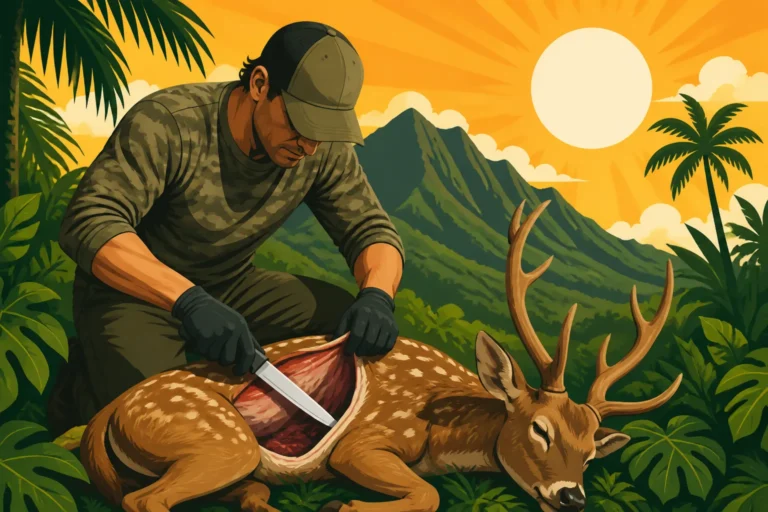
Practice your marksmanship diligently before your hunt. Know your effective range with your chosen weapon, whether you're using a rifle, muzzleloader, or bow. When you spot an animal near a fence, take extra time to assess the situation. Is it broadside? Is there a clear path for your bullet or arrow within the hunting unit? What's the backdrop? If there's any doubt about where the animal will fall or if it might run across the boundary after the shot, it's always better to wait for a better opportunity. A lost animal due to poor judgment is a hard lesson, but it’s one that must be learned to preserve the integrity of hunting near these critical conservation zones. Understanding how to Field Dressing Axis Deer in Hawaii Heat and Cooling Meat Fast on a Hawaii Hunt after a kill also becomes more urgent when near a boundary, as delays in retrieval can be costly.
Navigating Practical Challenges and Ethical Dilemmas
Hunting adjacent to conservation fences presents not just legal and strategic challenges, but also ethical and practical ones. As hunters, we have a unique relationship with the land and the animals, and respecting these boundaries means respecting the broader conservation goals, even when they restrict our immediate opportunities.
Respecting the Conservation Mission
It's easy to view conservation fences as an impediment to hunting. However, it's important to remember that these fences are typically built to protect Hawaii's last remaining native ecosystems from invasive ungulates. Many hunters are also staunch conservationists, understanding the delicate balance required to maintain healthy wildlife populations and habitats. By respecting these boundaries, you're not just following the law; you're actively participating in the larger effort to preserve Hawaii's unique biodiversity.
Think of it as a partnership. While some game animals are a resource we hunt, they can also be incredibly destructive in the wrong place. These fences delineate those "wrong places." By adhering to the rules and honoring the fences, you contribute positively to the public perception of hunters as responsible land users, not just exploiters. This respectful approach helps foster a better relationship between the hunting community and conservation organizations, ensuring that sustainable hunting can continue in Hawaii for generations to come.
What to Do If You Find Damage
Imagine you're walking along a fence line, carefully navigating the terrain, and you come across a section of fence that's been cut, pushed down, or otherwise damaged. Your first instinct might be to ignore it, or perhaps to even take advantage of the opening. However, a responsible hunter will do neither. Damage to conservation fences can compromise the entire purpose of the enclosure, allowing destructive ungulates into protected areas.
If you find damage, the ethical and correct action is to report it immediately to the local DOFAW office or game warden. Take photos if you can, and note the exact GPS coordinates of the damage. Provide as much detail as possible about the type of damage and its extent. Do not attempt to repair it yourself unless specifically authorized and equipped to do so. Your report helps land managers quickly assess and fix the breach, ensuring the fence remains effective. This active participation in maintaining conservation infrastructure demonstrates a commitment to the land beyond just harvesting game, reinforcing the positive role hunters can play.
Communicating with Land Managers
Sometimes, despite your best efforts, you might have questions about a specific boundary, notice an ambiguous sign, or need to inquire about the possibility of retrieving an animal that has crossed. In these situations, direct and respectful communication with the Hawaii Department of Land and Natural Resources (DLNR) Division of Forestry and Wildlife (DOFAW) is essential. They are the land managers, and they are there to help clarify rules and address issues.
Before making contact, gather all pertinent information: your exact location, the specific unit you are in, and a clear, concise question or description of the issue. Be polite and patient. Land managers are often stretched thin, and a respectful approach will go a long way. Building positive relationships with land managers is vital for the future of hunting in Hawaii. This includes understanding why Hawaii Hunting Units and How They Work and respecting when Hawaii Cancels or Shifts Seasons. A good example of this is seen when hunters collaborate with landowners for Hawaii Private Land Access Permits.
Planning Your Hunt Around Fenced Units
Effective planning is always the bedrock of a successful hunt, and it becomes even more critical when you're targeting areas bordered by conservation fences. The old adage "fail to prepare, prepare to fail" is particularly true here. Without thorough research and scouting, you risk not only a fruitless hunt but also legal complications.
Researching Unit Boundaries Before You Go
Before you even pack your bags, immerse yourself in the maps and regulations for your chosen hunting unit. This isn't just a quick glance; it's a deep dive. Start by identifying the specific unit numbers for the area you plan to hunt. Then, pull up the official Hawaii DLNR maps, which often outline public hunting lands, private property, and importantly, designated conservation areas. Cross-reference these with general topo maps to get a full picture of the terrain.
Pay close attention to where unit boundaries meet. Are they adjacent to a Natural Area Reserve? A fenced watershed? A State Park? Each of these areas will have different restrictions, and understanding what lies beyond the fence is just as important as knowing what's inside your huntable zone. Many resources, including platforms like GoHunt, offer digital overlays that clearly delineate these boundaries, making your research much more efficient. Don't assume anything; verify every boundary line. This preparation can also inform your decisions about Hunting Hawaii's Volcanic Terrain or hunting Hawaii's rainforest gulches, as these varied landscapes often feature distinct fence lines.
Tools for Digital Mapping and Scouting
Gone are the days when a paper map and compass were your only navigational aids. While still valuable backups, digital mapping tools are indispensable for hunting around Hawaii's conservation fences. Invest in a reliable GPS app (like Gaia GPS, onX Hunt, or the aforementioned OuterSpatial app which is often used for check-ins) for your smartphone or a dedicated handheld GPS unit. Ensure it can display topographical features, satellite imagery, and, most critically, public land boundaries and specific hunting unit overlays. Many of these apps also allow you to download maps for offline use, which is essential given the spotty cell service in remote Hawaiian locales.
Before your hunt, spend time "e-scouting" using these tools. Look for natural funnels, pinch points, and areas where fence lines might concentrate animal movement. Identify potential access points, parking areas, and emergency exits. Mark known fence lines and any "no-go" zones directly on your digital map. This digital reconnaissance will give you a tremendous advantage in the field, helping you stay oriented and legal, especially when tracking animals near those critical boundaries. It’s also crucial for understanding Hunting Hawaii's Fenced Conservation Boundaries as a dynamic, rather than static, element of the landscape.
The Importance of Physical Scouting
Even the best digital maps can't replace boots-on-the-ground scouting. If possible, make a scouting trip to your chosen unit before opening day, particularly if it's a new area for you or if you plan to hunt near a conservation fence. This allows you to verify fence locations, identify any new signage, and assess the current condition of the terrain. Is the fence clearly visible, or is it overgrown? Are there fresh animal tracks leading along the fence line, or signs of crossing attempts?
Physical scouting helps you understand the lay of the land in a way a map simply cannot convey. You'll get a feel for the elevation changes, the density of the vegetation, and the true scale of the area. This can also help you predict how animals will move in response to the fence, giving you valuable insights for setting up stands or planning your stalk. Scouting a Hawaii hunting unit before opening can save you a lot of time and frustration, ensuring you're confident in your approach and well-prepared to hunt ethically and legally around those vital conservation boundaries.
Disclaimer
The information provided in this guide is for general informational purposes only and does not constitute legal advice. Hunting regulations in Hawaii are subject to change. Always consult the most current Hawaii Department of Land and Natural Resources (DLNR) Division of Forestry and Wildlife (DOFAW) regulations, proclamations, and administrative rules before engaging in any hunting activities. It is the hunter's sole responsibility to know and follow all applicable laws.