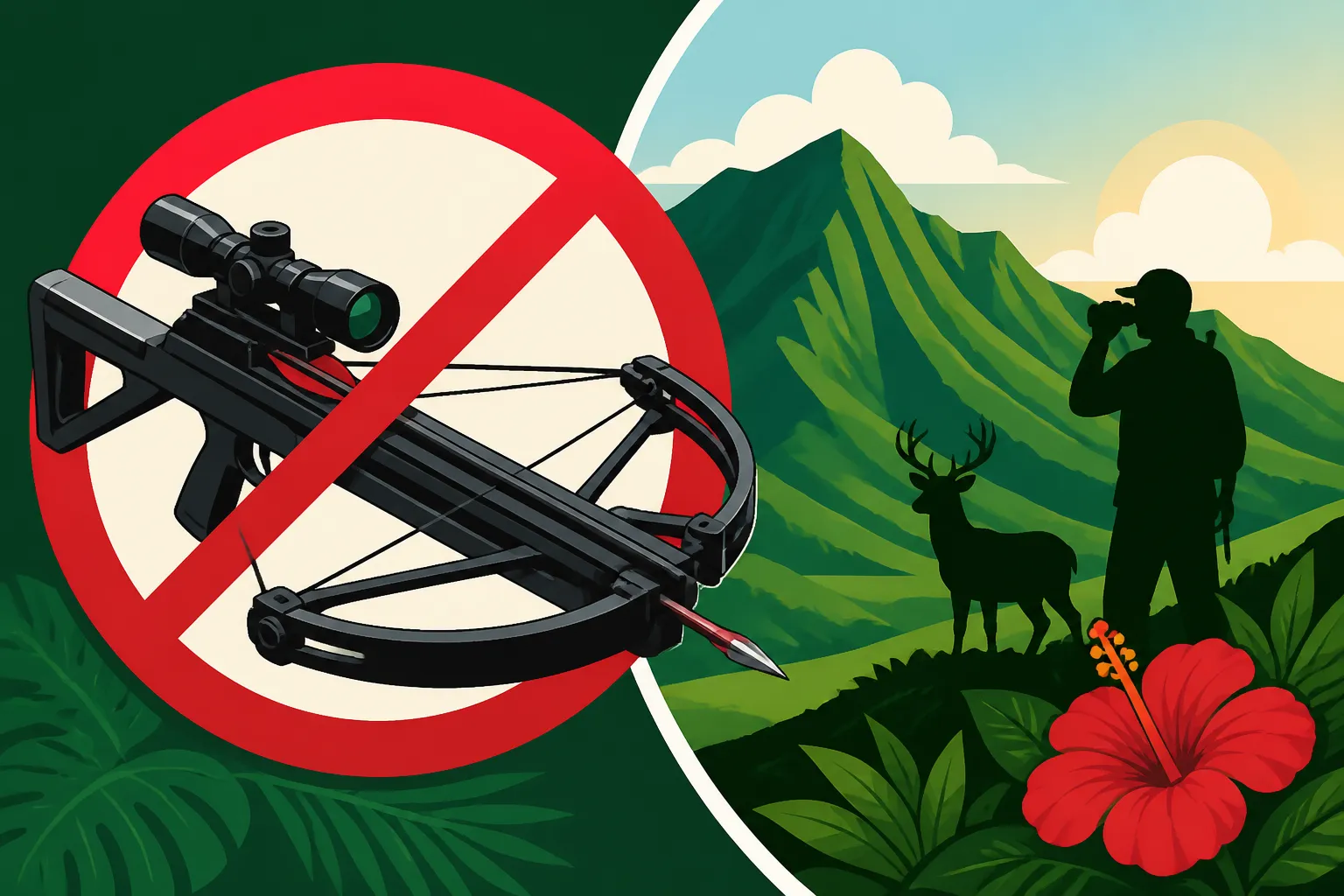
Are Crossbows Legal in Hawaii?
Trying to figure out Hawaii's hunting regulations can sometimes feel like trying to read ancient hieroglyphics, especially when it comes to specific equipment like crossbows. You might be an experienced crossbow hunter from the mainland, or perhaps a local looking to try a different method, and the big question looms: are crossbows even legal to hunt with here in the Aloha State? It’s a common point of confusion, and this guide is here to untangle the rules, making sure you understand exactly when and where your crossbow can legally join you in the field.
Understanding Hawaii's Stance on Crossbows in Hunting
The landscape of hunting regulations in Hawaii is unique, shaped by the islands' ecology, introduced species management, and local traditions. This distinct environment means that rules for hunting equipment, like crossbows, might differ significantly from what you're accustomed to elsewhere. It's not as simple as a blanket "yes" or "no," but rather a nuanced approach depending on the season, the game, and sometimes even the specific hunting unit.
The General Rule: Are Crossbows "Archery Equipment"?
This is where much of the confusion stems from. In many states, crossbows are categorized under "archery equipment" for hunting purposes, allowing them in traditional archery seasons. However, in Hawaii, the Department of Land and Natural Resources (DLNR), Division of Forestry and Wildlife (DOFAW) typically defines "archery equipment" quite specifically, often distinguishing it from crossbows. For a standard archery-only season, a compound bow, recurve, or longbow is usually what's meant.
This distinction is critical. If a season is explicitly labeled "archery-only," it's generally understood to mean traditional bows. The reasoning often revolves around maintaining the challenge and skill set associated with conventional bowhunting, or managing harvest rates in specific areas. It’s a common frustration for hunters accustomed to broader definitions, but it’s a rule firmly in place for most general archery periods in Hawaii. Always double-check the current hunting proclamations, which you can easily access via the GoHunt Hawaii portal, to ensure you're compliant.
When Crossbows Are Permitted for Hunting
Despite the distinction in "archery-only" seasons, crossbows are indeed permitted for hunting certain game in Hawaii under specific circumstances. The most common scenario where a crossbow can be legally used is during general rifle or "any legal hunting implement" seasons. When the regulations open a unit or species to firearms, crossbows often fall under the umbrella of acceptable methods. This means you might find opportunities to hunt Axis deer, feral pigs, or goats with a crossbow during these broader hunting windows.
Furthermore, Hawaii does make accommodations for hunters with certain disabilities. If you have a permanent physical disability that prevents you from drawing and holding a conventional bow, you may be eligible for a special permit to use a crossbow during archery seasons. This requires specific documentation and approval from DOFAW, demonstrating Hawaii's commitment to accessibility while maintaining the integrity of its hunting regulations. It's a compassionate approach that ensures more hunters can participate, provided they meet the strict criteria. Always confirm these details well in advance of your hunt.
Specific Regulations and Seasons for Crossbow Use
Hawaii's islands each have their own character, and sometimes, their own localized hunting rules. Understanding these specifics is paramount, as a regulation that applies on the Big Island might not hold true for Maui or Kauai, and vice versa. It’s not just about the type of weapon, but also about the timing and location of your hunt.
Crossbows and Archery-Only Seasons: A Key Distinction
As touched upon earlier, the primary hurdle for crossbow hunters in Hawaii often arises when a season is designated as "archery-only." In these instances, DOFAW's regulations are usually quite clear that only traditional bows—compound, recurve, or longbow—are permitted. This means that if you're eyeing an early season Axis deer hunt that's strictly for archers, your crossbow likely won't be legal unless you have a specific disability permit.
This isn't to say crossbows are completely excluded from archery seasons nationwide; it's just how Hawaii's regulations are structured to preserve a particular type of hunting experience. For hunters looking to participate in a true archery-only window, such as those sometimes offered for specific species or units, this distinction is crucial. It emphasizes the need to thoroughly review the current year's hunting proclamation for the specific island and game you intend to pursue. The language can be very precise, so reading it carefully or consulting the DOFAW office is always a good idea. Knowing the specific rules for Archery Equipment Rules for Big Game is essential here.
Island-Specific Rules and Exceptions
While the general principle holds true across the islands, there can be subtle differences in how regulations are applied or interpreted depending on the specific island or even the hunting unit. For example, some units might have broader "any legal weapon" seasons that implicitly include crossbows, while others might be more restrictive. This variability often reflects local game populations, habitat management goals, and the historical context of hunting in that particular area.
On Molokai, for instance, where Axis deer populations are managed through various seasons, you'll need to check if crossbows are legal for the specific hunt period you're applying for. Similarly, for hunting feral pigs, which are found across all major islands, the regulations for crossbows can vary by unit. It’s not uncommon to find that while a method is broadly legal, its application may be limited to certain management areas or specific times of the year. This makes checking Hawaii's Hunting Units and How They Work and Hawaii Game Mammal Seasons an absolute necessity before planning your trip.
Practicalities for the Crossbow Hunter in Hawaii
Bringing a crossbow to Hawaii for a hunt involves more than just checking legality. You'll need to consider the specific equipment requirements, the unique challenges of the Hawaiian terrain and climate, and how to navigate the state's licensing and permit system. Being well-prepared is key to a successful and compliant hunting experience.
Essential Gear and Performance Standards
Just like with any hunting weapon, Hawaii has minimum standards for crossbows and their ammunition, especially when targeting larger game animals like Axis deer or feral pigs. While specific draw weight minimums for crossbows aren't always explicitly stated in the same way they are for traditional bows, the general expectation is that your equipment should be capable of humanely harvesting the animal. This usually translates to a crossbow with a decent draw weight (typically 150 lbs or more) and bolts that are properly weighted and tipped with sharp, sturdy broadheads.
For broadheads, both fixed-blade and mechanical designs are generally allowed, but ensure they are in excellent condition and designed for big game. Two-blade broadheads are perfectly fine, but many hunters opt for three or four-blade designs for increased cutting surface. Considering the tough hide of a big boar or the quickness of an Axis deer, penetration and blade sharpness are paramount. Furthermore, Hawaii's humid environment and often rugged terrain mean your gear needs to be durable and well-maintained. Keeping your crossbow protected from moisture and grit is essential to ensure it performs reliably when it counts. You’ll want to review Archery Equipment Rules for Big Game to make sure your setup is up to snuff.
Navigating Licensing and Permits for Crossbow Hunters
Before you even think about pulling a trigger or launching a bolt, you need to ensure you have the correct Hawaii Hunting Licenses and What They Cost. All hunters, whether resident or nonresident, must possess a valid Hawaii hunting license. This is your fundamental authorization to hunt any legal game species in the state. You can purchase these licenses conveniently through the GoHunt Hawaii website, which is the official portal for all hunting-related transactions.
Beyond the general license, depending on the island and species, you might also need specific permit-tags. For example, hunting Axis deer on Lanai or certain units on the Big Island will require a permit-tag specific to that hunt. When applying for these permits, it's crucial to specify your weapon choice correctly, as this can sometimes influence eligibility for certain draw hunts or seasons. Furthermore, if you're a first-time hunter in Hawaii or new to crossbows, remember that completing a Hawaii Hunter Education Requirements course is mandatory unless you qualify for an exemption. This ensures you're familiar with all safety protocols and ethical hunting practices specific to the islands.
Crossbow Hunting in Hawaii: Pros, Cons, and Ethics
Choosing a crossbow for your Hawaii hunting adventure comes with its own set of advantages and disadvantages. It's a method that offers a unique experience, blending aspects of both traditional archery and firearms hunting. However, it also demands a strong commitment to ethical hunting practices and a deep understanding of the local environment.
Advantages and Trade-offs
Crossbows offer several compelling advantages, especially for hunters facing certain physical limitations or those new to archery. One of the biggest pros is the reduced physical strength required compared to drawing and holding a traditional compound or recurve bow. This makes crossbows an excellent option for older hunters, those with shoulder or back issues, or individuals with disabilities who might otherwise be unable to participate in archery seasons (where permitted by special permit). Their inherent stability also translates to generally higher accuracy at moderate ranges, which can increase confidence for many hunters.
However, these advantages come with trade-offs. Crossbows are typically heavier and bulkier than traditional bows, making them less agile in dense Hawaiian jungle or when navigating steep, rugged terrain. Reloading a crossbow is also a slower process, which can be a significant disadvantage if a follow-up shot is needed. Furthermore, some traditional archers view crossbows as less challenging, leading to ongoing debates about their place in "archery" seasons. Ultimately, the choice comes down to personal preference, physical capability, and a thorough understanding of Hawaii's specific regulations for the hunt you're planning.
Responsible Hunting Practices with a Crossbow
Regardless of your chosen weapon, responsible hunting is paramount in Hawaii. When using a crossbow, precise shot placement is absolutely critical. Animals like Axis deer are known for their resilience, and feral pigs can be incredibly tough, often carrying thick shields of gristle and mud. A poorly placed shot, even with a powerful crossbow, can lead to a long and often unsuccessful tracking job, especially in the dense vegetation or over the sharp lava flows found in many hunting units. Take the time to understand the anatomy of Axis Deer, Hawaii's Signature Big Game, Hawaii's Feral Pigs, Island by Island, Mouflon Sheep on Hawaii's Volcanoes, and Hawaii's Feral Goats and Why They Matter.
It's also essential to be prepared for extensive tracking and recovery efforts. Hawaii's terrain can be unforgiving, with steep gulches, thick tangles of guava, and thorny kiawe forests. This means investing in good quality optics, a reliable GPS, and understanding how to effectively track game. Remember, your responsibility doesn't end when the bolt leaves the string; it continues until the animal is recovered and properly cared for. Familiarize yourself with Field Care in Hawaii's Heat and Humidity to ensure your harvest is respected. Adhering strictly to all rules, checking in and out of units via services like OuterSpatial or GoHunt, and showing respect for the land and other hunters are all cornerstones of ethical hunting in Hawaii, no matter what weapon you carry.
| Feature | Crossbow | Compound Bow | Rifle |
|---|---|---|---|
| Physical Effort | Low (cocking is main effort) | Moderate to High (drawing and holding) | Low (recoil management is main effort) |
| Learning Curve | Relatively fast for accuracy | Moderate to high | Moderate (requires precision and safety training) |
| Accuracy | High at moderate ranges | High with practice | Highest at long ranges |
| Reload Speed | Slowest | Moderate | Fastest (depending on action type) |
| Weight/Bulk | Moderate to High | Low to Moderate | Moderate to High |
| Legality | Generally in "any legal weapon" seasons, special disability permits for archery seasons. | Generally in all archery seasons, often also in "any legal weapon" seasons. | Generally in "rifle" or "any legal weapon" seasons. |
| Typical Range | 20-60 yards | 20-50 yards | 50-300+ yards |
| Hawaii Application | Check specific unit & season regulations carefully. Often not considered "archery" for archery-only seasons. | Widely accepted in all archery seasons. | Widely accepted in most general mammal seasons, specific caliber rules apply. |
Disclaimer
The information provided in this guide is for general informational purposes only and is subject to change. Hunting regulations in Hawaii are set by the Department of Land and Natural Resources (DLNR), Division of Forestry and Wildlife (DOFAW), and can be updated annually or even seasonally. It is the sole responsibility of each hunter to consult the most current Hawaii Hunting Regulations and Proclamations issued by DOFAW before engaging in any hunting activity. Always confirm specific rules, season dates, unit boundaries, and weapon restrictions for your intended hunt through official DOFAW channels or the GoHunt Hawaii portal.