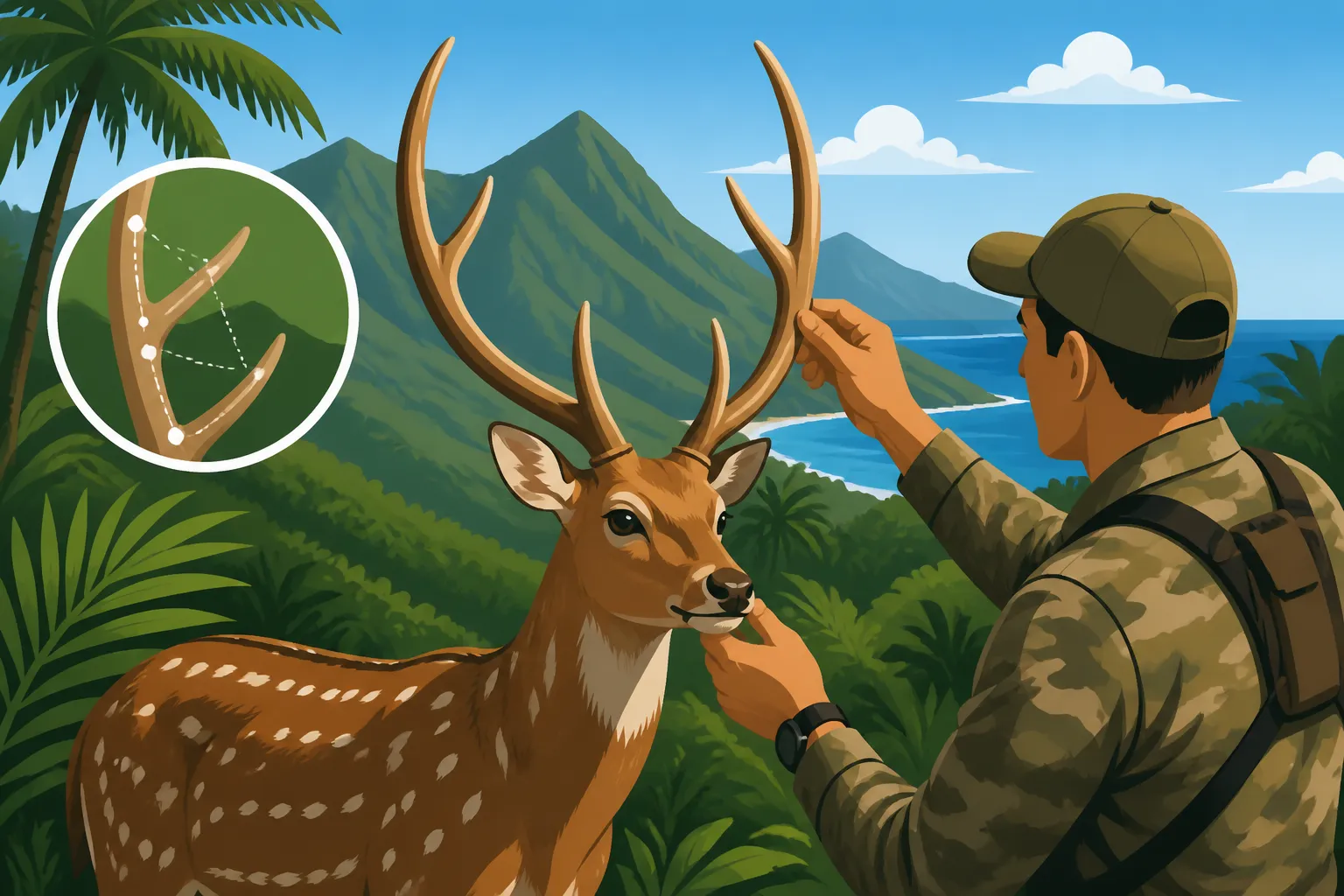
Judging an Axis Buck’s Antlers in the Field
If you've ever found yourself squinting through your binoculars, trying to figure out if that gorgeous Axis buck is the one you've been dreaming of, you know the struggle. Hawaii's Axis deer present a unique challenge for field judging, with their distinct antler configurations and a continuous, non-seasonal rut that means you could see bucks in velvet, hard horn, or even dropping antlers all at the same time. This guide is here to demystify the art of sizing up an Axis buck's antlers on the fly, helping you make informed decisions when it matters most.
Understanding Axis Deer Antler Growth and Cycles
Unlike the synchronized spectacle of a whitetail rut or the predictable antler drop of a mule deer, Axis deer operate on their own calendar. This makes understanding their antler growth incredibly important for accurate field judging.
The Continuous Antler Cycle
One of the biggest head-scratchers for hunters accustomed to mainland deer is the Axis deer's continuous antler cycle. You might be out in Unit A on Maui, glassing up a hillside, and see one buck in hard horn, ready to breed, while another nearby is still in velvet, and a third has already dropped one side. This isn't an anomaly; it's just how Axis deer roll. They don't have a single, distinct rutting period tied to photoperiod like many other deer species. Instead, breeding can occur year-round, which means antler development is also happening continuously among the herd. This phenomenon is a direct result of their native tropical environment where seasonal changes in day length aren't a strong signal.
This continuous cycle means you'll rarely find a whole population of bucks in the same stage of antler development. For you, the hunter, this translates into needing to be prepared to judge antlers at any stage of their growth. A buck in hard horn might appear significantly more impressive than one still growing in velvet, even if they share similar genetic potential. Likewise, trying to estimate the final size of a velvet rack can be particularly tricky, as velvet adds considerable bulk that isn't true bone. This unique aspect of their biology means that when you're out hunting, you're not just looking for a "rutting buck" in the traditional sense; you're looking for a mature animal, regardless of its current antler stage. It's a key reason why understanding Why Axis Deer Rut Timing Is Different is so crucial for success.
Typical Axis Antler Characteristics
Axis deer antlers possess a distinct architecture that sets them apart from most other deer species. When you're trying to figure out if that buck across the gulch is a shooter, you need to know what you're actually looking at. Generally, a mature Axis buck will have a main beam that sweeps upwards and backwards, often with a noticeable curve or bend. The primary points are the brow tines, which project forward and upward from the base, and then the critical trez tines (also known as the bez or middle tines), which typically grow upwards from the main beam, often somewhere between a third and halfway up its length. What's often missing, and important to note, is a point equivalent to a whitetail's G2. Instead, Axis deer usually have a fork or point at the very end of the main beam, which is considered the G3 and G4 equivalent.
This typical "three-on-a-side" configuration—brow tine, trez tine, and main beam fork—is what many hunters consider a classic Axis trophy. However, variations exist, and it's not uncommon to see extra points, drop tines, or atypical growth, especially on older bucks or those in areas with rich nutrition. The absence of a strong G2, combined with the often impressive length of the main beam and trez tines, gives Axis antlers their characteristic open, sweeping look. Learning to quickly identify these fundamental points is your first step in becoming a better field judge.
Key Factors for Field Judging Axis Buck Antlers
Field judging an Axis buck is a skill honed by experience, but there are specific visual cues you can train your eye to spot. It's all about breaking down the overall impression into individual, measurable components.
Length of Main Beam
The main beam is often the most prominent feature of an Axis buck's rack and contributes significantly to its overall score and aesthetic appeal. When estimating main beam length, try to use the buck's own body parts as a reference. A good starting point is the length of its ear, which is typically around 6-7 inches. Observe how far the main beam extends past the tip of the buck's nose when its head is held naturally. A truly impressive main beam will often sweep back past its shoulder or even further. On a mature Axis buck, you're looking for beams that appear long and graceful, often with a distinct curve.
Distance and perspective can play tricks on your eyes, making beams appear shorter or longer than they actually are. A buck standing uphill from you or quartering away might have its beams foreshortened, while one broadside or slightly downhill can make them seem more expansive. Practice observing bucks at various angles and distances, comparing beam length to known body measurements. For instance, a very mature buck might have beams that extend well beyond the point where the head meets the neck, perhaps even approaching the length of its entire head and neck combined. When you're out there Glassing Lanai's Open Ridgelines, pay close attention to this specific detail.
Mass and Circumference
Mass, or the circumference of the antler, is a critical component of a trophy Axis buck. It's what gives the antlers that heavy, substantial look, and it adds significantly to their score. Judging mass can be challenging from a distance, but again, using the buck's anatomy as a reference can help. Look at the base of the antlers, just above the burrs. Compare this thickness to the diameter of the buck's eye or the width of its ear at the base. A truly heavy-horned buck will have bases that appear thick, almost gnarled, and this mass should carry out well through the main beams, not thinning out too quickly.
Many younger bucks, even those with decent length, will have antlers that appear spindly or thin compared to a mature animal. As Axis bucks age, their antlers tend to gain more mass, sometimes at the expense of extreme length. So, if you see a buck with incredible mass right from the pedicle, even if the beams aren't record-breaking in length, you're likely looking at a very mature, high-quality animal. This characteristic is often more pronounced on older bucks, whose bodies are also typically heavier and more muscled, like the impressive animals you might find when Hunting Molokai's Big-Bodied Axis Bucks. Don't underestimate the power of mass; it can turn a good rack into a great one.
Tine Length and Symmetry
The tines of an Axis buck, primarily the brow and trez tines, add character and points to the score. You want to look for tines that are not only long but also well-defined and proportionate to the main beam. The brow tines should ideally be long and sturdy, projecting forward. The trez tines, which come off the main beam, are arguably the most important for visual appeal and score. A good trez tine will be long, often mirroring the upward sweep of the main beam itself, and it should be clearly distinguishable, not just a small bump. The points at the end of the main beam (the G3 and G4 equivalent) should also have decent length and separation.
Symmetry is another factor. While perfect symmetry is rare in nature, a buck with relatively even brow tines, trez tines, and matching forks on both sides generally presents a more pleasing aesthetic. However, don't discount a buck with character. Some hunters specifically seek out unique, non-symmetrical racks, believing they tell a story of the animal's life. Broken tines, unfortunately, can diminish both the score and the visual appeal, so always check for damage, especially if you're hunting later in the season when bucks might have been sparring.
Spread and Width
Antler spread refers to the width of the rack, typically measured as the greatest spread (the widest point, usually outside the main beams) or inside spread (the distance between the inside of the main beams). While not always a primary scoring factor for Axis deer compared to length and mass, a wide spread certainly adds to the impressive presence of a buck. To estimate spread, compare the widest point of the antlers to the width of the buck's ears, or even its shoulder width. A buck with antlers that extend well outside its ears is generally considered to have a good spread.
A truly wide buck might have antlers that seem to dwarf its head and neck, making for a spectacular silhouette against the Hawaiian landscape. Consider the overall balance of the rack; a very wide but short-beamed rack might look disproportionate, just as a long-beamed but narrow rack might. You're looking for a harmonious balance between spread, beam length, and mass that creates an overall impressive animal. This is especially true when you are trying to find the biggest animals in their range, as detailed in Axis Deer, Hawaii's Signature Big Game.
Practical Tips for Better Field Judging
Beyond understanding the anatomical nuances of Axis antlers, improving your field judging skills requires practical application and smart hunting strategies.
Using Optics Effectively
Your binoculars and spotting scope are your best friends when it comes to field judging. Trying to make a decision with the naked eye from anything but very close range is a recipe for regret. Invest in good quality optics (8x or 10x binoculars are excellent for general scanning, and a 15x or 20-60x spotting scope is invaluable for detailed assessment at longer distances). When you spot a buck, don't just glance. Take your time. Steady your optics, ideally on a tripod or braced against a tree, and truly study the animal. Look for all the characteristics discussed above: beam length, mass, tine length, and spread.
Patience is key. The buck isn't going anywhere fast, and rushing your decision can lead to passing on a great animal or, worse, taking one you regret. Observe the buck as it moves, turns its head, and feeds. Different angles will reveal different aspects of its rack. Sometimes, waiting for the buck to turn broadside or present a specific angle can be the difference between a confident shot and a hurried guess. Tools like those found on GoHunt often include mapping features that can help you plan your approach and find good glassing points, setting you up for better judging opportunities.
Understanding Body Size and Age
Antler size and body size are intrinsically linked, and understanding this relationship is crucial for accurate field judging. A physically immature buck, even if it has decent antler length, will often have a smaller, more athletic body. Its neck might be thin, and its belly tight. On such a buck, even a respectable rack can look larger than it is because the body provides a smaller frame of reference. Conversely, a truly mature, older Axis buck will often have a heavier, more substantial body—a thick, muscular neck, a deeper chest, and sometimes even a slightly sagging belly. On these big-bodied animals, a large rack might surprisingly appear smaller than it is, simply because the buck's sheer size makes everything else look less impressive.
Consider the whole animal, not just the antlers. Older bucks are more likely to have achieved their full antler potential, especially in terms of mass. While younger bucks might have longer beams, older bucks often pack on the density. Look for signs of age: a robust, thick neck that blends smoothly into the shoulders, a heavier overall appearance, and confident, deliberate movements. When you’re Reading Axis Deer Sign in Dry Country, remember that bigger body tracks mean bigger animals, usually older, and thus potentially bigger antlers. Combining antler characteristics with a good assessment of body size and apparent age will lead to more accurate field judging and a more satisfying hunt.
The "Trophy" Mindset
Ultimately, what constitutes a "trophy" is a deeply personal decision. Before you even step foot into a Hawaii unit like Puu Anahulu or Kahikinui, take some time to define what you're truly looking for. Is it the longest main beams? The heaviest mass? A specific number of points? Or perhaps a unique, character-filled rack? There's no wrong answer here. Your personal definition of a trophy should guide your decision-making in the field, not external pressures or arbitrary score numbers.
Hunting Hawaii's Axis deer is an incredible experience, regardless of the size of the antlers you ultimately take home. The challenge of the hunt, the stunning landscapes, and the quality of the meat are all significant rewards. Don't let the quest for a "score" overshadow the adventure. Sometimes, the most memorable buck isn't the biggest, but the one that tested your skills the most, or the one you shared with good company. The islands offer such incredible opportunities, from Axis Deer Hunting in Hawaii to Hunting Hawaii's Feral Pigs. Remember to savor the entire experience.
Axis Buck Antler Field Judging Reference Table
To help you quickly assess an Axis buck's antlers in the field, here's a quick reference guide.
| Antler Characteristic | What to Look For (Good Buck) | What to Look For (Exceptional Buck) | Common Pitfalls |
|---|---|---|---|
| Main Beam Length | Extends past the nose, often reaching mid-neck. | Sweeps back past the shoulder, appearing very long and graceful. | Foreshortening at a distance or uphill; velvet adds false length. |
| Mass (Circumference) | Bases as thick as eye diameter; mass carries well to trez tine. | Bases significantly thicker than eye; mass extends through the entire beam. | Thinning quickly from base; velvet looks bulkier than bone. |
| Tine Length | Brow tines 4-6 inches; trez tines 8-10 inches; clear main beam forks. | Brow tines over 6 inches; trez tines 10+ inches; long, defined main beam forks. | Broken tines; small, stubby trez tines; tines obscured by velvet. |
| Spread (Width) | Wider than the buck's ears (ear-tip to ear-tip). | Well outside the ears, often approaching or exceeding shoulder width. | Narrow racks can look longer; distance can make spread seem wider. |
| Overall Symmetry | Generally even points and beam curves on both sides. | Near-perfect match in length, mass, and point configuration. | Atypical points; one side broken; one side significantly smaller. |
| Body Size | Developed body, muscular neck. | Thick, heavy, mature body; neck blends smoothly into shoulders. | Young buck's antlers look bigger on a small body; old buck's antlers look smaller on a huge body. |
Keep this table in mind when you're out there. Combine these visual cues with patience, good optics, and an understanding of Spot-and-Stalk Tactics on Open Country, and you'll be well on your way to field judging with confidence. And remember, once you take that animal, knowing how to do proper Field Dressing Axis Deer in Hawaii Heat and Cooling Meat Fast on a Hawaii Hunt are the crucial next steps!
Disclaimer
Hunting is an inherently dangerous activity. Always prioritize safety, follow all Hawaii Department of Land and Natural Resources (DLNR) rules and regulations, and respect private property. This guide provides general information and should not replace official hunting regulations or professional instruction. Conditions in Hawaii's diverse terrain can change rapidly, so always be prepared.