How Hawaii’s Permit-Tag System Works
For hunters planning an adventure in the Hawaiian Islands, one of the biggest initial hurdles is often navigating the state's unique permit-tag system. It's not as straightforward as just buying a license, and misunderstandings can quickly lead to frustration or even legal issues. This guide is here to untangle the complexities, explaining exactly how Hawaii's permit-tag system works, what you need, and how to stay on the right side of the rules, ensuring your focus remains on the incredible hunting opportunities rather than bureaucratic headaches.
Understanding the Hawaii Hunting Permit-Tag System
At its core, Hawaii's permit-tag system is a mechanism for the state's Department of Land and Natural Resources (DLNR), specifically its Division of Forestry and Wildlife (DOFAW), to manage game animal populations and collect crucial data. Unlike many mainland states where a general hunting license might cover most species, Hawaii often requires a separate "permit-tag" for specific big game animals on particular islands and in designated hunting units. Think of your general hunting license as your entry ticket to hunt in Hawaii, but the permit-tag is your specific seat assignment for a certain game animal.
The Philosophy Behind Permit-Tags
The Hawaiian Islands are incredibly fragile ecosystems, and nearly all the game animals that hunters pursue here were introduced, often centuries ago. While they provide fantastic hunting opportunities, they can also exert immense pressure on native flora and fauna. The permit-tag system is a direct reflection of this ecological reality. It allows DOFAW to precisely control harvest numbers for species like Axis deer, Mouflon sheep, and feral goats on certain islands where their populations need careful monitoring or reduction to protect sensitive native habitats. By requiring specific tags, the state can track harvest rates, gather data on population health, and ensure sustainable hunting practices that align with broader conservation goals. It's a balancing act, ensuring hunters have opportunities while also safeguarding the unique natural heritage of the islands. This is particularly evident in efforts to protect native forests from browsing ungulates or managing areas like Mauna Kea to preserve endangered species habitat.
Key Terminology and Distinctions: License vs. Tag vs. Permit
It's easy to get these terms mixed up, but understanding the distinctions is vital.
- Hunting License: This is your fundamental authorization to hunt in Hawaii. Every hunter, resident or nonresident, must possess a valid Hawaii hunting license to participate in any hunting activity. It's an annual purchase and the first step you'll take. Think of it as your hunting ID card for the state. You can learn all about Hawaii Hunting Licenses and What They Cost in our detailed breakdown.
- Permit-Tag: This is a separate, species-specific and often island-specific authorization to harvest a particular animal. For example, if you're hunting Axis deer on Maui, you'll need a general hunting license and an Axis deer permit-tag. These tags dictate the species, the number of animals you can take, and sometimes the specific unit or season. They are often serial-numbered and must be physically attached to the animal immediately after harvest.
- Permit (Unit Permit): In some cases, particularly for drawn hunts or specific public hunting units, you might also need a "unit permit" or "access permit." This permit grants you legal access to a particular hunting area during a specified timeframe. While not always directly tied to an animal harvest like a tag, it's a critical component of the overall regulatory framework, ensuring controlled access and managing hunter density in sensitive areas. For example, some units on Hawaii Island require an access permit even for species that don't need a harvest tag.
Understanding these three distinct requirements is the foundation for legally hunting in Hawaii. You absolutely need your general hunting license, and then you'll layer on the appropriate permit-tags and unit permits depending on where and what you plan to hunt.
Which Animals and Islands Require Permit-Tags
The permit-tag system isn't universal across all game animals or all islands. It's specifically applied where population control and data collection are deemed most critical by DOFAW. Knowing which species on which islands require tags is paramount to avoid a frustrating and illegal hunt.
Big Game Species Requiring Tags: Axis, Mouflon, Goats, Black-Tailed Deer
Hawaii offers a fantastic range of big game, but the tag requirements vary significantly.
- Axis Deer: These beautiful, spotted deer are present on Maui, Molokai, and Lanai. Axis deer require a permit-tag for hunting on all these islands. The tags are particularly critical for managing their rapidly growing populations and mitigating their impact on agricultural lands and native forests. Maui has the largest population, but Lanai is famous for its drawn hunts. For non-residents, the cost of an Axis deer tag can be significant, reflecting the demand and the management costs.
- Mouflon Sheep: Found primarily on Hawaii Island (the Big Island) and Lanai, Mouflon sheep are another prized trophy species. Hunting Mouflon on both these islands requires a permit-tag. The Big Island's population on Mauna Kea is managed under strict rules, often involving drawn hunts and conservation efforts related to the endangered Palila bird. Lanai also offers Mouflon hunting, usually through a drawn muzzleloader or archery season.
- Feral Goats: While widespread across several islands, feral goats typically require a permit-tag for hunting on Lanai and Hawaii Island. On other islands like Maui or Molokai, they might be hunted under a general license with specific unit rules, but without a dedicated tag. Goat tags are a direct tool for managing their populations, which can be incredibly destructive to steep erosion-prone slopes and native plant communities.
- Black-Tailed Deer: Exclusively found on Kauai, the Black-tailed deer herd is unique to Hawaii. Hunting these deer does require a permit-tag on Kauai. The season is generally limited, often to specific weekends, and the tags are part of a controlled harvest designed to manage this isolated population.
It's crucial to always check the most current Hawaii Game Mammal Seasons and the specific unit rules for the island you plan to hunt, as regulations can change.
Island-Specific Requirements: Maui Nui, Hawaii Island, Kauai
The geography and ecology of each island lead to distinct hunting regulations.
- Maui Nui (Maui, Molokai, Lanai): This region is synonymous with Axis deer hunting. As mentioned, all Axis deer hunts on Maui, Molokai, and Lanai require a permit-tag. Lanai, in particular, is well-known for its highly sought-after permit-tags, which are allocated through a lottery system for its Axis and Mouflon seasons. The tags for Maui and Molokai Axis are generally over-the-counter but still mandatory. Hunters looking to specifically hunt Hunting Maui's Year-Round Axis Deer Units will find that tags are an essential part of the process, just as they are for Hunting Lanai's Drawn Axis Deer Weekends.
- Hawaii Island (Big Island): This island is home to Mouflon sheep and feral goats. Mouflon hunts on the Big Island (primarily Mauna Kea and Puu Waawaa) require a permit-tag and are often conducted via drawn hunts. Feral goats on the Big Island also require a permit-tag in many units. The island also has feral pigs, which generally do not require a tag, though you'll still need your general hunting license and might need a unit permit to access certain areas. This is why understanding Hawaii Island Hunting Unit Seasons is so vital, as rules can vary greatly even within the same island.
- Kauai: The Garden Isle is the only place in Hawaii with Black-tailed deer. These deer require a permit-tag. Feral pigs and goats are also present on Kauai and are typically hunted under the general hunting license, though specific unit rules apply. Kauai's hunting opportunities are often confined to Kauai's Weekend Hunt Calendar, making it essential to plan ahead and secure any necessary tags or unit permits well in advance.
What About Feral Pigs and Game Birds?
Many hunters traveling to Hawaii are keen to pursue feral pigs, one of the most exciting and challenging hunts the islands offer. The good news is that feral pigs generally do NOT require a separate permit-tag in Hawaii. Your valid Hawaii hunting license is usually sufficient. However, you will still need to adhere to specific unit rules, season dates (if applicable), legal weapons, and check-in/check-out procedures for the unit you are hunting. This also extends to game birds. For game birds like pheasant, francolin, chukar, or doves, you will need your general Hawaii hunting license and a Hawaii Game Bird Stamp, but no additional permit-tag is required for individual birds. This makes pig and bird hunting more accessible for those not wanting to navigate the drawn hunt or specific tag purchase process.
How to Obtain Your Hawaii Hunting License and Tags
The process for acquiring your necessary documents starts with the fundamental hunting license and then progresses to species-specific tags. It's important to do things in the correct order.
Getting Your Hunting License First
Before you can even think about permit-tags, you absolutely need to secure your general Hawaii hunting license. This is non-negotiable. For residents, this process is generally straightforward. For nonresidents, there's an additional step:
- Hunter Education: All hunters born after December 31, 1957, regardless of residency, must complete a hunter education course. If you're a nonresident and have a valid hunter education certificate from another state or country, you can typically apply for a Letter of Exemption. This letter certifies your prior hunter education, fulfilling Hawaii's requirement. It's critical to get this done well in advance of your trip. More details on Hawaii Hunter Education Requirements can be found in our comprehensive guide.
- Purchase Your License: Once hunter education is satisfied, you can purchase your license. The easiest way for many, especially non-residents, is online through the official DOFAW system, often referred to as GoHunt Hawaii. You can also purchase them in person at various authorized vendors or DOFAW offices on the islands. When buying through GoHunt, ensure all your information is accurate, as this is tied to any future permit-tag applications.
- Wildlife Conservation Stamp: Along with your general hunting license, you'll also need to purchase a Hawaii Wildlife Conservation Stamp. This stamp is mandatory for all hunters (except those under 16 hunting birds) and funds important wildlife management programs.
Remember, your license is valid for a specific period, usually July 1st through June 30th of the following year. Always check the expiration date.
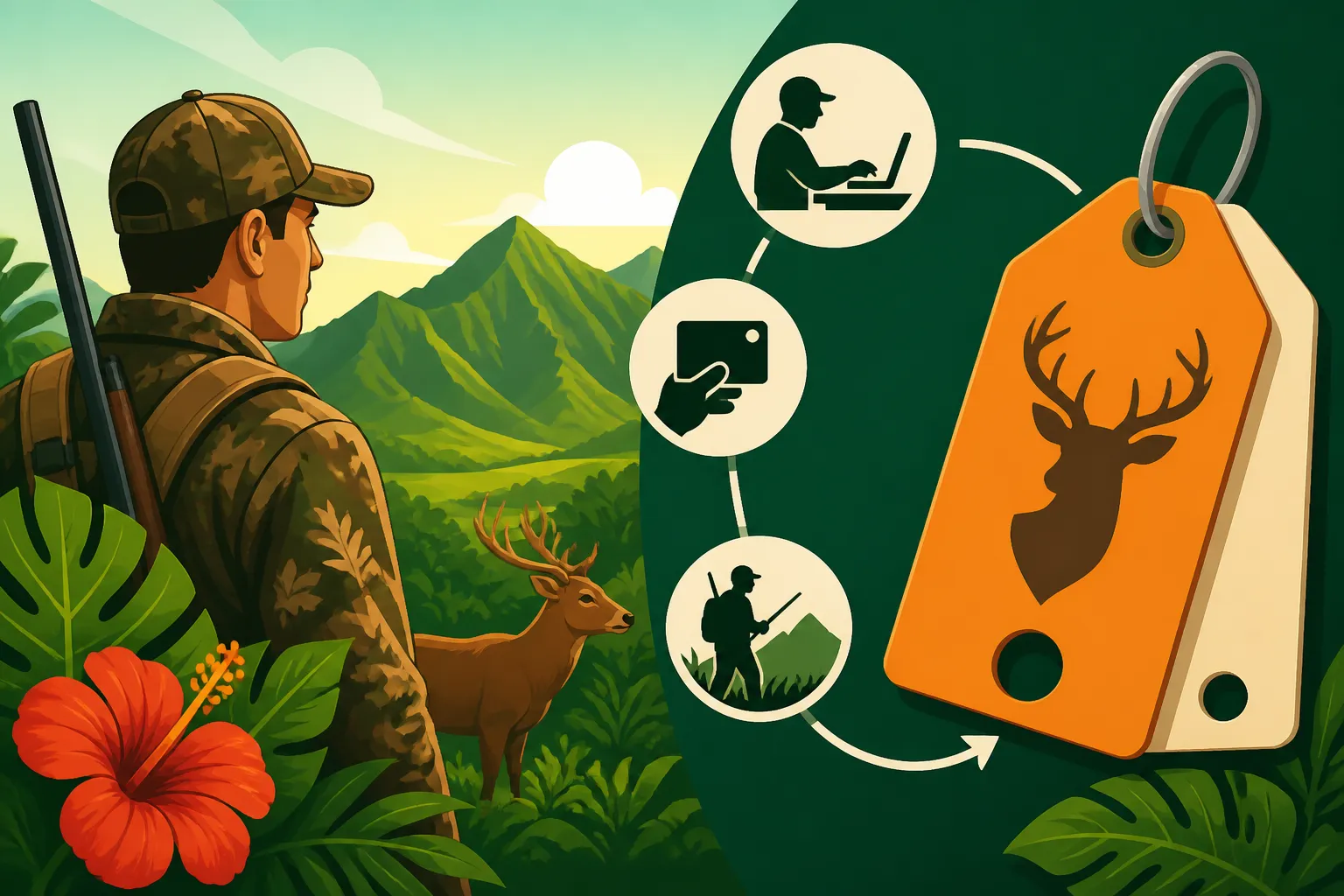
Purchasing Specific Game Tags: Online, In-Person
Once you have your Hawaii hunting license, you can move on to acquiring permit-tags for the specific big game animals you wish to pursue.
- Over-the-Counter Tags: For species like Axis deer on Maui or Molokai, and sometimes goats on specific units, tags might be available "over-the-counter." This means you can purchase them directly, often online through the GoHunt Hawaii portal or in person at a DOFAW office or authorized vendor. The number of these tags might be limited, so it's wise to purchase them as soon as you know your hunting dates.
- Drawn Hunt Tags: For highly desired hunts or for populations requiring stricter management, such as Axis deer on Lanai or Mouflon sheep on Mauna Kea, permit-tags are allocated through a lottery or "drawn hunt" system. This means you apply for the tag during a specific application period, and successful applicants are chosen randomly. You'll need to pay an application fee, and if successful, you'll then pay for the tag itself. The application deadlines are strict, and it's essential to stay informed about Hawaii's Drawn Hunts and Lotteries to avoid missing out. The GoHunt Hawaii platform is typically where these applications are managed, and results are posted.
Always double-check the specific regulations for the species and island you're interested in, as tag availability and purchasing methods can change annually. Some islands might offer unique combinations of over-the-counter and drawn hunt opportunities.
The Role of Drawn Hunts in Tag Allocation
Drawn hunts are a cornerstone of managing high-demand species and controlling hunter pressure in sensitive or limited areas. For example, the opportunity to hunt Axis deer on Lanai is almost exclusively through a draw, limiting the number of hunters on the island each season. This helps maintain a high-quality hunting experience and prevents over-harvesting on a relatively small landmass.
The process for drawn hunts generally involves:
- Application Period: A specific window during which hunters can submit their applications.
- Preference Points (Rare in Hawaii): While some states use preference points to reward unsuccessful applicants, Hawaii's system is generally a pure lottery, meaning everyone has an equal chance each year, regardless of past applications.
- Drawing and Notification: Applicants are randomly selected, and results are usually posted online or communicated via email.
- Tag Purchase: Successful applicants then have a limited window to purchase their allocated tags. Failure to do so typically results in forfeiture.
These drawn hunts are often for either-sex tags or for specific classes of animals (e.g., adult rams for Mouflon). They are the most challenging tags to acquire due to demand, but they often lead to some of the most rewarding hunts in Hawaii.
Attaching and Validating Your Permit-Tag in the Field
Having the permit-tag is one thing; using it correctly in the field is another. Proper tagging procedures are not just bureaucratic hurdles; they're essential for compliance, data collection, and demonstrating ethical hunting.
Proper Tagging Procedures After a Kill
Congratulations, you've harvested an animal! Now, the critical step of tagging. Hawaii's regulations are clear and must be followed immediately:
- Locate the Tag: Your permit-tag will typically be a durable, serial-numbered tag. It will often have sections to mark the date of kill, species, sex, and possibly the hunting unit.
- Fill Out Completely: Using an indelible pen (a permanent marker is best, as conditions in Hawaii can be wet and humid), accurately fill out all required information on the tag before attaching it to the animal.
- Attach Immediately: The tag must be securely attached to the carcass immediately after the animal is recovered and before it is moved from the kill site or transported in any vehicle. The best practice is to attach it to a leg or antler (if applicable) in a conspicuous manner that cannot be easily removed or lost.
- Keep Tag Intact: The tag must remain attached to the carcass until the meat is processed for consumption or taxidermy, or until the carcass is disposed of. You cannot remove the tag and keep it in your pocket while dragging the animal out.
- Validation: In some cases, there might be a specific validation step, though the act of filling out and attaching the tag often serves as validation. Always check the specific instructions on your permit-tag or the DOFAW regulations for any additional validation requirements.
Failing to properly tag an animal can lead to severe penalties, including fines, license revocation, and seizure of the harvested animal. For a more detailed look at Tagging Rules After the Kill, refer to our dedicated post.
What to Do if Your Tag Gets Lost or Damaged
Accidents happen. You're in rugged terrain, maybe a sudden downpour, and your precious permit-tag goes missing or becomes illegible. This is a tough spot, and unfortunately, there's no simple "get a new one" solution in the field.
- Prevention is Key: Before you even leave home, laminate your tags or put them in a sturdy, waterproof holder. Carry extra pens.
- Lost Tag: If you realize your un-used tag is lost while hunting, your hunt for that tagged species is effectively over until you can replace it. You cannot hunt a tagged animal without a valid, physical tag in your possession. Contacting DOFAW from the field is usually not feasible due to lack of cell service in many hunting areas. Your best bet is to return to a DOFAW office or authorized vendor as soon as possible to see if a replacement can be issued, which is often not guaranteed and may incur additional fees.
- Damaged/Illegible Tag: If a tag becomes damaged but is still attached and partially legible, try to reinforce it with tape and ensure as much information as possible is preserved. Take photos of the damaged tag and the animal with the tag attached for documentation. This may help in explaining the situation to a game warden, but it's still a precarious position.
The rule of thumb is: no valid tag, no legal harvest. Always treat your permit-tags like gold.
Special Rules for Youth Hunters and Guided Hunts
- Youth Hunters: Hawaii encourages youth hunting, and there are specific provisions. Young hunters (those under 16) generally need to be accompanied by a licensed adult hunter. While they might still need their own permit-tags for certain species, the supervising adult is ultimately responsible for ensuring all rules, including tagging, are followed. Some youth hunt weekends might have slightly different tag allocations or bag limits, so always check the specific youth hunt regulations.
- Guided Hunts: If you book a guided hunt with one of Hawaii's many reputable outfitters, like Mauna Kea Guides or Kuahiwi Ranch Hunts, your guide will be a wealth of knowledge on tagging procedures. However, it's still your responsibility as the hunter to ensure the tag is properly filled out and attached. The guide can assist and advise, but the legal obligation typically falls on the person who pulled the trigger. Reputable guides will emphasize proper tagging and make sure you understand the requirements. Always clarify with your guide beforehand how they handle tagging and what their expectations are.
Common Pitfalls and Misconceptions About Hawaii's System
The unique Hawaiian hunting landscape can trip up even experienced hunters from other states. Avoiding these common mistakes will save you a lot of grief.
Confusing Public and Private Land Rules
One of the most significant sources of confusion revolves around land ownership and access.
- Public Lands (DOFAW Units): These are state-managed lands (Forest Reserves, Game Management Areas, etc.) where hunting is regulated by DOFAW. Here, the permit-tag system is rigidly enforced for specified species, and hunters must adhere to specific check-in/check-out procedures for each unit, as detailed in Checking In and Out of Hawaii Hunting Units.
- Private Lands (Ranches): Many excellent hunting opportunities exist on private ranches across the islands. On private land, the permit-tag rules for state-managed species (Axis deer, Mouflon, Black-tailed deer) still apply. However, for feral pigs and goats (where state tags aren't required), private landowners might have their own permitting or fee systems in place, but these are separate from state DOFAW tags. You absolutely need permission to hunt private land. Do not assume that because you're on private land, state tag rules are irrelevant. This is a common and costly mistake. Always clarify with the landowner or outfitter what state tags are required for your intended quarry and what additional private land fees or permits apply.
Understanding Bag Limits and Season Structures
Hawaii's bag limits and season structures are tailored to individual species and island populations, and they can be quite different from what mainland hunters are used to.
- Bag Limits: Permit-tags are often issued for a single animal (e.g., one Axis deer, one Mouflon ram). Once you've harvested that animal and tagged it, that tag is used, and your bag limit for that species on that tag is met. Some hunts, particularly for feral pigs or goats in certain units, might have higher daily or season bag limits that don't require individual tags. Always confirm the specific bag limits for your permit-tag and hunting unit.
- Season Structures: Hawaii's game mammal seasons can vary wildly: some are year-round in certain units, others are limited to specific weekends, and still others are only open for a drawn hunt window. Hawaii Game Mammal Seasons provides a comprehensive overview, but it's crucial to consult the most recent DOFAW hunting regulations for the precise dates for your target species and unit. Overlapping seasons, such as archery, muzzleloader, and rifle, each have their own weapon restrictions and often their own permit-tag implications. For example, a Lanai Axis deer muzzleloader season might have different tag rules than the rifle season.
Misinterpreting bag limits or hunting outside of legal seasons, even with a valid tag, constitutes a violation.
The Importance of Hunter Education Compliance
We've touched on hunter education, but its importance can't be overstated. This isn't just a box to tick; it's a foundational requirement that underscores safety and responsible hunting.
- Mandatory for Most: As mentioned, if you were born after December 31, 1957, you must have hunter education. This applies to both residents and nonresidents.
- Nonresident Exemption: While nonresidents can get a Letter of Exemption based on another state's hunter education, applying for this well in advance is crucial. Arriving in Hawaii without this documentation and expecting to hunt can lead to immediate disappointment, as licenses and tags will be denied.
- Safety First: Beyond the legal requirement, Hawaii's diverse and often challenging terrain (steep gulches, dense jungle, sharp lava fields) demands a high degree of hunting safety awareness. The principles learned in hunter education are invaluable for navigating these unique environments, especially when considering Hawaii's Legal Weapons by Season and ensuring safe firearm handling.
Never underestimate the importance of full compliance with hunter education; it's the gateway to your Hawaii hunting adventure.
Checking In and Out of Hunting Units with Your Permit-Tag
Even with a valid license and permit-tag, your hunt isn't complete without adhering to the check-in and check-out procedures for most public hunting units. This step is vital for hunter safety, data collection, and managing pressure on specific areas.
Utilizing the OuterSpatial App
In a move towards modernization, DOFAW has increasingly relied on the OuterSpatial app for hunter check-in and check-out. This digital system allows hunters to:
- Geo-locate: The app uses your phone's GPS to confirm your location within or near a hunting unit boundary.
- Digital Check-in: You can check into a unit directly from your smartphone, eliminating the need for physical paper cards at a check station.
- Report Harvest: After a successful hunt, you can digitally report your harvest through the app, providing critical data on species, sex, and location. This data is invaluable for DOFAW in monitoring populations and making future management decisions.
- Real-time Information: OuterSpatial can also provide access to unit maps, boundary information, and current regulations or closures.
While incredibly convenient, relying solely on the OuterSpatial app requires a charged phone and, ideally, a downloaded map for areas with no cell service. It's always a good idea to have a backup plan, like a physical map or GPS device. For many public hunts, this app is now the primary method for Checking In and Out of Hawaii Hunting Units.
Traditional Paper Check Stations
While digital check-in is growing, many units, especially in remote areas or on islands with less developed infrastructure, still rely on traditional paper check stations.
- Physical Locations: These stations are typically located at the entrance or a designated access point for a hunting unit. They consist of a kiosk or box containing blank check-in/check-out cards.
- Fill Out Completely: Hunters are required to fill out a card with their name, hunting license number, date, time of entry, and intended hunting area.
- Deposit Stub: A portion of the card is typically deposited into a secure box at the station, while the hunter keeps a "hunter copy" for their record.
- Check-Out: Upon exiting the unit, hunters must complete the check-out portion of their card, including time of exit and any harvest information, and deposit it. This ensures DOFAW knows who is in the field and when they have safely left.
Always look for signs indicating whether a unit requires paper or digital check-in. If you see a physical check station, assume paper forms are necessary, even if you plan to use OuterSpatial as a backup.
Penalties for Failing to Check In/Out
Failing to properly check in or out of a hunting unit is a serious violation in Hawaii.
- Safety Risk: From a safety perspective, DOFAW uses check-in/check-out records to know who is in the field, which can be critical in emergency situations or if a hunter goes missing.
- Data Loss: It also deprives DOFAW of crucial data needed for wildlife management.
- Legal Consequences: Penalties for failing to check in or out can include citations, fines, and even suspension of hunting privileges. Game wardens regularly monitor these stations and enforce compliance.
Always assume that checking in and out is mandatory. It's a small but significant act of responsible hunting that contributes to the overall safety and management of Hawaii's unique hunting grounds.
The Conservation Impact of Hawaii's Permit-Tag System
Beyond the bureaucratic necessities, Hawaii's permit-tag system plays a crucial role in the broader conservation efforts of the islands. Given that most game animals are introduced species, managing their populations is often directly linked to protecting the incredibly fragile native ecosystems.
Managing Wildlife Populations and Habitat
The permit-tag system is a direct tool for DOFAW to manage the populations of species like Axis deer, Mouflon sheep, and feral goats.
- Population Control: By controlling the number of tags issued for a specific species in a specific unit, DOFAW can influence harvest rates. For rapidly reproducing species like Axis deer, liberal tag allocations or extended seasons might be used to reduce their numbers where they pose a threat to agriculture or native plants. Conversely, for more sensitive or limited populations, tags might be scarce or tied to drawn hunts to ensure sustainable harvest.
- Habitat Preservation: Many of Hawaii's native forests and unique plant communities are severely impacted by browsing and rooting ungulates. Goats can strip vegetation from steep slopes, leading to massive erosion. Pigs can destroy understory vegetation and create pathways for invasive weeds. The permit-tag system allows DOFAW to target harvest efforts in areas where these animals are causing the most ecological damage, directly contributing to the preservation of critical habitats. This often involves collaborations with programs focused on Hunting Hawaii's Fenced Conservation Boundaries where intensive management is needed.
- Disease Monitoring: The data collected through permit-tags and harvest reporting can also aid in monitoring wildlife health and disease prevalence, an important consideration in Hawaii where introduced diseases can impact both wildlife and livestock.
Funding for DOFAW Programs
The revenue generated from the sale of hunting licenses, stamps, and permit-tags is a vital source of funding for DOFAW's operations. This money supports:
- Wildlife Management: Funding goes towards hiring biologists, conducting surveys, habitat restoration projects, and managing hunting units.
- Enforcement: A significant portion supports game wardens and enforcement efforts, ensuring compliance with hunting laws and protecting wildlife from poaching.
- Hunter Education: The programs that teach new hunters safety and ethics are also supported by these funds.
- Infrastructure: Maintenance of roads, trails, and check stations within public hunting units also relies on these revenues.
Essentially, every license and tag purchased by a hunter contributes directly to the sustainable management and preservation of Hawaii's unique hunting resources and natural environments.
Data Collection and Future Hunting Opportunities
Perhaps one of the most unsung heroes of the permit-tag system is the data it generates. Every tag filled out and every harvest reported (digitally via OuterSpatial or at a paper check station) contributes to a larger dataset.
- Population Trends: This data helps biologists understand population trends, age structures, and reproductive rates of game animals.
- Geographic Distribution: It provides insights into where animals are being harvested, helping to map their ranges and understand movement patterns.
- Hunter Success Rates: This information can also inform hunter expectations and guide management decisions regarding season lengths, bag limits, and tag allocations for future years.
- Adaptive Management: In a dynamic environment like Hawaii, being able to collect and analyze this data allows DOFAW to practice adaptive management, making informed decisions that respond to changing ecological conditions, population shifts, and even climate impacts.
By meticulously following the permit-tag system, hunters aren't just complying with the law; they are actively participating in the scientific management and long-term sustainability of hunting in the beautiful Hawaiian Islands. It's a partnership between hunters and conservationists, all working towards a common goal.
Disclaimer
Please note: Hunting regulations in Hawaii are subject to change by the Department of Land and Natural Resources (DLNR) and the Division of Forestry and Wildlife (DOFAW). While every effort has been made to provide accurate and up-to-date information, it is the hunter's sole responsibility to consult the most current Hawaii Hunting Regulations issued by DOFAW before planning or engaging in any hunting activity. This guide is for informational purposes only and does not constitute legal advice.