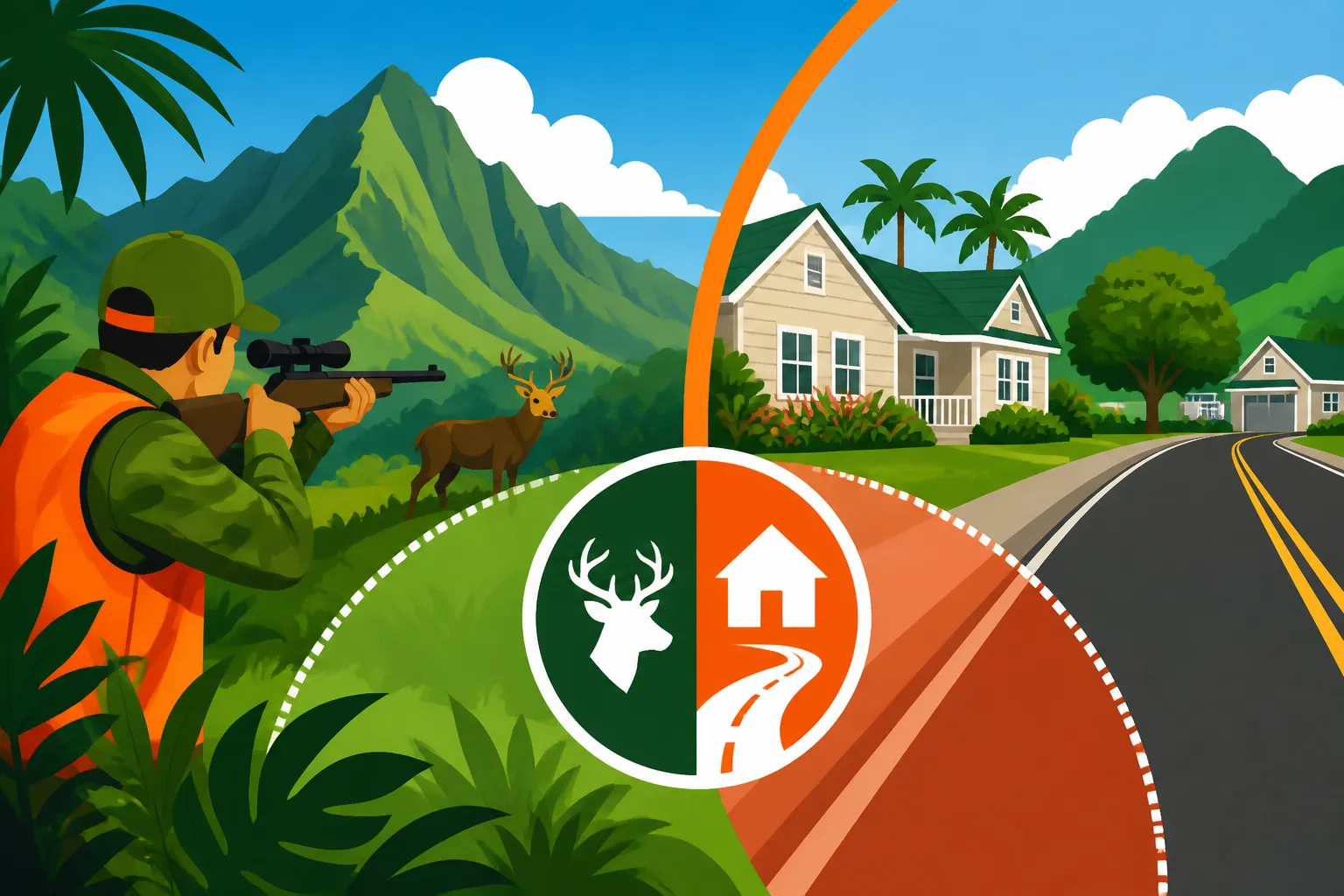
Rules on Hunting Near Homes and Roads
It’s a scenario that can easily turn a great day in the field into a nightmare: you’re deep into a hunt, following game sign, and suddenly you realize you’re much closer to a road or even someone’s backyard than you ever intended. Hunting in Hawaii, with its mix of remote wilderness, agricultural lands, and encroaching development, presents unique challenges when it comes to understanding and respecting the rules about hunting near homes and roads. This guide aims to clear up the confusion, helping you stay safe, legal, and respectful of both residents and other outdoor users.
Understanding Hawaii's Safety Zones and Prohibited Areas
Hunting in Hawaii isn't just about finding game; it's profoundly about knowing where you can and cannot hunt safely and legally. The islands are small, and public lands often butt right up against private residences, farms, or well-used recreational areas. Ignoring these boundaries, whether intentionally or accidentally, can lead to serious consequences, from fines and license revocation to much more dangerous outcomes.
The General "Safety Zone" Rule
Unlike some mainland states that have a universal, explicit "safety zone" distance (like 150 or 200 yards from an occupied dwelling) codified across all hunting, Hawaii’s approach is a bit more nuanced. While there isn't a single, statewide numerical distance that applies to every hunting scenario, the fundamental principle of public safety is absolutely paramount. You are expected to exercise extreme caution and common sense. This means ensuring your shot has a safe backstop and that you are not discharging a firearm in a manner that could endanger any person, domestic animal, or property.
For example, many specific hunting units, especially those near populated areas or where public access is common, will have explicit rules prohibiting the discharge of firearms within a certain distance of residences, public trails, or even other designated recreation sites within the unit. You might not see a blanket "200-yard rule" in the general hunting regulations, but you will find these restrictions in the specific descriptions for areas like portions of the Kapapala Cooperative Area on Hawaii Island, or within certain sections of the Kula Forest Reserve on Maui. It’s critical to remember that these are not just suggestions; they are legally binding regulations designed to protect everyone. Always double-check the specific rules for the unit you plan to hunt by consulting the latest Public Hunting Area maps and regulations from the Department of Land and Natural Resources (DLNR) Division of Forestry and Wildlife (DOFAW) or through resources like Hawaii's Hunting Units and How They Work.
Specific Prohibited Areas and No-Go Zones
Beyond general safety, there are explicit areas where hunting is outright prohibited or heavily restricted. These include:
- National Parks and Monuments: Areas like Hawaii Volcanoes National Park or Haleakala National Park are federal lands where hunting is generally not permitted, except in very specific, often controlled, management programs which are not typically open to the general public.
- State Parks and Recreation Areas: Many state parks, beaches, and designated recreational sites are also off-limits to hunting. Even if a hunting unit borders one of these areas, you cannot pursue game into them or shoot from within their boundaries.
- Watershed Protection Areas: While some watershed areas allow hunting as a management tool, others are strictly protected for water quality or endangered species habitat and may be entirely closed.
- Military Installations: Lands like the Pohakuloa Training Area on Hawaii Island might allow hunting under specific permits and rules, but generally, vast portions are closed to public hunting due to active military operations. Never assume access without explicit permission and clearance.
- Fenced Conservation Boundaries: Hawaii has many fenced areas designed to protect native forests from feral ungulates. These fences are usually clearly marked, and while you might be able to hunt up to the fence line, you cannot cross into the protected area. These conservation efforts are critical, and respecting these boundaries is part of responsible hunting. You can learn more about this by checking out Hunting Hawaii's Fenced Conservation Boundaries.
The key takeaway here is vigilance. Don't rely on assumptions. Always secure current information, whether it's checking the DOFAW website, calling the local district office, or using mapping apps that display unit boundaries and restrictions.
Navigating Public Roads and Rights-of-Way While Hunting
The convenience of road access in some Hawaii hunting units can be a double-edged sword. While it might get you closer to your hunting grounds, it also introduces a host of legal and ethical considerations regarding public safety and proper firearm handling. Understanding what you can and cannot do on and near public roads is crucial for every hunter.
Legal Shooting From Roads and Vehicles
Let's get straight to it: it is generally illegal and extremely dangerous to shoot game from a public road or from within a vehicle on a public road in Hawaii. This isn't just a recommendation; it’s a hard-and-fast rule. The exact wording in Hawaii Revised Statutes (HRS) Section 183D-23, "Use of vehicles, aircraft, and boats," prohibits shooting from, or in, a motor vehicle or aircraft. This also extends to public roads and highways. The intent is clear: to prevent reckless endangerment to other drivers, pedestrians, and nearby properties.
Imagine a situation where you see a pig crossing a dirt road on the edge of a unit, say near the Kapapala area on Hawaii Island. The temptation to make a quick shot might be high, but doing so from your truck or even standing on the maintained portion of the road is a definite no-go. You must be completely off the traveled portion of the road, in a safe position, and ensure your shot direction is away from the road and any potential traffic. Even if you're parked and out of the vehicle, if your firing position is on the road, you're likely violating the rules. This is where understanding Vehicle Rules on Hawaii Public Land becomes critical.
This rule also applies to driving on unimproved roads or trails within public hunting units. While some units permit vehicle access on designated roads, you still cannot shoot from the vehicle. Your firearm must be unloaded and encased when being transported in a vehicle. Always ensure your firearm is secured and out of sight to prevent theft and comply with transportation laws.
Transporting Firearms Safely on Public Ways
The safe transportation of firearms is another non-negotiable aspect of hunting in Hawaii, especially when you're moving between your home or lodging and the hunting unit, or even just driving along an access road within a unit. The law is quite clear: all firearms must be unloaded and cased when being transported in or on a vehicle. This applies whether you're driving on a busy highway in Honolulu, a quiet country road on Maui, or a gravel track deep within a forest reserve.
"Unloaded" means no ammunition in the chamber or magazine, and the magazine itself should ideally be removed from the firearm. "Cased" means enclosed in a gun case, scabbard, or other container that completely encloses the firearm. It doesn't need to be a locked hard case for transport to a hunting area (though a locked case is always a good idea for security), but it must be fully enclosed.
For example, if you’re heading out for Hunting Maui's Year-Round Axis Deer Units in the Kahikinui slopes, and you've got your rifle, it needs to be unloaded and cased while you're driving the winding roads to get there. Don't be that hunter with a rifle resting on the dash or uncased in the truck bed; it's a safety hazard, illegal, and gives all hunters a bad name. This rule also protects you, preventing accidental discharge and ensuring you don't appear to be "road hunting" to law enforcement or concerned citizens.
This principle extends to bows and arrows as well. While not subject to the same "unloaded" rules as firearms, broadheads should always be covered, and bows should be transported safely to prevent accidental nocking or damage. Responsible hunters understand that public perception matters, and adherence to these safety protocols builds trust within the community.
Hunting Near Private Property and Residential Boundaries
The unique land ownership patterns in Hawaii mean that public hunting grounds often exist in close proximity to private lands, including active ranches, agricultural operations, and even residential neighborhoods. Navigating these boundaries is perhaps the most critical skill for a responsible Hawaii hunter, demanding diligence and respect.
Identifying Private Land and Avoiding Trespass
This is perhaps the most common pitfall for hunters, especially those unfamiliar with the specific nuances of Hawaii's land divisions. Trespassing, even accidentally, is a serious offense in Hawaii and can quickly lead to citations, fines, confiscation of game and equipment, and even loss of hunting privileges.
The primary tool for avoiding trespass is knowing your unit boundaries. DLNR/DOFAW provides maps, often available online or at local offices, that clearly delineate public hunting areas. However, these maps aren't always perfect down to the foot, and ground features can be misleading. This is where modern technology really shines. Many Hawaii hunters rely on GPS units or mapping apps like onX Hunt, which overlay public and private land boundaries onto detailed topographic maps. Services like GoHunt also often provide detailed mapping information that can be invaluable.
Imagine you're hunting pigs in a gulch system on Oahu, near the Ewa Forest Reserve. One ridge might be public land, but the next could be a private cattle ranch or a future housing development. Without a reliable map, you could easily cross an invisible line. Even if you don't see "No Trespassing" signs, it is your responsibility to know where you are at all times. Assume that any land not explicitly designated as a public hunting unit is private property and off-limits unless you have secured prior written permission.
The phrase "ignorance of the law is no excuse" absolutely applies here. Before you step foot in a unit, take the time to study the map, understand its boundaries, and identify any adjacent private properties. Look for old fence lines, changes in vegetation, or even subtle surveyor markers that might indicate a property line. If there's any doubt, err on the side of caution and avoid the area. You can find more details on avoiding such issues by reviewing Hawaii Trespass and Closed Area Rules.
Respecting Residential Buffer Zones and Noise Concerns
Even when you're on legal hunting ground, being in close proximity to homes requires an extra layer of awareness and respect. While, as mentioned, there isn't always a fixed statewide "safety zone" distance from dwellings, ethical and responsible hunting dictates that you maintain a safe and respectful distance.
Consider a hunting unit that backs up to a small rural community, perhaps on Hawaii Island near Kona, where a huntable area transitions into a few scattered homes. Even if you're technically within the public hunting boundary, discharging a high-powered rifle close to these homes is not only potentially dangerous but also disruptive. The sound of gunshots can be alarming to residents, especially those not accustomed to hunting activity.
Noise concerns are also particularly relevant for dog hunters. While Dog Hunting Rules are an integral part of pig hunting in Hawaii, dogs can be loud. If you're hunting with dogs near residential areas, be mindful of the noise they generate. It's often best to plan your routes to stay as far away from homes as possible, or to only pursue game in areas where the topography or vegetation naturally muffles sound. A good hunter is a good neighbor, and that means minimizing disturbance wherever possible.
Additionally, be aware of line-of-sight. Your bullet can travel much further than you might think, and what looks like a clear shot through thick kiawe or guava can have unforeseen trajectories. Always ensure you have a safe and clear backstop that extends beyond your target and any perceived obstructions. This careful consideration of potential impacts on residents ensures that hunting remains a respected and viable activity in Hawaii.
Practical Tips for Responsible Hunting Near Developed Areas
Hunting successfully and responsibly in Hawaii's diverse landscape, especially where wild areas meet human habitation, requires more than just knowing the rules; it demands thoughtful preparation, proactive communication, and an unwavering commitment to safety.
Scouting and Planning Your Hunt Carefully
The most effective way to avoid issues when hunting near homes and roads is thorough scouting and meticulous planning. This isn't just about finding game; it's about understanding the lay of the land, identifying potential hazards, and mentally mapping out safe zones.
Before you even leave your driveway, spend time with detailed maps. DOFAW's unit maps are your bible. Look for prominent features like residential subdivisions, active agricultural fields, marked trails, and public access points. Pay close attention to unit boundaries, noting where they intersect with roads, rivers, or property lines. Apps like GoHunt can provide crucial insights, often showing property ownership overlays that can be a lifesaver.
When you scout in person, don't just look for game sign. Look for human sign. Are there fresh tire tracks on a dirt road? Are there fences that might indicate a property line? Are there houses visible through the trees? What about designated hiking trails that might bring non-hunters into the area? For instance, if you're planning on Spot-and-Stalk Axis Deer in Hawaii in a unit that has public trails, plan your route to avoid those trails during busy times, or choose a different area entirely.
Always consider your entry and exit points. Parking legally and safely off the main road is crucial. Think about where you'll be shooting from, and what's beyond your target. Visualize the terrain and how sound might carry. For areas where public access is near homes, consider a midweek hunt when foot traffic is usually lighter, if the unit allows. This diligent pre-hunt work drastically reduces the chances of an unpleasant encounter or a dangerous situation.
Communicating with Landowners and Locals
One of the most underutilized tools for responsible hunting is good old-fashioned communication. In a tight-knit community like Hawaii, a little aloha can go a long way. If you find yourself hunting on the edge of a property, and you see the landowner, take a moment to introduce yourself. Explain that you are hunting legally on the adjacent public land and are being mindful of their property. Ask if there are any specific concerns they have.
For example, if you are hunting near a macadamia nut farm boundary, and you happen to see the farmer, a quick, polite conversation can alleviate any worries they might have about your presence. You might learn about a hidden fence line, a sensitive area for their crops, or even gain permission for future access. This kind of interaction builds goodwill and helps to ensure that hunting is seen as a legitimate and respectful activity, rather than a nuisance or a threat.
Furthermore, if you're planning a hunt that might involve some noise, like a dog hunt in an area that borders a few homes, a courteous heads-up to nearby residents, if feasible and appropriate, can prevent complaints. Sometimes, simply letting people know what's happening can defuse potential tension. Of course, use discretion; don't trespass just to say hello, but if you have a natural opportunity, seize it.
Responsible hunting in Hawaii is about being an ambassador for the sport. It means going above and beyond minimum legal requirements to ensure safety, respect private property, and maintain positive relationships with local communities. By scouting carefully and communicating openly, we can all contribute to a hunting culture that thrives alongside Hawaii's unique residential and natural landscapes.
| Rule Category | Key Regulation/Consideration | Why It Matters | Your Action |
|---|---|---|---|
| Safety Zones | No shooting from public roads/vehicles. Clear line of sight & backstop. | Prevents accidental injury to people/property. Upholds public safety. | Be completely off public road; ensure safe shot angle and clear background. |
| Prohibited Areas | Respect boundaries of parks, preserves, military lands. | Legal requirement; protects sensitive ecosystems & public safety. | Consult unit maps rigorously. Understand Reading a Hawaii Unit Boundary Map. |
| Trespass | Know property lines; no hunting on private land without permission. | Avoids legal penalties, maintains landowner relations, respects property rights. | Use GPS/mapping apps. When in doubt, don't enter. Seek explicit permission. |
| Firearm Transport | Unloaded and cased in vehicles on public ways. | Prevents accidental discharge; deters road hunting; ensures public confidence. | Always unload and case firearms before entering a vehicle. |
| Noise & Disturbance | Be mindful of noise (shots, dogs) near residences. | Promotes good neighbor relations; minimizes complaints about hunting activity. | Plan routes away from homes. Consider time of day. Communicate if appropriate. |
| Unit-Specific Rules | Adhere to all rules for individual hunting units. | Regulations vary by unit and are legally binding. | Always check current DOFAW regulations for your specific unit. Use Using OuterSpatial Instead of a Paper Card for check-ins and boundary review. |
Disclaimer
Please remember that hunting regulations in Hawaii can change. While this guide provides comprehensive and up-to-date information at the time of writing, it is your responsibility to consult the official Hawaii Department of Land and Natural Resources (DLNR) Division of Forestry and Wildlife (DOFAW) regulations before every hunt. Always ensure you have the most current information regarding licenses, permits, unit rules, and safety protocols. Your safety and adherence to the law are paramount.