Spot-and-Stalk Axis Deer in Hawaii
Oh, the allure of an Axis deer hunt in Hawaii! It’s a dream for many, but the reality on the ground can be a truly humbling experience. Many hunters arrive, picturing wide-open plains and easy shots, only to be met with cunning animals, diverse and challenging terrain, and the intense heat that can turn even a short walk into an endurance test. This guide is all about helping you navigate the unique world of spot-and-stalk Axis deer hunting in Hawaii, breaking down the strategies and preparations needed to truly succeed in this beautiful, yet demanding, environment.
Understanding Axis Deer Behavior for Successful Spot-and-Stalk
Hunting Axis deer in Hawaii isn't like chasing whitetails in a timber stand; these are animals with highly developed senses, and their behavior is perfectly adapted to the island environment. To be successful, you need to think like an Axis, anticipate their moves, and respect their incredible awareness. It’s a game of chess, and they’ve been playing for generations.
Reading the Land and Deer Sign
Before you even think about putting on the sneak, you need to understand where Axis deer spend their time and what they leave behind. Unlike some deer species that are more solitary, Axis are often found in herds, and their movements are dictated by food, water, and security. On an island like Maui or Molokai, where Axis are abundant, you'll find them in a variety of habitats, from dry kiawe forests to open grasslands. Your job is to decipher the story the land tells.
Fresh tracks are your primary indicator. Look for distinct, sharp edges in the dirt or dust. If the edges are rounded or crumbling, the tracks are older, telling you the deer were there, but might not be now. Pay close attention to the size and direction. Are they heading toward a water source in the morning or back to bedding areas after feeding? Droppings, or scat, also provide crucial intelligence. Fresh droppings are typically moist and shiny; older ones are dry and dull. If you find a pile of fresh scat along a trail, you know you're in an active area. You'll also want to keep an eye out for rubs on small trees or bushes, where bucks have scraped their antlers. While Axis bucks can rub year-round because their antlers drop at different times, a cluster of fresh rubs can indicate a buck's preferred travel corridor or a staging area. Understanding Reading Axis Deer Sign in Dry Country is paramount to pinpointing where to focus your efforts, especially in the vastness of some units.
Daily and Seasonal Movements
Axis deer are creatures of habit, but those habits are heavily influenced by the time of day and year, especially the rut. Generally, you'll find them most active during the cooler parts of the day – early mornings and late evenings. They'll move from their bedding areas, often in thick brush or shaded gulches, to feeding grounds like open pastures, kiawe flats, or areas with palatable browse. As the sun climbs and temperatures rise, they'll seek shade and security. This means during the midday heat, you might find them bedded down, sometimes in surprisingly open areas if they feel secure, but more often tucked into dense cover where the air might be a little cooler. This behavior is critical for the spot-and-stalk hunter; a bedded deer offers the best chance for a close approach.
The rut for Axis deer in Hawaii is fascinatingly protracted and can occur throughout much of the year, although there are peaks. This contrasts sharply with mainland deer seasons. While you might find bucks in hard antler almost any month, the peak rut activity, characterized by increased vocalizations (like the distinctive Axis "bugle" or "bark"), sparring, and chasing does, often intensifies in late spring through summer, but don't count out other times. During the rut, bucks are less cautious, more focused on breeding, and can be distracted, which can be an advantage. However, their movements can also be more erratic as they cover larger areas. Concentrating your efforts around water sources during dry periods or key feeding areas during the early morning can significantly increase your odds. For specific strategies on morning movements, check out Hunting Axis Deer at First Light in Hawaii.
Choosing the Right Terrain for Spot-and-Stalk
Hawaii's hunting landscapes are incredibly diverse, from arid, volcanic slopes to lush, wet rainforests. For spot-and-stalk hunting Axis deer, certain terrains lend themselves better to the method, while others present unique, often formidable, challenges. Picking your battleground wisely can make all the difference between a successful stalk and a frustrating bust.
Open Country Advantages and Disadvantages
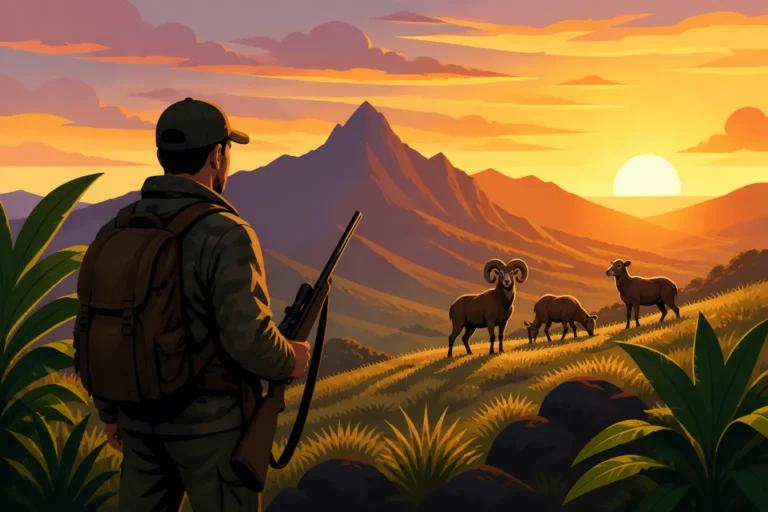
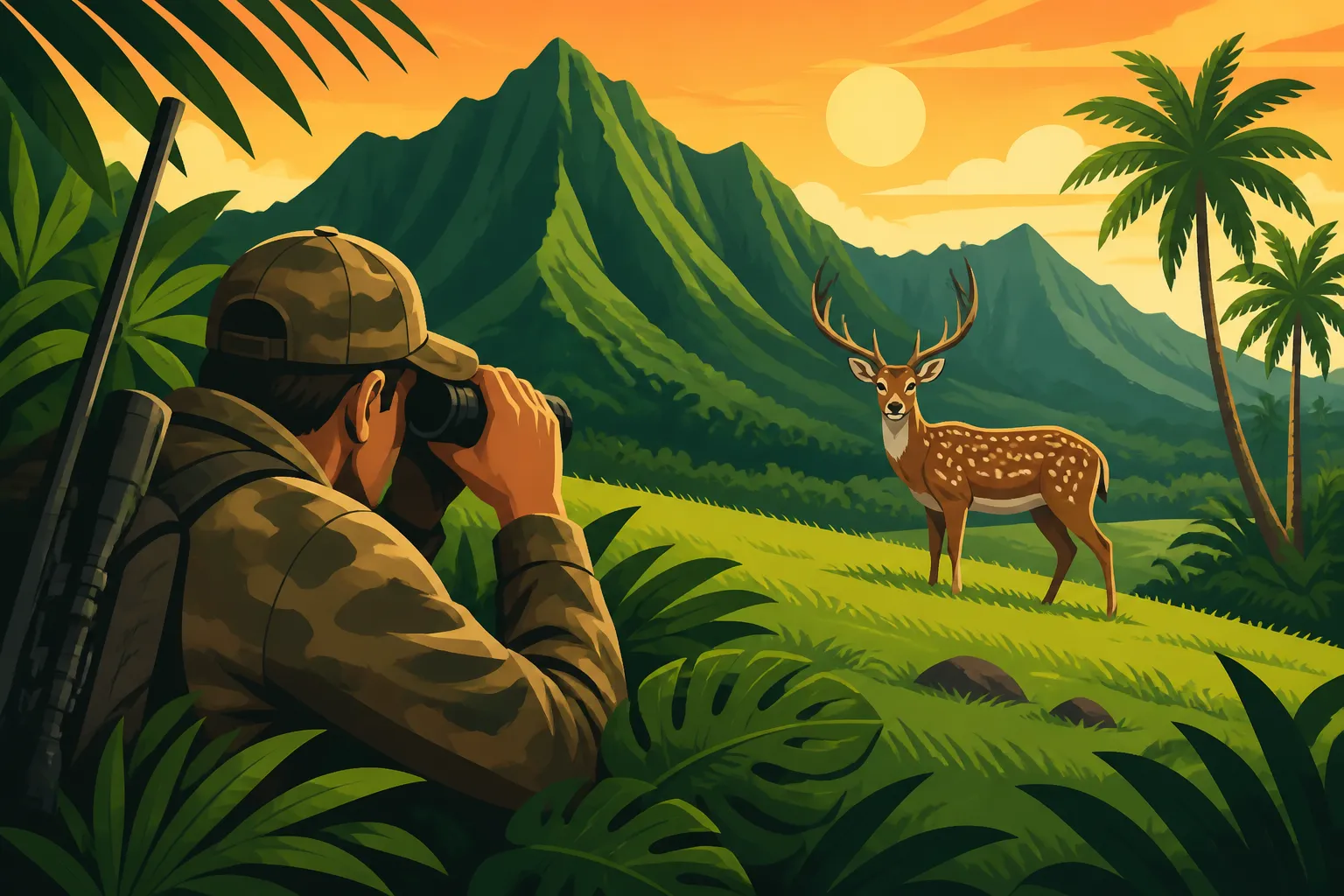
When most people picture "spot-and-stalk," they often envision wide-open, rolling hills, and that's exactly what you'll find in many of Hawaii's prime Axis deer units, particularly on Maui, Molokai, and Lanai. Areas like the vast kiawe flats on Lanai or the expansive pastures in Maui's Upcountry are perfect for glassing. The advantage here is obvious: you can see deer from a long way off. This allows you to observe their behavior, identify specific animals, and plan your approach meticulously. You can spend hours perched on a vantage point, scanning with your binoculars or spotting scope, letting your optics do the walking for you. You'll often spot herds of deer, giving you multiple options for a target buck.
However, the very thing that makes open country great for spotting makes it incredibly difficult for stalking. Every move you make is exposed. The ground is often dry and crunchy, making quiet movement a supreme challenge. Any gust of wind can carry your scent for miles, and those sharp-eyed Axis deer are constantly scanning their surroundings. Successfully stalking in open country requires extreme patience, using every ripple in the terrain, every sparse kiawe tree, every patch of tall grass for cover. It means crawling on hands and knees, or even belly-crawling, for hundreds of yards. It's mentally and physically exhausting. Targeting a specific area like Hunting a Kiawe Flat for Axis Deer means you'll need to master these specific tactics.
Thicker Cover Challenges and Opportunities
While the wide-open spaces dominate the typical Axis hunting imagery, there are plenty of areas, particularly on Maui and Molokai, where the terrain transitions into thicker pockets of vegetation. This might include dense patches of kiawe, pockets of haole koa, guinea grass, or even the edges of more substantial forest reserves. In these areas, the challenge shifts dramatically. You won't be glassing deer from a mile away. Instead, you'll be relying on closer-range spotting, either by slowly walking and scanning, or by finding higher ground that overlooks smaller, more defined clearings or gulches.
The disadvantage, of course, is that deer are much harder to locate. They can disappear into a small patch of brush like ghosts. The advantage, though, is that once you do spot a deer, the cover provides much better opportunities for a stealthy approach. The vegetation breaks up your outline, absorbs sound, and can sometimes even help to baffle your scent. However, moving through thick cover brings its own frustrations. Every step is a gamble; a dry branch snap or a rustle in the leaves can instantly alert a deer that's only yards away. You need to move agonizingly slow, picking up your feet, placing them down gently, and constantly checking the wind. It’s a painstaking process, but it can pay off with incredibly close encounters.
Essential Gear and Preparations for the Stalk
Successful spot-and-stalk hunting in Hawaii isn't just about technique; it's also about having the right tools and knowing how to prepare yourself. The islands throw unique challenges at hunters, from relentless heat and humidity to unforgiving volcanic rock and dense vegetation. Your gear needs to be up to the task, and your body needs to be ready.
Optics for Spotting and Evaluating
When it comes to spot-and-stalk hunting for Axis deer, your optics are arguably more important than your rifle or bow. You simply cannot effectively hunt Axis deer in Hawaii without good glass. You'll need two primary tools: a high-quality pair of binoculars and a reliable spotting scope.
Your binoculars (10×42 or 10×50 are excellent choices) are for general scanning and initial identification. They live around your neck or in a bino harness, ready for instant use. You'll spend an incredible amount of time behind them, picking apart hillsides, kiawe flats, and gulch edges. They are your eyes, extending your vision to detect the twitch of an ear, a flick of a tail, or the slight shift of a deer's body in distant cover. For the serious hunter, a good pair of rangefinding binoculars can be a game-changer, saving precious seconds when a shot opportunity arises. A spotting scope (15-45x or 20-60x) mounted on a sturdy tripod is essential for evaluating deer from extreme distances. Once you've spotted a potential target with your binoculars, the spotting scope allows you to magnify it, determine if it's a shooter buck, and accurately judge its antlers. For those looking to score a trophy, understanding Judging an Axis Buck's Antlers in the Field from afar is critical, and only a quality spotting scope will give you the detail you need without spooking the animal. This saves you countless wasted stalks on smaller bucks. Ensure your tripod is lightweight but stable enough for Hawaii’s often breezy conditions.
Footwear and Clothing for Stealth and Comfort
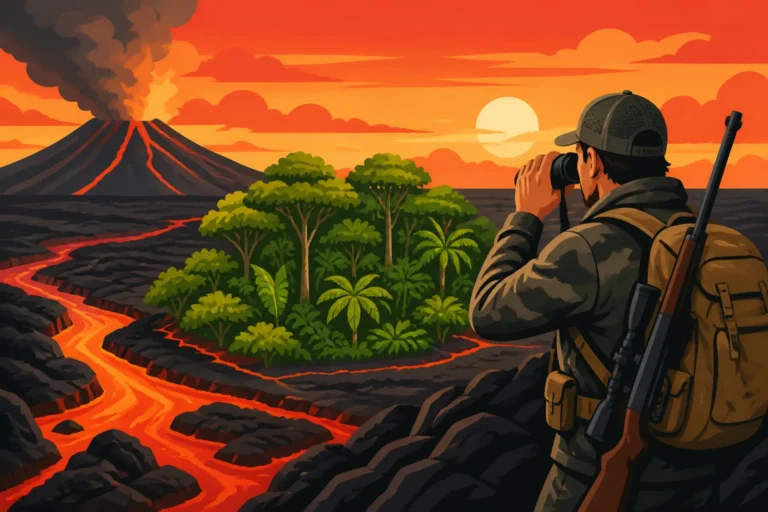
Hawaii's terrain is notoriously tough on footwear. You'll encounter everything from sharp lava rock to slick, muddy trails, and hot, dusty plains. Choosing the right boots is non-negotiable. Look for boots that offer excellent ankle support, a stiff sole to protect your feet from jagged rocks, and durable construction. Waterproofing is a plus, especially if you might encounter morning dew or unexpected showers, but breathability is also crucial for managing heat. For more specific advice, consider boots optimized for Boots for Hawaii Lava and Wet Forest. Comfort is paramount; you’ll be putting in miles, sometimes over very uneven ground. Break in your boots long before your hunt to avoid painful blisters.
Your clothing needs to serve multiple purposes: stealth, protection from the elements, and comfort in varying temperatures. Lightweight, breathable, moisture-wicking fabrics are ideal for the heat. Choose subdued, earth-toned colors like greens, browns, and grays that blend with the natural environment. While full camouflage isn't strictly necessary for Axis deer as it might be for some other species, breaking up your outline helps significantly. Avoid noisy fabrics that rustle with every step. Long sleeves and pants, even in the heat, offer protection from the sun, thorns, and biting insects. A wide-brimmed hat is also a wise investment for sun protection. Layering is always a good idea; even if it starts warm, mornings can be cool, and an unexpected rain shower can quickly drop temperatures.
Mastering the Spot-and-Stalk Techniques
This is where the rubber meets the road, or more accurately, where your boot meets the lava. The act of stalking an Axis deer is a meticulous blend of patience, observation, and calculated movement. It’s a dance with an animal that has evolved to evade predators, and you are trying to outwit its innate survival instincts.
Wind, Thermals, and Scent Control
In Hawaii, the wind is a constant, dynamic factor that can make or break your stalk. The prevailing trade winds can shift, and local thermals, which are air currents caused by temperature differences, add another layer of complexity. As the sun rises and heats the land, thermals tend to rise up slopes. As it sets and the land cools, they fall. This means the wind direction can effectively reverse depending on the time of day and the terrain you're in. Hunting Downwind in Hawaii's Shifting Thermals is an absolute must-read to understand these dynamics.
Always, always, always be aware of the wind direction. Carry a small bottle of powder or a wind checker to constantly monitor it. Your scent is your biggest giveaway. Axis deer have an incredibly keen sense of smell, far surpassing human capabilities. Even the slightest whiff of human odor will send them bounding away. You must approach from downwind, keeping the wind in your face or quartering. If the wind shifts during your stalk, you have two choices: either adjust your approach to stay downwind, which might mean a long detour, or pull back and try again another time. There's nothing more frustrating than getting within range only for a subtle shift in wind to carry your scent right to your target. Scent control measures, like scent-free clothing and sprays, can help, but they are never a substitute for smart wind management.
Moving Slowly and Using Cover
Once you've spotted your target and planned your approach, the actual stalk begins. This is not a race. Moving slowly is perhaps the single most important rule. Imagine you are moving in slow motion. Every step must be deliberate. Pick up your foot, scan the ground where you intend to place it for loose rocks or twigs, and then gently set it down, heel first, rolling to the toe. This "heel-to-toe" method minimizes noise.
Utilize every piece of natural cover available. This includes gulches, ridges, kiawe thickets, large rocks, and even subtle changes in elevation. The goal is to keep your body hidden or at least broken up, so you don't present a clear human outline. If the deer is bedded, observe its behavior. Is it alert? Are its ears constantly swiveling? Wait for it to lie its head down or look away before making your move. When you have to cross an open area, do so quickly but silently, keeping as low to the ground as possible. Sometimes, a full crawl is the only option, especially if you're in the Hunting Hawaii's Dry Kiawe Forest with minimal cover. If the deer looks in your direction, freeze instantly and become a part of the landscape. Do not move until its attention shifts. This extreme patience can feel agonizing, but it’s what separates the successful spot-and-stalk hunter from the one who repeatedly spooks game. Remember, Axis deer are herd animals, so if you spot one, there are likely others. Always scan the entire area for additional eyes and ears before committing to your stalk.
Post-Shot Strategy and Meat Care
Congratulations, you've made a good shot! But the hunt isn't over yet. In Hawaii's challenging environment, what happens immediately after the shot and how you handle the meat are just as crucial as the stalk itself. The heat and humidity can spoil meat incredibly quickly, so having a solid plan for recovery and cooling is non-negotiable.
Tracking and Recovery in Challenging Terrain
After the shot, resist the urge to immediately run to where you last saw the animal. Give the deer time. A gut-shot animal, for instance, might travel a short distance, lay down, and expire. If pushed too quickly, it could get up and run for miles, making recovery much harder. Wait at least 30 minutes for a good lung/heart shot, and an hour or more for a questionable shot, especially if you suspect a gut shot. Mark your shooting location and the last place you saw the deer.
Once you begin tracking, look for blood, broken branches, disturbed earth, and any other sign. Axis deer often leave a clear blood trail, but it can be sparse in thick vegetation or on hard ground. In Hawaii, you might be tracking over sharp lava, through dense tangles of kiawe, or down into steep, rocky gulches. This is where a good tracking dog (if legal and you have access) or a patient, methodical search with a buddy comes in handy. Pay attention to the animal's direction of travel and keep your head up to spot the deer itself. If you lose the trail, spread out and walk in ever-widening circles from the last confirmed sign. It's incredibly disheartening to lose an animal, so be persistent. Always carry a good flashlight or headlamp, even if you expect to be out before dark; recovery can often take longer than anticipated.
Field Dressing and Rapid Cooling of Meat
Once you've recovered your Axis deer, the clock starts ticking. Hawaii's tropical climate is brutal on game meat. High temperatures and humidity create a perfect breeding ground for bacteria, leading to rapid spoilage if not handled correctly. Field dressing must be done immediately.
The first step is to gut the animal quickly to allow the body heat to escape. Lay the deer on its back, elevate the hindquarters if possible, and carefully open the abdominal cavity from the sternum to the pelvis. Remove all internal organs. Some hunters in Hawaii also split the pelvis to allow for better airflow and ease of cleaning, especially with larger bucks. Wipe out the cavity with paper towels or clean rags to remove any blood or debris. If you have access to water, a quick rinse of the cavity can help, but ensure it's thoroughly dried afterward to prevent bacterial growth.
The next, and arguably most critical, step is rapid cooling. This is where most mainland hunters fall short when hunting in Hawaii. You cannot simply throw the deer in the back of your truck and drive around for hours. The meat needs to chill down as quickly as possible. Many successful Hawaii hunters quarter the animal in the field. This involves removing the four legs, backstraps, and tenderloins. These smaller pieces cool much faster than a whole carcass. Immediately place the quarters into game bags to protect the meat from flies and dirt. Then, get them into a cooler packed with ice. Having multiple coolers and plenty of ice waiting at your vehicle is a smart strategy. Layer ice on the bottom, then meat, then more ice. Drain melted water regularly and replenish with fresh ice. For detailed steps, refer to Cooling Meat Fast on a Hawaii Hunt. Neglecting this step means risking delicious venison, and believe me, Axis venison is some of the best wild game you'll ever taste.
Strategic Planning and Common Pitfalls
Hunting in Hawaii is a unique adventure, and like any adventure, it benefits from careful planning and an awareness of potential missteps. Many hunters, both local and visiting, have learned valuable lessons the hard way. Understanding these nuances can significantly improve your chances of a successful and enjoyable hunt.
Permitting and Access Considerations
Before you even book a flight or pack your gear, you need to understand Hawaii's specific hunting regulations. This is not the place for assumptions. Every island, and often every hunting unit on that island, has its own set of rules regarding seasons, bag limits, and allowed weapons. The permitting system can feel a bit complex at first glance, but resources are available.
You’ll need to purchase a Hawaii hunting license, and for Axis deer on islands like Lanai or specific units on Maui and Molokai, you’ll also need specific permit-tags obtained through a lottery draw or over-the-counter purchase. Many hunters use the GoHunt Hawaii website, the official portal for the Department of Land and Natural Resources (DLNR) Division of Forestry and Wildlife (DOFAW), to buy licenses, apply for draws, and check specific unit information. It's an indispensable tool. Access to public hunting land often requires checking in and out at designated stations or via the OuterSpatial app. Failing to check in or out can result in citations, so don't skip this step. Some areas are "weekend only," while others have year-round seasons. Always double-check the current regulations for your chosen unit, as rules can change due to various factors like drought, animal populations, or conservation efforts. Don't be that hunter who flies all the way to Hawaii only to realize they missed a critical deadline or chose a unit that's closed.
Avoiding Common Spot-and-Stalk Mistakes
Even seasoned hunters can make mistakes when encountering a new environment or a particularly wary species. Axis deer are incredibly sharp, and even small errors can cost you the hunt.
One of the most common pitfalls is rushing the stalk. Impatience is the enemy of the spot-and-stalk hunter. You've spotted a buck, you're excited, and you push too fast. This leads to noisy movement, getting busted by a hidden deer, or walking into an impossible wind situation. Remind yourself to slow down, take deep breaths, and move with purpose. Another mistake is not using optics enough. Hunters often want to move as soon as they see something. Instead, take your time with your binoculars and spotting scope. Observe the deer's behavior, pinpoint its exact location, and identify potential escape routes or hidden deer in the herd. Glass the terrain for your approach path. The more information you gather before you move, the higher your chances of success.
Underestimating the wind and thermals is another frequent error. As discussed, Hawaii's air currents are tricky. Don't just check the wind once; monitor it constantly. Carry multiple wind checkers. If the wind isn't right, don't force it. Sometimes the best decision is to wait, relocate, or come back another day. Lastly, poor physical preparation can lead to exhaustion and mistakes. Spot-and-stalk hunting in Hawaii involves long walks, often up and down steep, uneven terrain, in heat that can be stifling. Being in good physical condition will allow you to stay mentally sharp, move more quietly, and execute a better stalk. If you’re not accustomed to hiking in elevation or heat, start conditioning well in advance of your trip. The more prepared you are, the more you can enjoy the challenge and beauty of Hunting Maui's Year-Round Axis Deer Units or any other incredible unit you choose.
Hawaii Spot-and-Stalk Terrain Considerations
| Terrain Type | Best For Spotting? | Stalking Difficulty | Common Cover Elements | Key Challenges |
|---|---|---|---|---|
| Open Grasslands | Excellent | Very High | Tall grass, sparse kiawe bushes | Extreme exposure, crunchy ground, constant wind |
| Kiawe Flats | Good | High | Dense kiawe thickets, gulches | Thorns, limited visibility, noisy underfoot |
| Volcanic Flows | Varies | Moderate to High | Lava rock formations, kipukas | Sharp, unforgiving ground, few mature trees |
| Forest Edges | Moderate | Moderate | Dense canopy, varied undergrowth | Variable wind, hidden obstacles, thick brush |
| Gulches/Canyons | Low to Moderate | Moderate | Steep walls, dense vegetation | Steep ascent/descent, swirling winds, shadows |
Disclaimer
Hunting in Hawaii involves inherent risks, including but not limited to challenging terrain, unpredictable weather, and encounters with wildlife. Always prioritize safety, adhere to all local and state regulations, and obtain the necessary licenses and permits. The information provided in this guide is for informational purposes only and should not be considered a substitute for official regulations or professional guidance. Hunters are responsible for their own safety and for understanding and following all applicable laws.