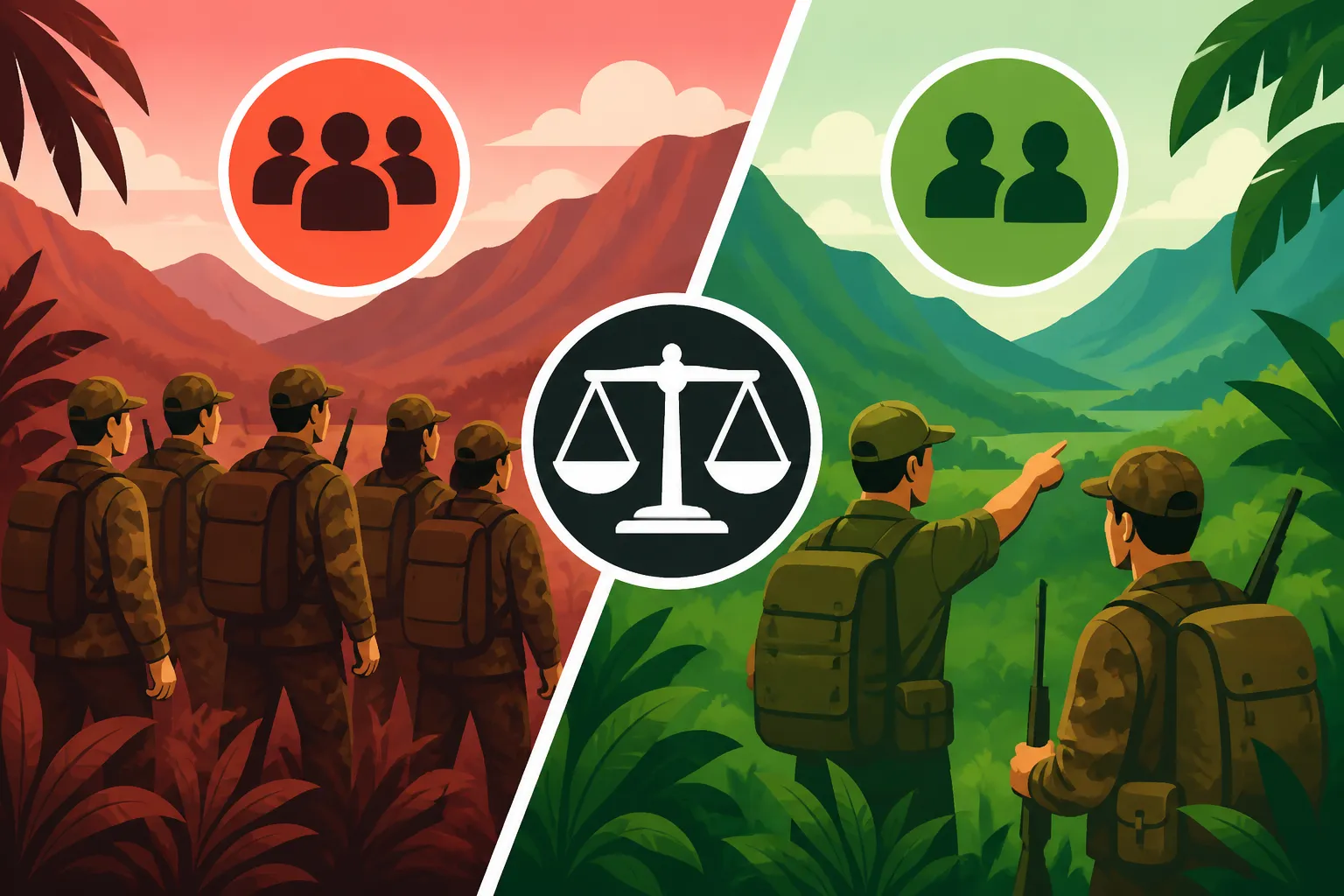
Group Size and Hunter to Guide Ratio
One of the trickiest parts about planning a guided hunting trip in Hawaii, especially if you're traveling with friends or family, is figuring out the ideal group size and what kind of attention you'll get from your guide. It’s a common frustration: you want to share the experience, but you also worry about whether a larger group will dilute the quality of your hunt. This guide aims to demystify hunter-to-guide ratios, helping you understand how different group configurations can impact your adventure across the islands.
Understanding Why Group Size Matters for Your Hawaii Hunt
When you think about a guided hunt in Hawaii, whether it’s chasing Axis deer on Maui or feral pigs in a Big Island gulch, the image of a seasoned guide leading you through the jungle or across a dry lava field probably comes to mind. What often isn't immediately apparent, however, is how the number of hunters joining that guide can profoundly alter the entire experience. It's not just about splitting the cost; it's about the focus, the safety, and even the type of hunting you'll do.
The Impact on Your Hunting Experience
Imagine you’re trekking through a dense koa forest, eyes peeled for pig sign, or glassing a vast dry pasture for Axis deer on Lanai. If it's just you and your guide, every whispered observation, every subtle movement, every decision about which direction to stalk is a shared, immediate conversation. Your guide's attention is entirely on your needs, your pace, and your shooting opportunities. This singular focus can dramatically increase your chances of success and the overall intensity of the experience. It feels more personal, more tailored, and often, more successful, especially when it comes to spotting elusive game or making quick decisions in challenging terrain.
Now, picture adding one or two more hunters to that scenario. Suddenly, the guide's attention is divided. They need to monitor everyone's safety, ensure everyone is moving quietly, and try to position multiple shooters for a shot. What if one person needs to adjust their gear, or another spots something in a different direction? These seemingly small logistical hurdles compound quickly in the field. The pace might slow down, or conversely, feel rushed, as the guide tries to accommodate multiple individuals. Opportunities that might have been perfect for a single hunter could be missed as the group tries to get into position. This isn't to say group hunts are bad—far from it—but it's crucial to understand that the dynamic shifts considerably.
Safety Considerations and Logistics
Hawaii's hunting terrain is incredibly diverse and can be genuinely challenging. From the steep, often wet, and slippery rainforests on the windward sides of the islands, where footing can be treacherous and visibility limited, to the vast, unforgiving lava fields and dry, broken country on the leeward sides, danger is a real factor. This isn't your average walk in the park. In these environments, safety is paramount.
A guide managing a single hunter can focus intently on that hunter's every step, ensuring they navigate difficult sections safely, maintain proper firearm discipline, and are always aware of their surroundings. When you introduce additional hunters, the guide’s logistical load increases significantly. They must ensure adequate spacing between hunters, especially if multiple people are carrying firearms. Communication becomes more complex, as does managing potential hazards like uneven ground, thick vegetation, or unexpected changes in animal movement. Staying Found in Dense Hawaii Rainforest is a very real challenge, and a guide has to manage this for everyone.
Think about traversing a steep gulch after a pig hunt, or working your way down a rocky slope to retrieve an Axis deer. With a larger group, the potential for someone to slip, lose their footing, or get separated grows. Your guide will often have a first aid kit and an emergency plan, but preventing incidents is always better. The hunter-to-guide ratio directly impacts how effectively a guide can maintain control and ensure the well-being of everyone in the party. For instance, Helicopter Access for Remote Hawaii Hunts adds another layer of logistical planning, and your group size will absolutely factor into seating arrangements and weight limits.
Typical Hunter-to-Guide Ratios in Hawaii
When you start looking at guided hunt options in Hawaii, you'll quickly notice that outfitters offer different packages based on the number of hunters per guide. These ratios aren't arbitrary; they reflect a balance of cost, experience, and logistical practicality for the specific type of hunting involved. Knowing what each ratio generally entails can help you set realistic expectations for your trip.
One-on-One: The Premium Experience
The 1:1 hunter-to-guide ratio is often considered the gold standard for guided hunts, and for good reason. This arrangement means you have your guide's undivided attention from the moment you meet until you're packed up and heading home. They are entirely focused on your success, your comfort, and your safety. In the field, this translates to:
- Personalized Pace: The hunt moves at your speed. If you need a break, the guide accommodates. If you want to push harder, they're right there with you.
- Enhanced Stealth: Two people moving through the brush are inherently quieter than three or four. The guide can fine-tune your movements, ensuring you’re as undetectable as possible. This is especially crucial for wary game like Axis deer or in dense pig country.
- Optimal Shot Opportunities: The guide can position you for the best possible shot, considering wind, cover, and animal behavior, without needing to worry about other hunters interfering or needing a turn. They can coach you through the shot in real-time.
- Direct Communication: Every observation, every strategy change, is discussed directly with you. There's no confusion or misinterpretation that can sometimes arise in a larger group.
- Targeted Species: If you have a specific trophy animal in mind, a 1:1 ratio gives you the best chance. The guide can focus on finding that mature Axis buck or a large boar.
Of course, this premium experience comes at a premium cost. One-on-one hunts are typically the most expensive per person because you're covering the full cost of the guide's time and resources yourself. However, for many, the significantly increased chances of success and the quality of the hunting experience make it well worth the investment. When browsing options on sites like BookYourHunt, you'll often see 1:1 rates clearly delineated.
Small Group Hunts: Balancing Cost and Attention
Many outfitters offer 1:2 or 1:3 hunter-to-guide ratios, which represent a popular compromise for many hunters. This is often the sweet spot for a pair of hunting buddies, a parent and child, or a small group of friends. In these scenarios, the cost per person is generally lower than a 1:1 hunt, making a guided Hawaii adventure more accessible.
With a 1:2 ratio, the guide can still provide a high level of personalized attention. They can often manage two hunters effectively, especially if both hunters have similar fitness levels and hunting styles. Communication is still relatively direct, and setting up two shooters for a simultaneous or sequential shot is often feasible. This ratio works particularly well for species that might present multiple targets, like a small group of feral pigs.
A 1:3 ratio can start to feel a bit more like a group effort, where individual attention might be slightly less intense, but the shared experience can be fantastic. The guide will be working hard to keep everyone on the same page, manage spacing, and point out opportunities. This ratio can be excellent for those who prioritize the camaraderie of a shared hunt and are perhaps a bit more experienced themselves, needing less constant oversight. For example, if you're hunting smaller game birds like francolin or pheasant, a 1:3 ratio might work fine, as the action can be spread out.
The trade-off here is that the guide's attention is, by necessity, divided. You might have to wait a bit longer for your turn for a shot, or the pace might be dictated by the slowest member of the group. However, the shared stories, the teamwork, and the reduced individual cost make these ratios very appealing for many hunters visiting Hawaii. What a Hawaii Guided Hunt Costs will typically reflect these differing ratios, with per-person costs decreasing as the group size increases.
Larger Groups and Specialized Hunts
While less common for traditional big game hunts like Axis deer or mouflon, some Hawaii outfitters might accommodate larger groups (e.g., 1:4 or more) for specific types of hunts or as part of a multi-guide operation. These are often tailored for corporate retreats, larger family gatherings, or specialized events.
For these larger groups, the experience shifts from highly personalized guiding to more of a logistical management role for the lead guide. Individual attention will be minimal, and hunters might rotate through positions or areas. Success often relies more on the collective effort and less on individual stalking skills directly coached by the guide. This setup can be fun for a social hunting experience where the harvest is secondary to the camaraderie and the adventure of being in Hawaii's wild places together.
Consider a driven pig hunt, where dogs push game towards waiting hunters, or a game bird shoot where multiple hunters are strategically positioned. In these scenarios, a higher hunter-to-guide ratio can still be effective because the hunting method itself accommodates more participants simultaneously. However, for a classic spot-and-stalk big game hunt, a very large group with a single guide could become frustrating and reduce individual success rates significantly. Make sure to clearly ask about the typical group size and ratio when Questions to Ask Before Booking come up.
| Ratio (Hunters:Guide) | Cost Per Hunter (Shape) | Individual Attention | Flexibility & Pace | Stealth Factor | Ideal For |
|---|---|---|---|---|---|
| 1:1 | Highest | Maximum | Fully Customized | Excellent | Trophy hunt, First-timer, Specific goals, Solitude |
| 1:2 | Moderate-High | High | Good, Shared Pace | Very Good | Two buddies, Parent/Child, Balanced cost/experience |
| 1:3 | Moderate | Moderate | Group Pace | Good | Small group of friends, Social hunt, Experienced hunters |
| 1:4+ | Lower | Minimal | Group Pace, Less Individual Input | Fair | Corporate outings, Specific driven hunts, High camaraderie |
Deciding on the Right Ratio for Your Goals
Choosing the right hunter-to-guide ratio for your Hawaii hunt isn't a one-size-fits-all decision. It truly depends on what you're hoping to get out of the experience. Are you aiming for a specific trophy? Is it a once-in-a-lifetime trip with your closest hunting partner? Or is it a more social affair with a group of friends, where the journey and shared adventure are as important as the harvest itself? Taking the time to consider these factors upfront will ensure you book a hunt that aligns with your expectations.
Factors to Consider Before Booking
Before you reach out to an outfitter or start browsing platforms like BookYourHunt for available dates, take a moment to reflect on these key aspects:
- Your Hunting Experience Level: Are you a seasoned hunter who can move quietly, make quick decisions, and shoot accurately under pressure? Or are you relatively new to hunting, perhaps even a first-timer, who might need more coaching and direct guidance? A less experienced hunter will generally benefit immensely from a 1:1 or 1:2 ratio, where the guide can provide continuous support and instruction. For a Guided Hunts for a First-Time Hunter, a lower ratio is almost always recommended.
- Your Physical Fitness: Hawaii's terrain can be grueling. Steep ascents and descents, uneven volcanic rock, dense jungles, and relentless heat and humidity are common. If you or members of your group have varying fitness levels, a larger group can mean someone constantly holding up the pace, or feeling rushed. A 1:1 ratio allows the guide to tailor the pace specifically to your stamina, while a small group hunt would need everyone to be on a similar fitness page. Fitness for a Steep Hawaii Hunt is not to be underestimated.
- Your Budget: Let’s be real, guided hunts are an investment. Generally, the more personalized the experience (i.e., fewer hunters per guide), the higher the cost per person. A 1:1 hunt will always be at the top end of the price spectrum, while 1:2 or 1:3 hunts offer a more accessible price point. You need to weigh the value of individual attention against what you're comfortable spending. Don't forget to factor in other costs beyond the guide fee, like licenses, tags, travel, and meat processing. Check out What a Hawaii Guided Hunt Costs for more detailed insights.
- Your Desired Species and Method: Are you after a trophy Axis buck, which often requires meticulous stalking and patience? A 1:1 or 1:2 ratio is almost essential for this. If you’re pig hunting with dogs, where the action can be fast and furious, a 1:2 or 1:3 might work if the guide is good at managing multiple dogs and hunters. For game bird hunting, where hunters might spread out, a slightly higher ratio might be acceptable. Consider how the specific game and hunting style interact with group size. Hunting Hawaii's Feral Pigs often involves different tactics than Axis Deer Hunting in Hawaii.
- The Social Aspect: Are you hunting to connect with friends, share stories, and simply enjoy the outdoors together? If the social element is a high priority, a 1:2 or 1:3 ratio can be perfect, fostering camaraderie and shared memories. If you crave solitude and a deep, personal connection with the hunt, then 1:1 is likely your best bet.
Communicating Your Expectations to Outfitters
Once you've reflected on these points, the next critical step is open and honest communication with potential outfitters. Don't be shy about expressing your desires and concerns. A reputable outfitter wants you to have a great experience and will be transparent about what they can offer.
Here’s what to discuss:
- Be Specific About Your Group Size: Clearly state how many hunters are in your party. If it's just you, emphasize your desire for a 1:1 experience. If it's three of you, ask what their standard ratio is for that number.
- Ask About the Guide's Experience with Your Chosen Ratio: Inquire about their typical setup for the group size you're bringing. Do they often run 1:2 hunts? How do they ensure both hunters get opportunities?
- Clarify What "Guided" Means for Their Ratios: For some, a guided hunt might mean one guide with two hunters, but a packer also joins. For others, it’s just the guide. Understand the full team on the ground.
- Discuss Your Success Expectations: If a trophy is your primary goal, make that clear. The outfitter can then advise if your desired ratio is conducive to that goal. While no outfitter can guarantee a kill, they can speak to their What Success Rates Actually Mean for different group sizes.
- Address Safety Protocols: Especially for larger groups or challenging terrain, ask how they manage safety with multiple hunters. This can give you peace of mind.
- Inquire About Flexibility: Is there any flexibility to adjust the ratio if circumstances change, or for a specific part of the hunt? (Though typically, once booked, ratios are set).
- Look for Reviews Related to Group Hunts: When checking references or reviews, look for feedback from hunters who booked with a similar group size to yours. This can provide real-world insights into how an outfitter manages their ratios.
Open dialogue early in the booking process is key to ensuring that the hunter-to-guide ratio you choose leads to the Hawaii hunting experience you've always dreamed of.
The Financial Side: How Ratios Affect Cost
Let's face it, money is a significant factor in planning any destination hunt, and a guided trip to Hawaii is no exception. Understanding how hunter-to-guide ratios impact the overall cost is crucial for budgeting and for recognizing the value you're getting for your investment. It’s not just about the sticker price; it’s about what that price includes and the quality of the experience it delivers.
Per-Hunter Pricing vs. Flat Fees
Most Hawaii outfitters will structure their pricing in one of two ways, sometimes offering both depending on the package:
- Per-Hunter Pricing: This is the most common model, especially for 1:1 or 1:2 ratios. You'll see a price listed "per hunter." For example, a 1:1 hunt might be $X, and a 1:2 hunt might be $Y per hunter. Generally, as the number of hunters per guide increases, the per-hunter cost decreases. This is because the guide's fixed costs (their time, fuel, vehicle use, equipment) are being split among more people. So, while a 1:1 hunt is the most expensive individually, a 1:2 hunt will be less expensive for each hunter than if they had booked separate 1:1 hunts.
- Flat Fees for a Group: Less common for standard hunts, but sometimes seen for specialty trips or private land access, an outfitter might quote a flat fee for the entire group regardless of whether it's one, two, or three hunters. In this scenario, the cost per person would naturally decrease as you add more hunters to hit that flat fee. This can be very appealing for a group of friends who are flexible with their numbers and want to maximize efficiency.
When comparing prices, always clarify whether the quoted cost is per hunter or for the group, and what the maximum number of hunters allowed for that price is. Also, ensure you know what's included and what's extra, such as licenses, tags, weapon rentals, meat processing, or taxidermy. These additional costs can add up quickly, regardless of the guide ratio. Your chosen outfitter should be transparent about What Is Never Included in a Hawaii Package.
Value Beyond the Price Tag
While cost is important, it's vital to think about the "value" you're receiving, which goes beyond just the dollar amount. A cheaper hunt might seem attractive on paper, but if the hunter-to-guide ratio is too high for your expectations, it could lead to disappointment.
Consider these aspects of value:
- Success Rates: A 1:1 or 1:2 hunt generally offers a higher statistical probability of success for big game. While you're paying more, you're investing in a higher likelihood of achieving your hunting goals, whether that's harvesting an animal or getting a shot opportunity. If your main objective is to harvest an animal, paying a bit more for a more favorable ratio could be a wise decision.
- Quality of Instruction: For new hunters or those wanting to improve their skills, the one-on-one attention of a guide is invaluable. They can offer personalized coaching on stalking, shooting fundamentals, reading sign, and field care in Hawaii's unique conditions. This mentorship is a significant part of the value.
- Safety Margin: As discussed earlier, a lower hunter-to-guide ratio often translates to enhanced safety. This peace of mind, especially in remote or challenging Hawaii terrain, is a value that can't be quantified in dollars.
- Memorable Experience: What are you ultimately paying for? A memory. A truly personalized, successful, and enjoyable hunt is priceless. If a higher ratio leads to frustration, missed opportunities, or a feeling of being overlooked, then the "cheaper" hunt might not have delivered true value. Conversely, if you prioritize the shared experience with friends and a successful harvest isn't the only goal, a slightly higher ratio could deliver immense value in camaraderie.
Ultimately, the best approach is to identify your priorities for the hunt, understand how different hunter-to-guide ratios will impact those priorities, and then find an outfitter that offers a package aligning with both your budget and your expectations. Platforms like BookYourHunt allow you to filter by specific outfitter offerings, helping you find those that clearly state their ratios and what they provide. Don't be afraid to ask for references from past clients who hunted with a similar group size when Choosing the Right Hawaii Outfitter.
Disclaimer
This article is for general informational purposes only and does not constitute professional advice. Laws, prices and regulations vary by location and change over time. Consult a qualified professional for guidance on your specific situation.