Hunting a Saddle Between Two Cinder Cones
Hunting Hawaii's unique volcanic landscapes can feel daunting, especially when you're looking at vast, seemingly barren stretches of cinder cones. It's easy to dismiss these areas as devoid of game, or to simply stick to the more obvious forest edges and gulches. But many hunters, myself included, have walked away frustrated because we missed the subtle clues these environments offer. The truth is, the saddles nestled between these dramatic cinder cones are often dynamic wildlife corridors, funneling game in ways that, once understood, can lead to incredibly rewarding hunts. This guide is designed to help you decode these unique habitats, understand animal movement within them, and equip you with the strategies to successfully hunt a saddle between two cinder cones in Hawaii.
Understanding Cinder Cone Saddles as Wildlife Corridors
When you look at a landscape dotted with cinder cones, your eye might be drawn to the conical peaks or the vast lava flows. However, savvy hunters learn to focus on the low points, the depressions, and especially the saddles that connect these features. These aren't just empty spaces; they're often vital pathways for game moving between feeding, bedding, and watering areas. Think of them as natural highways in a rugged environment. Animals will always choose the path of least resistance, and often, that path is through a saddle rather than climbing over a steep cone or navigating a dense lava field.
The Dynamics of Wind and Thermals in a Saddle
Hunting anywhere in Hawaii means understanding the wind, but in volcanic terrain with prominent features like cinder cones, wind behavior becomes even more critical and often unpredictable. The wind isn't just a consistent breeze; it's a living, swirling entity. As air currents hit the side of a cinder cone, they can be deflected, creating eddies and swirling pockets. In a saddle, these effects are magnified. You might feel a steady breeze pushing downslope in the morning, only for it to completely reverse and swirl upwards as the sun heats the ground and surrounding rock. This creates complex thermal drafts that can carry your scent in unexpected directions, or, if understood, give you a significant advantage.
During the early morning, as the air cools, thermals typically pull air down the slopes and through the saddle. This means your scent will likely be carried downslope. However, once the sun begins to warm the dark cinder and rock, especially later in the morning and into the afternoon, the thermals reverse. Warm air rises, pulling your scent up the slopes and out of the saddle. Animals, particularly Axis deer and Mouflon sheep that frequent these areas, are incredibly attuned to these subtle shifts. They’ll often use the changing thermals to their advantage, moving with the wind to detect predators or bedding down where their scent is carried away from danger. This constant shift means you need to be acutely aware of the wind's direction not just when you start your hunt, but constantly throughout the day. It might require repositioning or adjusting your approach more frequently than in a more uniform environment.
Identifying Natural Funnels and Bottlenecks
Beyond simply being low points, saddles between cinder cones often create distinct funnels and bottlenecks that concentrate animal movement. Imagine two large cinder cones, each creating a natural barrier. The saddle connecting them becomes the easiest, and often the only, viable route for animals moving between the broader areas on either side. These natural corridors can be further narrowed by patches of dense vegetation, fingers of lava flow, or even subtle changes in elevation that make one path slightly easier than another.
For instance, a saddle might have a section that's only 50-100 yards wide, flanked by steeper, rockier terrain on both sides. This narrow strip becomes a high-traffic zone. Similarly, look for breaks in continuous lava flows or dense kiawe patches that force animals into specific paths. Identifying these choke points is paramount to strategic hunting. Setting up an ambush point near one of these bottlenecks, especially at dawn or dusk when animals are most active, can dramatically increase your chances. These are the places where animals feel relatively safe from predators, moving quickly through to get to their desired destinations. Understanding the terrain's nuances here is key, as highlighted in "Hunting Hawaii's Volcanic Terrain," which delves deeper into how the land itself dictates animal pathways.
Scouting and Reading Sign in Volcanic Terrain
Scouting is always important, but in volcanic terrain, it’s a different beast entirely. The dark, often abrasive cinder and rock can make traditional sign reading tricky. Tracks might be less defined, and rub lines can be harder to spot. However, the open nature of many saddles can also work to your advantage, allowing you to glass vast areas. It's about adjusting your eyes and expectations to this unique environment.
Interpreting Tracks and Rubs on Cinder and Rock
Unlike the soft, forgiving soil of a forest floor, cinder and hard lava rock don't hold clear tracks easily. You won't always find perfectly defined hoof prints. Instead, you'll be looking for scuff marks, displaced pebbles, and areas where the dark cinder has been churned up, revealing lighter subsoil. For Axis deer, look for faint impressions, especially near water sources or along established trails that might be slightly more packed down. Mouflon sheep, with their harder hooves, might leave more defined chips or scrapes on softer volcanic rock.
Rubs and scrapes also differ. On a smooth tree trunk in a lush forest, a rub is obvious. In a cinder cone saddle, trees might be sparse, often hardy kiawe, koa, or mamane. Look for areas where these tougher branches have been polished or snapped. Mouflon rams, especially, will rub their horns on rocks, leaving tell-tale scuffs or even broken pieces of horn if they're particularly enthusiastic. Don't overlook low-lying bushes or even larger, fixed rocks that show signs of repeated contact. Game animals use whatever is available to mark their territory or relieve an itch. Pay close attention to the freshness of the sign – are the scuffs recent? Are there any fresh droppings nearby? "Reading Axis Deer Sign in Dry Country" offers further insights into what to look for when traditional indicators are scarce.
Pinpointing Water and Forage within Arid Saddles
Cinder cone saddles, particularly on the leeward sides of the islands, can be incredibly dry. Water sources are often few and far between, making them absolute magnets for game. In these arid environments, a single seep, a temporary puddle after rain, or even a small, stagnant pool can be the difference between life and death for animals. Identifying these crucial water points is a high-priority scouting task. Look for pockets where water might collect, depressions that capture runoff, or even signs of greener vegetation that indicate moisture beneath the surface. Sometimes, water might be less obvious, like moisture collected in deep crevices or shaded pockets that retain dew longer into the day.
Forage, too, will be scarce compared to wetter regions. Animals in these saddles will graze on hardy grasses, forbs, and browse on shrubs like kiawe or struggling native plants. Look for areas where these plants are abundant, even if they appear dry and sparse to your eye. Evidence of recent browsing – clipped stems, chewed leaves – will indicate where animals are feeding. Often, water and forage will be found in close proximity, making these micro-habitats invaluable. Game animals will move between these essential resources, often using the saddles as their primary travel routes. This makes a strategic stakeout near water or prime forage in a saddle a very effective tactic. Remember that in Hawaii’s heat, "Water and Heat Planning for a Hawaii Hunt" isn't just about human safety, but also predicting animal behavior.
Effective Hunting Strategies for Cinder Cone Saddles
Hunting a saddle between two cinder cones requires a blend of patience, observation, and adaptability. The open nature means animals can spot you from a long way off, but the undulating terrain can also provide excellent cover for a careful approach. It's a game of chess, using the land's features to your advantage.
Spot-and-Stalk Techniques on Open, Undulating Ground
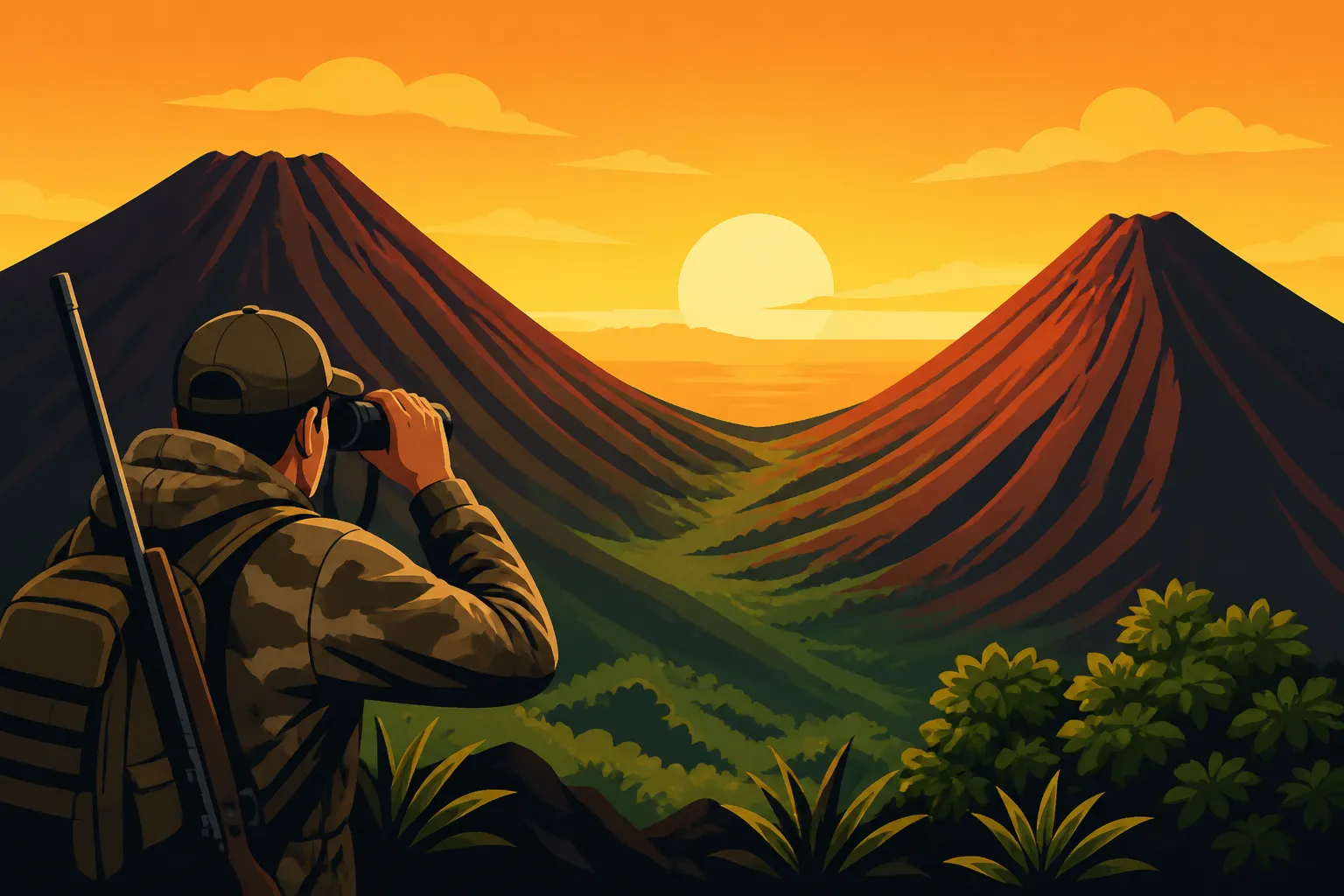
The expansive views often afforded by cinder cone saddles make them ideal for spot-and-stalk hunting, especially for species like Axis deer or Mouflon sheep. The key is to get to a high vantage point – perhaps even a low point on a "Hunting a Cinder Cone Rim" nearby – at first light and spend a significant amount of time glassing. Quality optics are non-negotiable here. Use your binoculars or spotting scope to systematically scan the entire saddle, paying close attention to shaded areas, depressions, and the edges where sparse vegetation might offer cover. Don't rush; animals can blend in incredibly well with the mottled colors of volcanic rock and dry brush.
Once you spot an animal, the stalk begins. The undulating terrain, with its dips and rises, offers surprising amounts of cover. Plan your approach carefully, always staying downwind and using every available fold in the terrain, every rock outcrop, and every clump of vegetation to break up your silhouette. Move slowly and deliberately, pausing frequently to re-evaluate the animal's position and the wind. The challenge is closing the distance without being seen or smelled in such open country. This is where patience truly pays off. Remember the principles of "Spot-and-Stalk Tactics on Open Country" – move like a shadow, use the sun to your advantage, and know when to hold still.
Using Prevailing Winds for Advantage
We've talked about the tricky nature of winds and thermals in saddles, but understanding them allows you to turn them into your greatest asset. Your primary goal is almost always to approach game from downwind. This sounds simple, but in a saddle, it requires constant vigilance. Before you even start your approach, determine the prevailing wind direction and consider how it might shift with rising temperatures.
If the morning thermals are pulling air downslope, you'll want to approach from below the animal, or circle wide to get to their leeward side. If the afternoon thermals are rising, you might need to approach from above. It’s a constant chess match against an invisible force. Carrying a wind checker (a small bottle of scent-free powder) and using it frequently will give you real-time feedback. Sometimes, the best strategy might be to set up on a high point, downwind from a likely travel corridor within the saddle, and wait for animals to move through. This passive approach, especially during those tricky mid-day thermal shifts, can be incredibly effective. Animals are relying on their sense of smell more than ever in these open spaces, so denying them your scent is paramount.
Gear Considerations for Hunting Volcanic Cinder Cone Saddles
Hunting in Hawaii’s cinder cone country isn't like hunting anywhere else. The environment is harsh, beautiful, and unforgiving. Your gear needs to be up to the task, specifically chosen to handle the unique challenges of abrasive terrain, intense sun, and unpredictable weather.
Footwear and Clothing for Abrasive Terrain and Heat
Your feet will take a beating in cinder cone country. The volcanic rock is abrasive and sharp, quickly wearing down soles and punishing ankles. Invest in high-quality, sturdy hunting boots with excellent ankle support and durable, stiff soles. Look for boots designed for mountain hunting or rugged, rocky terrain. I’ve seen countless pairs of less robust boots shredded after just a couple of days on Hawaiian lava and cinder. When "Walking Rough Lava Without Wrecking Your Boots" is a real concern, quality footwear is your best friend.
Clothing should prioritize breathability, sun protection, and durability. Lightweight, quick-drying materials are essential. Long-sleeved shirts and pants will protect you from the sun's intense rays and the scratchy vegetation. While the open country might not seem like it calls for camouflage, muted earth tones or digital camo patterns can help you blend in with the grays, browns, and sparse greens of the volcanic landscape. Even in dry country, a light rain jacket is a good idea; sudden showers are not uncommon, especially if clouds roll in.
Optics and Navigation for Expansive Views
In such open, undulating terrain, good optics are not just helpful, they're absolutely vital. A high-quality pair of binoculars (10x or 12x magnification) will be your primary scouting tool, allowing you to pick apart distant hillsides and depressions for subtle movements or hidden animals. Many hunters also bring a spotting scope (20-60x or higher) for serious long-range glassing, especially if targeting Mouflon sheep that might be far off on a distant lava flow or the higher slopes. "Glassing a Lava Flow for Mouflon Rams" is an art form that demands the best glass you can afford.
For navigation, while a traditional map and compass are always good backups, a reliable GPS unit or a smartphone with a robust hunting app like GoHunt or onX Hunt is invaluable. These apps provide detailed topographic maps, satellite imagery, and can show you your precise location in relation to unit boundaries and known features. With vast, similar-looking cinder cones, it's surprisingly easy to get disoriented, especially during a long stalk. Being able to mark waypoints for your vehicle, water sources, or observed game movement will save you time and prevent you from getting lost. Make sure your devices are fully charged and consider carrying a portable power bank.
Understanding the Unique Habitat of Hawaii's Volcanic Saddles
Hunting these saddles isn't just about the animals; it's about connecting with the raw, untamed beauty of Hawaii's volcanic heartland. These areas are often part of larger ecosystems, sometimes bordering "Hunting Hawaii's High Elevation Alpine Ground" or transitioning into dry kiawe forests, each presenting their own challenges and opportunities. The mix of ancient lava, resilient plant life, and the unique microclimates created by the cinder cones themselves make for an unforgettable hunting experience. Whether you're after the distinctive Axis deer or the majestic Mouflon sheep, mastering the art of hunting these saddles will significantly broaden your horizons as a Hawaii hunter. Just remember to use resources like GoHunt to stay updated on unit regulations and access points, as conditions and rules can change.
| Feature | Cinder Cone Saddle | Dense Rainforest Gulch | Open Ranch Pasture |
|---|---|---|---|
| Visibility | High to moderate | Low | Very high |
| Terrain | Undulating, rocky, abrasive cinder | Steep, wet, thick vegetation | Flat to rolling, soft soil |
| Wind/Thermals | Complex, swirling, directional shifts | Often predictable downslope flow | Consistent, less varied |
| Animal Movement | Funneled, corridor use | Follows trails, stream beds | Scattered, broad grazing |
| Scouting Sign | Scuffs, displaced rock, subtle rubs | Clear tracks, heavy rubs | Clear tracks, distinct browse |
| Stalking Cover | Undulations, rock formations, sparse brush | Very dense vegetation, low visibility | Limited, relies on terrain breaks |
| Key Challenge | Scent control, long-range spotting | Noise, navigating thick cover | Extreme visibility, no cover |
Disclaimer
Please remember that hunting regulations, seasons, and access rules in Hawaii are subject to change by the Department of Land and Natural Resources (DLNR) Division of Forestry and Wildlife (DOFAW). Always consult the most current Hawaii Hunting Regulations and unit-specific rules before planning any hunt. Ensure you have all required licenses and permits. Safety is paramount; be aware of your surroundings, carry appropriate gear, and inform someone of your hunting plans.