How Mouflon and Feral Sheep Interbreed
For anyone who’s spent time hunting the high, windswept slopes of Mauna Kea or the rugged lava flows of the Big Island, you know the sheep hunting in Hawaii isn't always as straightforward as it might seem. We often talk about "Mouflon" and "feral sheep," but the reality on the ground is far more nuanced, creating confusion about what you're actually pursuing and how these distinct populations have blurred over time. This guide will dive deep into the fascinating, and sometimes perplexing, world of how these two types of sheep interbreed here in the islands, and what that means for hunters and conservation efforts.
Understanding the Players: Mouflon and Feral Sheep
Before we can really grasp the dynamics of interbreeding, it's crucial to understand the foundational animals involved: the European Mouflon and the various strains of domestic sheep that have gone wild, becoming what we call "feral sheep" in Hawaii. Each has its own distinct lineage and characteristics, but centuries on the same remote islands have certainly mixed things up.
The European Mouflon's Journey to Hawaii
The European Mouflon (Ovis gmelini musimon) is a majestic wild sheep native to the Mediterranean islands of Corsica and Sardinia. They are recognizable by their reddish-brown coats, lighter saddle patches, and the impressive, curling horns of the rams. These animals were introduced to Hawaii Island in the 1950s, specifically for sport hunting. The idea was to establish a premier big game animal that could thrive in the challenging, high-elevation landscapes.
Initially, these Mouflon were released into fenced enclosures in areas like the Puu Laau region on Mauna Kea's slopes. From there, they eventually spread into the vast, open country, adapting to the unique volcanic terrain and the sparse mamane-naio forest. They are admired for their challenging habitat and keen senses, making them a highly sought-after trophy. If you’ve ever hiked the thin air of the Mauna Kea high country in pursuit of a ram, you know just how tough and rewarding a hunt for pure Mouflon can be.
Hawaii's Diverse Feral Sheep Populations
Feral sheep, on the other hand, have a much less glamorous, but equally significant, history in Hawaii. These are essentially domestic sheep that either escaped from ranches or were deliberately released to fend for themselves generations ago. Over time, these animals reverted to a wild state, developing survival instincts and physical traits better suited for the rugged Hawaiian environment.
Historically, various breeds of domestic sheep, including Merinos, Rambouillets, and even some hardy "hair sheep" types, were brought to Hawaii by early settlers and ranchers. Many of these animals eventually found their way into the wild, especially on the Big Island. Unlike Mouflon, feral sheep display a huge variety in their appearance – some are entirely woolly, others are hair sheep with little to no wool, and their coats can range from white to black, brown, or spotted. Their horns, if present, are often less symmetrical or impressive than a true Mouflon's, though some feral rams can grow quite substantial headgear. These sheep often occupy slightly lower elevations or more brushy areas than the high-climbing Mouflon, though their ranges do overlap significantly.
The Genetic Mix-Up: How Interbreeding Happens
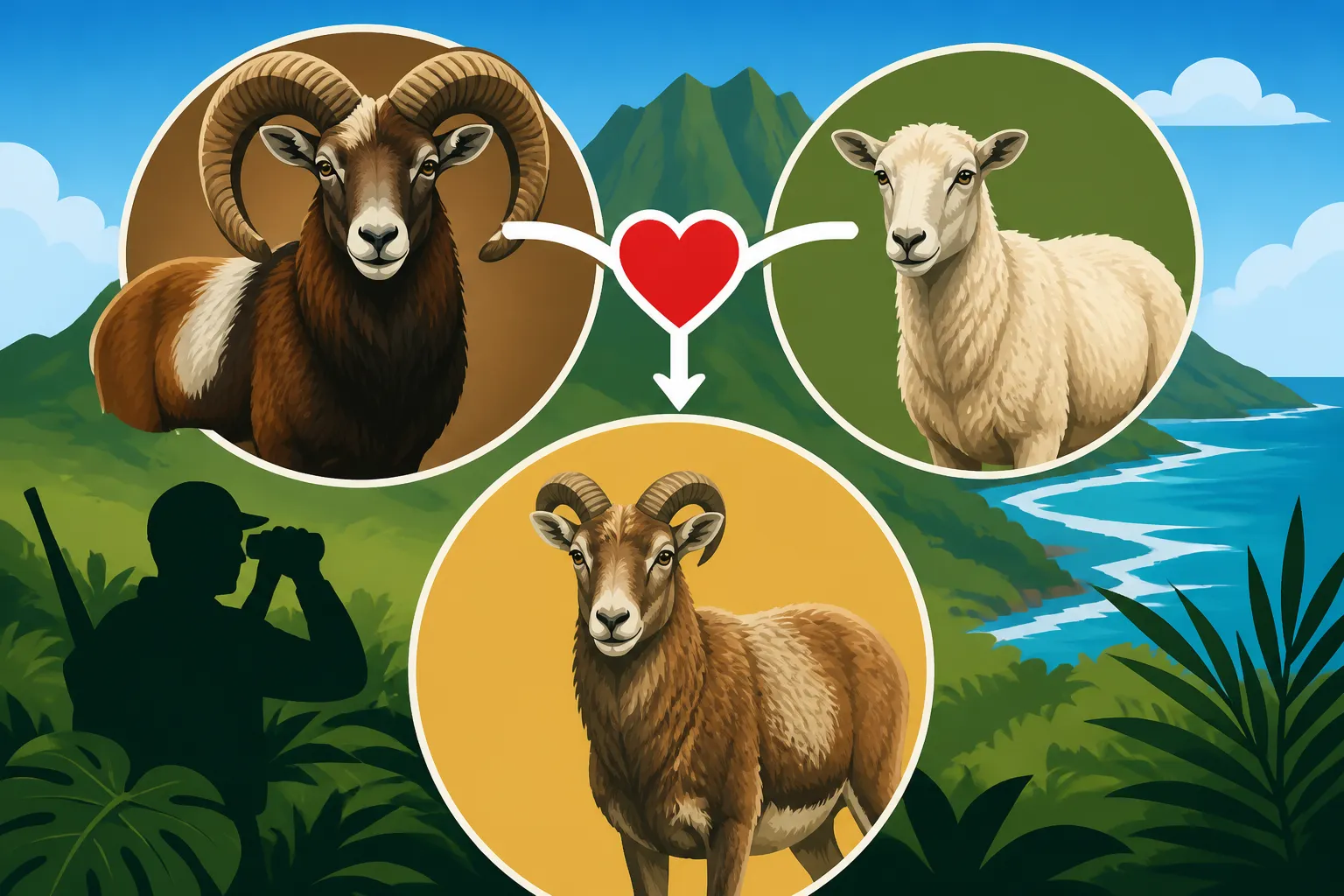
The simple truth is, when you put two genetically compatible species of sheep in the same environment for decades, they're going to get together. This is precisely what has happened on Hawaii Island, leading to a fascinating and sometimes confusing array of hybrid sheep.
Overlapping Territories and Breeding Opportunities
The primary driver for interbreeding is the shared habitat. While pure Mouflon tend to prefer the higher, drier, and rockier slopes of Mauna Kea, and feral sheep might linger in slightly lower, brushier areas, their ranges are far from exclusive. Especially during certain times of the year, or due to environmental pressures like drought, these populations can converge on common feeding grounds, water sources, or sheltered areas. When the breeding season arrives, rams and ewes from both groups will readily interact, leading to successful cross-breeding.
Imagine a large feral ram, perhaps with a sturdy build and a shaggy coat, encountering a sleek Mouflon ewe in a remote gulch. Nature doesn't check pedigrees; if they are reproductively viable and in proximity, they will breed. This natural inclination to propagate means that any fences or perceived ecological boundaries quickly become irrelevant in the face of biological imperative. It’s not uncommon to see mixed herds, with animals displaying a wide range of characteristics, moving across the same lava flows and open pastures that define so much of Hawaii's unique hunting grounds. This genetic exchange is a continuous process, creating a dynamic and evolving sheep population.
Genetic Compatibility and Hybrid Vigor
Mouflon and domestic sheep are highly genetically compatible, meaning they can produce fertile offspring. This isn't always the case with different species, but in the world of sheep, it's a common occurrence. The offspring of these crosses are often viable and, in some cases, can even exhibit what's known as "hybrid vigor"—a phenomenon where the mixed-breed animal is stronger, healthier, or more adaptable than either parent.
These hybrid sheep can then go on to breed with either pure Mouflon, pure feral sheep, or other hybrids, leading to a complex genetic mosaic. You might encounter a ram that has the horn shape of a Mouflon but the patchy white coat of a domestic sheep, or one with the body size of a large feral ram but the distinctive saddle patch of a Mouflon. This genetic fluidity is part of what makes hunting these sheep so interesting, but it also presents challenges for wildlife managers trying to maintain purebred populations or manage specific characteristics. The resulting mix can be tough and resilient, a true product of the rugged Hawaiian landscape.
Impact on Hunting and Conservation
The interbreeding between Mouflon and feral sheep has significant implications for both hunters and conservationists. It affects how the species are managed, how permits are allocated, and even how hunters perceive and pursue their quarry.
Management Challenges for DOFAW
The Hawaii Department of Land and Natural Resources (DLNR), specifically its Division of Forestry and Wildlife (DOFAW), faces a complex task in managing these mixed populations. Originally, the goal was often to establish pure Mouflon populations for sport. However, the widespread hybridization makes it incredibly difficult to define and manage distinct "Mouflon" or "feral sheep" hunting seasons in many areas.
DOFAW often aims to reduce the overall sheep population in certain zones to protect native mamane-naio forests, which are critical habitat for endangered bird species like the palila. In these contexts, the genetic purity of the sheep becomes less important than the ecological impact of their grazing. Therefore, hunting regulations, such as those for Hawaii Game Mammal Seasons, often treat all sheep on the Big Island under a broader "sheep" category, though specific units might have differing designations or goals. The ongoing legal battles and conservation efforts around The Palila and Mauna Kea's Sheep further complicate these management strategies, often leading to aerial control programs aimed at reducing sheep numbers across the board.
Identifying Hybrid Sheep in the Field
For hunters, recognizing the signs of hybridization can be part of the challenge and excitement. While a truly purebred Mouflon ram will have a very consistent reddish-brown coat, a distinct light saddle patch, and symmetrical, heavily-ridged horns that sweep back and then curl forward, a hybrid might show a blend of these traits.
When you're out glassing a lava flow for Mouflon rams, keep an eye out for these variations:
- Coat Color and Pattern: A pure Mouflon is typically uniform in color, aside from the saddle patch. Hybrids might have white patches, be completely white, black, or pied (two-toned). You might see a mostly Mouflon-colored animal with distinct domestic sheep markings on its legs or belly.
- Horn Shape and Texture: While Mouflon rams have that classic, tight curl, hybrids can have horns that are straighter, more divergent, or less massive. Some might even resemble the corkscrew horns seen in some domestic breeds. Horn texture might be smoother, lacking the deep annulations of a pure Mouflon. Judging a Mouflon ram's horn curl is a critical skill for any hunter seeking a true trophy.
- Body Conformation: Feral sheep often have a stockier build than the leaner, more athletic Mouflon. Hybrids might show an intermediate body type.
This table provides a quick visual guide to help distinguish between the primary types you might encounter:
| Trait | Pure Mouflon Ram | Pure Feral Sheep Ram (Common) | Common Hybrid Sheep Ram |
|---|---|---|---|
| Coat Color | Reddish-brown, light saddle patch, white belly/muzzle | Highly variable: white, black, brown, spotted, woolly or hairy | Mix of Mouflon and feral colors; often patchy, broken saddle |
| Horn Shape | Tight, backward-sweeping curl, tips forward, ridged | Variable: straighter, wider, corkscrew, or absent, less ridged | Variable: Mouflon-like curl but looser, wider, or with domestic traits |
| Horn Mass/Texture | Heavy, deeply ridged | Lighter, smoother, or with less defined ridges | Intermediate, can vary widely |
| Saddle Patch | Distinct, light-colored, on back | Absent | Often present but faded, broken, or irregular |
| Body Size/Build | Lean, muscular, agile | Stockier, sometimes heavier or more "blocky" | Can be intermediate, sometimes exhibiting hybrid vigor |
| Wool Coverage | Short hair, no wool | Can be heavily woolly, partially woolly, or entirely hair-coated | Variable, often sparse wool or mixed hair/wool |
When you're out in the field, sometimes the only way to be sure is by observing the animal for a good period or comparing it against clear examples. Resources like GoHunt can provide useful visual references and help you research specific unit characteristics before you head out. Ultimately, whether it's a pure Mouflon or a hybrid, any sheep taken in Hawaii represents a hard-earned trophy from a truly unique hunting landscape.
Conservation Perspectives on Hybridization
From a conservation standpoint, the interbreeding of Mouflon and feral sheep presents a dual-edged sword. On one hand, the hybridization can dilute the genetic purity of the introduced Mouflon, which was intended to be a distinct game species. This loss of genetic distinction can be concerning for some wildlife managers who prioritize species integrity. On the other hand, the primary concern in Hawaii's high-elevation ecosystems is the impact of all ungulates on fragile native plants and endangered bird habitat, particularly the mamane tree for the critically endangered palila.
Therefore, many conservation efforts focus on overall population control rather than the specific genetic makeup of each sheep. The goal is to reduce grazing pressure to allow native vegetation to recover. Hunting plays a vital role in this, and whether a ram is pure Mouflon, a feral sheep, or a hybrid, its removal contributes to the broader conservation objectives. When considering the delicate balance of these ecosystems, understanding how Mouflon and Feral Sheep Hybrids fit into the larger picture is essential for appreciating the management challenges in paradise. Hawaii's Feral Sheep on the Big Island are often a target for hunters, and their removal benefits the environment regardless of their genetic mix.
The Future of Sheep Hunting in Hawaii
The dynamic interplay between Mouflon and feral sheep, and their subsequent interbreeding, ensures that sheep hunting in Hawaii will always be a unique and evolving experience. Hunters will continue to encounter a fascinating spectrum of animals, from those that closely resemble the classic Mouflon to those that are clearly a blend of domestic and wild genetics.
Hunter Opportunities and Expectations
For hunters, this means approaching each sheep hunt with an open mind. While some may prioritize seeking a "pure" Mouflon ram, others might simply appreciate the challenge of pursuing any wild sheep in Hawaii's stunning, rugged terrain. The diversity of the sheep population means that every animal taken can be a distinctive trophy, reflecting the complex genetic history of the islands. Whether you're hunting Mouflon in Mauna Kea's Thin Air or focusing on other high-elevation opportunities, the experience is truly one-of-a-kind.
Understanding that many animals you encounter will likely have some degree of hybridity can help manage expectations and deepen appreciation for the hunt. It's about the adventure, the glassing, the stalk, and the satisfaction of a successful harvest in such an incredible place. Familiarizing yourself with Hawaii's Hunting Units and How They Work, especially those on the Big Island, will better prepare you for the variety of sheep you might encounter.
The Role of Research and Adaptive Management
As research into population genetics continues, wildlife managers will gain even deeper insights into the extent and impacts of hybridization. This knowledge will inform adaptive management strategies, which might involve targeted removal efforts in specific areas or adjustments to hunting seasons and bag limits. The ongoing commitment to protecting Hawaii's native ecosystems means that game species, regardless of their genetic background, will continue to be managed to minimize their environmental footprint.
Hunters often contribute directly to these efforts by providing valuable harvest data, which helps DOFAW monitor populations. Engaging with organizations that support ethical hunting and conservation in Hawaii can also help ensure that the unique hunting opportunities for sheep remain viable for future generations, allowing us to continue to appreciate the fascinating mix of Mouflon and feral sheep that roam these incredible islands. Ultimately, how Mouflon and feral sheep interbreed is a story still being written, one ram and ewe at a time, on the wild slopes of Hawaii.
Disclaimer
This article is for general informational purposes only and does not constitute professional advice. Laws, prices and regulations vary by location and change over time. Consult a qualified professional for guidance on your specific situation.