Rain Gear for a Windward Hawaii Hunt
Oh, the windward side of Hawaii! If you've ever planned a hunt on the Big Island near Hilo, or hiked into the deeper gulches of Maui or Oahu, you know that "rainy season" can feel like "all season." One of the biggest frustrations for hunters here is having rain gear that simply can't keep up with the persistent, often heavy, and always humid downpours. You end up soaked from the outside and the inside, feeling miserable and sometimes even cutting your hunt short. This guide is all about helping you choose and manage the right rain gear to stay as dry and comfortable as possible, even in Hawaii's most notoriously wet hunting grounds.
Why Hawaii's Windward Rain is Different
When folks from the mainland think about rain, they often picture a sudden downpour, maybe a drizzle, and then it clears. In Hawaii, especially on the windward sides of our islands, rain can be a whole different beast. It's not just about getting wet; it's about staying wet, staying humid, and battling the unique challenges our tropical climate throws at your gear.
The Perpetual Drip: What "Windward" Really Means for Weather
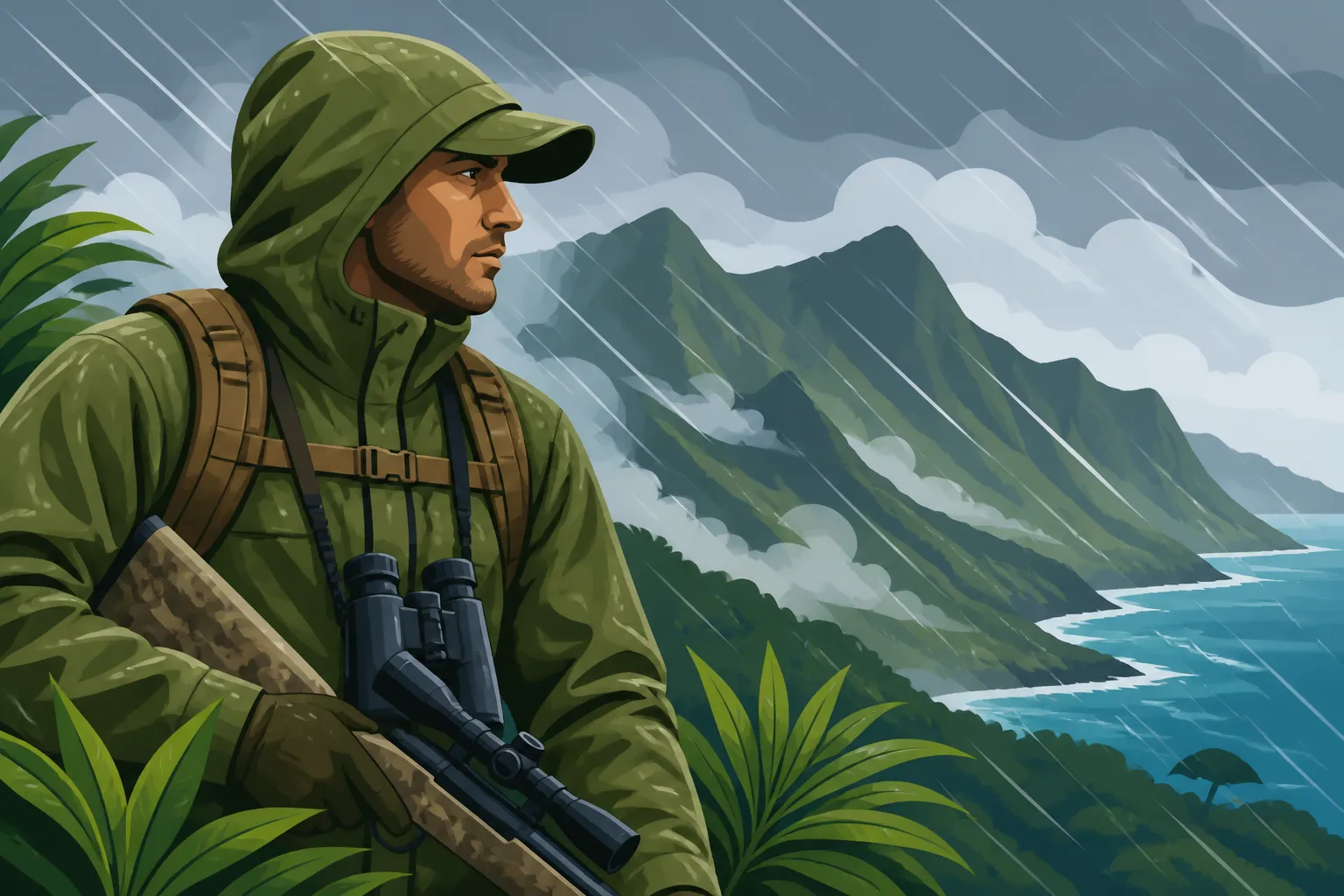
Imagine standing under a faucet that's constantly dripping, sometimes turning into a steady stream. That's a good mental image for hunting the windward side. These areas, exposed to the prevailing trade winds, intercept moisture-laden clouds straight from the ocean. They condense against the mountains, leading to frequent, often relentless precipitation. It's not always a torrential downpour, but it's rarely completely dry. You might experience mist so thick it feels like rain, followed by actual heavy showers, then back to a persistent drip from the canopy above. This constant moisture means your gear is always working, and any weak points will quickly be exposed. If you're Hunting Pigs in Hawaii's Rainforest Gulches or even stalking game birds in a wet forest, your gear needs to be up to the challenge of prolonged saturation, not just a passing shower.
Humidity and Heat: The Sweat Factor
This is where Hawaii really differs from hunting in colder, wet climates. Even when it's raining, the air temperature can be warm, often in the 70s or 80s Fahrenheit, with humidity levels pushing 90% or higher. This creates a terrible paradox: you need to keep the rain out, but your body is still generating heat and sweat. If your rain gear isn't breathable, that sweat has nowhere to go. It condenses on the inside of your waterproof shell, making you feel just as wet from your own perspiration as you would from the rain. You'll hear hunters here talk about "wetting out" from the inside – it's a real struggle. This factor demands rain gear that's not only waterproof but also highly effective at venting moisture vapor away from your body.
Vegetation and Terrain Challenges: Scratchy and Muddy
Hawaii's dense, often thorny vegetation, coupled with its volcanic and muddy soils, presents another layer of challenge for rain gear. A simple walk through a guava thicket or a kiawe forest on a wet day can tear flimsy rainwear to shreds. Think about navigating a Hawaii Gulch System after a heavy rain: you're pushing through wet, abrasive branches, sliding down muddy banks, and possibly even wading through shallow streams. Your rain pants, in particular, need to be exceptionally durable to withstand this kind of abuse. Seams get stressed, fabrics get scraped, and zippers get caked with mud. The mud itself can also degrade zippers and coatings over time if not properly cared for. You need gear that's built to take a beating, not just deflect water.
Choosing Your Rain Jacket: The Outer Shell
Your rain jacket is arguably the most critical piece of rain gear. It's your primary shield against the elements, and in Hawaii, it needs to perform a delicate balancing act between keeping water out and letting sweat escape.
Waterproof-Breathable Technology: Beyond "Water Resistant"
Forget anything labeled merely "water resistant." That's fine for a light mist, but for a true Hawaii windward hunt, you need full-on "waterproof-breathable" technology. This means the fabric is designed with a membrane that has pores small enough to block liquid water molecules (rain) from entering, but large enough to allow water vapor molecules (sweat) to escape. Brands use various proprietary membranes, but the most well-known is GORE-TEX. Other reputable options include eVent, Pertex Shield, and various in-house technologies from outdoor apparel companies.
When selecting, look at the "mm" rating for waterproofing and the "g/m2/24hr" rating for breathability. Higher numbers generally mean better performance, but there's always a trade-off with durability and price. For Hawaii's tropical downpours and high humidity, prioritize breathability as much as waterproofing. A jacket that's completely waterproof but doesn't breathe will just make you feel like you're in a sauna. Consider a 3-layer construction, where the membrane is sandwiched between a durable outer fabric and a protective inner lining, as this tends to be the most robust and breathable for demanding conditions.
Features That Make a Difference: Zips, Hoods, and Cuffs
The devil is in the details when it comes to rain jackets:
- Pit Zips: These are non-negotiable for Hawaii. Long zippers under the arms allow you to dump excess heat and humidity quickly without having to take off your jacket. When you're Hunting Pigs on Hawaii's Wet Windward Side, hiking up a steep incline, you'll be sweating even in the rain, and pit zips are your best friend for ventilation.
- Adjustable Hood: A good hood should move with your head, not obscure your peripheral vision. Look for hoods with multiple adjustment points (around the face, crown, and volume) so you can cinch it down snugly in driving rain or loosen it for better visibility when the rain eases. A stiff brim helps keep rain off your face and glasses.
- Waterproof Zippers and Storm Flaps: All zippers, especially the main front zipper, should be either waterproof (laminated and sealed) or protected by a substantial storm flap to prevent water ingress.
- Adjustable Cuffs: Cuffs that can be tightly cinched with Velcro or similar closures prevent water from running down your arms and into your gloves or sleeves.
- Pockets: Ensure pockets are zippered and ideally positioned to stay dry under your pack straps. Napoleon pockets (chest pockets) are often good for this.
Durability vs. Packability: Finding the Right Balance
You want a jacket that can stand up to the rigors of the Hawaiian bush, but you also don't want to carry a bulky, heavy garment if you're doing a lot of hiking.
- Heavy-Duty Shells: These are made with thicker, more abrasion-resistant face fabrics. They'll be heavier and less compressible, but they'll shrug off thorns and scrapes much better. If you anticipate heavy bushwhacking or are prone to tearing gear, this might be worth the extra weight.
- Lightweight, Packable Shells: These are designed to be extremely light and compress down to a tiny package, making them easy to stash in your pack. They're great for hunts where rain is possible but not guaranteed, or where you prioritize speed and agility. However, their thinner fabrics are more susceptible to tears from sharp branches or lava rock.
For most Hawaii hunters, a mid-range option that balances durability with reasonable weight and packability is ideal. You're looking for a good all-around performer that won't leave you feeling like you're wearing a trash bag or a suit of armor.
Beyond the Jacket: Protecting Your Entire Body
A great rain jacket is only half the battle. Your legs, feet, and head are equally vulnerable to the pervasive moisture of a windward Hawaii hunt. Neglecting these areas will quickly lead to discomfort and potential hypothermia, even in our warm climate.
Rain Pants That Actually Work: Full Zips and Tough Fabrics
Just like your jacket, your rain pants need to be waterproof-breathable. However, they face even more abuse from dense undergrowth and muddy terrain.
- Full-Length Side Zippers: These are incredibly useful. They allow you to pull your rain pants on and off without removing your boots, which is a huge convenience when the weather changes suddenly. They also provide massive ventilation when partially unzipped, helping to manage that internal sweat factor when you're hiking hard.
- Durable Face Fabric: Look for pants with reinforced knees and seat, or generally thicker fabric throughout. You'll be kneeling, sitting, and pushing through brush, so resistance to abrasion is key. Ripstop nylon is a good feature to look for.
- Adjustable Waist and Cuffs: A comfortable waist that can be adjusted to fit over your regular hunting pants is important. Cuffs that can be cinched down over your boots will prevent water from splashing up inside.
- Weight vs. Durability: Again, find a balance. Lightweight rain pants are great for packing, but might not hold up to repeated encounters with thorny Hunting a Kiawe Flat for Axis Deer. A slightly heavier, more robust pair will be a better investment in the long run for Hawaii's tough conditions.
Footwear for the Wet Jungle Floor: Staying Dry From the Ground Up
Your feet are often the first to get wet, and once they're soaked, the hunt can become miserable. This is where waterproof boots truly shine.
- Waterproof Boots: Invest in high-quality waterproof hunting boots. Look for boots with a Gore-Tex or similar waterproof membrane. They should be tall enough to handle shallow stream crossings and deep mud, typically 8-10 inches.
- Traction: Hawaii's wet terrain is notoriously slippery. The lava rock, slick mud, and decaying leaves demand aggressive lug patterns on your boot soles for maximum grip. A good pair of boots will have deep, multi-directional lugs to prevent slips and falls on the often treacherous trails. Boots for Hawaii Lava and Wet Forest are absolutely essential.
- Gaiters: Consider adding waterproof gaiters, especially if your rain pants don't fully cover the top of your boots or you're walking through tall, wet grass. They act as an extra barrier, preventing water, mud, and debris from entering your boots from above.
Head and Hand Protection: Keeping the Extremities Dry
Don't forget your head and hands! These areas, when wet and cold (even in relative warmth), can significantly impact your comfort and dexterity.
- Waterproof Brimmed Hat: While your jacket hood is crucial, a separate waterproof hat with a brim offers an extra layer of protection, keeping rain off your face and improving visibility. It also prevents water from running down your neck when you pull your hood back.
- Lightweight Waterproof Gloves: In humid, wet conditions, your hands can get clammy and lose grip, especially if you're handling a rifle or bow. Thin, waterproof gloves provide insulation, improve grip on wet surfaces, and keep your hands from getting waterlogged. Look for models that still allow good dexterity.
Strategic Layering and Gear Care in a Wet Environment
Having the right rain gear is crucial, but how you use it and care for it determines its effectiveness and longevity. In Hawaii's unique climate, strategic layering and diligent maintenance are not just suggestions – they're necessities for a successful hunt.
The Foundation: Moisture-Wicking Base Layers
This might sound counter-intuitive when talking about rain gear, but your base layer is arguably just as important as your outer shell, especially in Hawaii's humidity.
- Avoid Cotton at All Costs: Cotton absorbs moisture and holds it against your skin, making you feel cold and clammy even in warm temperatures. Once wet, cotton loses all insulating properties and takes forever to dry. It's a recipe for misery and potential hypothermia, even at 70 degrees Fahrenheit, due to evaporative cooling.
- Embrace Synthetics or Merino Wool: These materials are designed to "wick" moisture (sweat) away from your skin and transfer it to the outer layers where it can evaporate.
- Synthetics (polyester, nylon): Excellent at wicking, quick-drying, durable, and generally more affordable. They can sometimes retain odors more than merino.
- Merino Wool: Superb at wicking, naturally odor-resistant, and provides warmth even when damp. It's also incredibly soft. However, it's generally more expensive and less durable than synthetics against heavy abrasion.
Choosing a good base layer will keep your skin dry, regulate your body temperature, and prevent that miserable clammy feeling when you're exerting yourself in the rain.
Keeping Your Essentials Dry: Dry Bags and Pack Covers
Your rain gear protects you, but what about your other essentials? In Hawaii, assume everything will get wet unless it's specifically protected.
- Internal Dry Bags/Stuff Sacks: This is your best defense. Line your backpack with a large, heavy-duty dry bag, or use multiple smaller dry bags to organize and protect critical items like extra clothing, first-aid kit, wallet, phone, and food. Even if your pack has a "rain cover," rain can still soak through zippers and seams. Think about Packing Meat Out of a Hawaii Gulch – you'll need a dry pack for your tools and personal items as well.
- Waterproof Pack Cover: While not a substitute for internal dry bags, a good pack cover adds an extra layer of protection, especially for the exterior of your pack. It also helps keep mud and grime off your main pack fabric. Ensure it fits snugly and is made of durable, waterproof material.
- Waterproof Cases: For electronics like GPS devices, rangefinders, or phones, consider a dedicated waterproof case or pouch. Modern phones are often water-resistant, but a full waterproof case provides peace of mind.
| Feature | Synthetics (e.g., Polyester) | Merino Wool | DWR (Durable Water Repellent) Coating | Membrane (e.g., Gore-Tex) |
|---|---|---|---|---|
| Primary Function | Moisture-Wicking | Moisture-Wicking/Warm | Water Beading/Shedding | Waterproof/Breathable |
| Key Benefit | Dries fast, durable, affordable | Odor control, warm when wet | Prevents fabric saturation | Full protection from rain |
| Hawaii Relevance | Essential base layer | Excellent base layer | Crucial for outer shell performance | The core of rain gear |
| Longevity | Very good | Good, less abrasion resistant | Wears off, needs reapplication | Varies by care and quality |
| Maintenance | Easy to wash | Gentle wash recommended | Regular reapplication needed | Specific cleaning/retreating |
Maintaining Your Gear's Performance: Cleaning and Re-treating
Even the best rain gear won't perform optimally if it's neglected. Proper care is essential for extending its life and maintaining its waterproof-breathable properties.
- Regular Cleaning: Mud, dirt, sweat, and insect repellent can clog the pores of your waterproof-breathable membrane and degrade the Durable Water Repellent (DWR) coating on the outer fabric. Follow the manufacturer's instructions, but generally, use a technical wash specifically designed for waterproof fabrics (like Nikwax or Granger's). Avoid harsh detergents, fabric softeners, and bleach.
- Reactivating and Reapplying DWR: The DWR coating is what makes water bead up and roll off your jacket. Over time, it wears off, causing the fabric to "wet out" (absorb water), which reduces breathability and makes you feel colder. After cleaning, you can often reactivate the DWR by tumble drying your garment on a low-heat setting. When the DWR is no longer effective, even after washing and drying, you'll need to reapply it using a spray-on or wash-in DWR treatment product. This step is critical for your gear's performance in Hawaii's persistent rain.
- Proper Storage: Store your clean, dry rain gear in a cool, dry place. Avoid compressing it tightly for long periods, as this can damage the membrane. Never store wet or damp gear; it will quickly develop mildew, which can permanently damage the fabric and cause unpleasant odors.
Investing in quality rain gear and taking the time to care for it will make a world of difference on your Hawaii hunting adventures. You'll be more comfortable, stay warmer, and be able to focus on the hunt itself, rather than battling the elements.
Disclaimer
This article is for general informational purposes only and does not constitute professional advice. Laws, prices and regulations vary by location and change over time. Consult a qualified professional for guidance on your specific situation.