When a Tag Can Come Off the Carcass
The thrill of a successful hunt in Hawaii is something truly special, but that excitement can quickly turn to anxiety when you start thinking about all the rules you need to follow after the shot. One of the biggest head-scratchers for many hunters, especially those new to the islands or hunting big game, is exactly when you're allowed to remove that precious tag from your hard-won animal. It’s a crucial detail that can mean the difference between a clean hunt and a citation, and nobody wants that kind of headache after all their hard work. This guide will walk you through the specifics of Hawaii's tagging regulations, ensuring you know exactly when your tag needs to stay put and when it can finally come off.
The Initial Requirement: Tagging at the Kill Site
Let's start at the very beginning, right after you've harvested your animal. This is perhaps the most critical moment for proper tagging, and getting it wrong here can set you up for problems down the line. Hawaii's regulations are pretty clear on this point, leaving little room for interpretation.
Understanding Hawaii's Immediate Tagging Mandate
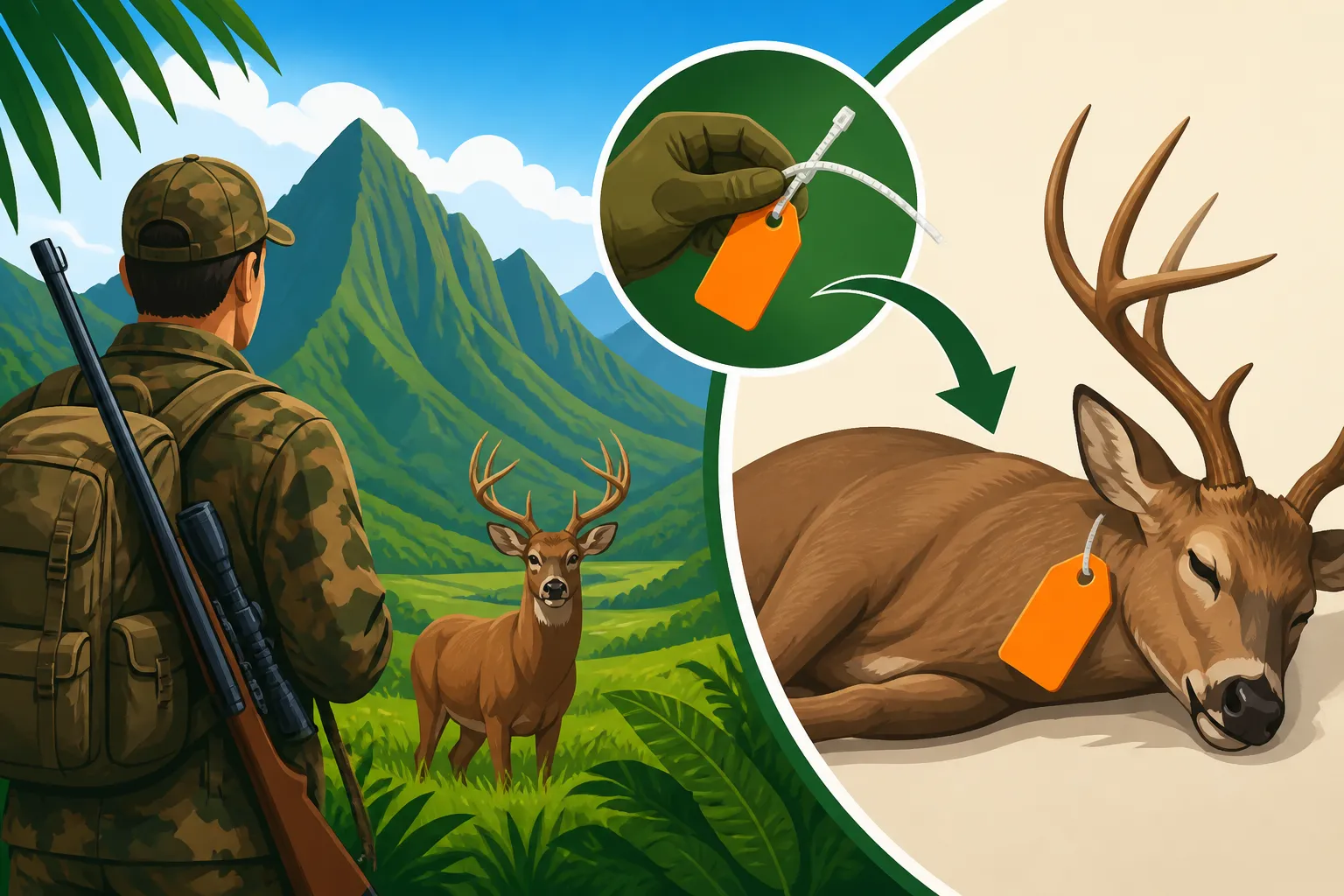
The law in Hawaii is unambiguous: once you've downed a game mammal that requires a tag – think Axis deer, Mouflon sheep, or Black-tailed deer on Kauai – that tag needs to be immediately affixed to the carcass. This isn't a suggestion; it's a legal mandate. The intent behind this rule is simple: to ensure accountability and prevent the illegal taking of multiple animals under a single tag. Imagine the chaos if hunters could wait until they got back to camp, or even worse, back home, to tag their kill! It would be nearly impossible to enforce bag limits or prevent poaching.
This immediate tagging requirement can feel like a rush, especially when you're still processing the excitement of the hunt or dealing with a challenging recovery. You might be deep in a gulch, far from your pack, or it might be pouring rain, but the rule stands. It's a fundamental part of responsible hunting here. If a conservation officer were to encounter you with an untagged animal, even if you’re just a few feet from where it fell, you could face significant penalties. This isn't just a minor infraction; it's taken seriously, and for good reason. It's best to have your tag, a pen, and a method to attach it (like zip ties or string) readily accessible so there’s no delay. I always suggest having a spare tag and pen too, just in case.
Proper Placement of the Hawaii Tag
So, you've got your animal, your tag is in hand, and you're ready to make it official. But where exactly does that tag go? Hawaii's regulations specify that the tag must be securely attached to the carcass in a visible manner. Generally, for most big game species, the preferred spot is through a hock tendon on one of the hind legs. This location is usually robust enough to prevent the tag from tearing off easily, and it’s typically accessible during field dressing. For animals with antlers, like an Axis buck, some hunters might be tempted to secure it to the antlers, and while this might seem logical, the hind leg is generally the most secure and universally accepted placement according to most local guides and regulations. The main thing is that it is firmly attached and visible.
You'll usually receive a paper or durable synthetic tag. Make sure you use a waterproof pen to fill out all the required information, such as the date, time, and specific hunting unit. You don't want a sudden downpour to render your tag illegible. Many hunters opt for sturdy zip ties to attach the tag, as they hold up well to the elements and rough handling. Make sure the tag is tight enough that it won't slip off, but not so tight that it damages the leg or makes it impossible to remove later. The goal is to ensure that if a conservation officer inspects your kill, they can easily verify all the necessary information. Remember, the integrity of the tag, and the information on it, is your proof of legal harvest. For more details on this critical step, you can always refer to guidance on topics like How to Attach a Hawaii Tag to a Carcass.
When the Tag Must Remain Attached
The journey from the kill site to your freezer isn't always a straight line, and throughout that process, your tag plays a vital role in legal compliance. There are several key stages where the tag absolutely must stay on the carcass.
Transporting Game from the Field to the Vehicle
Once you’ve field-dressed your animal, the next step is often getting it back to your truck, ATV, or even home. Whether you're carefully packing out your game piece by piece from a remote gulch after a long Still-Hunting Pigs in Hawaii's Wet Forest adventure, or just dragging it a short distance to a nearby road, the tag needs to stay with the animal. Even if you decide to quarter your animal in the field – a common practice here due to the heat and rough terrain – the tag must remain with a substantial portion of the carcass. Typically, this means it stays with the largest piece, often a hindquarter or the torso, until you reach your vehicle.
This is where common sense and adherence to the spirit of the law come in. The tag’s purpose is to identify your legally harvested animal. If you remove it too early, you could accidentally make it look like you're trying to hide something or that you've got an extra untagged animal. It's always better to err on the side of caution. Even if you're carrying out multiple trips to retrieve all the meat, the portion bearing the tag should be the first one to be secured or kept in sight. Think of the tag as the animal's official passport during its journey from the wild to your cooler. It needs to be present for every leg of that trip until it reaches its final processing destination.
Transporting on Public Roads and Between Units
Once you've loaded your animal into your vehicle, the tag's job isn't done. The regulations stipulate that the tag must remain attached and visible while the animal is being transported on public roads or moved between different hunting units. This is particularly important for hunters who might be traveling a significant distance, say from the slopes of Mauna Kea after a Mouflon Sheep Hunting on Hawaii Island trip, all the way back to Hilo or Kona.
Imagine driving through town, stopping for gas, or even picking up a celebratory meal. If your game animal is visible in the back of your truck or on a hitch carrier, the tag serves as immediate proof that it was legally harvested. Conservation officers conduct routine checks, and seeing a properly tagged animal makes their job, and your life, much easier. You don't want to be pulled over and have to explain why your pig or deer isn't tagged, only to point to a tag in your pocket. The tag needs to be on the animal. This rule ensures that harvested game can be easily identified as legal, preventing any confusion or suspicion of unlawful activity. It's also part of the broader system that includes Checking In and Out of Hawaii Hunting Units, where your harvest might be visually confirmed by a DOFAW agent.
Checking In and Out of Hunting Units
Hawaii's public hunting units often have specific check-in and check-out procedures, either at physical hunter check stations or through digital platforms like the OuterSpatial App to Check In. When you're exiting a unit with a harvested animal, the tag must be firmly attached to the carcass. This is often the point where your tag might be inspected by a Department of Land and Natural Resources (DLNR) Division of Forestry and Wildlife (DOFAW) official.
These check-out points are crucial control measures. They allow DOFAW to gather harvest data, monitor hunting pressure, and ensure hunters are complying with all regulations, including bag limits and proper tagging. If you arrive at a check station or are contacted by an officer while leaving a unit, they will typically ask to see your hunting license (like your Hawaii Hunting Licenses and What They Cost) and inspect your harvested animal, confirming the tag is correctly filled out and attached. Attempting to check out an untagged animal, or one with an improperly filled-out tag, can lead to serious legal consequences, including fines and the potential confiscation of your game. The tag is your proof that you followed the rules and respected the privilege of hunting in Hawaii.
The Specific Circumstances for Tag Removal
This is the big question, the one that causes the most confusion: when can you finally take that tag off? After all the care and effort you've put into keeping it secured, there comes a time when it can legitimately be removed.
Processing the Animal for Storage or Consumption
The golden rule for tag removal in Hawaii revolves around the processing of the animal. Generally, the tag can be removed once the animal has reached its final destination for butchering, dismemberment, or taxidermy preparation, and is no longer identifiable as a whole or transportable carcass. This means when you get your game back to your home, a local butcher shop, or a dedicated game processor, and you begin the process of breaking it down into individual cuts of meat or preparing it for a mount.
Think of it this way: as long as the animal's identity as a single, whole game mammal (or major portion thereof, like a halved carcass) is intact and being transported, the tag needs to be on. Once you start quartering it into smaller cuts like steaks, roasts, or ground meat, or you're caping it out for a taxidermist, the original "carcass" as defined by transport regulations no longer exists in the same way. At this point, the individual pieces of meat are typically stored in coolers, freezers, or packed for further transport (like if you're planning on Shipping Game Meat Between Hawaii Islands), and the tag's primary function of identifying the whole animal during transport is fulfilled.
Many hunters choose to keep the tag with the main hide or the head/antlers if they're pursuing a trophy, or simply file it away as a record of their successful hunt. But once the knife starts truly breaking down the carcass into smaller, unidentifiable parts that no longer resemble the whole animal for transport purposes, the tag can safely come off. The key is that the animal is no longer in a state where it could be mistakenly perceived as an untagged, illegally harvested whole carcass in transit.
What to Do With the Removed Tag
So, you've removed the tag. Now what? Can you just toss it? While there might not be a specific regulation detailing the disposal of a spent tag, it's generally a good idea to keep it, at least for a little while. Many seasoned hunters will either store the tag as a memento of their hunt, especially if it was a significant animal, or keep it until all the meat from that animal has been consumed. This provides an additional layer of personal record-keeping, should any questions arise much later down the line.
Some hunters even keep a log of their harvests, attaching the tag or its number to their personal records, including details like the weight of the animal, the unit it was harvested from, and the specific date. This is an excellent practice for contributing to future harvest reporting requirements, which can be an important part of your responsibility as a hunter. Remember, transparency and good record-keeping are always your friends when dealing with regulations. While you're preparing your game for consumption, don't forget important steps like Cooling Meat Fast on a Hawaii Hunt to ensure the best quality venison.
Navigating Common Misconceptions and Best Practices
Hawaii's unique hunting environment and regulations can sometimes lead to misunderstandings. Let's clear up a few common points and establish some best practices to ensure your hunting experience is smooth and compliant.
The "Trophy" Exception and Head-Keeping
A common question, especially for those pursuing a beautiful Axis buck or a impressive Mouflon ram, is about keeping the head or antlers as a trophy. Does this change the tagging rules? The short answer is, not really for the initial tagging and transport phase. Your tag still needs to be on the main carcass as it's transported out of the field and back home or to a processor.
Once you reach the point of processing, and you decide to cape out the animal to preserve the head and antlers, that's when the "carcass" effectively transforms. At this stage, the tag can be removed from what remains of the body. However, many hunters will then often attach the original tag (or a copy of the tag number) directly to the skull or cape of the trophy. This isn't a legal requirement for the skull once it's separated from the meat-bearing portions for personal processing, but it's a very smart practice for record-keeping and for demonstrating proof of legal take, especially if you're taking it to a taxidermist. It provides a clear lineage for your trophy, from the field to your wall.
When in Doubt, Keep It On
If you're ever in a situation where you're unsure whether it's okay to remove the tag, the safest bet is always to leave it on. Seriously, it's better to be overly cautious than to risk a fine or a confiscated animal. Hawaii's DOFAW officers are diligent, and they're there to enforce regulations designed to protect wildlife and ensure fair chase. Walking away from a check station with an untagged animal, or encountering an officer on a public road with one, is a headache you definitely want to avoid.
When you purchase your license, whether through the state’s official GoHunt system or other means, you're implicitly agreeing to abide by all hunting laws. It's your responsibility to know and follow these rules. If you find yourself in a gray area, don't hesitate to reach out to the local DOFAW office in the district where you're hunting. They are the ultimate authority on these matters and can provide clarification. It’s always better to ask beforehand than to face the consequences later.
Here's a quick summary table to help you visualize the scenarios:
| Scenario | Tag Status | Reason |
|---|---|---|
| Animal at kill site (pre-field dress) | Must be attached immediately | Legal requirement to identify legal harvest. |
| During field dressing (at kill site) | Must be attached | Remains part of the legal carcass. |
| Packing out from field to vehicle | Must be attached to largest portion | Identifies the legal carcass during initial transport. |
| Transporting in vehicle on public roads | Must be attached and visible | Required for legal transport and potential law enforcement checks. |
| Checking out of hunting unit | Must be attached | Verification by DOFAW officers during check-out process. |
| At home, prior to butchering | Must be attached | Until physical processing begins, it's considered a "carcass." |
| During active butchering/quartering | Can be removed | Animal is no longer a "carcass" for transport purposes; being broken into smaller, unidentifiable parts. |
| Meat stored in freezer/cooler (processed) | Can be removed (keep for record) | Identifiable individual cuts; tag's primary transport function is complete. |
| Trophy (head/antlers) separated & prepared | Can be removed (keep for record) | No longer attached to meat-bearing carcass; often kept with trophy for provenance. |
Remember that proper tagging is just one part of your responsibility. Always be prepared for Field Care in Hawaii's Heat and Humidity, and make sure you understand other crucial post-harvest steps like Reporting Your Harvest in Hawaii when required.
Disclaimer
Please remember that hunting regulations can change. While this guide provides comprehensive information based on current Hawaii hunting laws, it is always your responsibility to consult the most recent regulations published by the Hawaii Department of Land and Natural Resources (DLNR) Division of Forestry and Wildlife (DOFAW) before heading into the field. This article is for informational purposes only and should not be considered legal advice.