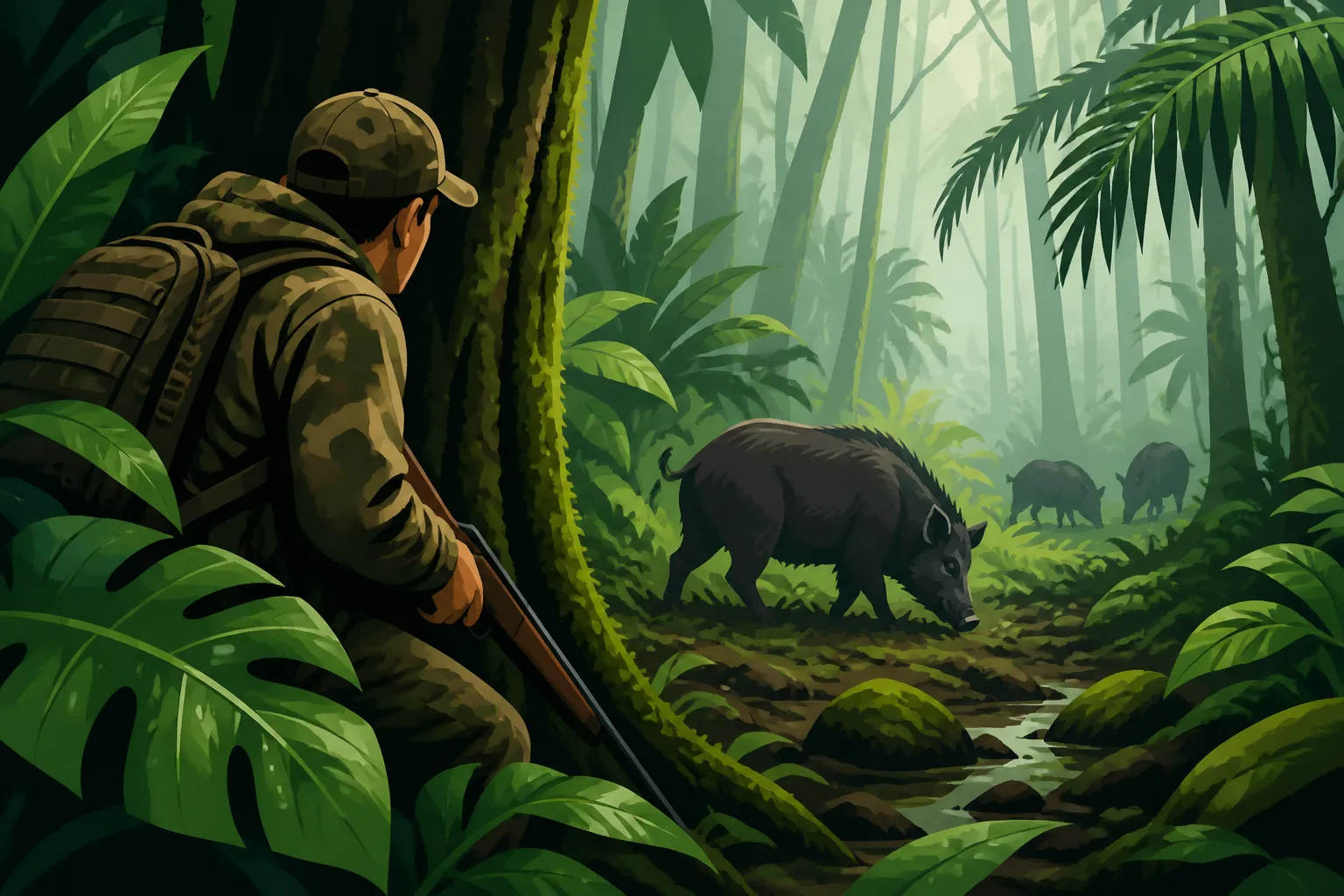
Still-Hunting Pigs in Hawaii’s Wet Forest
The dense, emerald canopies of Hawaii's wet forests are beautiful, no doubt about it. But for a hunter, they can feel like a green wall, an impenetrable fortress where feral pigs vanish into thin air. Many hunters here rely on dogs to navigate this labyrinth, but what if you prefer the quiet challenge of still-hunting? That's where the real test begins, pitting your senses and patience against an animal perfectly adapted to vanish in plain sight. This guide is all about equipping you with the strategies, gear, and mindset you'll need to successfully still-hunt pigs in these incredibly challenging, yet rewarding, Hawaiian jungles.
Understanding the Wet Forest Environment
Still-hunting in Hawaii's wet forests isn't like hunting anywhere else. It’s a sensory overload that demands a completely different approach from open-country hunting. The sheer density of vegetation, coupled with constant moisture, creates a unique set of obstacles and opportunities.
The Unique Challenges of Hawaii's Rainforests
Imagine stepping into a world where everything is green, wet, and alive. Hawaii's wet forests, particularly on the windward sides of islands like the Big Island (Hilo side) and Maui (Hana coast), are defined by their incredible humidity and annual rainfall, often exceeding 100 inches. This environment breeds an astonishing array of vegetation, from towering ʻōhiʻa and koa trees to a dense understory of hāpuʻu fern, ʻuluhe fern, and invasive species like strawberry guava and clidemia. These plants create a tangled mess that limits visibility to mere yards, often less.
The ground is perpetually damp, making every step a potential sound trap. Wet leaves, rotting logs, and slick mud can turn a quiet stalk into a noisy blunder in an instant. Furthermore, the terrain itself is often steep, riddled with hidden gulches, slippery rocks, and choked stream beds. You're not just fighting the vegetation; you're fighting gravity and the treacherous footing. It's easy to get turned around, even with a GPS, as the thick canopy blocks satellite signals and familiar landmarks disappear behind the next curtain of green. This is where Staying Found in Dense Hawaii Rainforest becomes an absolute necessity, not just a recommendation.
Pig Behavior in Dense, Wet Habitat
Feral pigs in Hawaii's wet forests are masters of evasion. Unlike their counterparts in dry, open kiawe flats, these pigs rarely need to travel far for food or water. The rainforest provides a constant buffet of fallen fruit, roots, insects, and new growth. They often create extensive networks of tunnels and bedding areas within the densest thickets, making them incredibly difficult to locate and approach. Their home ranges can be surprisingly small in these food-rich environments.
Pigs here tend to be nocturnal or crepuscular, meaning they're most active at dawn and dusk, but the perpetual dimness of the deep forest can extend their activity throughout the day. They rely heavily on their sense of smell, which is phenomenal, and their acute hearing to detect intruders long before you ever see them. They'll also use the constant background noise of the forest – wind in the trees, dripping water, rustling leaves – to mask their own movements, and will often freeze or sneak away quietly rather than crashing through the brush when startled. Understanding Why Feral Pigs Move Mostly at Night in other areas might give you insights, but in the dense wet forest, "night" can feel like it's all the time.
Essential Gear for Still-Hunting Wet Forest Pigs
Your gear choices for still-hunting in Hawaii's wet forests are critical. Comfort, durability, and practicality will directly impact your success and safety. You need equipment that can withstand constant moisture, prevent unnecessary noise, and help you navigate challenging terrain.
Footwear and Clothing for Stealth and Protection
When still-hunting in wet Hawaii forests, your footwear is perhaps the most crucial piece of gear. Forget those expensive breathable hiking boots; they'll be soaked through in minutes and stay wet for days. What you need are waterproof boots, preferably rubber boots or high-quality waterproof leather boots, that offer excellent traction on slick mud and wet rocks. Look for options with aggressive outsoles. I've seen many hunters swear by Muck Boots or similar brands for their combination of waterproof protection and decent ankle support. Make sure they fit snugly to prevent chafing during long, wet treks.
For clothing, think layers that dry quickly and are quiet. Cotton is a definite no-go; once it's wet, it stays wet, leading to chills and discomfort. Opt for synthetic blends or merino wool. A good base layer to wick moisture, a mid-layer for warmth (especially at higher elevations or early mornings), and a durable, waterproof yet breathable outer shell are essential. Camouflage patterns that blend with the deep greens and browns of the forest are helpful, but absolute silence in movement is paramount. Pay attention to fabrics that don't rustle or snag easily on dense undergrowth. A good lightweight rain jacket is non-negotiable, as showers can pop up at any moment, and getting soaked can quickly become dangerous. You'll want to check out Rain Gear for a Windward Hawaii Hunt for more specific advice on staying dry.
Weapon Choices for Close-Quarters Hunting
The dense environment dictates specific weapon choices. Shots will almost certainly be close-range, often within 30 yards, and frequently through brush or in low light. Therefore, pinpoint accuracy and sufficient knockdown power for an animal that can be notoriously tough are key.
| Weapon Type | Pros in Wet Forest | Cons in Wet Forest | Ideal Range |
|---|---|---|---|
| Rifle | High knockdown power, good for tough hogs. | Can be cumbersome in thick brush; over-penetration on close shots. | 25-75 yards |
| Shotgun (Slugs) | Excellent close-range power, less prone to deflecting on light brush. | Limited range beyond 50 yards; heavy if not carried properly. | 10-50 yards |
| Archery (Recurve/Compound) | Silent, challenging, excellent for close-quarters. | Requires significant practice and precision; short range, poor visibility. | 10-30 yards |
| Muzzleloader | Traditional challenge, good power. | Slow to reload, very susceptible to moisture. | 20-60 yards |
For rifles, calibers like .30-30, .45-70 Government, or even a .308 Winchester with heavy, controlled-expansion bullets are excellent choices. Lever-action rifles are popular due to their compact size and quick handling in tight spaces. If you're using a shotgun, stick to heavy slugs designed for big game. Archery, while incredibly challenging, offers the ultimate silent approach and is favored by many experienced local hunters. Just be sure to choose an arrow setup with enough kinetic energy for a clean pass-through. If you choose to go the muzzleloader route, be mindful of Muzzleloading in Hawaii's Humidity and take extra precautions to keep your powder dry.
Navigational Tools and Emergency Prep
Getting lost in Hawaii's wet forests is not just an inconvenience; it can be life-threatening. The dense canopy often renders cell phone GPS unreliable, and a compass might only get you so far without clear landmarks. A dedicated GPS unit like a Garmin InReach or a satellite messenger like the Zoleo is an absolute must-have. These devices not only provide reliable navigation but also offer SOS capabilities for emergencies, a critical feature where cell service is non-existent. You can use apps like OuterSpatial, but download your maps beforehand for offline use. Many hunters find that Using the OuterSpatial App to Check In is useful, but it's always best to have a backup.
Beyond navigation, always carry a small but comprehensive emergency kit. This should include a first-aid kit, a whistle, a headlamp with extra batteries, a fire starter, an emergency blanket, water purification tablets, and high-energy snacks. Even on a planned day hunt, weather can change rapidly, and a minor injury can turn a short walk into an unplanned overnight stay. Inform someone of your exact hunting area and expected return time, and stick to your plan. The rugged nature of the terrain also makes Water and Heat Planning for a Hawaii Hunt critical, even in cooler wet forests.
Mastering the Art of Silent Movement
Still-hunting is about becoming part of the forest, moving with such deliberate slowness and quietness that you blend into the natural sounds rather than disrupting them. It's an exercise in patience and hyper-awareness.
Reading the Terrain and Minimizing Noise
Your movement technique is paramount. Think "slow motion," taking one step at a time, testing the ground before committing your full weight. The forest floor is a minefield of fallen branches, rustling leaves, and slick mud. Try to step on solid ground, exposed roots, or large rocks when possible. Avoid brushing against ferns and low-hanging branches, as the sound can carry surprisingly far in the damp air.
When you absolutely must move through thick brush, do so slowly and deliberately. If you hear a branch snap, pause for a full minute, listening intently. A startled pig might run a short distance and then stop, trying to identify the source of the noise. This pause might give you a fleeting chance to spot them. Pay close attention to subtle changes in elevation; pigs often favor the slightly drier ground on small ridges or higher banks within a gulch. You'll often find yourself hunting along A Wet Forest Boundary Trail or a Windward Stream Valley where the terrain can be especially tricky.
Using Wind and Thermals to Your Advantage
Even in the thickest wet forest, wind and thermals play a critical role in carrying scent. Pigs have an incredible sense of smell, and a single whiff of human odor will send them scattering. Always hunt into the wind, or at least quartering into it. This means constant awareness of wind direction, which can be tricky in the swirling currents of a gulch or varied topography.
Thermals, the rising and falling air currents, are also crucial. In the morning, as the sun warms the forest, air tends to rise, carrying your scent uphill. In the evening, as temperatures drop, air sinks, carrying your scent downhill. Plan your approach and exit routes accordingly. If you're hunting a steep ridge or a valley, approach from below in the morning, letting your scent rise above you, and descend in the evening, letting your scent fall below you. This constant battle with scent is a significant part of the challenge, but mastering Hunting Downwind in Hawaii's Shifting Thermals is key to success.
Developing Your Stalking Pace and Patience
The phrase "still-hunting" truly emphasizes the "still" part. You'll spend far more time standing motionless and listening than you will actually walking. Your pace should be agonizingly slow – sometimes just a few yards in 10-15 minutes. Stop frequently, listen, and scan every shadow and clump of vegetation.
When you pause, slowly pan your head, looking for horizontal lines, unusual shapes, or subtle movements that betray a pig's presence. Pig hair can be surprisingly good camouflage against the browns and greens of the forest. Train your eyes to look for ears, the curve of a back, or the glint of a tusk. This constant stop-and-go requires immense patience and mental discipline. It's a psychological game as much as a physical one, demanding you ignore the urge to push forward and instead, embrace the quiet, observational hunt. This isn't a quick sprint; it's a marathon of stealth, perfect for those who truly appreciate the challenge of Still-Hunting Pigs in Hawaii's Wet Forest.
Locating Pigs Through Sign and Scent
Without dogs to track and bay, you need to become a master detective, interpreting the subtle clues pigs leave behind in the dense forest. Their movements, feeding habits, and even their unique smell can lead you to them.
Interpreting Fresh Pig Sign in Mud and Undergrowth
In the wet forest, pigs are constantly leaving calling cards. Muddy trails, rooted-up earth, and trampled vegetation are all indicators of their presence. Look for fresh tracks in soft mud, paying close attention to the dewclaws (the two small toes on the back of the leg) – prominent dewclaw marks usually indicate a larger, heavier pig. Reading Pig Sign Along a Muddy Trail can tell you not just if pigs are present, but how recently, and in what direction they were headed.
Rooting is another obvious sign. Pigs use their powerful snouts to dig for roots, worms, and fungi. Freshly turned earth, especially around the base of trees or in damp areas, means pigs have been actively feeding. The wetter the conditions, the more obvious and preserved these signs will be. Also, keep an eye out for flattened areas of grass or ferns where pigs have bedded down, often in dense thickets for cover.
The Distinct Scent of Feral Pigs
While less reliable than visual sign, the distinct scent of feral pigs can be a dead giveaway, especially in still air or when you're downwind of a bedding area. Feral pigs, particularly mature boars, have a strong, musky odor that some describe as a mix of urine, manure, and wild game. It's not always pleasant, but it's a smell you'll learn to recognize.
If you catch a whiff of that distinctive aroma, it's time to slow down even further, check the wind, and prepare for a close encounter. The stronger the smell, the closer the pigs. This can be particularly noticeable near their wallows or active feeding grounds. Remember, their sense of smell is far superior to yours, so if you can smell them, they've likely already detected any unfavorable shifts in your wind.
Identifying Wallows, Rubs, and Feeding Areas
Pigs love to wallow in mud and water, especially to cool down and deter parasites. These muddy depressions, often with disturbed vegetation around them, are excellent places to find fresh tracks and assess recent activity. They're typically found near water sources or in low-lying, boggy areas within the forest. Pig Wallows and What They Tell You about pig activity.
Rubs are also key indicators. Pigs, especially boars, will rub against trees, rocks, or even fence posts to mark their territory, remove parasites, or simply scratch an itch. Look for mud or hair left behind on rough bark or smooth surfaces, often at pig-shoulder height.
Lastly, identifying their preferred feeding areas can direct your hunt. Pigs are opportunistic omnivores; in Hawaii's wet forests, they'll gorge on fallen mango, guava, or avocado, root for ginger, taro, and various tubers, and consume a range of insects and carrion. Observing What Feral Pigs Eat in the Islands helps you predict where they might congregate. If you find a grove of fruit trees with fresh droppings and rooting activity, you've hit a jackpot.
Shot Placement and Recovery in Thick Cover
Getting a shot opportunity in Hawaii's wet forest is a triumph in itself. However, executing an ethical shot and recovering your animal presents its own unique set of challenges in such dense conditions.
Ethical Shot Placement on Hawaii Feral Pigs
Feral pigs are notoriously tough animals, built like tanks with thick skin, heavy muscle, and a protective layer of fat, especially on the shoulders of boars. For still-hunting in close quarters, precise shot placement is absolutely critical to ensure a quick, humane kill and to prevent a difficult, potentially dangerous, tracking job.
The ideal shot placement for a pig is the heart-lung area, just behind the shoulder and a little lower than you might aim on a deer. This vital zone is relatively small, so you need to be confident in your shot. Avoid quartering-to shots, which present minimal vitals, and headshots, which are often unreliable unless you have an absolutely perfect, broadside view and are very close. A pig's brain is surprisingly small and located deeper in the skull than many realize. If you have to take a less-than-ideal shot, prioritize a double-lung shot over a single lung or gut shot. For bowhunters, Choosing an Arrow Setup for Axis Deer principles apply – you need heavy, sharp broadheads and sufficient kinetic energy for a pass-through on a pig.
Tracking and Recovery in the Jungle
Even with a perfect shot, tracking a pig in the wet Hawaiian jungle can be a nightmare. The dense vegetation quickly closes around a blood trail, and the perpetually damp ground can make blood difficult to see, especially if it gets washed away by rain. Mark your shot location meticulously, using flagging tape or prominent natural features. Note the pig's reaction and direction of travel.
Wait at least 20-30 minutes after the shot to begin tracking, especially if you suspect a marginal hit. A mortally wounded pig might lie down quickly if undisturbed, but if pushed, it can travel miles. Track slowly and systematically, looking for disturbed vegetation, broken branches, and subtle blood signs. A good headlamp is essential, even during the day, to help illuminate blood in the dim forest. If the trail is lost, expand your search in concentric circles from the last confirmed sign. Remember, Getting a Pig Out of a Hawaii Gulch is a significant undertaking, so try to recover your animal as close to an accessible point as possible.
Field Care and Extraction Challenges
Once you've recovered your pig, field care in the heat and humidity of Hawaii is paramount to preserving the meat. Rapid cooling is essential to prevent spoilage. Gut the animal immediately, removing all entrails. If possible, rinse the cavity with clean water (being mindful of environmental regulations) to remove any blood and cool the carcass. Skinning the animal in the field can also help it cool faster, but this leaves the meat more exposed to insects and dirt. For larger pigs, you might need to quarter the animal to make it manageable for transport.
Extracting a pig from a steep, wet gulch or dense forest can be a back-breaking ordeal. Consider bringing a sturdy game bag or frame pack. If you're hunting with a partner, taking turns carrying sections of the animal makes the job easier. For solo hunters, quartering the animal into smaller, more manageable loads is often the only way. This is where Packing Meat Out of a Hawaii Gulch really comes into play. Even if you're close to a trail, the terrain can be brutal. Having a plan for this before you even head out is crucial.
Mental Fortitude and Safety Considerations
Still-hunting pigs in Hawaii's wet forest is as much a mental game as it is a physical one. The environment tests your patience, resilience, and awareness in ways few other hunts can.
The Psychological Game of Still-Hunting
The sheer difficulty of still-hunting in these conditions can be incredibly frustrating. Long hours of slow, silent stalking, often resulting in no opportunities, can wear down even the most experienced hunter. You'll question every rustle, every shadow. Doubt can creep in, making you wonder if there are even any pigs around. This is where mental fortitude becomes your most valuable asset.
Embrace the challenge. Celebrate the small victories: a successful silent step, identifying fresh sign, getting a clear mental image of the terrain. The reward for success in such a demanding environment is immense. Remind yourself that the elusive nature of the animal and the density of its habitat are precisely what makes this hunt so unique and ultimately, so satisfying. The solitude and immersion in nature are part of the allure, and Hunting Hawaii's Wet Forest Boundary Trail offers a different kind of experience than a wide-open savanna.
Navigating Hazards and Staying Safe
Hawaii's wet forests, while beautiful, are not without their dangers. Beyond getting lost, the terrain itself poses significant risks. Steep, slippery slopes, hidden drop-offs, loose rocks, and dense, thorny vegetation can lead to falls and injuries. Always move carefully, using trekking poles for stability if needed.
Other hazards include introduced species like mosquitos (some carrying diseases like dengue fever or chikungunya virus), rat lungworm (so be careful with any foraged produce, and clean hands well before eating), and potentially aggressive feral boars, especially if cornered or wounded. Be aware of your surroundings, and never approach a wounded animal carelessly.
Moreover, if you are hunting on public lands, ensure you've familiarized yourself with the specific unit rules and checked in and out properly. Utilizing the GoHunt Hawaii portal (which manages permits and information for several units) or Buying a License Through Go Hunt Hawaii ensures you have the latest regulations. Always inform someone of your hunting plans, expected return time, and specific area you'll be in. A satellite messenger like an inReach can be a lifesaver for emergencies in areas with no cell service.
Disclaimer
Hunting in Hawaii involves inherent risks. This guide provides general information and recommendations. Always consult the latest Hawaii Department of Land and Natural Resources (DLNR) Division of Forestry and Wildlife (DOFAW) regulations, obtain necessary licenses and permits, and prioritize safety. Conditions can change rapidly, and personal responsibility is paramount.