Archery Equipment Rules for Big Game
One of the biggest headaches for any bowhunter planning a trip to Hawaii, or even for seasoned locals, is navigating the often-confusing maze of archery equipment regulations for big game. It’s not just about having a bow and arrow; the state has very specific rules designed to ensure ethical harvests and minimize animal suffering. This comprehensive guide is here to untangle those knots, giving you a clear picture of what you need to know and what gear you need to pack for your Hawaiian big game archery adventure.
Understanding Hawaii's Core Archery Regulations for Big Game
When you're gearing up for a bowhunt in Hawaii, it's crucial to understand that the rules aren't just suggestions; they're legal requirements designed to promote ethical hunting and ensure a quick, humane kill. These regulations apply across the board to what Hawaii considers "big game" animals – namely Axis deer, Mouflon sheep, feral goats, feral sheep, and the black-tailed deer on Kauai. Thinking you can just bring your regular hunting setup from the mainland without checking the local statutes is a common, and potentially costly, mistake.
Minimum Draw Weight Requirements
Let's talk draw weight, because this is often the first hurdle for many archers. Hawaii's Department of Land and Natural Resources (DLNR), through its Division of Forestry and Wildlife (DOFAW), sets clear minimums to ensure that the arrow has enough kinetic energy to achieve a clean pass-through and vital organ damage on big game. For most big game species in Hawaii, the minimum draw weight for compound bows and recurves is 40 pounds. This isn't just an arbitrary number; it's based on the size and resilience of animals like Axis deer and Mouflon sheep.
Imagine you're stalking a wary Axis buck through the kiawe flats on Maui. These animals can be tough, especially the mature bucks that can tip the scales well over 200 pounds. An arrow from an underpowered bow might not penetrate deep enough, leading to a wounded animal and an agonizing recovery. This is exactly what the regulations aim to prevent. It's a real frustration when you've trained hard, made a perfect stalk, only to find your equipment isn't up to the task. Always make sure your bow is tuned and tested at or above this 40-pound minimum. Some specific units or hunts might have slightly different stipulations, so always double-check the latest DOFAW announcements or the helpful resources on platforms like GoHunt before you head out.
Permitted Arrow and Broadhead Specifications
Beyond the bow itself, the arrow and broadhead you choose are equally critical components of an ethical setup. Hawaii has specific guidelines here too, emphasizing sharp, effective cutting surfaces designed for big game.
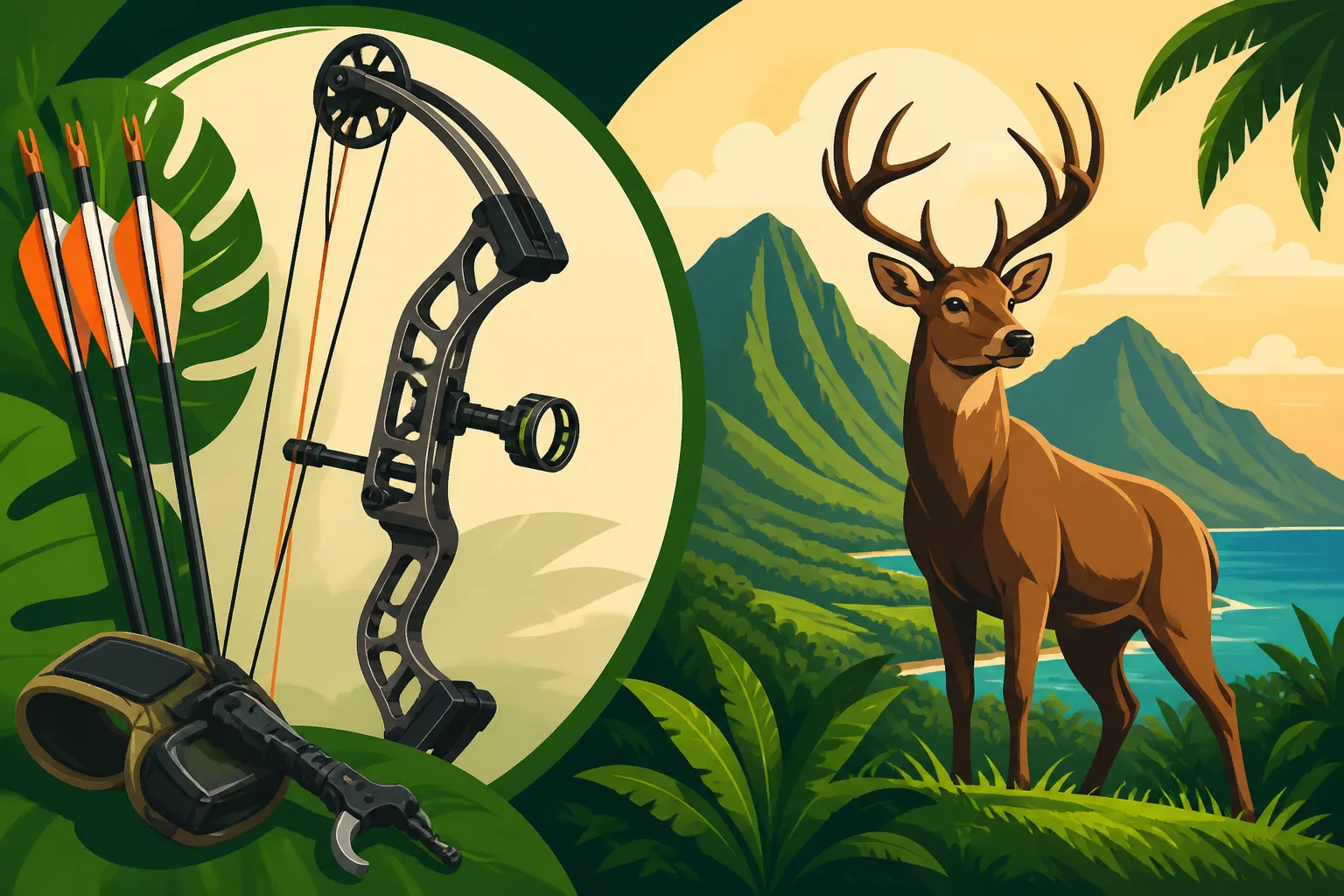
For arrows, while there isn't typically a strict minimum length or weight (beyond what is practical for proper bow function and ethical kinetic energy), the focus is squarely on the broadhead. Broadheads for big game must be fixed-blade or mechanical/expandable types with a minimum cutting diameter of 7/8 inch.
Now, this is where some hunters get tripped up. Many states allow a wide variety of mechanical broadheads, and while Hawaii generally permits them, you absolutely must ensure they meet that 7/8-inch minimum expanded diameter. Fixed-blade broadheads, with their solid construction and consistent cutting surface, are a favorite among many Hawaiian bowhunters, especially when pursuing thick-skinned feral pigs or tenacious goats. For example, a heavy-duty fixed blade like a G5 Montec or a Wasp Boss often performs exceptionally well in the dense muscle and bone of a large Axis buck. The key is that it needs to be razor-sharp. Dull broadheads are an archer's worst enemy, leading to poor penetration and unethical outcomes. Always carry a broadhead sharpener or fresh blades, and check them regularly, even if it feels like overkill. The success of your hunt, and the welfare of the animal, often hinges on this one small detail.
Specific Archery Rules for Different Game Species and Islands
Hawaii is a mosaic of islands, each with its unique terrain, wildlife populations, and sometimes, subtle variations in hunting regulations. While the core archery rules for big game are largely consistent, understanding any species-specific nuances or island-based distinctions is vital. This ensures you're not just legal, but also optimally equipped for the particular challenge ahead.
Archery Rules for Axis Deer and Mouflon Sheep
When you're talking about Hawaii's premier big game, Axis deer and Mouflon sheep are usually at the top of the list. These animals demand respect and appropriate gear, and the archery regulations reflect that. Generally, the statewide 40-pound minimum draw weight and 7/8-inch minimum broadhead cutting diameter apply rigorously to both Axis deer and Mouflon sheep. There are no special exceptions to lighten these requirements for these species.
Consider hunting for a trophy Mouflon ram on the windswept slopes of Mauna Kea on Hawaii Island. These rams are hardy, accustomed to rugged, high-altitude terrain, and can carry a lot of bone and muscle. Your arrow needs to be capable of breaking through dense wool and hide to reach vital organs. Similarly, an Axis buck, especially a large one found on Molokai or Maui, presents a substantial target with dense musculature. A well-tuned bow, accurately shot, with a broadhead that maintains integrity and cuts efficiently, is paramount. Many hunters gravitate towards heavier arrows (450-550 grains total weight) when pursuing these animals, aiming for maximum kinetic energy and momentum to achieve reliable pass-throughs, even with the 40-pound minimum draw weight. For more specific details on these hunts, you might check out resources like Axis Deer Hunting in Hawaii or Mouflon Sheep Hunting on Hawaii Island.
Archery Regulations for Feral Pigs and Goats
Feral pigs and goats are often seen as different challenges in Hawaii, and while the core archery regulations remain the same (40-lb draw weight, 7/8-inch broadhead), the practical application and choice of equipment can vary slightly based on their behaviors and habitats.
Feral pigs, found across many islands and often thriving in dense, wet rainforest gulches or deep kiawe thickets, are incredibly tough animals. They are known for their thick hide, particularly around the shoulders (the "shield" on boars), and their propensity to fight. For Hunting Hawaii's Feral Pigs, many archers prefer robust fixed-blade broadheads with strong ferrules that can withstand impact with bone and dense muscle. While mechanicals are legal if they meet the diameter requirement, some hunters worry about them failing to open or breaking on impact with a tough pig hide or shield. Penetration is key in these scenarios, especially if you encounter a large boar.
Feral goats, on the other hand, often inhabit steep, rocky coastal cliffs or volcanic terrain, like those you'd find when Hunting Hawaii's Feral Goats. While they might not have the "shield" of a boar, they are agile and can cover ground quickly after a shot. A broadhead that provides a wide cutting diameter and quick blood trails is beneficial for recovery in such difficult terrain. Their hide can be thick, particularly on older billies, and their bone structure is surprisingly dense. Again, a sharp, durable broadhead, whether fixed or a reliable mechanical, is essential. Remember, regardless of the species, the goal is always a humane, quick kill, and your equipment should reflect that commitment.
Black-Tailed Deer on Kauai
Kauai offers a unique hunting experience as it's the only island with a population of Black-Tailed Deer. These deer were introduced decades ago and have established a presence, primarily in the Kokee and Na Pali-Kona areas. While they are a deer species, they are typically smaller than the Axis deer found on other islands. However, they are still classified as big game, and thus the standard archery equipment rules apply.
This means a minimum 40-pound draw weight is still required for hunting black-tailed deer with a bow on Kauai. Your broadhead still needs to meet the 7/8-inch minimum cutting diameter. Just like with Axis deer, ethical hunting dictates using equipment capable of a clean, quick kill. While a smaller body size might suggest less penetration is needed, the dense muscle and bone structure of any deer requires ample kinetic energy. Terrain on Kauai can be steep and heavily vegetated, making tracking a challenge. A good blood trail from an effective broadhead is invaluable. For more on this unique hunting opportunity, you can look into Black-Tailed Deer Hunting in Hawaii. Always remember to check Kauai's specific unit rules and season dates, as they can differ from other islands.
Practical Considerations and Compliance for Hawaii Bowhunters
Having the right gear is one thing, but knowing how to use it effectively and staying compliant with the ever-evolving regulations is another entirely. Hawaii's diverse ecosystems and varying unit rules mean that practical preparation is just as important as the equipment itself.
Equipment Preparation and Ethical Hunting
Preparation isn't just about packing your bags; it's about making sure your gear is dialed in and your skills are sharp. Ethical hunting, especially with a bow, demands precision and responsibility.
First and foremost, practice, practice, practice! It's not enough to just meet the minimum draw weight; you need to be proficient and accurate with your setup. Shoot the exact arrows and broadheads you plan to hunt with. Broadheads, especially mechanicals, can change an arrow's flight characteristics compared to field points. You need to know exactly where that arrow will hit at various distances. Many experienced hunters recommend shooting out to your maximum ethical range – the distance at which you can consistently place all your shots within a 6-8 inch circle. Given that What a Hawaii Axis Buck Weighs can be substantial, and a vital zone can appear smaller than you'd expect, pinpoint accuracy is critical.
Understanding animal anatomy is also non-negotiable. Know the precise location of the heart and lungs on Axis deer, Mouflon, pigs, and goats. A well-placed shot is far more important than raw power. For example, when hunting Bowhunting Hawaii's Public Units, you'll often encounter shots at quartering angles. Knowing how to adjust your aim for vitals at these angles comes from study and practice. This commitment to ethical hunting is what separates responsible archers from those who might cause unnecessary suffering. Make sure your bow is perfectly tuned, your arrows fly true, and your broadheads are sharp enough to shave hair.
Staying Updated and Avoiding Common Pitfalls
Hawaii's hunting regulations, while generally stable, can sometimes see updates or changes, especially regarding specific units or seasons. Relying on outdated information is a sure path to frustration or, worse, a violation.
The biggest pitfall for many, particularly non-resident hunters, is assuming that archery rules from their home state apply in Hawaii. They don't. Always consult the official Hawaii DOFAW hunting regulations for the current year. These are usually available online or through their offices. Services like GoHunt are excellent resources, as they often aggregate and simplify these complex regulations, making it easier to see season dates and specific weapon requirements by unit. For instance, when planning for Hawaii Archery Season Windows, checking GoHunt or the DOFAW website will give you the most accurate and current information.
Another common mistake is neglecting to properly check in and out of hunting units. Even if your archery equipment is perfect, failing to follow administrative procedures like Checking In and Out of Hawaii Hunting Units can lead to fines or loss of hunting privileges. The use of the OuterSpatial app for digital check-ins, for example, is becoming more prevalent, and hunters should be familiar with it. Not knowing how to use Using OuterSpatial Instead of a Paper Card could delay your hunt or cause issues.
Finally, never underestimate the impact of Hawaii's unique environment on your equipment. High humidity can affect string materials, and rough volcanic terrain or dense jungle can be tough on arrows and broadheads. Always inspect your gear before and after a hunt, and carry spares where feasible. Investing in quality gear and knowing the rules backward and forwards will make your Hawaiian archery hunt a much more rewarding and successful experience. And if you're a new hunter, remember that Hawaii Hunter Education Requirements exist to equip you with the knowledge needed to hunt safely and ethically, which includes understanding all equipment regulations.
| Big Game Species (Hawaii) | Minimum Draw Weight (Compound/Recurve) | Minimum Broadhead Cutting Diameter |
|---|---|---|
| Axis Deer | 40 lbs | 7/8 inch |
| Mouflon Sheep | 40 lbs | 7/8 inch |
| Feral Goats | 40 lbs | 7/8 inch |
| Feral Pigs | 40 lbs | 7/8 inch |
| Black-Tailed Deer | 40 lbs | 7/8 inch |
Note: These are general statewide requirements. Always verify the most current regulations with the Hawaii DLNR/DOFAW for any specific unit or season, as rules can change.
Disclaimer
The information provided in this guide is for general informational purposes only and is subject to change. Hunting regulations in Hawaii are set by the Department of Land and Natural Resources (DLNR) Division of Forestry and Wildlife (DOFAW) and can be updated annually or seasonally. It is the responsibility of every hunter to consult the most current official Hawaii hunting regulations before engaging in any hunting activity. This guide does not constitute legal advice.