Why Goats Cause Erosion in Hawaii
For anyone who’s spent time hiking Hawaii's wilder corners, especially in the dry, rugged areas or along steep coastal cliffs, you’ve probably seen the unmistakable signs: patches of bare earth, loose soil tumbling down slopes, and gnarled, exposed tree roots. This isn't just natural wear and tear; it's often a direct consequence of Hawaii's pervasive feral goat populations, whose unchecked activities are a primary driver of land degradation and devastating erosion across our islands. This guide will delve deep into the mechanics of how these resilient, but destructive, animals contribute to the severe erosion problems that plague Hawaii's delicate ecosystems.
The Relentless Pressure of Feral Goats on Hawaii's Landscape
Feral goats didn't just appear here; they were introduced centuries ago and have since thrived in Hawaii's diverse environments, becoming an entrenched part of the landscape. While they might seem like just another wild animal, their grazing habits and sheer numbers exert immense pressure on native vegetation and fragile soils, setting the stage for significant erosion. It's a complex problem, but understanding their role is key to appreciating the larger conservation challenges we face.
A Brief History of Goats and Their Proliferation
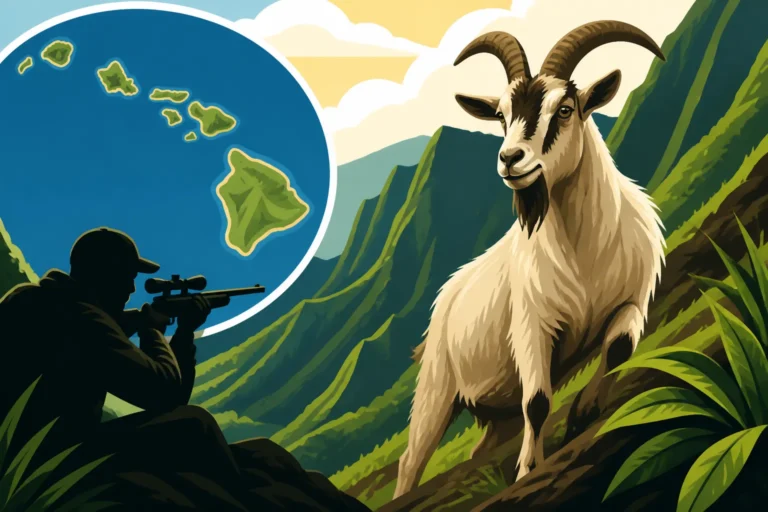
Goats first arrived in Hawaii with Captain Cook in 1778, and over the centuries, escaped domesticated animals formed wild herds. Unlike native Hawaiian species, which evolved in an ecosystem devoid of large grazing mammals, our plants never developed defenses like thorns, bitter tastes, or deep root systems to withstand such intense browsing. Goats found a paradise of edible vegetation and few natural predators, allowing their populations to explode across islands like Hawaii Island, Maui, Molokai, and Kauai. You can learn more about their journey in How Feral Goats Reached Hawaii.
These animals are incredibly hardy and adaptable, able to survive in everything from arid kiawe flats to steep, wet gulches. Their rapid reproduction rates and ability to consume almost any plant material mean that once established, a goat population can quickly overwhelm an area. This is particularly evident in places like the dry leeward slopes, where food might seem scarce to us, but to a goat, it’s a buffet.
Overgrazing: The Root of the Problem
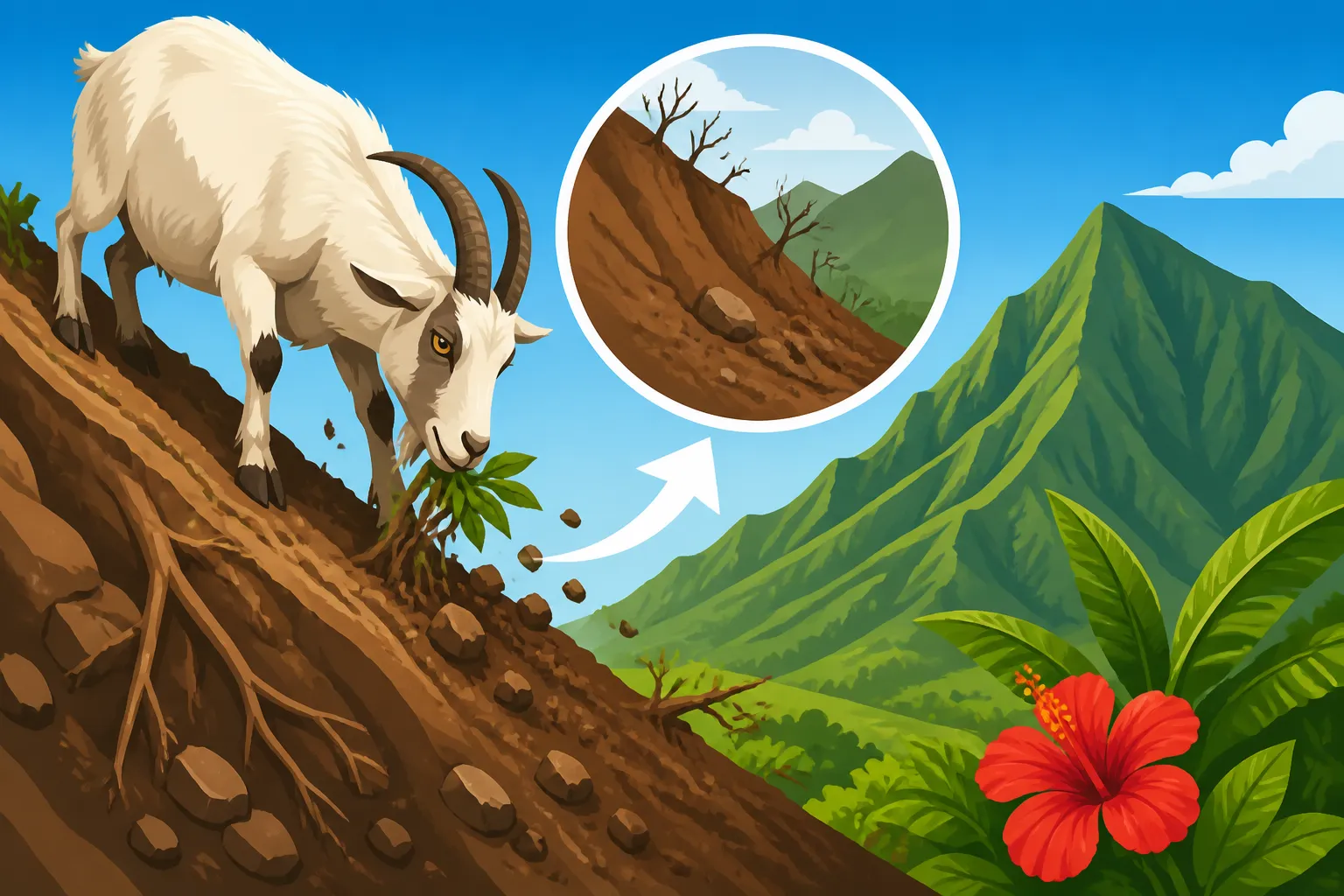
The most direct way goats cause erosion is through relentless overgrazing. Imagine a hillside covered in various shrubs, grasses, and small trees – plants that hold the soil in place with their root systems. Goats browse indiscriminately, consuming young seedlings, mature plants, and everything in between. They strip foliage, girdle trees, and prevent new growth from establishing.
Consider a typical scenario in a dryland forest on Hawaii Island or Maui. Herds of goats move through, systematically eating every palatable plant. They don't just nip off the tops; they often pull plants up by the roots, especially when vegetation is sparse. This leaves the ground bare and exposed. Without the protective canopy of leaves to break the force of raindrops and without the intricate network of roots to bind the soil, the topsoil becomes vulnerable. When the inevitable heavy rains arrive, that bare soil has nothing to cling to. It washes away easily, carving gullies and leaving behind a scarred, barren landscape. This is especially true when considering What Goats Eat in Dry Country.
The Mechanics of Soil Loss: How Goats Accelerate Erosion
It’s not just what goats eat; it’s also how they move and exist on the landscape. Their physical presence, combined with the loss of vegetation, creates a perfect storm for accelerating soil erosion. Our volcanic soils, often shallow and lacking robust organic layers, are particularly susceptible to these forces.
Trampling and Soil Compaction
Beyond grazing, the physical activity of goat herds significantly degrades soil structure. Goats, especially in larger groups, move constantly. Their sharp hooves are designed for climbing rugged, rocky terrain, which means they can access incredibly steep slopes and cliff faces. While this agility helps them survive, it’s devastating to the soil. As they walk, they break up the delicate soil crust, pulverizing it into fine particles. This makes the soil much more easily transported by wind or water.
Furthermore, repeated trampling compacts the soil, particularly in areas where goats congregate, such as near watering holes or bedding grounds. Compacted soil loses its porosity, meaning it can’t absorb water effectively. Instead of soaking into the ground and recharging groundwater, rainwater simply runs off the surface, carrying loose soil particles with it. This runoff gains speed and volume as it flows downhill, turning small trickles into erosive torrents that scour the land. You can often see this effect when Hunting Goats on a Sea Cliff Safely where trails worn by goats funnel water directly down the face.
Hooves as Erosive Tools
The hooves themselves act as miniature digging tools. On steep slopes, goats create a network of trails and terracettes—small, narrow ledges formed by their repeated footfalls. These trails, while providing easy passage for the goats, become conduits for water. Instead of rainwater diffusing across a vegetated slope, it channels directly into these goat-made paths. Once water is concentrated, its erosive power multiplies exponentially, quickly transforming these trails into deep, destructive rills and gullies.
Imagine a heavy downpour after a long dry spell. The ground is dry and loose from goat activity. Rain hits the exposed soil, churns it into mud, and then flows along these goat paths, carrying vast amounts of sediment downhill. This sediment then clogs streams, smothers coral reefs, and impacts coastal water quality, affecting everything from fishing to tourism. The problem extends far beyond the immediate hillsides.
Loss of Soil Stabilizers: Roots and Leaf Litter
The absence of a healthy plant community means the loss of critical soil stabilizers. Plant roots act like natural rebar, weaving through the soil and holding it together. When goats remove these plants, that natural binding agent is gone. The soil becomes loose, friable, and easily dislodged.
Additionally, a healthy forest floor is typically covered in a layer of leaf litter and decaying organic matter. This acts as a protective blanket, cushioning the impact of raindrops and allowing water to slowly infiltrate the soil. It also provides nutrients and fosters a healthy microbial community that contributes to soil structure. Goats, by eating everything, eliminate this vital layer. Their presence in areas like Hunting Hawaii's Forest Reserves directly undermines the health and resilience of these critical natural areas. The result is a cycle where less vegetation leads to more erosion, which in turn makes it harder for vegetation to regrow, perpetuating the degradation.
The Broader Environmental Impact of Goat-Induced Erosion
The immediate visual of eroded hillsides is just the tip of the iceberg. Goat-induced erosion triggers a cascade of negative environmental consequences that impact Hawaii's unique biodiversity, water resources, and even its coastal ecosystems.
Impact on Native Plants and Animals
Hawaii's native flora and fauna are incredibly fragile. Many endemic species are specialized to specific microclimates and depend on stable soil conditions and particular plant communities. When goats denude an area, they not only remove the food source and habitat for native insects, birds, and other creatures, but they also alter the physical environment itself. The loss of shade, increased soil temperatures, and reduced moisture further stress remaining native plants, making it easier for invasive weeds to take hold.
For example, many of Hawaii's rare forest birds rely on specific native trees and the insects that live on them. When goats destroy these forests, these birds lose their homes and food, pushing already endangered species closer to extinction. The integrity of entire ecosystems, from the mountain slopes to the ocean, is compromised.
Water Quality Degradation and Sedimentation
One of the most significant and far-reaching impacts of goat-induced erosion is on water quality. As soil washes down from the mountains, it ends up in streams, rivers, and eventually, the ocean. This sediment carries with it nutrients, pollutants, and debris. High levels of sediment make stream water murky, harming aquatic life that relies on clear water for feeding and reproduction.
Once it reaches the coast, this sediment settles on coral reefs, smothering them. Coral polyps are delicate and need sunlight to thrive; when covered in silt, they cannot photosynthesize and eventually die. This degrades the very foundation of Hawaii's marine ecosystems, impacting fish populations and the vibrant biodiversity our islands are famous for. Our beautiful beaches and clear waters are intrinsically linked to the health of our upland forests and the control of feral ungulates.
Increased Risk of Landslides and Natural Hazards
On an archipelago characterized by steep volcanic slopes, heavy rainfall, and seismic activity, erosion by goats exacerbates the risk of natural hazards like landslides and mudslides. When vegetation is removed and soil is destabilized, these slopes become inherently less stable. During intense rain events, the saturated, loose soil can give way catastrophically.
These events aren't just an ecological concern; they pose a direct threat to human safety and infrastructure. Roads can be blocked, homes damaged, and lives put at risk. The financial cost of repairing damage from erosion-induced landslides can be substantial, draining resources that could otherwise be used for other community needs. It's a stark reminder that what happens in the remote wilderness can directly affect populated areas downwind and downstream. This is a real concern in many of Hawaii's Hunting Hawaii's Forest Reserves areas which are often steep.
Management and Mitigation Efforts
Addressing goat-induced erosion is a complex and ongoing challenge that requires a multi-faceted approach. Hunters play a vital role, but broader conservation strategies are also essential.
Hunting as a Management Tool
Hunting is one of the most effective and direct ways to control feral goat populations in Hawaii. By reducing herd numbers, hunters directly alleviate the grazing and trampling pressure on native vegetation and soils. This is why many hunting units have liberal bag limits for goats, and some allow year-round hunting in certain areas. Understanding Hawaii Game Mammal Seasons is crucial for those who wish to participate.
The Division of Forestry and Wildlife (DOFAW) manages public hunting units with an eye toward ecological restoration, and hunters are considered crucial partners in this effort. For hunters using resources like GoHunt, understanding specific unit regulations and access points helps them contribute to these management goals. Whether you’re on the Big Island or Kauai, targeting feral goats is a direct act of conservation.
Here's a look at how goat impacts change with the effectiveness of hunting efforts:
| Terrain Type | Typical Goat Impact (High Population) | Impact with Effective Hunting/Management |
|---|---|---|
| Steep Cliffs/Pali | Severe denudation, creation of deep trails, increased rockfall risk | Reduced browsing pressure, stabilization of fragile cliff vegetation |
| Dry Lowland Forests | Complete removal of understory, soil pulverization, desertification | Regeneration of native grasses and shrubs, improved soil cover |
| Wet Forest Slopes | Browsing of native seedlings, trampling leading to mudslides | Protection of sensitive understory, reduced soil compaction, improved water retention |
| Volcanic Lava Fields | Sparse vegetation removed, increased dust and particulate matter | Limited vegetation able to return, habitat for specialized native species |
Fencing and Exclusion Projects
In particularly sensitive areas, or where native plant restoration is a priority, fencing is often employed to exclude goats. These fences, often several miles long, are designed to keep goats out of specific zones, allowing native vegetation to recover without grazing pressure. These "exclosures" can be incredibly effective, and the visual difference between a fenced and unfenced area is often dramatic, with lush native growth flourishing inside the fence.
However, fencing is expensive, labor-intensive to construct and maintain, and can be controversial, especially when it restricts hunter access or crosses traditional hunting grounds. Why Hawaii Fences Out Pigs and Goats is a complex issue, but the ecological benefits for critical watershed areas and endangered species habitats are undeniable. These projects are a testament to the severe impact of ungulates on Hawaii's unique environment.
Restoring Native Vegetation
Ultimately, preventing erosion is about restoring the protective cover of vegetation. This involves planting native species that are well-adapted to the local environment and can help bind the soil. Reforestation efforts, often undertaken by volunteers and conservation groups, focus on reintroducing plants that were historically present in an area. This is a long-term endeavor, often requiring initial protection from goats and other browsing animals.
The commitment to restoring native vegetation goes hand-in-hand with population control. Without effectively managing feral goat numbers, any planting efforts would be futile, as the new seedlings would simply become another food source for hungry herds. It’s a continuous battle, but one that is absolutely essential for the long-term health of Hawaii’s unique and irreplaceable ecosystems. Every step taken to reduce goat populations, whether through hunting or other means, directly contributes to the recovery of our precious lands and waters.
Disclaimer
This article is for general informational purposes only and does not constitute professional advice. Laws, prices and regulations vary by location and change over time. Consult a qualified professional for guidance on your specific situation.