How Goat Herds Move Through a Canyon
Hunting goats in Hawaii's rugged canyons can feel like trying to solve a puzzle while scrambling up and down a vertical obstacle course. Many hunters find themselves frustrated, seeing a goat one moment only for it to vanish into the labyrinthine cliffs and thickets, leaving them wondering how these elusive animals navigate such challenging terrain. This guide will take a deep dive into the fascinating world of Hawaiian feral goat behavior within canyon systems, helping you understand their patterns so you can hunt them more effectively.
Understanding Goat Behavior in Hawaii's Canyons
Feral goats in Hawaii aren't just surviving in canyons; they're absolutely thriving in them. These aren't your typical docile farm animals; they are incredibly agile, intelligent, and perfectly adapted to the island's steep, broken country. To truly understand how goat herds move through a canyon, you need to think like a goat – or at least understand their priorities. Their survival hinges on their ability to find food, water, and shelter, all while avoiding perceived threats, which primarily means predators (including hunters) and sometimes even aggressive pigs.
The Canyon as a Fortress and Feeding Ground
Canyons in Hawaii, whether carved by ancient rivers, volcanic activity, or relentless erosion, offer a unique combination of resources and security. From the sheer, sun-baked walls of Waimea Canyon on Kauai to the more vegetated gulches of the Big Island, goats use these features to their advantage. The steep, often near-vertical slopes provide an immediate escape route from danger, as few other animals can follow them into such precarious positions. This sense of security allows them to feel relatively safe as they feed and rest.
However, the canyon isn't just a fortress; it's also a larder. Pockets of vegetation cling to ledges, grow along streambeds (even seasonal ones), and flourish on the less-exposed slopes. These microclimates within the canyon can hold lusher forage than the surrounding dry plains, especially during drought periods when goats become incredibly reliant on these sheltered areas. They're constantly evaluating these areas for palatable leaves, grasses, and shrubs. What Goats Eat in Dry Country is a crucial piece of knowledge here, as it dictates where they'll spend their time. They'll navigate treacherous trails that look impassable to us, often single-file, to access these pockets of food.
Herd Dynamics and Lead Animals
Goat herds are not random collections of individuals; they operate with a clear social structure, especially when navigating complex terrain like a canyon. Typically, an older, more experienced nanny goat will serve as the matriarch and lead the herd. This isn't always the biggest goat, but it’s often the one with the most knowledge of the territory, including safe paths, feeding areas, and escape routes. When you observe a herd moving, pay close attention to the lead animal; its decision-making will dictate the entire group's movement.
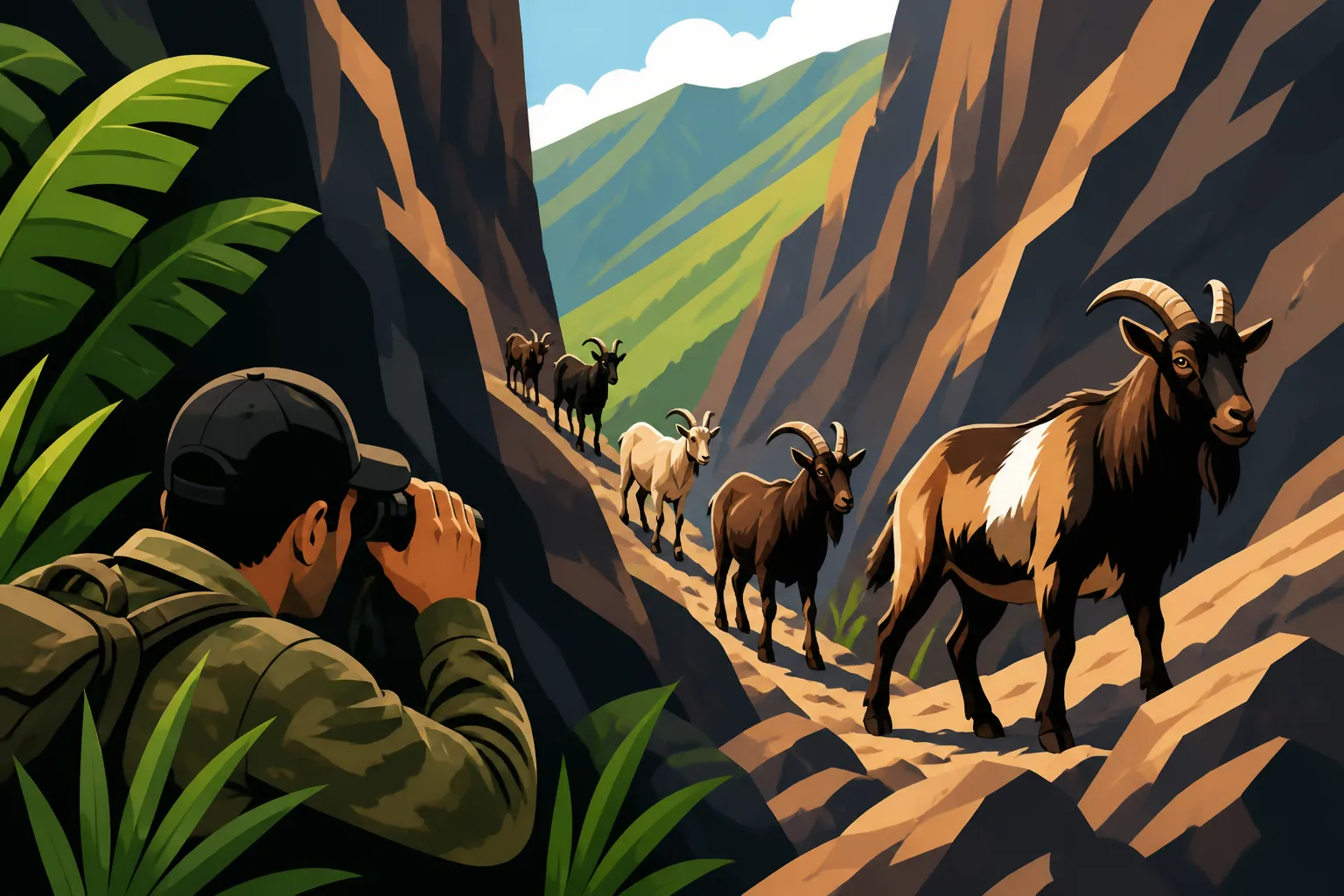
The rest of the herd, including kids, younger nannies, and often several billy goats, will follow closely. In a canyon, this often means moving in a single file along narrow game trails worn into the rock and dirt. These trails, barely visible to the untrained eye, are critical pathways. They connect different levels of the canyon, provide access to water sources, and lead to bedding areas. Disrupting the lead animal can cause chaos in the herd, sending them scattering in unpredictable directions, often deeper into the most inaccessible parts of the canyon. Understanding Telling a Billy From a Nanny can help you focus on the lead for tactical hunting.
Factors Influencing Canyon Goat Movement
The way a goat herd moves through a canyon isn't static; it's a dynamic dance influenced by several key environmental factors. Ignoring these factors is a sure way to find yourself out of position, watching your target disappear over a cliff face. Successful canyon goat hunters are adept at reading the landscape and predicting how these elements will shape goat behavior.
Time of Day and Thermal Movement
Just like many other game animals, Hawaiian feral goats are most active during the cooler parts of the day: early morning and late afternoon into early evening. This is particularly true in the often-hot, exposed canyon environments. At first light, you'll often see herds emerging from their bedding areas on sheltered ledges or in dense thickets within the canyon, moving to feed. This is when they are most likely to traverse open slopes or cross saddles between canyon sections. Why Hawaii Goats Move at First Light is a key article that elaborates on this.
As the sun climbs higher, they seek shade. Canyons offer natural shade lines that shift throughout the day. Goats will move with these shade lines, browsing as they go, or seek out caves, overhangs, or dense vegetation on north-facing slopes to bed down during the midday heat. In the late afternoon, as temperatures drop, they become active again, moving towards evening feeding grounds and eventually back to their secure bedding sites for the night. This thermal movement is predictable and a primary driver of their daily patterns.
Terrain Features and Escape Routes
The specific topography of a canyon dictates much of a goat's movement. They will stick to the path of least resistance when moving between areas, but also prioritize escape routes. This means they often navigate along benches, ledges, and slopes that are accessible to them but difficult for a human to traverse. A goat can spring up or down a near-vertical face with incredible speed and agility, using tiny hoof holds that are invisible to us.
When spooked, a canyon goat herd will almost invariably head upwards or deeper into the most broken, steepest terrain available. They know these areas are their best defense. They'll utilize narrow draws, sheer rock faces, and thick brush to put distance and obstacles between themselves and perceived danger. Understanding these natural escape corridors is critical. If you push a herd from below, expect them to climb. If you come at them from above, they'll likely drop down a seemingly impossible route. Hunters need to be thinking multiple steps ahead, anticipating not just where the goats are, but where they will go when pressured. Hunting Goats on a Sea Cliff Safely offers additional insights into goat behavior on steep terrain.
Wind and Scent
Wind is a constant factor in Hawaii, and its behavior within a canyon can be complex and tricky. Thermals—the rising and falling air currents—play a huge role, especially in the mornings and evenings. As the sun heats the canyon floor, air rises, carrying scent upwards. In the evenings, as the air cools, it descends, carrying scent downwards. Goats are highly attuned to scent and will position themselves to catch incoming wind currents, using their noses to detect danger long before they see it.
This means that a goat herd moving through a canyon will often travel into the wind, or at least across it, to maximize their ability to smell what's ahead. When bedding down, they'll often pick a spot where the wind can carry scent from below or behind them, while they can visually scan the more open approaches. This is why a hunter approaching from downwind in a canyon can be so effective, but it also means carefully studying the micro-thermals and prevailing winds. A strong trade wind can be a consistent factor, but local canyons can create swirling, unpredictable air currents that will quickly give away your position if you're not careful. Reading Hawaii's Trade Wind Patterns is an excellent resource for understanding this complex dynamic.
Tracking and Predicting Canyon Goat Herds
Successfully hunting goats in Hawaii's canyons isn't just about spotting them; it's about understanding their habits well enough to predict their next move. This involves a combination of careful scouting, reading sign, and patient observation. Think of yourself as a detective, piecing together clues to form a clear picture of the herd's routine.
Reading Sign Along Canyon Trails
Goats leave plenty of sign, especially in frequently used canyon areas. Their droppings, distinct from pig or sheep droppings, are often found in concentrations along well-traveled trails and near bedding sites. Look for fresh tracks in dusty patches or muddy streambeds at the bottom of a gulch – these can tell you how recently goats have passed through and in which direction. Worn paths on rock ledges, scuff marks, and even rubbed areas where they've scratched against rocks or vegetation are all indicators of goat presence.
Pay close attention to browsed vegetation. Goats are notorious for stripping leaves and bark, particularly from their preferred forage. Freshly nipped leaves or branches with visible bite marks are a clear signal that goats have been feeding in the area recently. Within a canyon, these signs can lead you from one feeding pocket to another, eventually revealing the network of trails they use. The more fresh sign you find, the closer you are to a herd. Sometimes, the only way to confirm a goat's presence is to look for these subtle indicators. Telling Pig Sign From Goat Sign can help you differentiate.
Glassing Canyon Walls and Features
One of the most effective strategies for locating canyon goats is patient, thorough glassing. Because goats often frequent exposed ledges and open slopes within the canyons, a good pair of binoculars or a spotting scope is your best friend. Position yourself on a high vantage point, preferably across the canyon or on a ridge overlooking a section of it. Start your scan from the bottom up, meticulously working your way across every rock face, every patch of vegetation, and every shadowed crevice.
Don't just look for whole animals; look for pieces: a flash of white, a horizontal line that doesn't belong, or the subtle movement of an ear. Early mornings and late evenings are prime glassing times when goats are more active. Focus on areas with varied terrain: where steep rock gives way to small benches, near water sources (even seasonal seeps), and along the edges of thick vegetation. It takes patience, but eventually, your eyes will learn to pick out the subtle shapes of goats against the complex backdrop of the canyon. Glassing a Hawaii Coastline for Goats offers invaluable tips for this technique, applicable to any canyon.
Predicting Herd Movement Based on Observation
Once you've located a herd or identified an area with consistent sign, the next step is to predict their movement. This comes from combining all the factors we've discussed: time of day, wind direction, and the layout of the terrain. If you spot a herd feeding on a sunny slope in the morning, where do they go when the sun gets high? Look for nearby shaded ledges, caves, or denser pockets of vegetation. If you see them moving along a particular bench, where does that bench lead? Does it connect to a water source or a more secure bedding area?
Consider the wind: if the wind is blowing directly into their faces, they're likely moving to feed. If it's at their backs, they might be moving to a new bedding area where they can keep an eye on their backtrail and allow the wind to carry scent from ahead. By observing their patterns over time, even for a few hours, you can start to anticipate their travel corridors. The goal is to get ahead of them or position yourself in a choke point where they are likely to pass, rather than simply chasing them through the demanding terrain.
Here's a quick reference for typical canyon goat movement patterns:
| Time of Day | Activity Level | Typical Movement | Key Factors | Hunting Strategy Notes |
|---|---|---|---|---|
| Dawn – Mid-morning | High | Moving from bedding to feeding areas, often climbing or traversing slopes. May hit water. | Cooler temps, rising thermals, seeking forage. | Intercept along known trails, glass exposed areas. Approach upwind/crosswind. |
| Mid-morning – Midday | Low | Seeking shade, bedding down on ledges or in thickets. Minimal movement. | Rising sun, heat, strong thermals (up-canyon). | Difficult. Focus on glassing shaded bedding areas from afar. Avoid spooking. |
| Midday – Afternoon | Low/Moderate | May shift within shade, light browsing, re-positioning as shade lines move. | Peak heat, thermals at their strongest, seeking security. | Patience. Wait for evening activity. Stalking is extremely risky. |
| Late Afternoon – Dusk | High | Moving from bedding to evening feeding, often descending or traversing to accessible forage. | Cooling temps, falling thermals, seeking evening meal. | Intercept along trails, focus on lower slopes. Approach downwind/crosswind. |
| Night | Low | Bedded down in secure, sheltered spots within the canyon. | Darkness, predators (rare), security. | Not a legal or practical hunting time. Plan for dawn. |
Adapting Your Hunting Strategy to Canyon Goat Movement
Knowing how goats move is only half the battle. The other half is adapting your own movements and tactics to leverage that knowledge. Hunting Hawaiian canyons is physically demanding, so smart strategy can save you energy and increase your chances of success.
Utilizing Canyon Features for Stalking
Canyons, while challenging, also provide excellent cover for a hunter willing to work for it. Use the natural contours of the land to your advantage. Deep draws, rock outcroppings, and thick vegetation can all serve as natural blinds and stalking lanes. Instead of trying to walk directly at a goat, identify a route that keeps you out of sight and allows you to approach from a favorable position – often from above, or across a crosswind.
The key is patience and meticulous movement. Goats have excellent eyesight and can pick up subtle movements against the backdrop of the canyon. Move slowly, deliberately, and take advantage of every piece of cover. This often means crawling, ducking, and taking long pauses to glass and reassess the herd's position. Think of it like a game of chess, using the canyon walls and terrain as your board. Spot-and-Stalk Tactics on Open Country can be adapted to the more broken canyon environment, focusing on using terrain to break up your silhouette.
The Advantage of High Ground and Patience
When hunting canyons, high ground is almost always your friend. Gaining elevation allows you to glass vast sections of the canyon, identify goat trails, and spot herds from a distance without disturbing them. From a high vantage point, you can plan your approach, identifying potential obstacles and escape routes for the goats. It also gives you a better understanding of the wind and thermals that will influence your stalk.
Once you spot a herd, the hardest part is often having the patience to wait for the right moment. Don't rush into a bad shot or a risky stalk. Sometimes, the best strategy is to simply observe the herd for an hour or two, letting them move into a more favorable position or waiting for a cloud to pass and offer temporary concealment. Remember, goats are masters of their canyon domain; forcing a situation will almost always result in them disappearing into the wilderness. Walking Rough Lava Without Wrecking Your Boots is essential reading for navigating these types of units, as sturdy footwear is critical for maintaining patience and mobility.
Packing Out Meat from Steep Terrain
Successfully harvesting a goat in a Hawaii canyon is a huge accomplishment, but the real work begins after the shot. Canyons, by their very nature, make packing out meat incredibly difficult. The steep, unstable terrain, combined with Hawaii's heat and humidity, means you need a solid plan for field dressing and extracting your animal. Goats often fall in the most inaccessible places, requiring careful planning to retrieve them.
Make sure you carry enough water, a sharp knife, and game bags. Break down the animal into manageable pieces as quickly as possible to facilitate cooling and ease of transport. If you're hunting with a partner, the task becomes much more feasible. Consider lighter pack frames designed for meat hauling. The phrase "it's all downhill from here" often proves to be a lie in Hawaii's gulches, where every direction can be an uphill climb at some point. Being prepared for a strenuous pack-out is as important as the hunt itself. Getting a Pig Out of a Hawaii Gulch offers relevant advice that translates well to goats, especially regarding the physical demands of extraction. And remember to check with GoHunt for any specific unit regulations on game transport.
Disclaimer
This article is for general informational purposes only and does not constitute professional advice. Laws, prices and regulations vary by location and change over time. Consult a qualified professional for guidance on your specific situation.