Telling Pig Sign From Goat Sign
One of the most common head-scratchers for any hunter in Hawaii, especially if you're new to the islands or new to hunting these specific game animals, is figuring out just what left that sign in the dirt. Was it a rooting pig, or a browsing goat? The truth is, these animals leave distinctly different calling cards, and mistaking one for the other can send you on a wild goose chase in the wrong habitat. This guide will walk you through the key differences in pig and goat sign, helping you read the Hawaiian landscape like a seasoned pro.
Why Distinguishing Pig and Goat Sign Matters
It might seem like a minor detail, but knowing whether you're tracking a pig or a goat can make or break your hunt in Hawaii. These two animals, while both abundant and often found in similar broad areas, have vastly different preferences when it comes to habitat, behavior, and how you'll need to approach them.
Different Hunting Strategies
Imagine spending hours still-hunting a dense, wet gulch only to realize all the sign you're seeing is from goats that prefer the exposed ridges a thousand feet above. It's a frustrating scenario many hunters have faced! Pigs, particularly the feral kind found across Hawaii, are masters of concealment. They love thick, damp cover – think dense strawberry guava, tangled ʻōhiʻa forests, and deep, often muddy gulches. Hunting them often involves slow, methodical still-hunting, working with dogs to bay them, or targeting specific food sources. You'd be thinking about strategies like Hunting Pigs in Hawaii's Rainforest Gulches or even specialized techniques like Dog and Knife Pig Hunting in Hawaii.
Goats, on the other hand, are creatures of the open, steep, and rocky. They thrive on precipitous cliffs, lava flows, and dry, sparse shrubland. Your approach for goats is typically built around glassing vast areas, spotting them from a distance, and executing careful spot-and-stalk maneuvers across challenging terrain. If you're looking for goats, you'd be studying techniques for Hunting Goats on Hawaii's Coastal Cliffs, not slogging through the jungle. Mistaking the sign means you're likely geared up for the wrong environment and animal, leading to a lot of wasted effort and maybe even a missed opportunity.
Impact on Habitat
Beyond the hunt itself, understanding the specific impact these animals have on the ecosystem can also give you clues. Their feeding habits are quite distinct, and the type of damage they leave behind tells a story. Feral pigs are notorious for their rooting behavior. They use their strong snouts to dig up the soil in search of roots, tubers, and invertebrates, creating significant ground disturbance. This rooting destroys native plant communities, churns up the soil leading to erosion, and creates perfect breeding grounds for invasive species and even mosquitoes. If you see widespread, churned-up earth, that's a huge clue pointing to pigs. You'll often see this kind of activity near areas where What Feral Pigs Eat in the Islands is abundant.
Goats, by contrast, are browsers. While they might occasionally paw at the ground, their primary impact comes from consuming vegetation, often stripping bark from trees or eating young saplings, preventing forest regeneration. On steep slopes, their constant movement and browsing can denude the land, leading to significant erosion, especially during heavy rains. If you're on a dry, rocky hillside and see vegetation browsed high up, or bark stripped from trees, it's a strong indicator of goats. This distinction helps you confirm which animal is utilizing a particular area and guides your expectations.
Legal and Unit Specifics
Hawaii's hunting regulations and unit management can sometimes have nuances that depend on the species. While many units are open for both pigs and goats, understanding the dominant species based on the sign can inform your permit applications or help you choose which unit to focus on. For instance, some units might have specific seasons or bag limits that favor one animal over the other, or certain areas might be known for larger populations of a particular species.
Knowing what sign you're seeing can help you confirm you're in an area managed for your target. For example, some higher elevation areas like portions of Hunting Puu Waawaa's Forest Reserve might have more sheep and goat activity, while denser, lower elevation areas like Hunting Hilo Forest Reserve Country are historically prime pig habitat. Checking the current Hawaii Game Mammal Seasons and unit rules is always critical, and the type of sign you're finding can either confirm your choice or tell you you might need to adjust your strategy or even your unit. Resources like GoHunt often display unit maps and general game presence, but your boots-on-the-ground observation of sign is the ultimate confirmation.
Deciphering Tracks and Trails
When you're out in the field, tracks and trails are often the most immediate and frequent signs you'll encounter. Learning to read these subtle differences is foundational to identifying your quarry.
Pig Tracks: Wider and Rounder
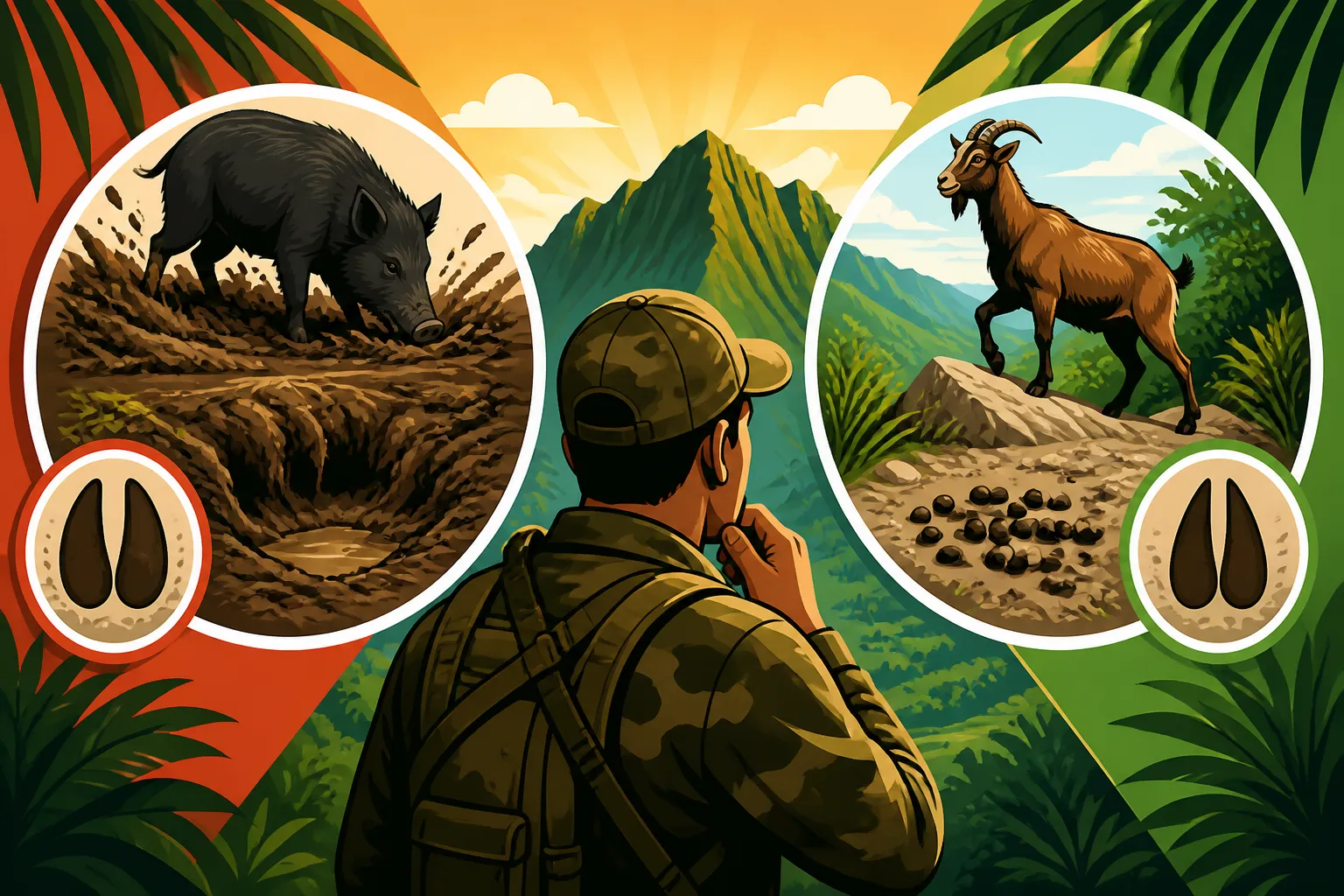
Feral pig tracks are generally quite distinct once you know what to look for. Their hoof prints are typically wider and more rounded compared to a goat's, giving them a somewhat "boxy" appearance. The two main toes are usually splayed, and a key characteristic is that their dewclaws will often register in the track, especially in soft, muddy ground or when they're running. These dewclaw impressions will appear as two small, blunt marks behind and slightly to the sides of the main hoof.
When you're Reading Pig Sign Along a Muddy Trail, you'll notice how the entire track leaves a substantial impression. The overall shape suggests a heavier, more powerful animal built for rooting and pushing through dense undergrowth. Think of a track that looks like a blunt heart shape with those tell-tale dewclaw nubs. A large boar's track can be quite substantial, often 2-3 inches wide, reflecting their sturdy build.
Goat Tracks: Narrower and Pointier
Goat tracks, in contrast, are usually narrower and more pointed at the toe. The two main hooves are more distinct and tend to come to a sharper point. Their dewclaws rarely register in the track unless the animal is moving at high speed, descending a steep slope, or on exceptionally soft ground. This absence of dewclaw marks in most normal walking tracks is a significant differentiator.
Goat tracks also reflect their agile and sure-footed nature, built for navigating rocky ledges and steep terrain. The hooves might appear more sharply defined, and when they are walking on hard ground, only the very tips might leave a faint impression. On lava flows, you might see slight scrapes or polish marks rather than clear prints. The overall impression is one of elegance and precision compared to the pig's more robust, splayed print.
Trail Patterns and Travel Habits
The way these animals move and the kinds of trails they create are also strong indicators. Pigs are creatures of habit and efficiency in dense cover. Their trails are often well-worn, deep, muddy "pig highways" that cut straight through thickets, connecting bedding areas to feeding grounds, watering holes, and wallows. These trails can be incredibly mucky, especially after rain, forming distinct tunnels through vegetation that are just wide enough for a pig to squeeze through. You'll notice they often follow the path of least resistance through dense jungle, but once a trail is established, it becomes a permanent route. You might see these heavily used routes when hunting near traditional pig haunts like Hunting Pigs Near a Taro Patch.
Goat trails, while sometimes well-used, tend to be less defined and more scattered, especially on open, rocky terrain. They often follow contours along steep hillsides, rocky ledges, or wind through sparse kiawe forests. Unlike pigs, goats are not afraid of heights or exposure, so their trails will often lead to precarious places with wide-open views. You might find "goat highways" along cliff edges or up steep, eroded gullies, but they won't have the same deeply worn, muddy character as pig trails. Their trails on hard ground are more like scrapes or faint paths where they've repeatedly walked, rather than deeply cut ruts. They use their incredible balance to navigate difficult terrain, often moving in single file.
Examining Feeding and Activity Signs
Beyond tracks, the evidence left by feeding and other daily activities provides unmistakable clues to which animal has been present. These signs directly reflect their dietary needs and behavioral patterns.
Pig Rooting and Wallows
This is perhaps the most obvious and unmistakable sign of feral pigs: rooting. Pigs will use their powerful snouts to literally plow up the earth, turning over rocks, tearing up sod, and digging into the soil in search of roots, bulbs, grubs, and other edibles. This activity leaves large, disturbed patches of ground, often looking like someone took a rototiller to the forest floor. The extent can range from small, isolated excavations to massive areas of overturned earth. If you see widespread patches of disturbed soil, especially in damp areas, you can be almost certain a pig has been at work. The kind of impact varies depending on What Feral Pigs Eat in the Islands.
Another clear sign is the presence of pig wallows. These are muddy depressions, often found near streams, springs, or low-lying areas that collect water. Pigs use wallows to cool down, shed parasites, and cover themselves in mud, which protects them from biting insects and the sun. A wallow will be a distinct, muddy depression with clear tracks in and out, often with hair rubbed off on nearby trees or rocks where the pig has scratched itself after bathing. Finding an active wallow is like finding a pig's personal spa day.
Goat Browsing and Rubs
Goats, unlike pigs, are browsers. Instead of rooting, they consume vegetation, often at heights that pigs simply cannot reach. Look for signs of torn and chewed leaves, twigs, and small branches on shrubs and trees, sometimes several feet off the ground if the goats are standing on their hind legs or on a steep slope. They have incisors on their lower jaw but a hard dental pad on their upper jaw, leading to a tearing rather than a clean-cutting action. You might also find bark stripped from saplings or lower branches, particularly from plants like kiawe or haole koa. The patterns of consumption will directly reflect What Goats Eat in Dry Country.
Additionally, mature billy goats, particularly during the rut, will rub their horns on small trees, shrubs, or rocks to mark their territory and shed velvet. These "rubs" will show scuff marks, scraped bark, and often leave strands of goat hair. The height and diameter of the rubbed object can give you an idea of the size of the animal, and are an excellent sign that you're in an area frequented by billies.
Droppings and Scat
While perhaps less exciting to examine, droppings (scat) are an incredibly reliable indicator of animal presence.
Pig scat is highly variable, reflecting their omnivorous diet. It can be soft and clumpy, resembling dog scat, or more cylindrical and segmented, depending on what they've been eating. You might find undigested plant matter, seeds, insect parts, or even hair in it. It's rarely consistently pelleted and often has an irregular shape. The consistency can also vary greatly with diet and moisture, from firm to quite loose.
Goat droppings, conversely, are almost universally pelleted. They are small, dark, and typically firm, resembling small marbles or large rabbit pellets. You'll often find them in concentrated piles where goats have bedded down or rested, or scattered along trails and feeding areas. The uniform, pelleted appearance is a clear giveaway. If you find small, dark, individual pellets, you're almost certainly looking at goat sign.
Other Important Clues and Habitat Preferences
While tracks and feeding signs are primary indicators, a host of other clues, including subtle rubs, vocalizations, and, critically, the specific type of habitat, can paint a complete picture of which animal is using an area.
Rubs, Beds, and Urine Marks
Beyond the obvious, paying attention to more subtle signs can round out your understanding. Pigs, especially boars, may rub against trees or rocks to scratch themselves or mark territory, leaving behind mud, hair, and sometimes a distinct musky odor. Their beds are often simple depressions in thick cover, usually large enough for their body, where they've pushed away vegetation. You might also notice patches of coarse, dark hair snagged on thorns or rough bark where they've squeezed through thickets.
Goats, particularly larger billies, will also leave rubs from their horns, as mentioned before, but these are distinct from a pig's muddy body rub. Look for strands of goat hair caught on thorny bushes or rough bark as they navigate tight squeezes, often lighter in color and finer than pig hair. Their beds are often scraped-out depressions on rocky ledges, under overhangs, or in areas with good visibility, providing them with a vantage point and protection from the elements. The size and location of these beds can even help with Telling a Billy From a Nanny. Urine marks for both animals are usually hard to distinguish unless fresh, but the context of other signs around them can help.
Vocalizations and Sounds
Sometimes, your ears will provide the first clue. Feral pigs can be surprisingly noisy animals, especially when they're feeding in a group or moving through dense brush. You might hear grunts, squeals, or the distinct rustling and crashing of them pushing through thick vegetation. If you hear a commotion in a dense guava thicket, particularly around dawn or dusk, it's highly likely to be pigs.
Goats, on the other hand, are generally much quieter. They move with incredible stealth and agility, even in groups, across rocky terrain. While you might hear the occasional bleat or "mehh" sound, particularly from younger goats or if a herd is startled, it's usually less frequent and less boisterous than pig vocalizations. If you hear what sounds like rocks dislodging high above you on a cliff, it's probably goats.
Preferred Habitats: Wet vs. Dry
Perhaps the most significant overarching clue when trying to distinguish pig from goat sign is the habitat itself. This is often the first thing you assess when planning your hunt using resources like GoHunt, and it's the strongest predictor of which animal you're likely to encounter.
Pigs thrive in wet, dense environments. They gravitate towards areas with abundant water, deep shade, soft soil for rooting, and plenty of thick cover for bedding and escape. This means you'll find them predominantly in rainforests, deep gulches with perennial streams, and the lush, windward sides of the islands where rainfall is frequent. Think about areas where you'd be Hunting Pigs on the Dry Leeward Side if there's a reliable water source, but their primary domain is the wet side. If you're slogging through muddy, humid jungle with dense undergrowth, the odds are heavily in favor of pig sign.
Goats, conversely, prefer dry, open, and often precipitous terrain. They are incredibly adapted to arid conditions and can survive on minimal water, often getting moisture from the vegetation they browse. Their preferred habitats include steep sea cliffs, high-elevation lava flows with sparse vegetation, dry rocky canyons, and leeward slopes where rainfall is scarce. If you're scaling a sun-baked, rocky ridge with sparse scrub, or carefully navigating a sea cliff, you're almost certainly in goat country. Techniques for Hunting Goats on a Sea Cliff Safely are built around these specific types of terrain. Understanding this fundamental difference in habitat preference is a game-changer for any hunter in Hawaii.
Here's a quick reference table to help you keep these distinctions straight in the field:
| Sign Category | Feral Pig Sign | Feral Goat Sign |
|---|---|---|
| Tracks | Wider, rounder, splayed, dewclaws often visible (mud). | Narrower, more pointed, distinct hooves, dewclaws rarely visible. |
| Trail Patterns | Deep, muddy "highways" through dense cover; direct. | Scrapes along rocky ledges, contours; less defined; often steep. |
| Feeding Sign | Extensive rooting, overturned earth, disturbed soil. | Browsing (torn leaves, twigs), stripped bark on shrubs/trees. |
| Wallows | Muddy depressions, often near water, with hair. | Absent. |
| Rubs | Muddy body rubs on trees/rocks; coarse hair. | Horn rubs on small trees/rocks; finer hair. |
| Scat (Droppings) | Variable (clumpy, cylindrical, often irregular). | Pelleted (small, dark, firm, marble-like). |
| Beds | Depressions in thick, dense cover. | Scraped areas on rocky ledges or under overhangs with views. |
| Vocalizations | Grunts, squeals, rustling, crashing in thickets. | Generally quiet; occasional bleats or falling rocks. |
| Preferred Habitat | Wet, dense forests, deep gulches, windward slopes. | Dry, open, rocky, steep terrain, sea cliffs, lava flows, leeward slopes. |
Disclaimer
This article is for general informational purposes only and does not constitute professional advice. Laws, prices and regulations vary by location and change over time. Consult a qualified professional for guidance on your specific situation.