How Lava Flows Shape Hawaii Game Range
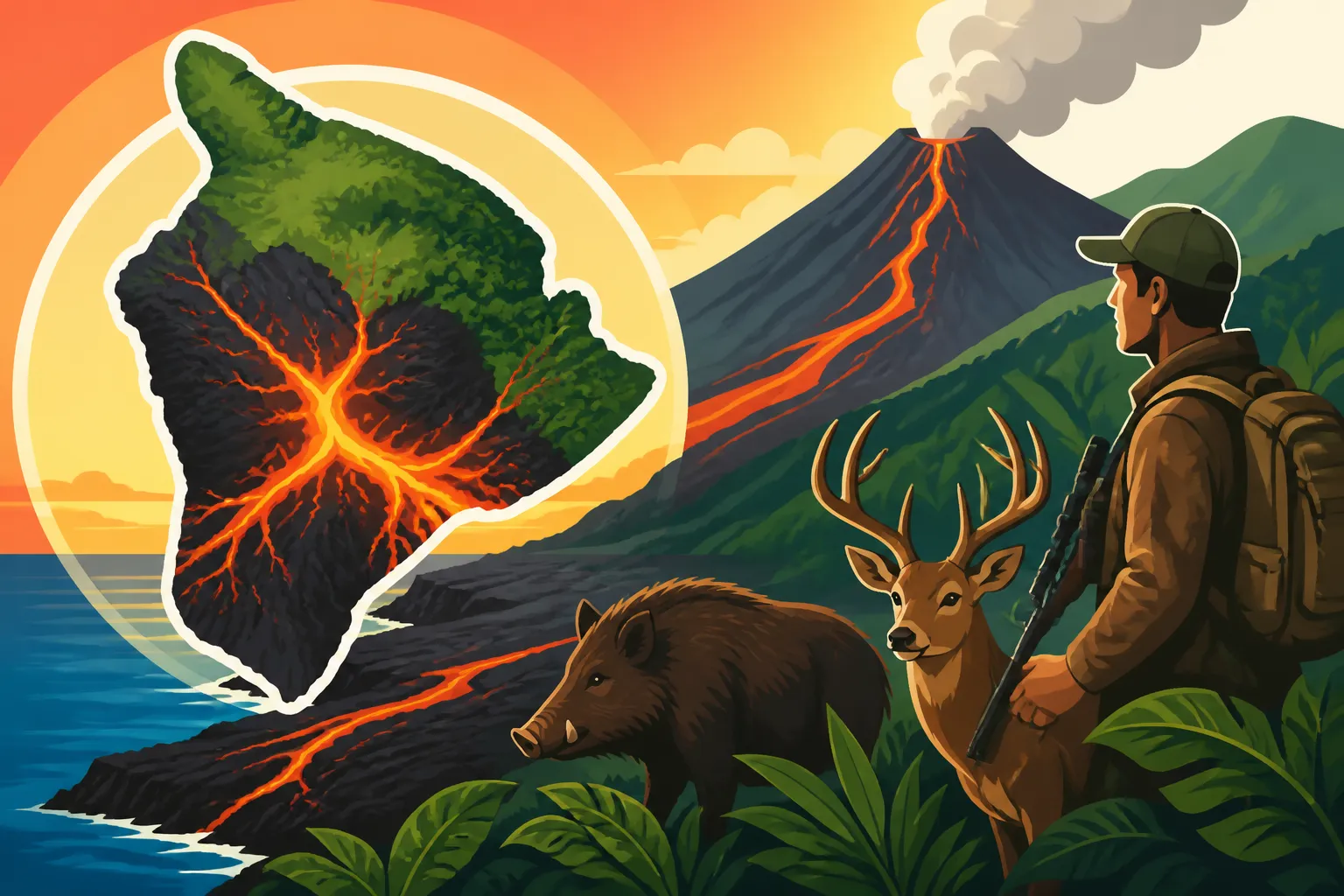
Hunting in Hawaii is unlike anywhere else on earth, and much of that unique challenge comes directly from the very ground beneath your feet: the volcanic landscape. If you've ever tried to chase a pig through a jagged a'a flow or spot a mouflon on a black pahoehoe field, you know the frustration and sheer wonder of it all. This guide is dedicated to unraveling the mystery of how these incredible, ever-changing lava flows dictate where Hawaii's game animals live, move, and ultimately, how you can hunt them more effectively.
The Raw Power of a Recent Flow and Its Lasting Impact
Imagine an eruption has just ceased, and a fresh blanket of lava, perhaps miles wide, has cooled across the landscape. It's a stark, desolate scene, looking more like the surface of the moon than a lush island paradise. For hunters, understanding this initial desolation and its slow, painstaking reclamation is key to grasping why game animals utilize these areas later on, or avoid them entirely.
Initial Desolation and Gradual Reclamation
When lava first cools, it forms a surface devoid of soil, water, and organic matter. Nothing can grow there immediately. This means absolutely no food, no cover, and no reason for game animals to be present. It's truly a blank slate. However, over time, nature begins its remarkable work of succession. Microscopic lichens are often the first pioneers, clinging to the rough surface and slowly, infinitesimally slowly, breaking down the rock. Then come the hardy ferns, establishing root systems in tiny cracks where dust and organic matter accumulate. Think about the incredible resilience needed for a plant to take hold in such a harsh environment. It can take decades, even centuries, for enough organic material to accumulate to support anything larger than a small shrub. For a hunter, this means that very recent, unbroken lava fields are almost always barren of game, simply because the basic resources they need—food, water, and substantial cover—haven't had time to develop. Trying to Walking Rough Lava Without Wrecking Your Boots just for the sake of it, hoping for game, would be an exercise in futility and quick boot destruction. You need to focus your efforts where life has a chance to take hold.
Shelter and Water in a Young Lava Landscape
Even in relatively young lava flows, there are subtle features that can attract game, albeit temporarily. The irregular, chaotic nature of pahoehoe (ropy lava) and a'a (jagged, clinkery lava) creates countless depressions, overhangs, and sheltered pockets. While these areas might not sustain permanent populations, they offer crucial, fleeting resources. A deep crack or a sheltered depression in a pahoehoe flow, for instance, can collect rainwater after a heavy shower. These temporary pools, even if muddy and brackish, become vital watering holes in an otherwise arid landscape. During a hot, dry spell, a pig, goat, or even an axis deer might travel surprising distances to reach such a spot. Similarly, the same irregular terrain that makes walking difficult for a hunter can provide surprisingly good shelter for an animal trying to escape the sun or a strong wind. A goat might bed down under a lava overhang, or a pig might root around the edges of a soil-filled depression, seeking relief. These are transient opportunities, but they demonstrate how even the most desolate landscapes offer specific niches that game can exploit if conditions are right. Hunters who understand the micro-topography of these flows and how water collects can sometimes find success by focusing on these subtle draws.
Established Flows and the Formation of "Kipukas"
As lava flows age and more eruptions occur, a fascinating geological phenomenon often emerges: the kipuka. These are perhaps one of the most important features for understanding game distribution in Hawaii's volcanic terrain.
Kipukas: Islands of Life in a Sea of Stone
A kipuka is essentially an island of older land, often featuring established forest or vegetation, that has been completely surrounded and cut off by newer lava flows. Imagine a verdant hill or a small grove of trees that, through sheer geological luck, was bypassed by a river of molten rock. The lava flowed all around it, leaving it untouched, creating an isolated oasis. These kipukas are absolute magnets for game animals. They offer everything the surrounding barren lava lacks: dense cover, reliable food sources (plants that have had time to grow), and often more consistent water retention in their older, more developed soils. For species like feral pigs, a kipuka offers rich rooting grounds and bedding areas. Goats might seek refuge on its slopes, and axis deer, particularly on the Big Island where they are less common, would find valuable browse. Hunting a Hawaii Lava Kipuka means concentrating your efforts on these pockets. They act as natural funnels and sanctuaries, drawing animals in from the harsher, surrounding landscape. When scouting, identifying kipukas on a map or with tools like GoHunt can save you countless hours of walking over unproductive, sharp lava.
The "Edge Effect" and Game Movement Along Flow Boundaries
Beyond the kipukas themselves, the boundaries where younger lava flows meet older, vegetated areas create what we call an "edge effect." This is where two distinct habitats meet, and these transition zones are often incredibly productive for wildlife. The lava side might offer open visibility and sunning spots, while the vegetated side provides cover, shade, and food. Game animals will often travel extensively along these boundaries, utilizing the best of both worlds. A pig might forage along the forest edge, occasionally venturing onto the rougher lava for minerals or to escape insects, before retreating back into the dense cover. Mouflon sheep, while adept at navigating lava, will often graze on the sparse vegetation that establishes at the interface, finding sustenance where the lava has begun to break down and blend with older soils. These edges are natural travel corridors and feeding grounds. For hunters, these are prime areas to set up, still-hunt, or glass, anticipating animal movement. Look for rub marks, tracks, and scat right where the black rock meets the green. Reading Axis Deer Sign in Dry Country, especially along these lava edges, can reveal recent activity and travel patterns that are invisible deeper in the flow.
Older, Weathered Flows and Habitat Diversity
Not all lava flows remain barren. Over long periods, the elements – wind, rain, and time – break down even the most resistant rock, slowly transforming it into something more hospitable for life. This process leads to entirely different hunting scenarios.
Degraded Lava as Diverse Habitat
Think about flows that are hundreds or even thousands of years old. The sharp, jagged edges of a'a become rounded, and the smooth, ropy surfaces of pahoehoe crack and crumble. Rain and wind carry dust, organic debris accumulates, and finally, rudimentary soil begins to form. This allows for a much more diverse plant community to take root. We're talking about the establishment of tough grasses, shrubs, and eventually, the iconic ʻōhiʻa lehua and hāpuʻu ferns that characterize much of Hawaii's native forests. These older flows, while still rocky and challenging, begin to offer significant food and cover. Pigs will root in pockets of deeper soil, searching for tubers and invertebrates. Goats will browse on the nascent shrubs and young trees. Even game birds, like chukar or francolin, might utilize these areas for feeding and nesting where pockets of dense vegetation provide concealment. When you're Hunting an Ohia Forest Opening, remember that many of these forest openings are often over ancient lava, where the growth is less uniform, creating varied terrain that animals love. The terrain may still be tough on your boots and ankles, but the potential for finding game increases dramatically.
Strategic Hunting in Degraded Lava Fields
Hunting in these older, degraded lava fields requires patience and a keen eye for detail. The terrain is often uneven, making silent movement difficult, and visibility can be a mixed bag – sometimes wide open, sometimes quickly obscured by patches of dense vegetation. This is where glassing becomes an invaluable skill. Finding an elevated point, perhaps the rim of an old cinder cone or a high ridge, and systematically scanning the landscape with good optics can reveal animals that would otherwise be invisible. Glassing a Lava Flow for Mouflon Rams is a classic example; their drab coloring blends in remarkably well with the volcanic rock, and often only a flick of an ear or the distinctive curl of a horn gives them away. Once an animal is spotted, the challenge shifts to the approach. The broken, noisy terrain makes a direct stalk incredibly difficult. Often, the best strategy is to use the natural contours of the lava, the rises and depressions, to stay out of sight, moving slowly and deliberately. You might also find game trails that animals have worn over generations, making travel slightly easier and indicating common routes between feeding and bedding areas. These trails, even if faint, are goldmines for hunters navigating the complex landscape.
Species-Specific Adaptations to Lava Environments
Different game animals interact with Hawaii's lava flows in unique ways, showcasing their incredible adaptability to these harsh environments. Understanding these preferences can greatly inform your hunting strategy.
Mouflon Sheep and the High Lava Fields
Mouflon sheep, particularly on the slopes of Mauna Kea and Mauna Loa on Hawaii Island, are perhaps the most iconic lava-dwelling game species. These majestic animals thrive in the high-elevation, often treeless, and incredibly rocky lava fields. Their hooves are perfectly adapted for gripping the rough volcanic rock, allowing them to navigate steep, unstable terrain with remarkable agility. They often feed on sparse, hardy vegetation like mamane and various grasses that manage to eke out an existence in the thin soils found in older lava flows. When you're Hunting Mouflon in Mauna Kea's Thin Air, you're often traversing vast expanses of desolate, high-altitude lava, where the sheep blend in perfectly with their surroundings. They use the folds and undulations of the lava as cover, disappearing and reappearing as if by magic. Their strategy is often to retreat to the highest, most inaccessible ridges when pressured, using the rough terrain to their advantage. Spotting a ram against the dark lava can be incredibly difficult, making patience and powerful optics absolutely essential.
Feral Pigs and Goats in Volcanic Landscapes
Feral pigs and goats also utilize lava landscapes, but with different strategies. Pigs, while not as adept at scaling sheer rock faces as goats, will exploit any pockets of soil or kipukas within the lava fields. They are powerful rooters, and even minimal soil accumulation among the rocks can hold enough food – tubers, insects, fallen fruit – to attract them. You might find them rooting along the edges of a pahoehoe flow where it meets a gulch with deeper soil, or within the denser vegetation of a kipuka. Their activity often leaves tell-tale signs: upturned soil, muddy wallows in depressions where water collects, and tracks in any soft ground.
Goats, on the other hand, are the masters of the cliff and the crag. Their incredible balance and agility allow them to traverse seemingly impossible lava formations, including the sheer faces of sea cliffs and deep canyon walls. They use lava ledges for bedding down, escaping predators (or hunters), and accessing small pockets of vegetation. Hunting Goats on a Sea Cliff Safely is a testament to their preference for these challenging, exposed volcanic environments. They often blend in seamlessly with the dark rock, and their ability to navigate treacherous terrain means they can quickly disappear over a drop-off or into a network of lava tubes. Unlike pigs, which prefer to hide in thick cover, goats often seek out elevated, open lava fields where they can spot danger from a distance, relying on their agility to escape.
Here's a quick look at how these different species typically interact with Hawaii's varied lava flows:
| Lava Flow Type | Typical Game Species & Behavior | Hunting Considerations |
|---|---|---|
| Fresh/Young Flows | Very limited. Transient use by pigs/goats for temporary water/shelter. | Generally unproductive. Focus on very specific water collection points. Footwear is critical. |
| Kipukas within Flows | High density. Pigs, goats, mouflon, axis deer for food, water, cover, bedding. | Prime hunting areas. Hunt edges, trails into and out of kipukas. Scout for established trails. |
| Older, Degraded Flows | Mouflon (high elevation), goats (any elevation), pigs (where soil accumulates), some birds. | Glassing from elevated points is effective. Spot-and-stalk is challenging due to noisy terrain. Look for browse lines. |
| Lava Flow Boundaries | All species use these as travel corridors, foraging areas, and transition zones. | Excellent ambush points. Look for fresh sign. Plan your approach to avoid being silhouetted against the flow. |
| Steep Lava Slopes/Cliffs | Goats (dominant), mouflon (high elevation). Use for escape, bedding, and accessing browse. | Very challenging and potentially dangerous. Long-range shooting or careful, patient stalking from above or below. |
Understanding how these ancient and modern volcanic landscapes define the lives of Hawaii's game animals is not just academic; it's essential for any hunter looking to be successful in the islands. Whether you're planning a trip or you're a local looking for new insights, spending time studying topographic maps (perhaps even with a powerful tool like GoHunt to visualize terrain) to identify lava flows, kipukas, and elevation changes will give you a significant advantage. The patterns of these flows, from their initial devastation to their eventual reclamation, are the very canvas upon which Hawaii's unique hunting opportunities are painted. Hunting Hawaii's Volcanic Terrain truly is a masterclass in adaptation, for both the animals and the hunters who pursue them. Knowing the subtle nuances of these geological features is just as important as knowing your rifle or bow. Don't forget, Water and Heat Planning for a Hawaii Hunt is absolutely crucial in these often exposed and dry lava landscapes, where shade and reliable water sources can be few and far between. This is particularly true when you’re out Hunting a Dry Lava Desert Unit.
Disclaimer
This article is for general informational purposes only and does not constitute professional advice. Laws, prices and regulations vary by location and change over time. Consult a qualified professional for guidance on your specific situation.