Why Island Game Animals Grow Differently
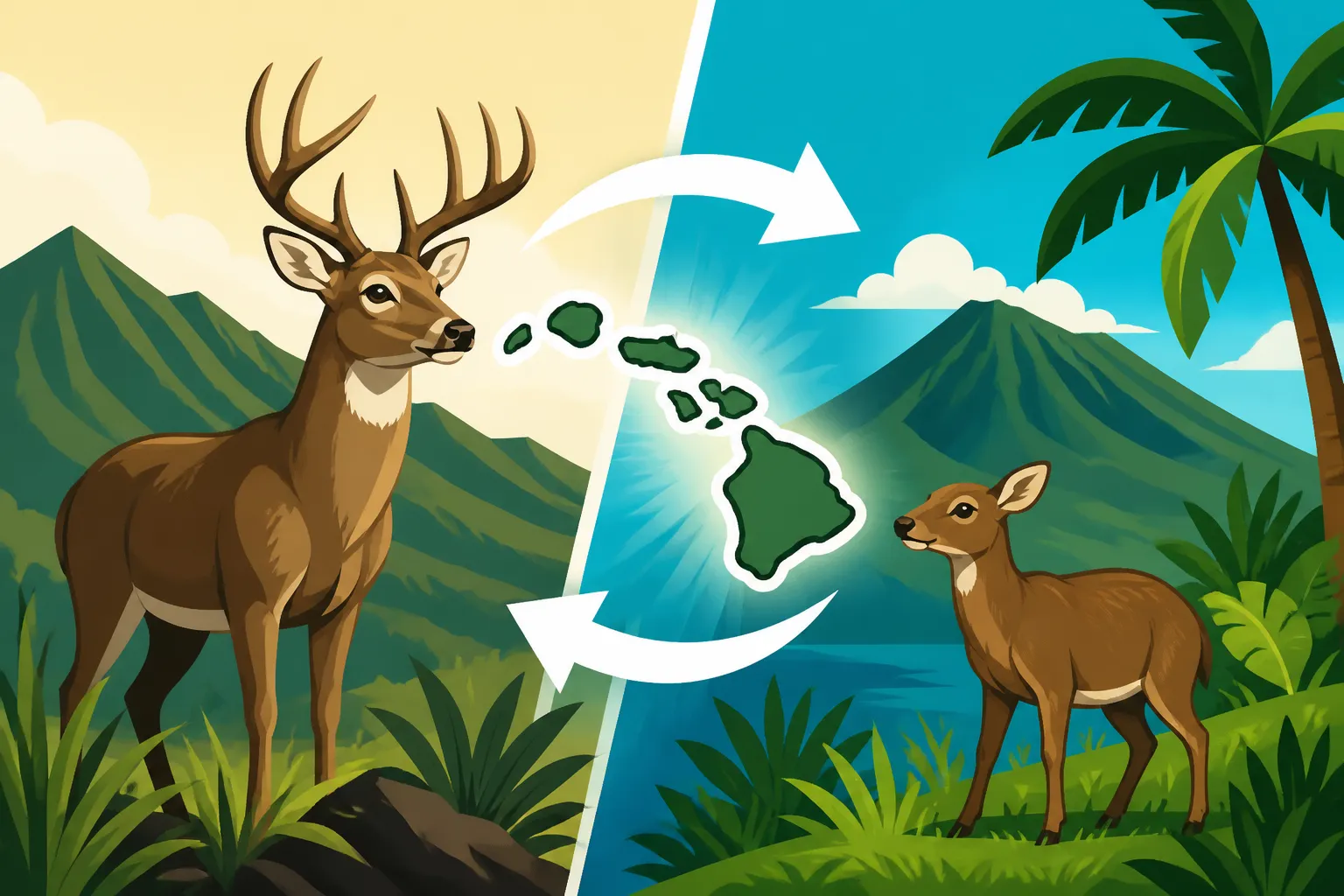
It's a common question I get from hunters planning their first trip to Hawaii, or even seasoned local hunters who are just starting to notice the nuances: why do the game animals here often look, well, different? You see pictures of massive mainland whitetails or colossal wild hogs, and then you encounter an island axis deer or a feral pig, and something just feels… scaled differently. You're not imagining it. The truth is, Hawaii's unique island environment profoundly impacts how its introduced game animals grow, from body size and antler development to horn length and tusk mass. This guide will dive deep into the fascinating reasons behind these differences and what they mean for you as a hunter.
The Unique Pressures of Island Ecosystems on Game
When an animal population is introduced to an island, especially one as isolated and geologically distinct as Hawaii, it enters a completely new evolutionary playground. The pressures and opportunities are vastly different from those on a large continental landmass, leading to observable changes in growth patterns and overall animal characteristics over generations. It's a natural phenomenon, and understanding it helps us appreciate the resilience and adaptability of these creatures.
Limited Resources and Carrying Capacity
One of the most immediate and impactful factors on island game growth is the sheer limitation of resources. Islands are finite. They have a specific amount of land, a fixed array of forage, and a limited supply of fresh water, especially in Hawaii's often dry, leeward areas. This isn't like the vast expanses of the mainland where animals can migrate hundreds of miles to find better forage or escape drought. Here, if the grass isn't green or the waterhole is dry, their options are incredibly restricted.
Think about a small pasture on Maui versus an immense agricultural field in the Midwest. While Axis deer might thrive initially on lush island forage, sustained high populations inevitably strain the environment. When there are too many mouths to feed, every animal competes more intensely for every blade of grass, every fallen fruit, every drop of water. This constant competition for limited nutrition means that individual animals might not reach their full genetic potential for size or antler growth, simply because the energy isn't available to build larger bodies or impressive racks. It's a continuous balancing act between population numbers and the land's ability to support them, and the animals' growth reflects that struggle.
Lack of Natural Predators
This might seem counterintuitive at first glance. You'd think a lack of predators would lead to bigger, healthier animals, right? In some ways, it does: more animals survive to maturity. However, the absence of apex predators like wolves, bears, or mountain lions on Hawaii's islands has a cascading effect that circles back to resource availability. Without these natural population controls, game animal numbers can often swell beyond what the fragile island ecosystem can sustainably support.
When populations boom, they quickly overgraze their habitat. This overgrazing degrades the quality and quantity of available food for all animals. So, while an individual might not face the immediate threat of a predator, it faces the chronic stress of food scarcity due to high population density. This persistent nutritional stress, generation after generation, can lead to smaller average body sizes and less impressive antler or horn development. The animals are constantly just getting by, rather than having an abundance of resources to invest in maximum growth. It's a tough trade-off, and one that Hawaii's ecosystem grapples with daily. Why Hawaii Game Animals Have No Predators touches on this in more detail.
Genetic Bottlenecks and Adaptation
Many of Hawaii's game animals, like the Axis deer or Mouflon sheep, were introduced with a relatively small founding population. This creates what's known as a "genetic bottleneck." When only a few individuals start a new population, they carry only a fraction of the genetic diversity present in the original, larger mainland population. Over time, this limited gene pool means less variation in traits, including those related to growth potential.
While island animals do adapt to their new environment – evolving to be hardier, more efficient foragers in specific habitats – this adaptation often favors survival over sheer size. For example, an animal that is slightly smaller but can survive on tougher forage might out-reproduce a larger animal that requires more abundant, richer food. These adaptations can subtly shift the average growth potential of the population. It's not about being "inferior," but about being perfectly suited to the specific challenges of island life. Sometimes, this means being a bit more compact, more agile for traversing steep gulches, or more efficient at converting sparse vegetation into energy. This unique evolutionary path can result in animals that simply don't have the genetic blueprint to grow as large as their continental cousins, regardless of how much food is available.
Environmental Factors Shaping Growth in Hawaii
Hawaii isn't just "an island"; it's a collection of incredibly diverse microclimates and terrains, each with its own set of environmental variables that can dramatically influence animal growth. From lush, wet rainforests to arid, rocky lava flows, the conditions change drastically, and so do the animals living within them.
Climate and Vegetation Zones
Hawaii's islands are famous for their distinct climate zones, often separated by just a few miles. You can go from a wet, windward rainforest to a dry, leeward desert in a short drive. These zones dictate the type and abundance of vegetation available for game animals.
In the drier leeward areas, like much of Maui's Axis deer country or the lower slopes of Mauna Kea where goats roam, forage can be sparse and tough. Animals here often graze on kiawe pods, dry grasses, and whatever drought-resistant shrubs they can find. This type of forage, while sustaining, might not provide the rich protein and mineral content necessary for maximum growth. As a result, animals in these drier zones might exhibit smaller average body sizes and less robust antler or horn development. The nutritional demands of producing large antlers or putting on significant body mass are high, and if the diet is consistently marginal, the growth potential will be limited. This is a common challenge for hunters, as even a mature buck in a dry zone might not match the size of a younger animal from a more fertile area. Hunting Hawaii's Dry Kiawe Forest showcases some of these challenges.
Conversely, in the wetter, more fertile zones – think of the deep gulches on the Big Island or parts of Oahu's forest reserves where pigs thrive – vegetation is abundant and often more nutrient-rich. Pigs in these areas, for example, might have access to a wider variety of fruits, roots, and invertebrates, allowing them to pack on more weight. However, even in these lush environments, the sheer density of vegetation can limit the quality of browse, as many species are invasive and not highly nutritious, or too tall to be easily reached. The dense canopy can also restrict sunlight, further reducing the nutritional value of undergrowth.
Water Availability and Quality
Water is life, and in Hawaii, consistent access to clean water is a critical factor for game animal growth. Many parts of the islands experience prolonged dry seasons, making water sources incredibly valuable and often hotly contested. Animals that spend their lives constantly searching for water are expending valuable energy that could otherwise go towards growth.
When water is scarce, animals may congregate around limited waterholes, increasing competition and stress. Drought conditions can drastically reduce the succulence of forage, making it less palatable and less digestible, even if it's technically "available." This means animals are essentially trying to extract nutrients from dry, fibrous material, which is much harder on their systems. How Drought Moves Hawaii Game Animals explores this in detail. Furthermore, the quality of water can also play a role. Natural springs or rainwater catchments are ideal, but if animals are forced to drink from stagnant pools or brackish sources, it can affect their overall health and ability to thrive, ultimately impacting their growth potential. A hunter using a service like GoHunt to scout units can often pinpoint known water sources, which are prime areas to find healthy animals.
Volcanic Terrain and Nutritional Impact
Hawaii's volcanic terrain is stunningly beautiful, but it presents unique challenges for game animals. From razor-sharp a'a lava fields to nutrient-poor cinder cones, the landscape itself influences what can grow and, by extension, what animals can eat.
Lava flows, especially newer ones, offer very little in terms of forage. Animals traversing these areas must be incredibly hardy and resourceful. While some pioneering plants do take root, the overall biomass and nutritional density are low. This forces animals to travel further and expend more energy for less caloric return. The soil itself, derived from volcanic ash and weathered rock, can be rich in some minerals but deficient in others, leading to a potentially imbalanced diet over generations. For example, specific trace minerals crucial for antler development might be less available in certain volcanic soils.
Even in older, more vegetated areas, the steep, uneven terrain means constant exertion for animals. Climbing in and out of gulches, navigating rocky ridges, and moving through dense brush all burn calories. An animal that spends its life on such challenging ground might allocate more of its energy budget to maintaining muscle and navigating its environment rather than packing on maximum body fat or growing the largest possible antlers. Hunting Hawaii's Volcanic Terrain truly brings this into perspective. This constant physical demand subtly shapes the animals, making them incredibly tough and lean, but sometimes at the expense of sheer bulk.
Specific Examples: How Hawaii's Iconic Species Are Affected
Let's look at how these general principles manifest in the specific game animals you'll find here in Hawaii. It helps to ground the theory in tangible examples that hunters often encounter.
Axis Deer: Size and Antler Development
Axis deer are a prime example of island adaptation. While they were introduced from India, a land of predators and diverse habitats, their Hawaiian life is markedly different. On islands like Maui and Molokai, where Axis deer populations can be very high, the limited forage and water resources often mean bucks, on average, don't reach the massive body sizes or antler scores seen in certain populations in Texas or even their native range.
You'll find that What an Axis Buck Weighs varies significantly by island and even by unit. A Molokai buck might consistently be larger-bodied than a Maui buck due to different population densities and habitat types, even if antler size isn't always proportionate. The constant pressure of high numbers means that while there are still impressive bucks, the average animal might be smaller, and their antlers may be less symmetrical or robust than a deer from a low-density, nutrient-rich continental environment. You'll observe a lot of variation in antler drop and velvet cycles too, which is unique to Axis deer in Hawaii, further showcasing their adaptation to a year-round breeding cycle rather than a strict seasonal one.
Feral Pigs: Weight and Tusk Growth
Hawaii's feral pigs are another fascinating case study. These animals, a mix of Polynesian pigs and later European boar introductions, have carved out a niche in almost every habitat imaginable, from dry kiawe flats to dense rainforests. What a Hawaii Feral Boar Weighs can vary wildly. A pig from a lush, wet gulch on the Big Island with abundant taro and fruit might be a true monster, weighing well over two hundred pounds. However, a pig from a drier, more marginal area might be considerably smaller and leaner, simply because the consistent food sources aren't there to fuel massive growth.
Their tusk development also reflects their environment and genetics. While some boast impressive cutters, the average tusk length can be influenced by diet, age, and genetics. Pigs that consistently eat soft forage or dig in rich soil might have less tusk wear than those rooting in rocky, abrasive ground. The constant search for food and the tough terrain often produce animals that are incredibly muscled and agile, but perhaps not as universally large as some of their continental counterparts. Tracking their movements and finding their feeding grounds, often assisted by detailed unit maps from resources like GoHunt, is key to targeting larger animals. What Feral Pigs Eat in the Islands has more on this.
Mouflon and Goats: Body Mass and Horns
Mouflon sheep, primarily found on the higher slopes of Mauna Kea on the Big Island, and feral goats, ubiquitous across many islands, also show distinct island growth patterns.
For Mouflon, living in the thin air and sparse mamane-naio forest of Mauna Kea is a brutal existence. Where Mouflon Feed on Mauna Kea will tell you how tough it is. They are adapted to this harsh environment, often appearing leaner and more compact than their European ancestors. What a Hawaii Mouflon Ram Weighs reflects this, typically being smaller than many continental sheep species. Their horns, while often beautiful and tightly curled, might not achieve the sheer mass or spread seen in other wild sheep, again due to the consistent energy deficit imposed by their high-altitude, resource-limited environment. The constant battle against high winds, cold temperatures, and limited forage means survival and reproduction are prioritized over excessive horn growth.
Feral goats, meanwhile, have mastered survival on Hawaii's incredibly steep and rocky terrain, including How Goats Survive on Hawaii Sea Cliffs. They are masters of converting sparse, tough vegetation into energy. While impressive billies with long, sweeping horns are definitely present, What a Hawaii Feral Goat Weighs shows they are generally lean animals. The constant climbing and precarious footing demand a strong, agile, and often lighter build, rather than bulky mass. Their horn growth is more a testament to their incredible resilience and ability to scrape by on almost nothing, rather than an indication of abundant resources.
Implications for Hunters: What to Expect in the Field
Understanding these differences isn't just academic; it directly impacts your hunting expectations and strategies when you're out in Hawaii's diverse units.
Adjusting Expectations for Trophy Size
The most important takeaway for any hunter coming to Hawaii, especially those from the mainland, is to adjust your trophy expectations. A "trophy" animal in Hawaii is often defined differently than on a continent. While you absolutely can find truly exceptional animals—big-bodied boars, wide-antlered axis bucks, and rams with impressive full curls—they might not always match the sheer scale of animals found in other regions with richer ecosystems and lower population densities.
Instead of focusing solely on Boone & Crockett scores, consider the context: the incredible challenge of hunting these animals in Hawaii's unique and often punishing terrain. The effort, the adventure, and the experience of pursuing a wild animal in such a wild and beautiful place become the true measure of the "trophy." Appreciate the animal for its resilience and for the story it tells of survival in a truly one-of-a-kind environment.
Understanding Seasonal Changes in Growth
Even within Hawaii's consistent tropical climate, seasonal changes in rainfall and temperature play a huge role in forage quality and, consequently, animal growth. A dry season can quickly turn lush areas into brown, sparse grazing lands, impacting animal condition almost immediately. You might find that animals are leaner and less robust after a prolonged drought, while a period of good rain can lead to a surge in forage and better animal health.
For Axis deer, while they technically rut year-round, peaks in breeding activity often correlate with periods of better forage, influencing when bucks are in hard antler. Understanding these micro-seasonal shifts, which you can often track through local reports or by checking the detailed conditions for different units on sites like GoHunt, can inform your hunt timing. If you're chasing pigs, targeting the wet season might put you onto areas with more abundant rooting opportunities and heavier animals. Hunting Hawaii's Game Mammal Seasons gives a good overview of when and where to expect these conditions.
Hunting Strategies for Island Animals
Given these differences in growth and the environmental factors at play, specific hunting strategies become even more critical here.
- Focus on Health and Age: Instead of just antler width, learn to identify signs of overall health and maturity in island animals. A healthy, older animal, even if not the largest in terms of sheer antler score, represents a significant accomplishment in a resource-limited environment. Look for indicators like overall body mass, neck size, and horn or antler integrity.
- Target Resource Hotspots: Knowing that resources are limited, successful hunters often focus on areas where those resources are most concentrated. This means scouting for reliable water sources in dry country Hunting a Water Source in Dry Hawaii Country, finding lush gulches with abundant forage for pigs Hunting Pigs in Hawaii's Rainforest Gulches, or locating specific food trees that drop fruit during certain times of the year. The online maps provided by platforms like GoHunt can be invaluable for identifying these areas within specific hunting units.
- Adapt to the Terrain: The physical demands of hunting in Hawaii are no joke. Whether you're Walking Rough Lava Without Wrecking Your Boots or navigating Hunting a Steep Windward Gulch, physical fitness is paramount. Animals that thrive in this environment are incredibly adept at moving through it, so your tactics need to match their agility. Spot-and-stalk often involves long, arduous hikes and careful navigation of tricky terrain.
- Embrace the Unpredictable: Island ecosystems can be more volatile. Droughts can hit hard, local weather patterns can shift rapidly, and animal movements can change quickly based on localized forage conditions. Being adaptable and open to changing your plans based on what you observe in the field is a hallmark of a successful Hawaii hunter. The animals are constantly adapting, and so should you.
| Animal Species | Average Continental Size (Male) | Average Hawaii Size (Male) | Key Growth Influencers in Hawaii |
|---|---|---|---|
| Axis Deer | 150-250 lbs (body), 30-40" antlers | 100-200 lbs (body), 20-30" antlers | Limited forage, high population density, year-round rut |
| Feral Pig | 200-400+ lbs (body) | 100-300 lbs (body) | Diet variability (wet vs. dry forest), genetics |
| Mouflon Sheep | 100-150 lbs (body), 25-30" horns | 70-120 lbs (body), 20-28" horns | High altitude, sparse forage, harsh climate |
| Feral Goat | 150-250+ lbs (body), large horns | 70-150 lbs (body), long horns | Coastal cliffs, dry forage, constant exertion |
This table provides a general comparison. Actual sizes will vary widely based on specific locations, age, and individual animal health.
Disclaimer
This article is for general informational purposes only and does not constitute professional advice. Laws, prices and regulations vary by location and change over time. Consult a qualified professional for guidance on your specific situation.