How Elevation Changes Hawaii Game Behavior
Hawaii's diverse landscapes are truly a marvel, offering hunters everything from dry, cactus-studded plains to misty, dense rainforests, often within just a few miles. But this incredible variety, while beautiful, also presents a unique challenge: the behavior of our game animals changes dramatically with elevation. This guide will walk you through how altitude impacts everything from where animals live and what they eat, to their daily routines and how you, as a hunter, need to adapt your strategy to find success in the islands' vertical world.
Understanding Hawaii's Vertical Zones and Their Impact on Game
When you think about hunting in Hawaii, it's easy to picture a single kind of environment, but the reality is far more complex. Our islands are essentially massive volcanoes rising from the sea, creating distinct ecological zones as you ascend. Each zone has its own climate, vegetation, and, consequently, its own population of game animals, all behaving differently based on the challenges and opportunities their elevation presents.
Coastal Lowlands and Dry Kiawe Forests
Down near sea level, especially on the leeward sides of the islands like parts of Maui, Molokai, and the Big Island, you'll find expansive stretches of dry kiawe forest and open, often sun-baked, grasslands. This is a common haunt for Axis deer and feral goats, as well as some resilient pigs. The temperatures here are consistently warm, sometimes scorching, and water is often the limiting factor.
Animals in these lowlands have adapted to conserve water and tolerate heat. You'll often find Axis deer bedding down in the dense shade of kiawe trees during the hottest parts of the day, emerging at dawn and dusk to feed and drink. Goats, with their incredible agility, will navigate the rocky, arid slopes and gulches, finding sparse forage that other animals can't touch. Hunting in these areas demands early starts, keen glassing, and a deep understanding of where water sources might be, even ephemeral ones after a rain. Hunting Hawaii's Dry Kiawe Forest is a fantastic resource for diving deeper into these challenging, yet rewarding, environments.
Mid-Elevation Wet Forests and Gulches
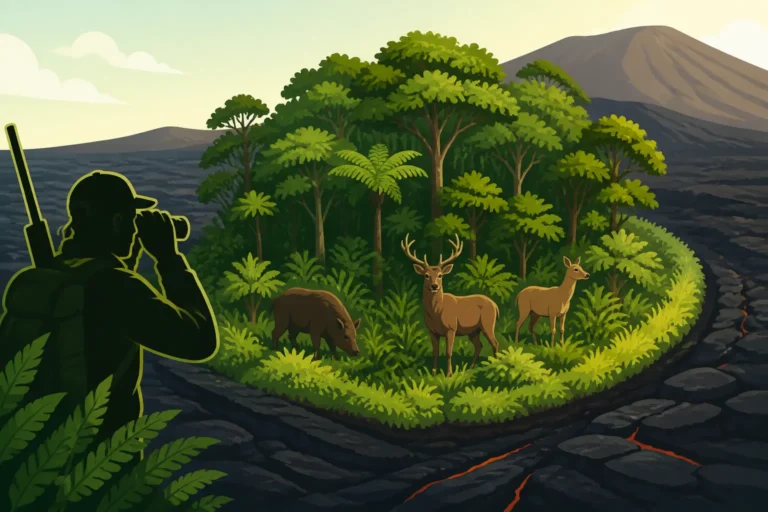
As you gain elevation and move towards the windward sides of the islands or into the central uplands, the landscape transforms. Here, you enter the lush, often perpetually damp world of Hawaii's wet forests. Think dense guava thickets, towering eucalyptus stands, and a labyrinth of steep, fern-choked gulches. This is prime habitat for Hawaii's feral pigs, and you might encounter goats in the rockier, more open patches within this zone.
The constant moisture, cooler temperatures, and abundant undergrowth mean a year-round food supply for pigs, leading to consistent rooting activity. Animals here are often less concerned with water and more focused on finding shelter and forage. The dense vegetation limits visibility, turning hunting into a much more intimate, close-quarters affair. You're less likely to spot animals from a distance and more likely to stumble upon fresh sign or hear them moving through the brush. The physical demands are different too, involving slogging through mud and navigating slippery, uneven terrain. Hunting Pigs in Hawaii's Rainforest Gulches offers excellent insights into mastering this type of terrain.
High-Elevation Alpine and Subalpine Deserts
Ascend even higher, particularly on the Big Island's towering volcanoes like Mauna Kea and Mauna Loa, and you enter a starkly different world: the alpine and subalpine zones. Above the tree line, the air is thin and crisp, temperatures can swing dramatically, and vegetation becomes sparse, dominated by hardy grasses, shrubs, and the iconic mamane tree. This is the exclusive domain of Hawaii's Mouflon sheep and often feral sheep and their hybrids.
Mouflon sheep are perfectly adapted to this rugged, high-altitude environment. Their thick coats protect them from the cold nights, and they thrive on the tough forage found here. Hunting in this zone is a test of endurance and lung capacity. You'll be glassing vast, open expanses of lava rock and cinder cones, often contending with strong winds and rapidly changing weather. Animals here are wary and can spot you from incredible distances, making long-range shooting skills and stealthy approaches paramount. Understanding their feeding patterns around mamane trees is key, as is adjusting to the altitude yourself. Hunting Mouflon in Mauna Kea's Thin Air goes into detail on what it takes to succeed in these challenging conditions.
How Elevation Influences Specific Game Species
Each game animal in Hawaii has its preferred elevation range, but even within those preferences, their behavior shifts depending on the specific altitude and microclimates they encounter. It's not just about where they live, but how they live at different heights.
Axis Deer Behavior Across Elevations
Axis deer, primarily found on Maui, Molokai, and Lana'i, are generally creatures of the drier, lower to mid-elevation lands. They thrive in open grasslands, kiawe forests, and pasture edges where browse is plentiful. However, even these deer demonstrate elevation-dependent behavior. During prolonged dry spells in the lowlands, herds might push higher into cooler, slightly wetter mid-elevation zones to find succulent forage or reliable water sources.
Their rut, while generally year-round in Hawaii, can see peaks that correlate with localized rainfall patterns, which are inherently tied to elevation. For instance, a band of rain at 2,000 feet might trigger a flush of new growth, concentrating deer there even if lower elevations are parched. Bucks will follow the does, meaning hunters need to think vertically when considering rutting activity. You might find them in thick guava patches at 1,500 feet if the feed is good, even though they're more commonly associated with the open flats below. Spotting and stalking becomes a different game when the cover changes from sparse kiawe to dense mid-elevation brush. Reading Axis Deer Sign in Dry Country will help you decipher their movements regardless of elevation.
Feral Pig Adaptations to Different Altitudes
Feral pigs are perhaps the most adaptable game animal in Hawaii, capable of thriving from sea level pineapple fields all the way up to dense ohia forests at 7,000 feet. However, their daily routines and what they're foraging for vary significantly with elevation. In the lower, drier zones, pigs often become highly nocturnal, seeking out water sources under the cover of darkness and bedding deep in the thickest, shadiest gulches during the day. Their diet might include fallen fruit from kiawe or mango trees, and they'll root for tubers in irrigated pastures.
As you move into the cooler, wetter mid-elevations, pigs can be more active during daylight hours, especially on overcast or rainy days. The dense rainforest provides constant cover and an endless buffet of roots, worms, and fallen fruit. Their rooting patterns change, often becoming more widespread and less concentrated around specific water sources. Above 4,000 feet, where the forest thins and temperatures drop, their activity might again shift, focusing on more temperate plant species and finding thermal cover. Understanding these dietary and activity shifts is crucial for successful pig hunting. Hunting Hawaii's Feral Pigs provides a broader overview of pig hunting that can be layered with these elevation insights.
Mouflon Sheep and High-Altitude Living
Mouflon sheep are the undisputed kings of Hawaii's high country, primarily found on the Big Island's Mauna Kea and Mauna Loa. Their entire existence is dictated by the extreme conditions of these elevations. They spend their lives above the tree line, typically between 6,000 and 10,000 feet, in vast expanses of lava fields and sparse mamane-naio forest. Their diet consists almost exclusively of the hardy, drought-resistant vegetation found at these heights, particularly mamane pods and leaves, which are rich in protein.
These animals have evolved to handle significant temperature fluctuations, from freezing nights to warm, sunny days, often all within a single 24-hour period. Their excellent eyesight and keen sense of smell are honed by living in open country where predators (like hunters) can be spotted from miles away. When hunting Mouflon, you're looking for specific patterns: rams often hang out in bachelor groups on exposed ridges, while ewes and lambs might be found lower down in the gulches for protection. Their movements are often predictable, tied to available forage and sheltered bedding areas, which are scarce in the high desert. Mouflon Sheep Hunting on Hawaii Island offers more detail on these majestic animals.
Practical Hunting Strategies for Varied Elevations
Successfully hunting across Hawaii's diverse elevations isn't just about knowing where the animals are; it's about adapting your entire approach – from preparation to execution – to the unique challenges each vertical zone presents.
Scouting and Planning for Elevation Changes
Preparation is paramount when you're dealing with such varied terrain. Before you even set foot in a unit, spend time studying topographic maps. Identify significant elevation changes, potential gulches, ridges, and water sources. Look for areas where different elevation zones meet, as these transition zones are often hotspots for game moving between habitats. Online tools and apps like GoHunt can be invaluable for pinpointing specific contours, understanding prevailing wind patterns, and identifying potential travel corridors.
Beyond maps, consider your own physical conditioning. A hunt in the lower, dry kiawe can mean miles of relatively flat, hot walking, while a mid-elevation rainforest hunt might involve intense climbing and descending through thick, muddy terrain. A high-elevation Mouflon hunt is a true test of stamina, where every step feels heavier in the thin air. Scouting a Hawaii Hunting Unit Before Opening emphasizes the importance of this groundwork. Don't forget to account for potential weather changes, which can be far more dramatic and localized with elevation – a sunny morning at sea level can quickly turn into a cold, foggy deluge at 3,000 feet.
Gear Adjustments for Upland vs. Lowland Hunts
Your gear needs to be as adaptable as the landscape. For lowland, dry hunts, focus on lightweight, breathable clothing, wide-brimmed hats, and plenty of water. Sun protection is critical. Footwear should be durable but not necessarily heavy-duty mountaineering boots, perhaps something with good ankle support but designed for hot weather. Good binoculars or a spotting scope are essential for glassing vast open areas.
| Elevation Zone | Clothing | Footwear | Water/Hydration | Key Gear Considerations |
|---|---|---|---|---|
| Coastal Lowlands | Lightweight, breathable, light colors | Durable, breathable hiking boots (low/mid-cut) | High volume (3-4L+), electrolyte mixes | Wide-brim hat, sunscreen, good optics, rangefinder |
| Mid-Elevation Wet | Quick-drying, synthetic layers, rain gear | Waterproof, aggressive tread boots (mid/high-cut) | Moderate (2-3L), water filter | Rain jacket/pants, headlamp, GPS, sharp knife/machete |
| High-Elevation | Layered (base, mid, shell), warm hat/gloves | Sturdy, insulated, waterproof mountaineering boots | Moderate (2-3L), insulated reservoir | Binoculars/spotting scope, wind protection, first-aid |
In mid-elevation wet forests, waterproofing is king. Think rain jackets, waterproof pants, and boots with excellent traction for muddy, slippery slopes. A good headlamp is non-negotiable for navigating dense cover at dawn or dusk, and a reliable GPS device or app is vital for staying found in areas with limited visibility. For high-elevation hunts, layering is crucial. You'll need warm base layers, insulating mid-layers, and a windproof, waterproof shell to contend with the cold and unpredictable weather. Robust mountaineering boots with stiff soles are a must for traversing rough lava. Don't skimp on water, even if it feels cooler, as the exertion in thin air can lead to dehydration. Boots for Hawaii Lava and Wet Forest provides excellent advice on footwear.
Tactical Approaches for Different Elevation Zones
The way you hunt also needs to change with the elevation. In the dry lowlands, especially for Axis deer, early morning and late evening are your prime times. Focus on glassing ridgelines and open flats from a distance, then using spot-and-stalk tactics to close the gap. Wind direction and thermals are paramount here, as they can shift unpredictably. Spot-and-Stalk Tactics on Open Country is a must-read.
For pigs in the mid-elevation wet forests, still-hunting slowly and quietly through dense cover is often the most effective method. Look for fresh rooting, distinct tracks, and rub marks on trees. Listen for their grunts or the sounds of them feeding. A good pig dog team, if you're into that, can also be incredibly effective here, navigating the thick stuff better than any human. Still-Hunting Pigs in Hawaii's Wet Forest details these techniques.
High-elevation Mouflon hunting is often a game of patience and glassing. Find a vantage point, settle in, and systematically scan the vast landscape. Mouflon blend in incredibly well with the lava, so a good spotting scope is invaluable. Once you spot them, a long, careful stalk, often using terrain features for cover, is usually required. Be prepared for long shots due to the open nature of the country.
Environmental Factors and Hunter Considerations
Beyond the game animals themselves, the dynamic environment of Hawaii's vertical landscape presents its own set of challenges and opportunities that hunters must respect and understand.
Thermals, Wind, and Scent Management
One of the most critical, yet often overlooked, aspects of hunting in varied elevations is understanding thermals and wind patterns. Warm air rises and cool air falls. In the morning, as the sun warms the land, air currents tend to rise up the slopes. In the evening, as the land cools, air currents typically fall down the slopes. These thermal shifts are magnified in Hawaii's steep terrain.
This means your scent management strategies need to be constantly adjusted. Hunting pigs in a deep gulch at mid-elevation, for example, might require you to be below the animals in the morning, letting your scent rise above them, then transitioning to be above them in the evening. In high-elevation open country, strong trade winds can dominate, but even here, localized thermals around ridges and valleys can swirl unpredictably. Always try to hunt with the wind in your face or across your body. Ignoring this can quickly alert animals to your presence, especially keen-nosed Axis deer or Mouflon. Hunting Downwind in Hawaii's Shifting Thermals will elaborate on this crucial skill.
Water Sources and Animal Concentration Points
Water is life, and in Hawaii, its availability is often directly tied to elevation and rainfall patterns. On the dry, leeward lowlands, natural water sources are scarce, making any spring, seeping rock face, or even a ranch stock pond a critical congregation point for Axis deer and feral goats, especially during extended dry periods. Hunters who meticulously Hunting a Water Source in Dry Hawaii Country can significantly increase their chances of success here. These spots become pinch points where animals are forced to visit, often at predictable times of day.
As you move up into the wetter, mid-elevation forests, water is generally more abundant. Puddles, streams, and seepages are common, so animals don't need to travel far to drink. Here, water sources might be less of a concentration point for big game and more of an indicator of pig activity, as they love to wallow in muddy areas. In the high alpine zones, water can once again become scarce, particularly after periods of drought. Mouflon might travel significant distances to find snowmelt or small, isolated springs, making those areas high-value targets for glassing. Knowing where these critical hydration points are across the elevation spectrum is a powerful tool in your hunting arsenal, and utilizing mapping services like GoHunt to mark potential water sources can give you a real edge.
Disclaimer
This article is for general informational purposes only and does not constitute professional advice. Laws, prices and regulations vary by location and change over time. Consult a qualified professional for guidance on your specific situation.