Reading Hawaii’s Trade Wind Patterns
There’s nothing quite as frustrating as meticulously planning a stalk, moving like a shadow through the thick kiawe or the wet forest, only to have a sudden, inexplicable shift in the breeze carry your scent right to a wary animal. In Hawaii, where the terrain twists and turns, understanding the wind isn't just helpful – it's absolutely critical for success. This guide will help you decipher Hawaii's complex wind patterns, from the dominant trade winds to localized thermals and how they impact your hunting strategy.
Understanding Hawaii's Dominant Trade Winds
For many hunters, especially those visiting from the mainland, the idea of "wind" might seem straightforward. You check the forecast, get a general direction, and plan accordingly. But in Hawaii, it's rarely that simple. Our islands are small, steep, and constantly interacting with the vast Pacific, creating a meteorological dance that's both beautiful and maddening for a hunter trying to stay concealed.
The Consistent Easterly Push
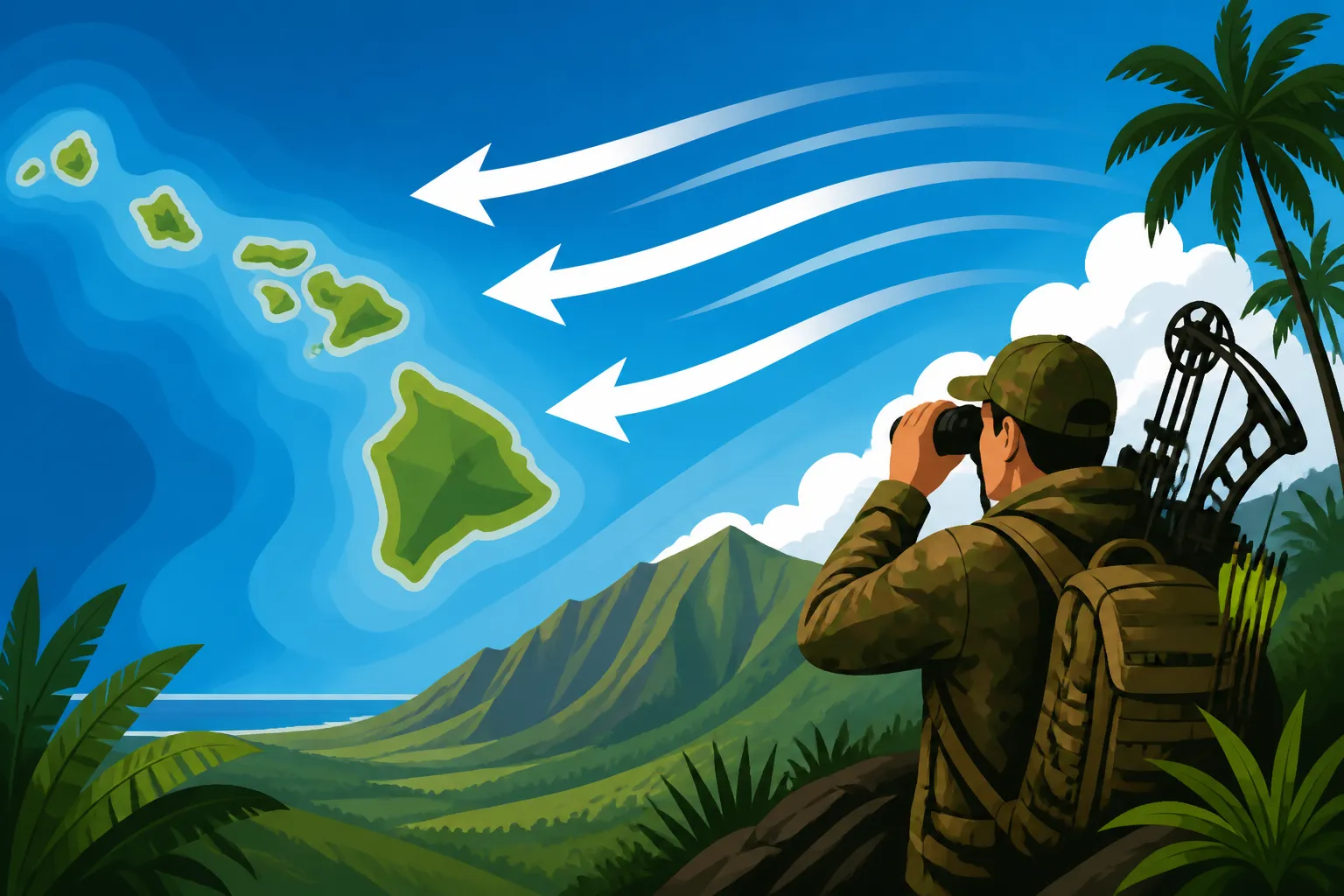
At its core, Hawaii is dominated by the trade winds, which typically blow from the northeast to the east. These aren't just any winds; they're part of a global circulation pattern, driven by atmospheric pressure differences and the Earth's rotation (the Coriolis effect, for those who like the science!). For much of the year, especially during the spring and summer, these trades are remarkably consistent. You'll often feel that steady, warm breeze coming off the ocean, pushing moisture onto our windward (east-facing) slopes, which is why places like Hilo on the Big Island or the Koʻolau mountains on Oʻahu are so wet and lush.
On the leeward (west-facing) sides of the islands, you'll experience what's known as a "rain shadow" effect. The mountains block the moisture-laden trade winds, causing them to drop their rain on the windward side. By the time the air descends on the leeward side, it's drier and warmer. This often means the direct force of the trade winds is also mitigated on the leeward side, but that doesn't mean there's no wind. Instead, the leeward slopes often experience more localized, thermally-driven winds, which can be even more complex. A strong trade wind can feel like a constant, predictable force, but once you step into a gulch or behind a ridge, that predictability can vanish in an instant.
How Terrain Shapes Local Wind Currents
This is where Hawaii's unique volcanic topography really throws a wrench into the works. Even with a strong trade wind blowing steadily across the ocean, once it hits our towering volcanoes and deep valleys, it gets broken up, channeled, and swirled in ways you wouldn't believe. Imagine the massive shield volcanoes of Mauna Loa or Haleakalā, acting like colossal sails, deflecting and accelerating the air.
For example, a trade wind hitting the eastern slopes of Mauna Kea on the Big Island might be a consistent 15-20 mph. But as that air flows over the saddle between Mauna Kea and Mauna Loa, it can create a powerful, localized wind tunnel, often called a venturi effect, increasing the wind speed dramatically. Then, as it spills down the leeward side, it can create chaotic eddies and gusts. The deep, verdant gulches of the Windward Coast or the steep, rocky canyons of Molokai and Kauai are notorious for this. You might have a wind vane showing a steady easterly flow, but down in a deep ravine, the air could be swirling in every direction, carrying your scent up, down, or across with frustrating inconsistency. When you're Hunting Hawaii's Volcanic Terrain or hunting Hawaii's wet forest, these localized effects are even more pronounced and critical to understand.
Recognizing Deviations from the Norm
While trade winds are our "normal," Hawaii's weather is far from static. There are times when these reliable patterns break down, and that's when a hunter needs to be extra vigilant and adaptable. These shifts can turn a straightforward hunt into a game of chess against an invisible opponent.
When the Trades Lie Down or Shift
One of the most significant deviations occurs when the trade winds weaken or disappear entirely. This often happens when high-pressure systems move away from the islands, reducing the pressure gradient that drives the trades. When the trades "lie down," the islands become susceptible to Kona winds. These are typically southerly or southwesterly winds, bringing a completely different weather pattern, often characterized by muggy, humid conditions and, on the leeward side, heavy rains that can last for days.
For a hunter, Kona winds mean throwing out all your assumptions about scent management. Instead of blowing from east to west, the wind could be coming from the south or southwest, changing everything about your approach. The air can feel heavy and still, then suddenly gust in an unexpected direction. These periods are particularly tricky because the wind can be very light and variable, especially in sheltered areas. This is when local thermals – the rising and falling of air due to temperature differences – become the dominant force, making it incredibly difficult to Hunting Downwind in Hawaii's Shifting Thermals.
The Impact of Low-Pressure Systems
Beyond the weakening of trades, approaching low-pressure systems, especially tropical depressions or hurricanes (though rare to hit directly, their outer bands often affect us), can completely override established wind patterns. These systems bring not just rain, but often strong, sustained winds from unusual directions, sometimes shifting wildly over a short period. Imagine stalking through a patch of Hunting Hawaii's Dry Kiawe Forest when the wind suddenly whips from north to south, then back again, carrying your scent everywhere.
During these events, winds can be exceptionally gusty and unpredictable. They can intensify rapidly, making glassing difficult and stalks dangerous on exposed ridges or cliffs. The sheer power of these winds can also make animals behave differently, often hunkering down in sheltered areas, which might change their usual feeding or bedding patterns. It's during these times that safety becomes paramount, and sometimes, the smartest move is to postpone the hunt. Always check the local weather advisories before heading out, especially if you see any indication of a tropical system in the forecast.
Practical Strategies for Wind Assessment While Hunting
Knowing what the wind might do is one thing; understanding what it is doing right now, right here is another. Hawaii's microclimates mean that a general forecast, while a good starting point, won't tell you the whole story. You need to become a master of ground-level observation.
Using Visual Cues in the Field
The most reliable way to assess wind in Hawaii is to pay close attention to your surroundings. Nature is constantly giving you clues:
- Vegetation Movement: Look at the leaves on the trees, the blades of grass, and any hanging vines. Are they swaying consistently in one direction? Are they just quivering, indicating light, swirling air? In denser areas, watch for the subtle rustle of leaves, even if you can't feel a breeze on your skin. Pay attention to different heights; the wind at ground level might be different from the wind just 10 feet up.
- Dust and Dirt: In dry, dusty areas like those on the leeward sides of Maui or the Big Island, a puff of fine dirt thrown into the air will instantly show you the wind direction. This is especially useful in open country when you're Glassing Lanai's Open Ridgelines or Hunting a Cinder Cone Rim.
- Spiderwebs and Fine Debris: These are excellent indicators of light air movement. A spiderweb gently swaying or a tiny seed floating can reveal a subtle breeze that your skin might not detect.
- Moisture or Steam: In the wetter, cooler parts of the islands, particularly at dawn, watch for steam rising from warm ground or water. Its movement will reveal subtle air currents.
- Clouds and Fog: While not always direct ground-level indicators, low-lying clouds or fog can show wind direction at slightly higher altitudes, which can inform what might be happening on ridge tops.
Beyond these visual cues, carrying a small, lightweight wind checker like a squeeze bottle with fine powder or even a few strands of dental floss tied to your pack can be incredibly effective for checking precise wind direction before making that critical move on an animal.
Leveraging Technology and Forecasts
In today's world, it's tempting to rely solely on your phone for weather information. Apps like AccuWeather, The Weather Channel, or even specialized hunting apps can provide general wind speed and direction for a given area. However, it’s vital to understand their limitations in Hawaii. These apps often rely on broader meteorological models and might not accurately capture the extreme microclimates found here. The wind reported for "Hilo" might be entirely different from the wind deep in a Hunting a Steep Windward Gulch or high up on the slopes of Mauna Kea.
Use these tools for your initial planning and to understand the general prevailing conditions. For instance, if the forecast calls for weak trades and southerly winds, you know to expect more variability. But once you're on the ground, your own senses and observations take precedence. Always remember that No Cell Signal on a Hawaii Hunt is a common reality in many of our remote hunting units, so don't become overly reliant on digital tools. Sometimes, the GoHunt app or the OuterSpatial app are useful for checking into units or looking at boundary lines, but they won't give you real-time micro-wind data.
The Importance of Thermals in Gulches and Valleys
Thermals are perhaps the most misunderstood and challenging aspect of wind for hunters in Hawaii. These are localized air movements driven by temperature changes, and they often dominate wind patterns in mountainous or heavily carved terrain, sometimes completely overriding the broader trade winds.
- Morning Thermals (Up-drafts): As the sun rises and warms the land, the air near the ground heats up and begins to rise. This creates an "up-draft" that pulls air up slopes and out of valleys and gulches. So, if you're hunting at dawn in a deep valley, your scent will likely be carried uphill. This is crucial to remember when planning your initial approach to animals that might be bedding high up or moving down to feed.
- Evening Thermals (Down-drafts): As the sun sets, the land cools faster than the air above it. The cooler, denser air begins to sink, creating a "down-draft" that pushes air down slopes and into valleys. If you're hunting in the late afternoon, your scent will likely be carried downhill or down-valley. This means animals moving up out of a gulch to feed might still get your scent if you're positioned too high above them.
The transition times – mid-morning and mid-afternoon – are often the most unpredictable, as thermals shift. In a place like the Waimea Canyon on Kauai or a deep lava flow kipuka on the Big Island, these thermal shifts can happen quickly and dramatically. Always consider the time of day and the sun's position relative to the terrain when planning your movement, especially in areas with significant elevation changes. This is key for understanding animal behavior, as species like Axis deer or Mouflon sheep often use these thermal currents to their advantage, moving with the wind to detect predators.
Hunting Tactics Adapted to Hawaii's Winds
Now that we understand the various wind patterns, how do we put this knowledge into action? Adapting your hunting tactics to Hawaii's winds is about more than just staying downwind; it's about predicting, reacting, and sometimes, even using the wind to your advantage.
Approaching Animals with the Wind in Mind
Every stalk begins with the wind. The general rule is always to approach an animal from downwind, ensuring your scent doesn't reach them. However, in Hawaii, this is a dynamic calculation.
- The "Rule of Three": In Hawaii, you often have to consider wind from three directions: the prevailing trade wind, localized thermals, and potential swirling eddies. You might be generally downwind of a target according to the broader forecast, but a sudden thermal shift in a gulch or a gust swirling off a ridge can bust you. Always aim for a "cross-wind" approach if a direct downwind path is impossible or too noisy. This gives you a little more leeway if the wind shifts slightly.
- Predicting Animal Movement: Animals in Hawaii are experts at using the wind to their advantage. Axis deer, for example, will often bed down with the wind at their back, allowing them to detect danger in front of them visually, while their nose covers their rear. Pigs might bed in thick cover, relying on their incredible sense of smell. Reading Axis Deer Sign in Dry Country can give you clues about their bedding and feeding areas, which helps predict where they might be relative to the wind. Plan your approach to intercept them when they are moving into or across the wind.
- Stand Placement: If you're still-hunting or taking a stand, consider placing yourself so that any likely approach of the animal puts them into the wind, but you remain undetected. This often means finding a point of advantage that uses the terrain to channel the wind, providing a consistent flow for your scent. In open country, like a Hunting a Macadamia Orchard Edge or a dry pasture, this can be easier than in dense jungle.
Dealing with Swirling Winds in Thick Cover
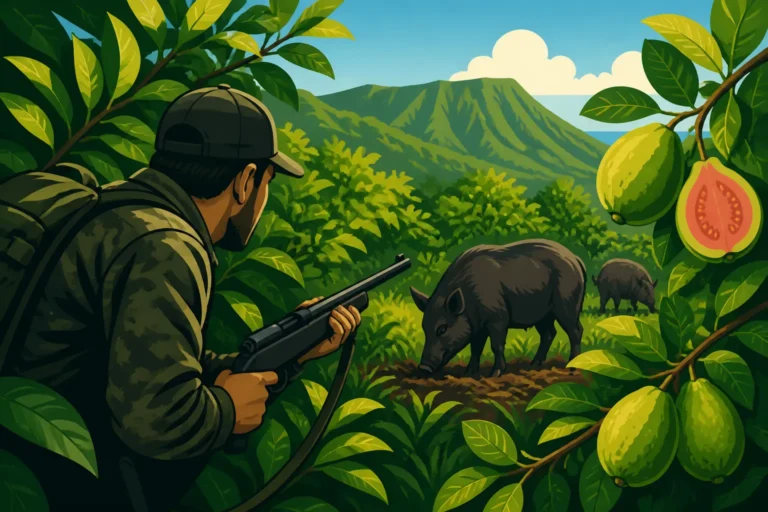
Thick cover, whether it's the dense strawberry guava of a rainforest or a tangled kiawe flat, amplifies the challenge of wind. The canopy can break up direct wind flow, creating localized swirls and dead air pockets that make predicting scent incredibly difficult.
- Slow Down and Observe: In these areas, your movement must be agonizingly slow. Stop frequently, check the wind constantly with a wind checker, and observe the subtlest movements in the vegetation. Don't rush into a thicket assuming the wind will hold.
- Short, Calculated Movements: Instead of long pushes, break your stalk into small, deliberate segments. Advance cautiously when the wind is favorable, then pause and re-evaluate if it swirls. This is where patience is truly a virtue.
- Use Natural Barriers: Look for natural barriers like rock outcrops, large fallen trees, or dense clumps of bushes that might create temporary wind shadows or channel the wind in a more predictable way, giving you a momentary advantage.
- Focus on Sound and Sight: Since scent becomes so challenging, hone your other senses. Listen for the rustle of leaves that might indicate an animal moving, or scan for a twitching ear or a flash of hide. In areas where the wind is truly chaotic, prioritizing visual and auditory detection might be your best bet, while still trying to manage your scent as much as possible. This is particularly true when Still-Hunting Pigs in Hawaii's Wet Forest.
Remember, every hunting unit in Hawaii is different, from Hunting Hawaii's Game Management Areas to the various Forest Reserves. Understanding how the specific terrain of your chosen unit interacts with the prevailing and local winds is a key part of your scouting and preparation.
Here's a quick overview of Hawaii's common wind conditions and their hunting implications:
| Wind Type | Typical Direction | Consistency & Strength | Common Hunting Implications | Tactical Adjustment |
|---|---|---|---|---|
| Trade Winds | NE to E | Consistent, Moderate | Predictable scent drift on open windward/leeward slopes. Stronger on exposed ridges, weaker in deep gulches. | Plan approaches from the west/southwest. Use terrain features (ridges, deep valleys) to your advantage, knowing they can create local variations. Ideal for planning longer stalks. |
| Kona Winds | S to SW | Variable, Light to Gusty | Highly unpredictable scent. Often still and muggy, then sudden gusts. Thermals become dominant. Rain often accompanies. | Prioritize close-range ground observation (leaves, dust). Shorter, more cautious stalks. Double-check wind constantly. Be ready for sudden shifts. Consider hunting sheltered areas where wind might be less erratic. |
| Morning Thermals | Uphill/Up-gulch (daylight) | Light, consistent | Scent carried uphill or out of valleys/gulches. Animals may move down from higher elevations to feed. | Position yourself below animal's likely travel path, or plan uphill approaches with extreme caution. Best to be above a target at first light, as your scent will be carried away. |
| Evening Thermals | Downhill/Down-gulch (dusk) | Light, consistent | Scent carried downhill or into valleys/gulches. Animals may move up from lower elevations to bed. | Position yourself above animal's likely travel path, or plan downhill approaches with extreme caution. Best to be below a target in the evening, as your scent will be carried away from their uphill movement. |
| Low-Pressure/Storm | Highly Variable | Strong, Gusty, Unpredictable | Complete disruption of normal patterns. Extreme shifts, strong gusts. Animals may hunker down. Safety concerns. | Reconsider hunt if conditions are severe. If hunting, stay extremely alert. Focus on sheltered areas. Wind direction changes rapidly – continuous checking is paramount. Prioritize safety over success. |
| Wind Tunnels | Directional (terrain-driven) | Strong, focused | Scent funneled and accelerated. Can create "safe zones" on one side, but intense scent drift on the other. | Identify these terrain features during Scouting a Hawaii Hunting Unit Before Opening. Use the leeward side of the tunnel for approach, but be wary of swirling eddies immediately downwind. |
Navigating Hawaii's winds can be one of the toughest challenges for any hunter, but by understanding the dominant patterns, recognizing deviations, and mastering ground-level assessment, you'll dramatically increase your chances of success. It's a constant learning process, but one that will deepen your connection to the unique and wild landscapes of our islands.
Disclaimer
Hunting in Hawaii carries inherent risks due to rugged terrain, unpredictable weather, and the presence of wild animals. Always prioritize safety, adhere to all local regulations, and be prepared for rapidly changing conditions. The information provided in this guide is for informational purposes only and should not replace proper planning, training, and adherence to Hawaii Department of Land and Natural Resources (DLNR) rules and regulations.