No Cell Signal on a Hawaii Hunt
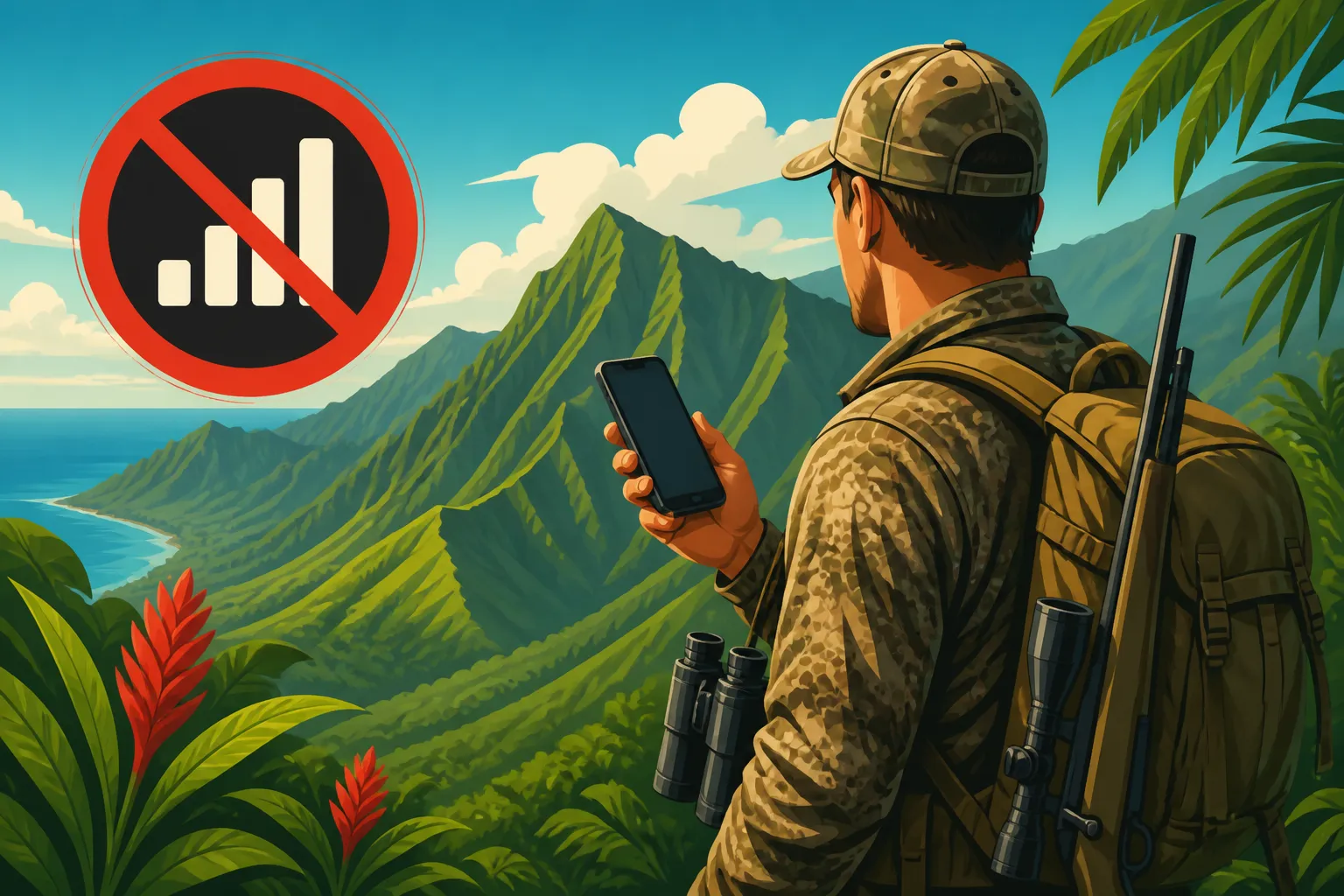
There's nothing quite like the feeling of heading out into Hawaii's stunning, rugged backcountry, gear packed, and ready for a hunt. But that feeling can quickly turn to a pang of anxiety when you look down at your phone and see those dreaded words: "No Service." It's a common frustration here, where the lush, dramatic landscapes that make hunting so incredible also conspire to swallow up your cell signal. This guide is all about helping you prepare for, navigate, and stay safe during a Hawaii hunt, even when your phone is nothing more than a camera in the wild.
The Reality of Losing Signal in Hawaii's Backcountry
Hawaii's beauty often comes hand-in-hand with its isolation. Unlike many mainland areas where a signal might just be spotty, here, it can disappear completely for miles, leaving you in a true communication blackout. It's not just an inconvenience; it's a safety concern that every hunter needs to take seriously.
Why Cell Service Drops Out So Quickly Here
Think about Hawaii's unique geology for a moment. You've got towering volcanic peaks like Mauna Kea and Haleakala, deeply carved gulches that plunge hundreds of feet, and dense, multi-layered rainforests. These features are incredible to behold, but they're absolute nightmares for cell tower signals. Radio waves struggle to penetrate thick vegetation, wrap around steep ridges, or drop into deep valleys. You might have full bars on the main highway, then take a dirt road for five minutes, and poof, your signal is gone.
This isn't limited to specific islands; it's a statewide challenge. On Hawaii Island, imagine hiking into the vastness of the Mauna Loa slopes or trying to track pigs through the dense Puna rainforest. On Maui, the sprawling slopes of Kahikinui or the deep canyons of West Maui are notorious for dead zones. Even on more populated islands like Oahu, once you venture off the main roads into the Waianae Mountains or the Ewa Forest Reserve, you'll find signal quickly becomes a luxury, not a guarantee. Major carriers like Verizon, AT&T, and T-Mobile simply can't cover every inch of this complex terrain. It’s not a failing of your phone or your provider; it’s just the raw, beautiful reality of hunting in such wild, untouched places.
The Dangers of Relying Solely on Your Phone
In our modern world, we're so accustomed to having a phone in our pocket that it's easy to assume it's always there for us. But when you step into Hawaii's hunting units, that assumption can be dangerous. Your phone, without service, is useless for calling for help if you take a bad fall in a steep gulch, get turned around in a dense kiawe flat, or find yourself stuck by a sudden flash flood.
Imagine a scenario: you're Hunting Pigs in Hawaii's Rainforest Gulches on the windward side of the Big Island. The ground is slick, the vegetation is thick, and you slip, twisting an ankle. Or perhaps you're Hunting Goats on Hawaii's Coastal Cliffs on Molokai, and a sudden weather front rolls in, making the terrain treacherous. In these moments, needing to make a call to your hunting partner or emergency services isn't a "nice-to-have," it's absolutely critical. Furthermore, constantly searching for a signal drains your phone battery incredibly fast, leaving you without even your downloaded maps or flashlight function when you need it most. It’s a gamble you simply cannot afford to take when venturing into remote Hawaiian wilderness.
Essential Tools for Off-Grid Navigation and Communication
Since your phone can't be your sole lifeline, it's time to embrace a multi-faceted approach to navigation and communication. Think of it as a safety net, with redundant systems to ensure you're never truly alone out there.
Reliable Navigation Without Bars
The key to navigating Hawaii's hunting units safely is to assume your phone won't have service, and plan accordingly. This means using a combination of modern and old-school tools.
Offline Maps and Digital GPS
Your smartphone can still be an invaluable navigation tool, but only if you prepare it correctly. Before you leave home, make sure to download detailed topographic maps of your entire hunting unit directly to your phone. Apps like Gaia GPS and onX Hunt are fantastic for this. OnX Hunt, in particular, is a favorite among hunters because it clearly delineates public and private land boundaries, which is crucial for Hunting Hawaii's Fenced Conservation Boundaries. Once downloaded, these maps work perfectly even when your phone is in airplane mode, using the phone’s built-in GPS receiver rather than cellular data. This also significantly conserves battery life, allowing your phone to last much longer. When you're in the field, use your phone in airplane mode to navigate; save cellular data for emergencies if you happen to briefly pick up a signal. This way, you always know where you are, where you're going, and how to get back, even if you’re deep in an area like Hunting Hawaii's Kipuka Islands of Forest.
Physical Maps and Compass
As much as we rely on technology, electronics can fail. Batteries die, screens crack, and devices can be lost or water-damaged. This is why a good old-fashioned paper topographic map of your hunting unit and a reliable compass are absolutely non-negotiable backups. Make sure the map is waterproof or stored in a waterproof bag. Learn how to read it and how to use your compass before you're standing in a featureless patch of dense uluhe fern on Kauai. These skills are fundamental for Staying Found in Dense Hawaii Rainforest or when the lava flows make every direction look the same. You can often obtain paper maps from the Department of Land and Natural Resources (DLNR) Division of Forestry and Wildlife (DOFAW) offices or sometimes from local hunting stores and outfitters. Being able to triangulate your position and follow a bearing can literally save your life when everything else goes dark.
Dedicated GPS Devices
While your phone has a GPS, a dedicated handheld GPS unit, like those offered by Garmin, often boasts superior satellite reception, better battery life, and rugged, waterproof construction. Many of these units also come pre-loaded with detailed topographic maps and allow you to mark waypoints, track your route, and easily find your way back to your truck or camp. Some advanced models, such as the Garmin inReach Mini or Alpha, combine GPS navigation with satellite communication capabilities, which brings us to the next critical tool. For those Hunting Hawaii on Foot Without a Truck in truly remote areas, a dedicated GPS device is often preferred for its reliability and durability in challenging terrain.
Emergency Communication Solutions
Once you've tackled navigation, the next step is ensuring you can call for help or communicate with loved ones when a cell signal is nonexistent.
Satellite Communicators
This is arguably the single most important piece of gear for any serious hunter venturing into Hawaii's signal-starved backcountry. Devices like the Garmin inReach series, Zoleo, or Spot X offer two-way text messaging and SOS capabilities anywhere in the world, as long as they have a clear view of the sky. They utilize satellite networks, completely bypassing the need for cell towers. This means you can text your spouse to let them know you’ll be out later than expected, or, crucially, hit the SOS button to alert emergency services to your exact location if you face a serious injury or Emergency Plans on a Remote Hawaii Hunt. Most come with subscription plans that vary based on your anticipated usage, but the peace of mind they provide is priceless. For hunting with dogs, some models even integrate GPS Collars for Pig Dogs in Thick Cover, allowing you to track your canine companions and communicate in one system.
Personal Locator Beacons (PLBs)
Similar to satellite communicators in their ability to send a distress signal, PLBs are generally a simpler, one-way device. They transmit an SOS signal to a search and rescue coordination center, giving your precise location. While they don't offer two-way messaging, they are often smaller, have longer battery lives, and require no subscription fees after the initial purchase. They're a "break glass in case of emergency" tool, less about regular check-ins and more about extreme distress. For those who prioritize a pure, dedicated emergency signal without the bells and whistles of texting, a PLB is an excellent choice.
VHF Radios
For short-range communication with hunting partners, especially if you get separated in dense forest or thick brush, handheld VHF radios can be incredibly useful. These are line-of-sight devices, so their range can be limited in mountainous or heavily vegetated terrain, but within a mile or two, they can be a lifesaver for coordinating movements or calling out if you need assistance. They don't require any subscription or cell service, making them a reliable tool for keeping your hunting party connected. Ensure everyone in your group has one and knows how to use it, especially when navigating tricky spots like Hunting a Hawaii Gulch System.
Smart Preparation and Best Practices for Your Hunt
Knowing what gear to bring is only half the battle. The other half is intelligent planning and adopting responsible habits that maximize your safety and success in Hawaii's challenging, no-signal environments.
Pre-Hunt Planning and Intel Gathering
The work for a safe and successful hunt often begins long before you even step foot in the unit. Meticulous planning is your best defense against the unexpected.
Share Your Plan and Check In
This is paramount. Before every hunt, especially in remote areas, leave a detailed hunting plan with a trusted friend or family member who is staying behind. This plan should include:
- Your specific hunting unit (e.g., Hunting Puu Waawaa's Forest Reserve).
- Your exact entry and exit points.
- Your intended route or areas you plan to cover.
- Your expected return time.
- Who to call (DOFAW, local authorities) if you don't check in by a predetermined time.
- Details of your hunting partners and vehicle information.
This way, if something goes wrong and you can't communicate, someone knows where to start looking. DOFAW also requires hunters to Checking In and Out of Hawaii Hunting Units at designated stations or via the OuterSpatial app, which logs your presence in a unit. However, Using OuterSpatial Instead of a Paper Card for check-in doesn't guarantee your safety if you get lost or injured once you're deep inside the unit. The human element of sharing your plan is a crucial backup.
Scouting and Familiarization
There's no substitute for knowing your ground. If possible, scout your hunting unit beforehand. Even if you can't physically scout, study maps (both paper and digital) intently. Identify prominent landmarks, potential escape routes, water sources, and areas of dense vegetation. Understand the topography – where are the steepest gulches, where are the lava flows, where are the thickest koa forests? Knowing what to expect reduces the chance of getting disoriented. Many of Hawaii's units, particularly those requiring Hunting Hawaii on Foot Without a Truck or accessible only via Reaching a Hawaii Unit by 4WD Road, can be incredibly complex. The more familiar you are with the terrain, the less likely you are to rely solely on a map and compass when the going gets tough.
Battery Management
With multiple electronic devices, battery management becomes critical.
- Phone: Keep your phone in airplane mode as much as possible to conserve battery. Only turn off airplane mode when you might expect a signal or for a quick burst of use.
- Portable Chargers: Carry a fully charged power bank (or two!) to recharge your phone, headlamp, and other USB-powered devices.
- Spare Batteries: For dedicated GPS units, headlamps, and satellite communicators, carry extra sets of fresh batteries.
- Temperature: Cold weather can drain batteries faster, but so can extreme heat. Keep electronics protected from direct sun and extreme temperatures when not in use.
On-The-Ground Tactics and Safety
Once you're out there, mindful practices can make a huge difference in your safety margin.
The Buddy System
Hunting with a partner, especially in remote, no-signal areas, is always a good idea. Not only can you help each other track game or pack out an animal, but you also have an immediate resource if one of you gets injured. Discuss communication protocols before you start hiking: how far apart will you stay, what signals will you use if you lose sight of each other, and what's the plan if you become separated? If you're tackling Hawaii Units That Need a Long Walk In, having a buddy is more than just company; it's a safety imperative.
Marking Your Trail
Whether you're using the track-back feature on your GPS device or leaving subtle, temporary markers, knowing how to retrace your steps is invaluable. A GPS device constantly records your path, making it easy to follow your exact route back to your starting point. In particularly dense or featureless terrain, temporary flagging tape (used sparingly and removed on your way out) can help mark key turns or confusing junctions. The goal is to avoid ever feeling truly lost.
Knowing Your Limits
Hawaii's terrain is deceptively challenging. A short distance on a map can translate to hours of strenuous hiking through thick brush, over jagged lava, or up and down steep gulches. Don't push yourself beyond your physical capabilities or into unfamiliar territory when you're without communication. Be realistic about how far you can travel and return safely before dark, especially if you're Packing Meat Out of a Hawaii Gulch. If a situation feels too risky, trust your gut and turn back. There's always another day to hunt.
Water and Essentials
Even a day hunt can turn into an unexpected overnight stay. Always carry more water than you think you'll need, along with high-energy snacks, a basic first-aid kit, a headlamp, a knife, and emergency shelter (like a space blanket). The tropical heat and humidity in Hawaii can quickly lead to dehydration, and an injury can quickly become life-threatening without basic supplies. Always refer to a comprehensive What to Pack for a Hawaii Hunt list and consider adding extra safety items due to the lack of cell service.
Comparison of Off-Grid Navigation and Communication Tools for Hawaii Hunting
| Tool Type | Pros | Cons | Best Use Case for Hawaii Hunting |
|---|---|---|---|
| Smartphone (Offline Maps) | Familiar interface, readily available, detailed topo/satellite maps, cost-effective (if already owned). | Relies on battery, can be fragile, not designed for harsh environments, no communication without signal. | Primary navigation when pre-loaded with maps (e.g., Gaia GPS, onX Hunt), especially for checking boundaries on public land like the Puu Anahulu Game Management Area. Keep in airplane mode to save battery. |
| Dedicated Handheld GPS | Rugged, waterproof, long battery life, excellent satellite reception, precise tracking and waypoint marking. | Requires learning curve, additional cost, no communication unless integrated. | Primary, reliable navigation in truly remote or challenging terrain (lava fields, dense forests). Ideal for tracking your route and finding your way back to camp. |
| Satellite Communicator | Two-way text messaging and SOS from anywhere, weather updates, track sharing. | Requires subscription, additional cost, can be bulky, minor delay in message transmission. | Essential for communication and emergency alerts in all no-signal areas. Allows check-ins with family, coordination with hunting partners, and Emergency Plans on a Remote Hawaii Hunt activations. Examples: Garmin inReach, Zoleo. |
| Personal Locator Beacon (PLB) | Dedicated emergency device, very long battery life, no subscription after purchase, robust. | Only sends one-way SOS signal, no casual communication or navigation. | Pure emergency backup. For hunters who want the ultimate "push button for rescue" option without the ongoing cost or complexity of two-way communication. |
| Physical Map & Compass | No batteries needed, highly reliable, provides big-picture overview of terrain. | Requires skill to use, can be cumbersome, susceptible to water damage (unless laminated), no real-time position. | Absolute essential backup for all electronic devices. Critical for Staying Found in Dense Hawaii Rainforest or when technology fails. Best when combined with digital maps for planning and understanding Hawaii's Hunting Units and How They Work. |
| VHF Radio | Immediate, direct short-range communication with partners, no signal needed (line-of-sight). | Limited range (especially in rugged terrain), no long-distance or emergency services contact. | For group communication with hunting partners within a few miles, especially in heavy cover or deep gulches where visual contact is difficult, like when Hunting Pigs With Dogs in Hawaii. |
Hunting in Hawaii offers some of the most unique and exciting experiences imaginable, but it demands respect for its wild, untamed nature. The lack of cell signal is not just a minor inconvenience; it's a fundamental aspect of hunting here that requires careful preparation and the right tools. By embracing redundancy in your navigation and communication, sharing your plans, and being acutely aware of your surroundings, you can ensure that your adventures in the islands' stunning backcountry are both thrilling and, most importantly, safe.
Disclaimer
Hunting is an inherently dangerous activity. The information provided in this guide is for informational purposes only and should not be considered a substitute for professional training, comprehensive research, or adherence to all local, state, and federal hunting regulations. Always prioritize safety, practice ethical hunting, and be prepared for emergencies. Conditions in Hawaii's hunting units can change rapidly, and hunters are responsible for their own safety and decisions in the field.