Hawaii’s Two Feral Goat Types
It's a common frustration for hunters in Hawaii to encounter "goats" without fully realizing the distinct differences between the types that roam our islands. While they all fall under the broad category of Capra hircus (feral goat), there are indeed two primary types you'll encounter, each with its own characteristics, preferred habitats, and even subtly different hunting challenges. This guide will dive deep into unraveling the mysteries of Hawaii's two feral goat types, helping you understand their origins, how to identify them in the field, and what to expect when you set out to hunt them.
The Arrival and Impact of Feral Goats in Hawaii
Before we talk about the specific types, it's crucial to understand how goats came to Hawaii and the profound impact they've had on these delicate island ecosystems. They weren't always here, and their introduction set the stage for the hunting opportunities and conservation challenges we face today.
Historical Introduction of Goats to the Islands
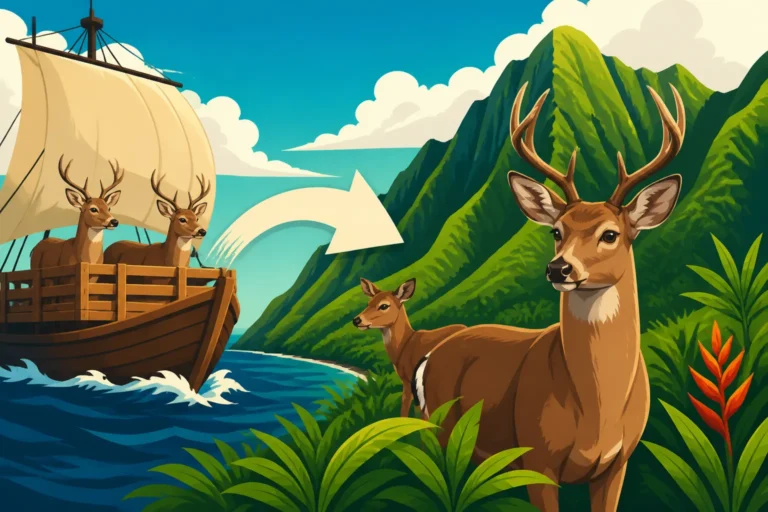
The story of Hawaii's feral goats begins with European contact. While it's often attributed to Captain Cook in the late 1700s, who left goats on various islands as a potential food source for future visitors, other early explorers and settlers also contributed to their spread. These were domestic goats, brought for their meat, milk, and even their hides. However, Hawaii's rugged terrain and lack of natural predators proved to be an ideal environment for them to thrive, and many escaped captivity or were intentionally released.
Unlike mainland big game species that evolved alongside a complex web of predators, these goats faced no such pressures here. They multiplied rapidly, colonizing vast swathes of land, from the dry coastal cliffs to the higher, drier slopes of our volcanoes. This rapid proliferation, combined with their insatiable appetite for vegetation, quickly led to significant ecological problems that continue to this day. They are, unequivocally, an invasive species, and understanding their history helps contextualize their presence and the need for management.
The Ecological Footprint of Feral Herds
The impact of these feral goat herds on Hawaii's unique and fragile ecosystems is nothing short of devastating. Imagine an island ecosystem that evolved for millions of years without large grazing mammals; then, suddenly, an animal that eats nearly everything green is introduced and multiplies unchecked. The consequences are dire. Goats browse indiscriminately, consuming native plants that have no natural defenses against such intense herbivory. They target seedlings and young plants, preventing forest regeneration, which is critical for watershed health.
Their constant grazing strips hillsides bare, especially in arid areas, leading directly to severe soil erosion. When the protective layer of vegetation is gone, heavy rains simply wash away the topsoil, carving deep gully erosion scars into the landscape and carrying sediment into our precious coral reefs. This loss of habitat also impacts native birds and insects, many of which are already endangered. If you want to learn more about this specific issue, I've covered Why Goats Cause Erosion in Hawaii in another post. Hunting feral goats isn't just a sport here; it's a vital act of conservation, directly contributing to the health and recovery of Hawaii's natural environment.
Unpacking Hawaii's Two Primary Feral Goat Types
When most hunters talk about "goats" in Hawaii, they're often lumping two distinct populations together. While they share a common ancestor and are both considered feral, their appearance, and sometimes their preferred habitats, can differ quite a bit due to varying genetic influences over generations.
The Common Feral Goat: A Widespread Grazer
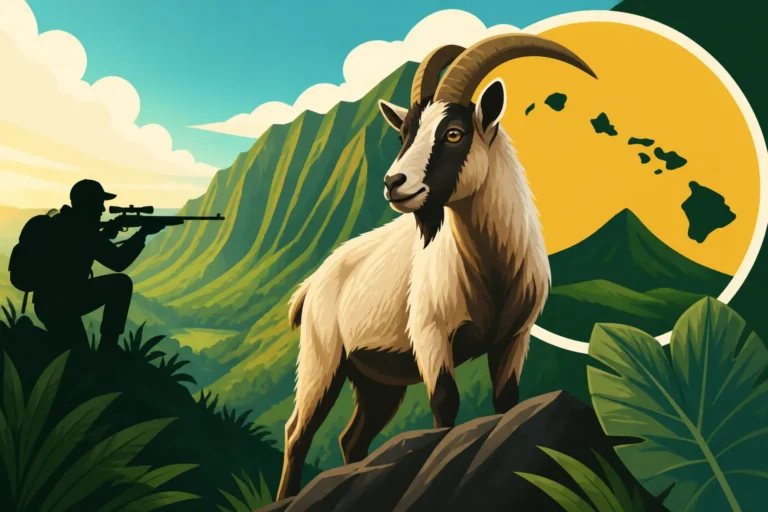
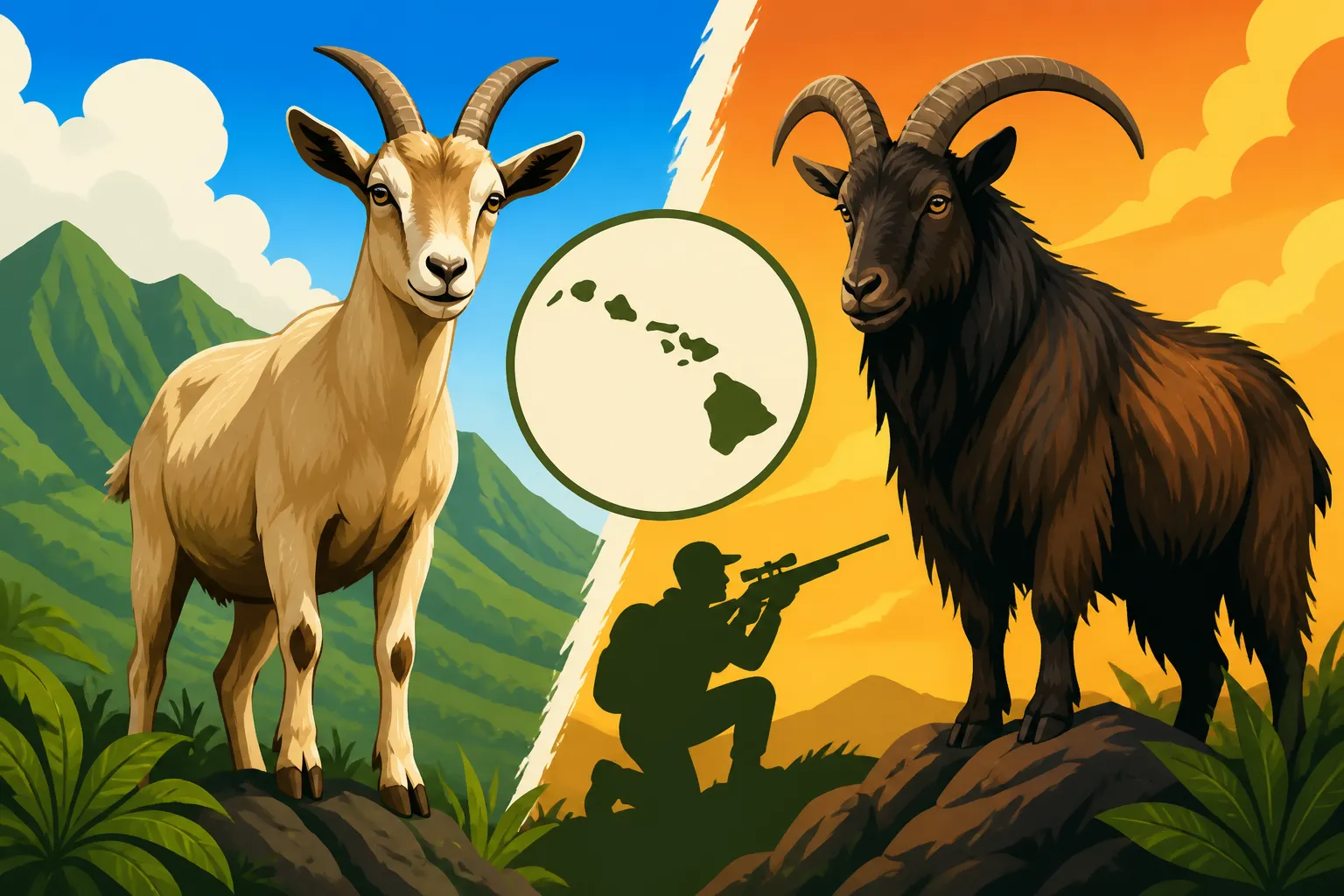
The most commonly encountered feral goat across all the Hawaiian islands is what many simply refer to as the "common feral goat." These animals are descendants of the various domestic breeds initially brought to Hawaii – Spanish, Nubian, Alpine, and other mixed-breed stock. Their appearance can be incredibly diverse, reflecting this varied genetic background. You'll find them in almost any color imaginable: solid black, brown, white, tan, or often a striking mix of colors and patterns, like pinto or spotted. Their coats are typically short and sleek, though some may have slightly longer hair on their back or along their legs.
Their horns also vary widely in shape and size. Most common feral goats will have horns that curve backward, sometimes with a slight spiral, but rarely with the dramatic, tight spirals you see in true wild sheep. These goats are typically stocky and agile, perfectly adapted to navigating the steep, rugged terrain of Hawaii's mountains, gulches, and coastal cliffs. They are the quintessential "mountain goat" of the islands, found in large numbers and providing consistent hunting opportunities in many units.
The Angora Hybrid: A Distinctive Presence
While not a pure Angora, the second distinct type you'll encounter carries clear genetic traits from the Angora goat breed, resulting in what we call an "Angora hybrid." These goats are instantly recognizable by their most striking feature: their long, shaggy, often woolly coat. This luxurious hair, sometimes referred to as mohair, can range from pure white to various shades of cream, gray, or even light brown. It often gives them a much larger, bulkier appearance than their common feral cousins, though their underlying build might be similar.
Beyond the coat, Angora hybrids often exhibit more pronounced, spiraled horns. These horns tend to be thicker at the base and can twist upwards and outwards, sometimes forming impressive, wide-sweeping arcs or tight corkscrews. They are often found in higher, drier elevations, particularly on the Big Island, where conditions might be more favorable for their woolly coats. Spotting a beautiful Angora hybrid ram with a full, flowing coat and impressive horns is often a coveted trophy for hunters, a testament to its unique blend of domestic origins and wild adaptation.
Here's a quick comparison of these two main types:
| Feature | Common Feral Goat | Angora Hybrid Feral Goat |
|---|---|---|
| Appearance | Stocky, athletic build, diverse color patterns | Often appears larger due to long hair, leaner frame |
| Coat | Short, sleek, varied colors (black, brown, white, spotted) | Long, shaggy, woolly (mohair), typically white, cream, or light grey |
| Horns | Backward curving, sometimes with slight spiral, varied size | Thicker, more pronounced spiral, often wide-sweeping or corkscrew |
| Typical Size | Up to 100-150 lbs, though many smaller | Can reach 150-200 lbs, appears larger due to hair |
| Habitat | Extremely adaptable: coastal cliffs, steep gulches, dry forests | Higher elevations, drier slopes, open country, cinder cones |
| Prevalence | Widespread across all islands with goat populations | More localized, particularly noticeable on the Big Island's higher slopes |
| Identification | Visual ID based on color, horn shape, and lack of long hair | Visual ID based on long, shaggy coat and distinctive horns |
Characteristics and Habitats: Spotting the Differences in the Field
Knowing the history is one thing, but being able to differentiate these goats in the field is key for any hunter. Their physical traits, behavioral patterns, and preferred stomping grounds often provide the best clues.
Physical Traits and Behavioral Patterns of Common Feral Goats
The common feral goat in Hawaii is a master of adaptation, which is why you find them almost everywhere. Physically, they are robust and compact, built for agility. Their legs are muscular and relatively short, giving them a low center of gravity that's perfect for scrambling up and down steep cliffs and navigating rocky, uneven terrain. Their hooves are hard and cloven, providing excellent grip on slick rocks and loose soil. As mentioned, their coats are generally short, making them less prone to overheating in the lower elevation, often humid, environments they frequent. Colors truly run the gamut – I've seen everything from jet-black billies resembling devils to piebald nannies with patches of white and brown, and everything in between. Their horns are typically impressive, but usually curve backward and slightly outward, not usually coiling in tight spirals.
Behaviorally, these goats are extremely wary. They live in herds that can range from a handful of animals to dozens, especially in areas with less hunting pressure. They have excellent eyesight and hearing, and they're quick to bolt if they sense danger. When disturbed, they'll often scatter, using the terrain to their advantage, disappearing into thick gulches or scaling seemingly impossible rock faces. Understanding How Goat Herds Move Through a Canyon can be crucial here. They are prolific breeders, and their populations rebound quickly, which is why consistent hunting pressure is so important for ecosystem management. Look for them feeding on a wide variety of vegetation, from grasses and forbs to the leaves and bark of small trees and shrubs. They're often most active in the early morning and late afternoon, though in areas with heavy pressure, they may become more nocturnal.
The Unique Features and Preferred Terrain of Angora Hybrids
Angora hybrids, on the other hand, bring a touch of the exotic to the Hawaiian goat population. Their most obvious distinguishing feature is that long, flowing, often pristine white coat. This mohair can be quite dense and can sometimes get tangled with burrs and debris, giving them a somewhat unkempt but still impressive appearance. While their underlying body structure might be similar to other feral goats, their hair makes them look significantly larger, especially the mature billies. Their horns are often a hunter's delight, forming those distinct helical spirals that can truly add to a trophy. You might find a ram with two or three full turns to his horns, making for a truly spectacular mount.
These goats tend to favor different types of terrain than their short-haired relatives. While they are still incredibly agile and can handle steep country, their dense coats make them more comfortable in cooler, higher-elevation environments that are often drier and more open. On the Big Island, for example, you're more likely to find robust Angora hybrids on the broad, sweeping slopes of Mauna Kea or Mauna Loa, grazing among scattered cinder cones and open pastures, rather than deep in a humid rainforest gulch. This preference for Hunting Hawaii's High Elevation Alpine Ground means hunters need to be prepared for different challenges: thin air, colder temperatures, and vast, open landscapes requiring long-range glassing and shooting. Their visibility due to their light, shaggy coats can be a blessing for spotting them, but also a curse when trying to get close.
Hunting Strategies for Each Feral Goat Type
Just as their characteristics and habitats differ, so too do the most effective hunting strategies for pursuing common feral goats versus their Angora hybrid cousins. Understanding these nuances will significantly increase your chances of success.
Stalking the Agile Common Feral Goats
Hunting the common feral goat often means embracing the rugged, unforgiving terrain they call home. These goats frequently inhabit steep coastal cliffs, deep, tangled gulches, and dry, rocky hillsides. Your primary strategy will often involve a lot of glassing, patient observation, and a methodical spot-and-stalk approach. Because they often live in larger herds, finding them isn't always the hardest part; getting within shooting range without being detected by multiple pairs of eyes and ears is the real challenge. You'll want to use high-quality binoculars or a spotting scope to scan distant hillsides and cliff faces for any movement or tell-tale shapes. Look for them moving at dawn and dusk, when they're most active, or bedding down on a shaded ledge during the hotter parts of the day.
When you spot a herd, assess the wind rigorously. Goats have an incredible sense of smell, and the swirling thermals in Hawaii's gulches and cliff country can be tricky. Always try to approach from downwind, using natural terrain features like ridges, washes, and thick vegetation for cover. Stealth is paramount. Every step needs to be deliberate and quiet. It's often a game of patience, waiting for the herd to move into a favorable position, or for a lone billy to break away. A successful stalk might involve long crawls, careful descents into gulches, or tedious traverses along cliff edges. For specific tactical advice on this kind of hunt, I'd highly recommend reading up on Hunting Goats on a Sea Cliff Safely or Hunting Goats in Hawaii's Canyon Country. Remember, these goats are extremely tough, so a well-placed shot is essential.
Approaching the Wary Angora Hybrids
Hunting Angora hybrids, especially the large, impressive rams, often requires a different mindset and skillset. Their preferred high-elevation, open country means that long-range glassing becomes even more critical. You'll spend a lot of time behind your optics, systematically picking apart vast landscapes, looking for those tell-tale white patches or the distinctive horn curls. Because of the sparse cover, getting within bow range can be incredibly difficult, often making rifle hunting the more practical choice for these animals. You'll want to be proficient with your rifle and comfortable taking shots at extended distances, as opportunities for close-range stalks are often rare.
Once you spot an Angora hybrid, your stalk will likely be less about navigating dense cover and more about covering long distances while staying out of sight in undulating terrain. Think slow, deliberate movements, using every contour, rock, and sparse shrub for concealment. The cool, dry air at higher elevations can also carry sound further, so silence is still key. The sheer scale of the landscape means you might spend hours working your way towards an animal, only for it to move unexpectedly. Patience and perseverance are your best allies. Before heading out, make sure you know the unit rules. Information on seasons, units, and permit requirements can often be found on the GoHunt Hawaii portal, making it easier to plan your high-elevation adventure. Also, being physically prepared for the elevation and strenuous hiking is non-negotiable. Glassing a Hawaii Coastline for Goats has some principles that apply, even though the terrain is different, as the emphasis on distant observation remains.
Management, Conservation, and the Hunter's Role
Understanding the two types of feral goats is not just about hunting preference; it's deeply tied to Hawaii's unique conservation challenges. These animals, regardless of their coat or horn shape, are considered invasive, and their control is a critical component of preserving the islands' fragile native ecosystems.
The Need for Feral Goat Population Control
Hawaii's native flora and fauna evolved in isolation, without large browsing mammals. When goats were introduced, they encountered an environment completely unprepared for their impact. Every bite they take, every seedling they consume, every patch of soil they denude contributes to the decline of native forests and the erosion of precious topsoil. This isn't just an aesthetic issue; it has profound implications for the entire ecosystem, including the watersheds that supply our fresh water and the nearshore reefs that depend on clear ocean water.
Uncontrolled goat populations accelerate the invasion of non-native weeds, which thrive in disturbed soil, further outcompeting native plants. They can also create fire hazards by drying out vegetation and opening up fuel loads. The Hawaiian Department of Land and Natural Resources (DLNR), through its Division of Forestry and Wildlife (DOFAW), actively manages these populations, and hunting is recognized as a vital tool in this effort. Without consistent pressure, goat numbers would quickly spiral out of control, causing irreversible damage to the islands' irreplaceable natural heritage. This is why you'll often see generous bag limits for goats in many units.
How Hunters Contribute to Island Ecosystem Health
Hunters in Hawaii play an absolutely essential role in conservation. By actively participating in feral goat hunts, we directly help manage populations and mitigate their negative impacts on native ecosystems. Every goat harvested contributes to reducing grazing pressure, allowing native plants a chance to recover and forests to regenerate. This isn't just about taking an animal; it's about being an active steward of the land. Our efforts contribute to healthier watersheds, less erosion, and ultimately, a more resilient environment for Hawaii's unique and often endangered native species.
Beyond the harvest itself, hunters also provide valuable data through mandatory reporting requirements. When you use the GoHunt platform or check in at a hunter station, your harvest information helps DOFAW track population trends, understand success rates, and make informed management decisions for future seasons. This feedback loop is crucial for adaptive management. Understanding How Hawaii's Permit-Tag System Works and fulfilling your Harvest Reporting Requirements After a Kill is more than just following the rules; it's part of being a responsible hunter and a conservation partner. By heading out into the field, whether you're targeting a common feral goat on a sea cliff or an Angora hybrid on a high-elevation plain, you're doing your part to protect the very special and unique natural beauty of these islands for generations to come.
Disclaimer
This article is for general informational purposes only and does not constitute professional advice. Laws, prices and regulations vary by location and change over time. Consult a qualified professional for guidance on your specific situation.