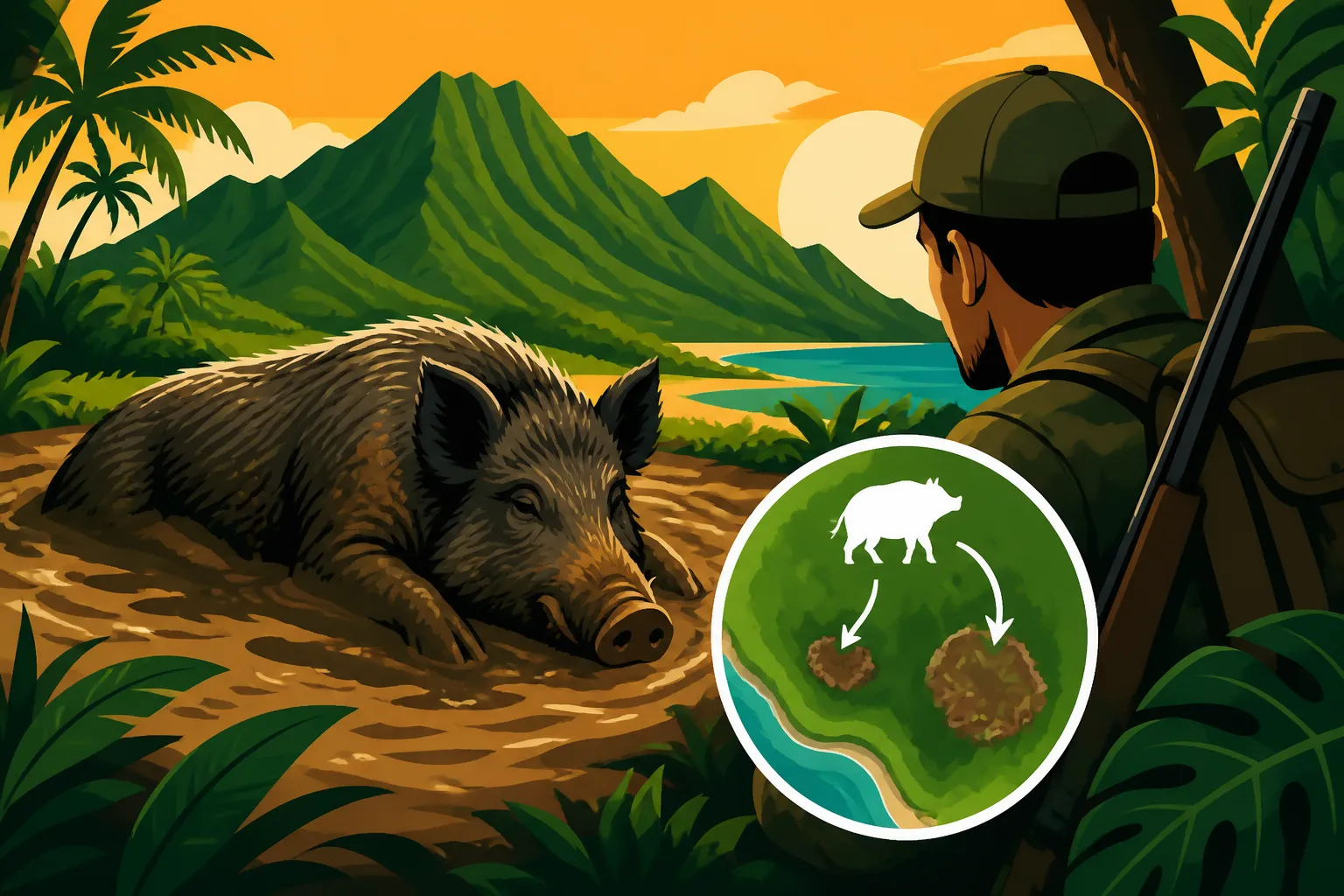
Pig Wallows and What They Tell You
Ah, the elusive Hawaii pig! You spend hours tromping through dense guava thickets or navigating gnarly lava flows, feeling like you're playing a frustrating game of hide-and-seek. One of the best ways to outsmart these wily animals is by becoming a master detective of their sign, and nothing screams "pig was here, and will be again!" quite like a fresh wallow. This guide will dive deep into what pig wallows are, what they tell you, and how to use this invaluable intelligence to put you closer to your quarry.
The Muddy Secrets: Understanding Pig Wallows
When you're out there, boots on the ground, sweat stinging your eyes from the humidity, finding clear, undeniable signs of pigs can feel like hitting the jackpot. Pig wallows are exactly that – a jackpot of information, if you know how to read them. They're more than just muddy puddles; they're essential parts of a pig's life cycle and social behavior in the Hawaiian islands.
What is a Wallow and Why Do Pigs Use Them?
At its core, a pig wallow is simply a depression in the earth, often in a low-lying area, filled with mud or water. Pigs, being the intelligent and adaptable creatures they are, seek these out for several crucial reasons. Firstly, pigs can't sweat effectively to regulate their body temperature like we can. Imagine being covered in thick hair, living in Hawaii's tropical heat and humidity, with no real way to cool down! Wallowing in cool mud is their natural air conditioning system. It helps them shed excess heat, especially after a long night of foraging or during the midday sun.
Beyond temperature regulation, wallows serve as a critical defense against parasites. The thick mud acts like a natural armor, caking onto their skin and suffocating external pests like ticks, mites, and even some biting insects. As the mud dries and they rub against trees, fences, or rocks, it helps slough off not just the mud but also the irritating parasites with it. It's their version of a spa day, crucial for their comfort and health. Furthermore, wallows can be territorial markers, communicating presence to other pigs, and often serve as social hubs, indicating areas where sounders (groups of pigs) congregate.
Hawaii's Climate and the Importance of Wallows
The unique climate and terrain of Hawaii make pig wallows particularly telling. From the damp, lush forests of the windward sides to the dry, arid leeward slopes, the need for pigs to find water and mud is constant, though expressed differently. On the wet, windward side, like parts of the Hilo Forest Reserve Country on Hawaii Island or the rainforest gulches on Maui, wallows are abundant. You'll find them in stream beds, seepages, or even just low spots where rain collects. Here, the challenge isn't finding a wallow, but discerning which ones are actively used versus those that are just perpetually muddy.
Conversely, on the dry, leeward sides, such as the kiawe flats of Lanai or the dry slopes of Mauna Kea's lower elevations, a wallow becomes a goldmine. In these arid environments, any natural water source is a magnet for pigs, and a wallow near one signals a high probability of activity. Pigs will often travel significant distances to reach these crucial mud holes, making them focal points for hunting strategy. The scarcity of water in these areas means that any wallow, especially a fresh one, is likely a regular stop on a pig's circuit. Understanding these environmental differences helps you interpret the wallow's story more accurately.
Decoding the Freshness: When Was the Last Visit?
Finding a wallow is one thing, but knowing when pigs last used it is the real skill. A fresh wallow means pigs are likely in the area, perhaps even bedded nearby, while an older one might indicate past activity but not necessarily current presence. Learning to differentiate between the two is vital for effective hunting.
Fresh Wallows: Prime-Time Intelligence
A fresh wallow is like a flashing neon sign for a hunter. It indicates recent pig activity, often within the last 12-24 hours, making it an excellent spot for an ambush or to begin tracking. When you stumble upon a fresh wallow, look for these tell-tale signs:
- Wet, Gooey Mud: This is the most obvious indicator. The mud will still be moist and easily disturbed, sometimes even dripping from nearby vegetation if a pig just emerged.
- Clear, Sharp Tracks: Pig tracks in fresh mud will be crisp, with well-defined edges. You'll often see the dew claws clearly imprinted, especially if the ground is soft. You might also discern the size and number of pigs.
- Strong, Distinct Scent: Pigs have a musky odor, and a fresh wallow, especially if recently used by multiple animals, can have a noticeable "piggy" smell. Trust your nose!
- Disturbed Vegetation: Look for broken branches, bent grass, or rubbed bark on trees around the wallow where pigs might have scratched themselves or entered/exited.
- Bubbles or Froth: Sometimes, if a pig has just left, the wallow might still have small bubbles or a slight froth on the surface from their activity.
Finding a fresh wallow during your scouting or on a hunt day means you're in a high-probability area. It suggests that pigs are using this spot regularly, and it’s a prime candidate for a sit-and-wait approach, especially during the cooler parts of the day when pigs might be heading to or from their bedding areas.
Older Wallows: Still Useful, But Different Message
Just because a wallow isn't fresh doesn't mean it's useless. Older wallows, while not indicating immediate presence, still provide valuable intel about pig movement patterns, historical activity, and preferred areas. These wallows might have dried mud, faded tracks, and some vegetation beginning to grow back in.
- Dry, Cracked Mud: The mud will be dry and hard, often with cracks forming on the surface as it shrinks. It won't stick to your boots.
- Faint, Weathered Tracks: Tracks might still be visible, but their edges will be rounded and less distinct, softened by sun and rain.
- Lack of Strong Scent: The musky pig odor will have dissipated. You might detect a faint, earthy smell, but nothing as pungent as a fresh wallow.
- Regrowing Vegetation: Small weeds, grasses, or even moss might start growing within the wallow itself, indicating it hasn't been disturbed in a while.
So, what do older wallows tell you? They show you historical travel corridors and preferred areas. A line of old wallows could indicate a major pig highway through a dense section of forest. An old wallow near a bedding area suggests that while pigs might not be there right now, this spot has been a consistent resource for them. It might be worth checking nearby food sources or other signs to see if activity has shifted or if pigs simply haven't needed to wallow as much recently. Don't dismiss them; they are pieces of a larger puzzle.
Wallow Freshness Indicators
To help you quickly assess what you're seeing, here’s a quick comparison:
| Indicator | Fresh Wallow | Older Wallow |
|---|---|---|
| Mud Condition | Wet, soft, gooey, easily disturbed | Dry, hard, cracked, may crumble |
| Track Definition | Clear, sharp edges, dew claws often visible | Faint, rounded edges, weathered, less detail |
| Scent | Strong, musky pig odor | Faint, earthy, or no discernible scent |
| Vegetation | Disturbed, bent, broken; mud on leaves | Starting to regrow in and around wallow |
| Surface | May have bubbles or ripples | Flat, undisturbed, possibly dusty |
| Significance | High probability of recent/current presence | Indicates historical use, travel corridors |
Beyond Freshness: What Else Wallows Tell You
Beyond simply knowing when a wallow was used, there's a wealth of other information hidden in and around these muddy depressions. A seasoned hunter reads these nuances like an open book, piecing together the movements and behaviors of Hawaii's wild pigs.
Size and Shape: Clues to Pig Numbers and Size
The physical characteristics of a wallow can give you insights into the pigs themselves. A small, shallow wallow with a single set of tracks might indicate a lone pig or a smaller animal. Conversely, a large, deep, churned-up wallow with multiple overlapping tracks and heavily disturbed edges is a strong indicator of a sounder – a group of pigs including sows, piglets, and sometimes a boar.
You can also get a sense of the size of the individual pigs. Larger, deeper hoof prints suggest bigger animals. If you see very wide tracks, especially in a wallow frequented by a sounder, it could mean there’s a big-bodied boar accompanying them. This detail can be crucial if you're targeting a trophy boar, as it helps you narrow down your search area to where the bigger animals are moving. Keep an eye out for signs of tusks scraping the mud, which further confirms the presence of a mature boar.
Associated Sign: Rubs, Scratches, and Droppings
A wallow is rarely an isolated piece of sign. Pigs are creatures of habit, and their activities often leave a trail of clues that, when combined with a wallow, paint a much clearer picture. Always look for accompanying sign in the immediate vicinity.
- Rubs: After wallowing, pigs will often rub against trees, stumps, or rocks to scratch off dried mud and parasites. Look for mud smears and bristles left on rough bark or exposed rock faces. The height of the rub can give you an idea of the pig's size. Fresh mud on a tree trunk near a wallow is a powerful confirmation of recent activity.
- Rooting: Pigs are notorious for their rooting behavior, using their strong snouts to dig for roots, tubers, and invertebrates. Check the ground surrounding the wallow for freshly turned earth. Extensive rooting indicates a consistent food source nearby, further reinforcing the wallow as a key location. This is especially common when you're Hunting Pigs Near a Taro Patch or in areas with soft, fertile soil.
- Droppings: Fresh pig scat near a wallow tells you not only that pigs are present but also what they've been eating. Their diet varies greatly depending on the season and environment, from fruits and berries to roots and invertebrates. Knowing their diet can help you locate other feeding areas. For more details, our article on Reading Pig Sign Along a Muddy Trail goes into depth on interpreting droppings.
Wallow Locations: Connecting the Dots to Food and Water
The location of a wallow itself is a major clue. Pigs need water, food, and cover. Wallows typically link at least two of these necessities.
You'll often find wallows strategically located:
- Near Water Sources: In dry country, a wallow will almost always be close to a spring, stream, or seep. These are critical bottlenecks where pigs concentrate. You'll find these when Hunting a Water Source in Dry Hawaii Country.
- Adjacent to Feeding Areas: Whether it's a field of fallen macadamia nuts, a patch of ripe guava, or a taro patch, pigs will often have a wallow nearby. They feed, then wallow to cool down, then likely move to cover.
- Along Travel Corridors: Pigs often create distinct trails, sometimes called "pig highways," that connect their bedding areas to food and water. Wallows are frequently found along these routes, indicating a regular stop on their daily circuit.
- In Thick Cover: While wallows are open to the sky, they are often nestled just within the edge of dense cover, allowing pigs to quickly disappear after cooling off. This is particularly true when you're Hunting Pigs in Hawaii's Rainforest Gulches where the vegetation is incredibly thick.
By observing where wallows are situated in relation to other features, you can start to map out a pig's daily or nightly routine. This mapping is invaluable for predicting their movements and setting up an effective hunting strategy.
Integrating Wallow Intel into Your Hunt Strategy
Okay, you've identified a wallow, assessed its freshness, and gathered all the associated clues. Now what? The final, and arguably most important, step is to integrate this "wallow intel" into your actual hunt plan. This is where your detective work turns into action.
Strategic Placement: Hunting the Wallow Edge
Once you've found an active wallow, especially a fresh one, the most direct approach is often to set up an ambush. Pigs are creatures of habit, and if they're using a wallow, they'll likely return to it.
- Timing is Key: Pigs tend to visit wallows during the cooler parts of the day – early morning (just after dawn) or late evening (before sunset). These are prime times to be on stand, watching the wallow. Sometimes, in particularly hot weather or under heavy hunting pressure, pigs might wallow in the middle of the day in dense cover.
- Wind Direction: Always approach and set up downwind of the wallow. Pigs have an incredible sense of smell, and a shifting thermal or an improper wind direction will bust your hunt every time. Position yourself so your scent isn't blowing towards the approach routes or the wallow itself. Remember that Hawaii's trade winds can be tricky, and thermals often drop in the mornings and rise in the evenings.
- Concealment and Cover: Find good natural cover to conceal yourself. This could be a thick hau bush, a stand of kiawe, or the edge of a koa forest. Break up your outline and remain motionless. You don't need a fancy blind; just blend into your surroundings.
- Patience and Persistence: Hunting a wallow requires patience. Pigs don't run on our schedules. Be prepared to wait quietly for extended periods.
By patiently observing a wallow, you can often gain insights into the specific times pigs frequent it and the direction from which they typically approach, allowing you to fine-tune your setup for maximum effectiveness.
Combining Wallows with Other Pig Sign
While wallows are powerful indicators, they are just one piece of the puzzle. The most successful pig hunters are those who can read the entire landscape, combining wallow intelligence with other crucial signs.
- Connecting the Dots: Use wallows as anchors in your hunting area. From a wallow, look for clear trails leading to bedding areas, feeding grounds, or other water sources. If you find a fresh wallow, immediately start looking for fresh rooting, rubs, and tracks leading away from it. This will help you understand the pig's routine and potential travel routes. Our guide on Still-Hunting Pigs in Hawaii's Wet Forest emphasizes reading multiple signs to track down pigs effectively.
- Scouting for Multiple Signs: When you're Scouting a Hawaii Hunting Unit Before Opening, don't just look for wallows. Look for freshly rooted areas, broken branches, fresh tracks along muddy trails, and even active mud rubs on trees. If you find multiple types of fresh sign in one area, that area becomes a high-priority hunting zone.
- Interpreting Absence: If you find a lot of old wallows but no fresh ones, coupled with minimal rooting or tracks, it could indicate that pigs have moved on from that immediate area, perhaps due to a lack of preferred food, water, or increased pressure. This tells you to expand your search.
Scouting for Wallows: A Key Pre-Hunt Activity
Effective pig hunting in Hawaii starts long before opening day, and scouting for wallows is a critical part of that preparation. Spending time in your chosen unit well in advance allows you to understand the terrain, identify key pig activity areas, and formulate a solid plan.
- Pre-Season Reconnaissance: Dedicate scouting trips to walking trails, gulches, and known pig habitats. Look specifically for wallows, noting their location (you can mark them on a map or GPS) and freshness. This initial scouting gives you a baseline of pig activity.
- Utilizing Technology: Tools like the GoHunt app or other mapping software can be incredibly helpful. You can digitally mark wallows and other pig sign, build a comprehensive map of your hunting unit, and plan your approach routes without disturbing the animals. This digital mapping helps you visualize pig patterns and identify potential ambush spots.
- Seasonal Changes: Remember that wallow activity can change with the seasons. During extended dry periods, pigs will concentrate around the few remaining water sources and associated wallows. During wet seasons, wallows might be more spread out, and pigs might not need to visit specific spots as frequently to cool down. Adjust your strategy based on these environmental factors. For example, Hunting Pigs on the Dry Leeward Side often means focusing heavily on limited water sources and wallows, while Hunting Pigs on Hawaii's Wet Windward Side requires a broader search.
By diligently scouting and interpreting the language of pig wallows, you'll be well on your way to a more successful and rewarding hunt in Hawaii. These muddy depressions are more than just a place for pigs to cool off; they're a treasure map for the keen-eyed hunter.
Disclaimer
This article is for general informational purposes only and does not constitute professional advice. Laws, prices and regulations vary by location and change over time. Consult a qualified professional for guidance on your specific situation.