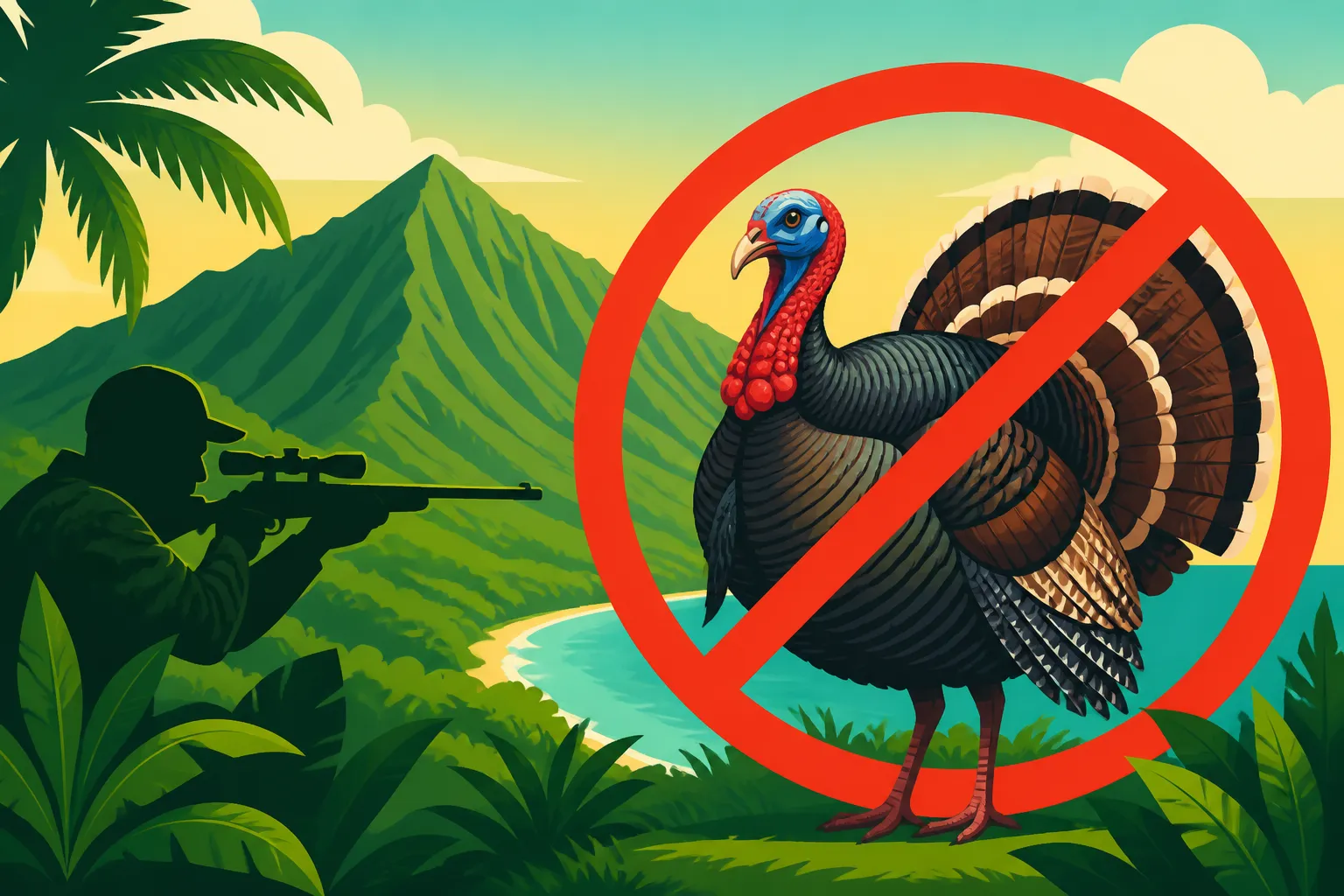
Why Hawaii’s Wild Turkeys Are Off Limits
It can be truly puzzling for hunters in Hawaii. You might be out in the field, perhaps scouting for pigs or birds, and suddenly, a flock of wild turkeys struts across your path. They're big, they look like fantastic game animals, and yet, they remain completely off-limits for hunting in the islands. This can feel like a missed opportunity, a bit of a head-scratcher when other introduced species are actively managed for harvest. This guide is here to unravel that mystery, explaining why these majestic birds are currently not on the Hawaii hunting roster and what the future might hold for them.
The History of Wild Turkeys in Hawaii
It’s easy to assume that because an animal is here, it's always been here, or at least that it was introduced for hunting. But the story of wild turkeys in Hawaii is a little more nuanced, and their journey to the islands didn't necessarily begin with hunting seasons in mind. Like many of Hawaii's other game species, they are not native to these islands but were introduced over time for various reasons, including establishing new game populations and, sometimes, just as a curiosity.
Early Introductions and Their Purpose
Wild turkeys, primarily the Rio Grande subspecies, found their way to Hawaii much like other game birds – through releases aimed at diversifying the local fauna. These introductions weren't always as meticulously planned or documented as modern wildlife management practices. Often, early settlers, ranchers, or even government agencies saw potential in bringing in new species that could thrive in Hawaii's diverse ecosystems. The idea was to create more hunting opportunities or simply to establish new populations. However, unlike axis deer or feral pigs, which quickly established robust populations and became prime game animals, the turkeys had a rockier road. Their initial spread was slower, and their populations tended to concentrate in specific, often drier, upland areas of the Big Island, with smaller, more scattered populations elsewhere.
Where Hawaii's Wild Turkeys Live Today
Today, if you're going to spot wild turkeys in Hawaii, your best bet is on Hawaii Island, particularly in the ranchlands and dry forests of the Kona side, or in the higher elevation pastures and mamane-naio forests of Mauna Kea and Mauna Loa. These birds favor open woodland mixed with grasslands, where they can roost in trees and forage on seeds, insects, and berries. They've also been observed in parts of Maui, though their numbers there are far less significant and their presence more localized. What's interesting is how quickly these birds adapt, thriving in areas that, at first glance, might not seem like classic turkey habitat. Yet, despite their adaptability, their populations haven't exploded in the same way as, say, feral goats or pigs, which quickly spread across multiple islands and became ubiquitous. You might see them scratching around the edges of a pasture while on a Hunting Hawaii's High Elevation Alpine Ground hunt.
Current Population Status and Management
The primary reason Hawaii's wild turkeys are off-limits for hunting boils down to their current population status and the cautious approach taken by the state's wildlife management agencies. While some hunters report seeing turkeys, the overall picture, from a scientific management perspective, often tells a different story.
Why They Are Not Hunted
The Hawaii Department of Land and Natural Resources (DLNR), specifically the Division of Forestry and Wildlife (DOFAW), manages all game species in the state. For a species to be open to hunting, it generally needs to meet several criteria: a healthy and sustainable population, a wide enough distribution to support public access, and clear management goals that often involve population control. Unfortunately, Hawaii's wild turkeys don't quite hit these marks consistently across the islands. While there are pockets where turkeys are abundant, the overall population numbers are not deemed robust enough to withstand hunting pressure. There's a concern that opening a season, even a limited one, could quickly decimate local flocks and set back conservation efforts. The birds are still considered to be in an establishment or recovery phase, rather than a population control phase. This often leads to the question of why wild turkey hunting is still closed.
Population Trends and Perceived Numbers
It's common for hunters to observe a group of turkeys and think, "Wow, there are so many here! Why can't we hunt them?" This is a natural perception, but it sometimes differs from the broader ecological assessment. While local pockets might indeed hold good numbers, these populations can be isolated, and the total statewide numbers might be quite low. Turkey populations can also fluctuate year to year due to weather, predation, and habitat changes. DOFAW's role is to look at the larger picture, often through scientific surveys and data collection, to determine if a species can sustain hunting pressure without risking its long-term viability. For turkeys, the data currently suggests that their numbers are not consistently high enough or widely distributed enough to support a general hunting season. The focus, instead, is on allowing these populations to grow and stabilize.
You might see more turkeys than you expect in certain areas, especially on the Big Island. Here's a quick comparison of why some birds are huntable and others, like the turkey, are not:
| Game Bird Species | Huntable Status | Primary Reason for Status | Typical Habitat in Hawaii |
|---|---|---|---|
| Chukar Partridge | Open | Healthy, widespread populations in specific areas. | Dry, rocky, high-elevation slopes (e.g., Mauna Kea) |
| Francolin (Erckel's, Gray, Black) | Open | Well-established, often abundant populations. | Grasslands, open forests, agricultural lands |
| Ring-Necked Pheasant | Open | Stable populations in suitable habitats. | Agricultural fields, brushy areas, lower elevations |
| Doves (Barred, Spotted) | Open | Abundant and widespread. | Open country, pastures, farm fields |
| California Quail | Open | Sufficient numbers in dry uplands. | Dry, brushy uplands, open woodlands |
| Wild Turkey | Closed | Limited distribution, fluctuating or insufficient numbers to sustain hunting pressure. | Dry upland forests, ranchlands, specific Big Island areas |
Note: Always check the latest regulations from DOFAW or on platforms like GoHunt for current season dates, bag limits, and specific unit rules for all huntable species, as these can change.
Conservation and Future Prospects for Hawaii's Turkeys
The decision to keep wild turkeys off the huntable species list is rooted deeply in conservation principles. Hawaii's ecosystems are particularly fragile, and the introduction of non-native species, while sometimes creating hunting opportunities, also carries ecological risks. For turkeys, managing their population means balancing potential hunting interest with the long-term health of the species and the environment.
The Role of DOFAW in Species Management
The Division of Forestry and Wildlife (DOFAW) is the state agency responsible for managing Hawaii's wildlife, including its game species. Their mandate is to conserve native species while also providing sustainable hunting opportunities for introduced game. When it comes to wild turkeys, DOFAW's approach has been one of careful monitoring rather than active harvest management. They track population numbers, distribution, and overall health to determine if conditions are suitable for a hunting season. This often involves weighing various factors: the bird's reproductive rates, habitat availability, potential impacts on native flora and fauna, and the carrying capacity of the land. It’s a delicate balance, and for turkeys, the current data has consistently leaned towards protection over opening a season. This also ties into How Hawaii's Turkey Flocks Are Doing in the broader ecosystem.
What Would Need to Change for a Season to Open?
For a wild turkey season to open in Hawaii, several key factors would likely need to shift significantly. First and foremost, a sustained and substantial increase in population numbers across broader geographic areas would be required. This isn't just about seeing more turkeys in one small valley; it's about robust, healthy populations that can withstand regular harvest pressure without declining. This might involve habitat improvements or natural population booms that establish turkeys in new, suitable areas. Second, DOFAW would need to conduct thorough studies to confirm these population increases and ensure that hunting wouldn't negatively impact the species or other sensitive ecological components. Finally, there would need to be a clear management plan, including season dates, bag limits, and specific huntable units, much like those for Hawaii Game Bird Seasons and Bag Limits. This whole process is often lengthy and requires careful scientific assessment before any changes are made to the Hawaii Game Bird Hunting regulations.
The Hope for Future Hunting Opportunities
While wild turkeys remain off-limits for now, the future isn't entirely without hope for hunters who dream of a Hawaii turkey hunt. Wildlife populations are dynamic, and with continued conservation efforts, careful monitoring, and potentially favorable environmental conditions, turkey numbers could increase to a point where a limited, managed season becomes viable. Hunters can contribute to this future by respecting current regulations, reporting observations of turkey populations to DOFAW, and supporting wildlife conservation efforts in the state. For now, the best strategy is to keep an eye on official DOFAW announcements and check reliable sources like GoHunt for any updates to Hawaii's hunting regulations. Until then, we’ll have to appreciate these birds from afar, understanding that their protection is part of a larger, often complex, ecological management plan for the islands.
Disclaimer
This article is for general informational purposes only and does not constitute professional advice. Laws, prices and regulations vary by location and change over time. Consult a qualified professional for guidance on your specific situation.