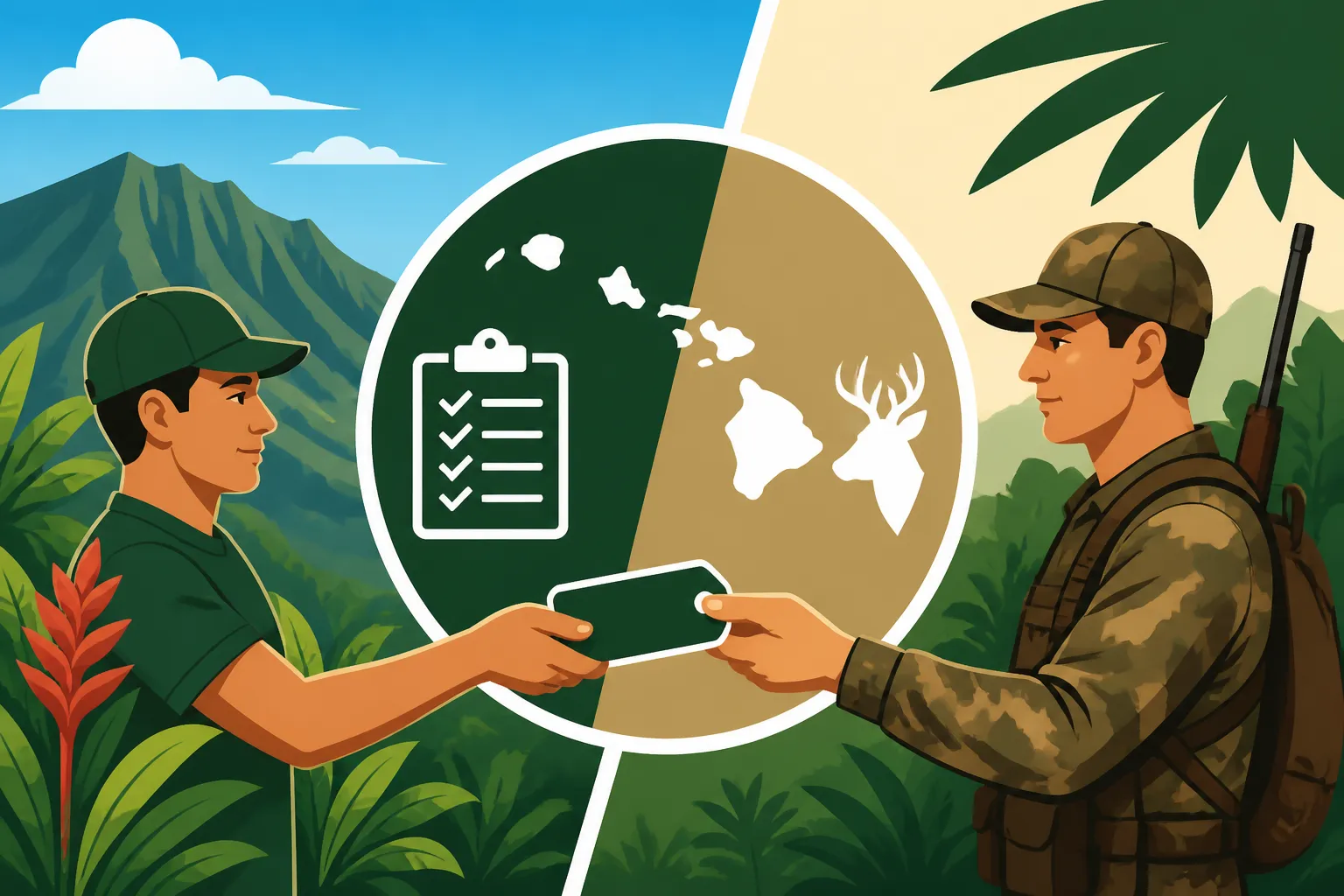
Checking In and Out of a Hawaii Unit
One of the trickiest parts about hunting in Hawaii, especially if you're new to it or visiting from the mainland, isn't finding the game or navigating the challenging terrain – it's often the administrative stuff. We've all been there, standing at the edge of a unit, map in hand, wondering if we've actually checked in correctly and if we're going to accidentally land ourselves in hot water before we even step foot into the field. This guide is here to demystify the process of checking in and out of Hawaii's hunting units, ensuring you're compliant, safe, and ready to focus on the hunt.
Why Hawaii's Check-In/Check-Out System Matters So Much
It might seem like an extra layer of bureaucracy, a hoop to jump through before you can even get your boots dirty, but Hawaii's check-in and check-out system for hunting units serves some really important purposes. It’s not just about tracking who’s where; it’s a critical tool for hunter safety, resource management, and even helping to shape future hunting opportunities. Ignoring it can lead to more than just a stern talking-to – it can mean fines or even losing your hunting privileges.
Ensuring Hunter Safety in Remote Areas
Imagine you're deep in a gulch in the Waiakea Forest Reserve, or perhaps navigating the rocky slopes of Mauna Kea, and something unexpected happens – a fall, a twisted ankle, or you simply get turned around as the fog rolls in. Without a record of your presence in a specific unit, search and rescue efforts become incredibly difficult. The check-in system provides authorities with vital information: who is in what unit, and when they were expected out. This can literally be a lifesaver, giving responders a starting point and a timeline.
It also helps prevent over-crowding in popular areas. While Hawaii's hunting isn't typically shoulder-to-shoulder, knowing how many hunters are in a unit at a given time can improve safety by reducing the chance of accidental encounters or conflicts. When you're in the field, knowing that authorities have a record of your presence, and your planned exit, offers a quiet layer of reassurance, especially if you’re hunting alone or in a remote area without cell service.
Critical for Wildlife and Habitat Management
Beyond safety, the check-in and check-out data is invaluable for the Department of Land and Natural Resources (DLNR) and its Division of Forestry and Wildlife (DOFAW) in managing Hawaii's diverse game populations and fragile ecosystems. Every time you fill out that card or log in on the app, you're contributing to a larger dataset. This data helps DOFAW understand hunter pressure on specific units and species. If a unit consistently sees high hunter numbers but low harvest rates, it might indicate declining animal populations or changes in behavior, prompting further investigation or management adjustments.
This information also helps assess the impact of hunting on different habitats. For instance, if a particular unit shows increasing hunter activity for feral pigs, but the pigs are still causing extensive damage to native forests, it might suggest the need for different management strategies or a review of hunting season lengths or bag limits. By complying with the check-in/check-out rules, you’re playing a direct role in sustainable hunting and conservation efforts.
How Data Shapes Future Hunting Opportunities
The information collected from hunter check-ins and check-outs, combined with harvest reports, forms the backbone of how DOFAW allocates resources and plans future hunting seasons. Do hunters prefer certain units? Are specific species being harvested more effectively in one area than another? This data influences decisions about season dates, open units, and even the implementation of special hunts or lotteries.
For example, if the data shows that a particular unit for Axis Deer in Maui is consistently under-utilized, DOFAW might consider extending the season or increasing the available tags to encourage more hunters. Conversely, if a unit is experiencing significant pressure, they might implement a drawn hunt system to control hunter numbers, as seen with some of the more sought-after species or areas. Your participation in this system directly feeds into these decisions, ensuring that Hawaii's unique hunting heritage continues for generations to come. Make sure you're also familiar with other administrative requirements, like understanding Hawaii's Permit-Tag System and How It Works to ensure you're fully prepared.
The Traditional Method: Paper Hunter Check Stations
For many years, and still a valid option in numerous units, the paper hunter check station was the only way to officially register your presence. It's the old-school method, one that many of us grew up with, and it has its own quirks and charms. While technology offers a convenient alternative, understanding the traditional method is essential, as not all units have reliable cell service for app-based check-ins.
Locating and Using Physical Check-In Boxes
These check stations are typically wooden boxes or kiosks located at key access points to hunting units, often where public roads or trails enter a designated hunting area. You might find them at the start of a jeep trail in a Game Management Area or along the boundary of a Forest Reserve. Inside, you'll usually find sign-in sheets, pencils (sometimes, if you're lucky!), and a box for depositing your completed check-out card.
When you arrive at the station, your first step is to locate the sign-in sheet. You'll need to fill out your name, hunting license number, the date and time of entry, your vehicle information, and often your planned exit time and contact information. You'll also specify which unit you'll be hunting in, which is crucial if the station serves multiple adjacent units. It's a good idea to bring your own pen or pencil, as the ones provided are often missing or unusable. Taking a quick photo of your filled-out card with your phone can also serve as a personal backup, just in case.
Common Pitfalls of Paper Check-Ins
While straightforward, the paper system isn't without its challenges. One of the most common frustrations is the lack of working pens or pencils. Nothing's worse than being ready to hit the trail only to realize you can't properly fill out your card. Another issue is legibility; in a rush or with cold hands, handwriting can be messy, leading to difficulties if authorities need to decipher your information.
Weather can also be a factor. Rain can soak the forms, making them impossible to write on or read. Over time, the boxes themselves can fall into disrepair, making it hard to access the forms. And, of course, there's always the human element – forgetting to sign out, or simply not realizing there was a check station in the first place. This is why knowing Hawaii's Hunting Units and How They Work in detail is so important, as each unit can have slightly different access points and rules.
The Importance of Checking Out Even on Paper
Just as vital as checking in is making sure you complete the check-out process. When you finish your hunt, whether successful or not, you must return to the check station and fill out the departure section of the form. This includes your exit time, the date, and any harvest information (species, sex, location). If you had a successful hunt, this is also where you’d record details like your Tagging an Animal Correctly in Hawaii or your specific weapon used.
Forgetting to check out can be a serious oversight. It can trigger unnecessary search and rescue operations, wasting valuable resources and potentially putting emergency personnel at risk. It also skews the data DOFAW collects on hunter effort and success, which, as we discussed, directly impacts future hunting opportunities. So, even if you’re exhausted and just want to get home, take those few extra minutes to properly check out – it’s a courtesy to others and a responsibility as a hunter.
Embracing Technology: Using the OuterSpatial App
In recent years, Hawaii has introduced a digital solution to streamline the check-in and check-out process: the OuterSpatial app. This mobile application has been a game-changer for many hunters, offering a convenient, modern way to comply with regulations. While it's not available for every unit, it's becoming increasingly prevalent and is highly recommended where available.
How the OuterSpatial App Works for Hunters
The OuterSpatial app essentially puts the check station in your pocket. Available for both iOS and Android devices, it allows hunters to digitally check in and out of designated units using their smartphone. First, you'll need to download the app and create an account. It's a good idea to do this before you head into the field, especially since cell service can be spotty in many hunting areas. Once logged in, you can search for the specific hunting unit you plan to visit.
When you arrive at the unit boundary or access point, you simply open the app, navigate to the correct unit, and select the "check-in" option. The app will prompt you for similar information to the paper forms: your name, hunting license number, date, planned exit time, and often vehicle details. You can input your harvest data directly into the app upon successful completion of your hunt when you Check Out After the Hunt. The app often integrates with the broader GoHunt Hawaii system, which helps manage licenses and permits, making it a comprehensive tool for hunters.
Advantages and Convenience of Digital Check-Ins
The benefits of using the OuterSpatial app are numerous. Foremost is convenience – no more searching for a pen or worrying about wet paper. You can complete the process quickly and efficiently, often right from your vehicle. The digital record is always clear and legible, eliminating any ambiguity about your information. This is particularly helpful when dealing with various licenses and permits, like those you might acquire through the GoHunt system, as all your details are already linked.
The app also often provides real-time information. While this might not always include seeing other hunters' positions (for privacy and safety), it can sometimes show unit boundaries, closed areas, or important announcements from DOFAW. This digital platform also streamlines data collection for DOFAW, making their management efforts more efficient and accurate. Furthermore, some units on the Big Island and Maui, for example, have excellent cell coverage at common entry points, making the app a breeze to use. This is where Using the OuterSpatial App to Check In really shines.
Addressing Cell Service and Battery Life Concerns
While the app is fantastic, it's not without its potential drawbacks, primarily revolving around cell service and battery life. Many of Hawaii's prime hunting units are in remote, mountainous, or heavily vegetated areas where cell signal is nonexistent. This can render the app unusable for check-in or check-out. It’s crucial to understand that if there’s no cell service, you’ll need to default to the paper check station if one is available. Always have a backup plan.
To combat this, I always recommend checking in on the app before you lose service, even if you're a little early, or making sure you have a paper form as a backup. Similarly, hunting all day with GPS tracking on your phone can drain your battery rapidly. Always carry a portable power bank and charging cables. Imagine successfully bagging a nice pig in a deep gulch, then realizing your phone is dead, and you can't check out or report your harvest. This emphasizes the importance of preparing for No Cell Signal on a Hawaii Hunt and managing your devices wisely.
What Happens If You Forget to Check Out?
This is a question that weighs heavily on many hunters' minds, and for good reason. Forgetting to check out of a hunting unit in Hawaii isn't just a minor oversight; it can have significant consequences, ranging from unnecessary alarm to formal penalties. It's a situation you definitely want to avoid, both for your peace of mind and to maintain good standing with DOFAW.
Unnecessary Search and Rescue Operations
The most serious potential consequence of forgetting to check out is triggering an unnecessary search and rescue operation. When you check in, you typically provide an estimated time of return. If that time passes and you haven't checked out, especially if your vehicle is still at the trailhead, DOFAW personnel or local authorities may initiate a search. This is particularly true if you were hunting alone or if weather conditions have deteriorated.
These operations are costly, time-consuming, and divert resources from genuine emergencies. While it's reassuring to know they're looking out for your safety, being the cause of a false alarm is something no hunter wants. It can lead to an uncomfortable conversation, to say the least, and marks you as someone who doesn't adhere to basic safety protocols. This consequence is exactly why the rule exists and why it's stressed to Check In at a Hawaii Hunter Station and check out diligently.
Penalties and Loss of Hunting Privileges
Beyond the potential for a false alarm, there are formal penalties for failing to check in and out. While minor, isolated incidents might result in a warning, repeated offenses or particularly egregious oversights can lead to citations and fines. The specific penalties can vary depending on the severity and frequency of the violation, as well as the unit rules.
In more serious cases, hunters could face the temporary or even permanent suspension of their hunting privileges in Hawaii. Losing your ability to hunt in the islands for a period of time is a significant consequence, impacting both residents and non-resident hunters who invest time and money into their trips. DOFAW takes these regulations seriously as they are fundamental to managing public lands and ensuring safety. Don't risk it; always double-check your check-out status, whether on the app or on paper, especially when considering What Happens If You Forget to Check Out.
Impact on DOFAW's Data Collection
While not a direct penalty to you, failing to check out also corrupts the valuable data that DOFAW relies on for management. Incomplete data sets make it harder to accurately assess hunter effort, harvest rates, and wildlife populations. If hunters consistently fail to provide accurate information, it can lead to skewed conclusions, potentially impacting future season lengths, bag limits, or even unit closures.
Imagine if DOFAW thinks a unit has far more hunter days than it actually does because people are checking in but not out. This could lead to a perception of over-pressuring animals, when in reality, the hunter numbers are lower. Accurate data from every hunter helps ensure that management decisions are based on the best available information, ultimately benefiting the entire hunting community and the wildlife we pursue. It's a small task with a big collective impact.
Tips for a Smooth Check-In/Check-Out Experience
Navigating Hawaii's check-in and check-out system doesn't have to be a source of stress. With a little preparation and attention to detail, you can make the process smooth and hassle-free, leaving you more time and energy to focus on the actual hunt. Here are some practical tips to ensure you're always squared away.
Pre-Trip Planning and Preparation
The key to a smooth experience starts long before you even leave your home. Before heading to the unit, make sure you've thoroughly read the current hunting regulations for Hawaii, specifically for the island and unit you plan to hunt. Rules can change, so always check the latest DOFAW announcements. Understanding Hawaii's Weekend and Holiday Hunting Rules or any specific season dates for your target species is also crucial, as check-in times might be affected.
If you plan to use the OuterSpatial app, download it, create your account, and familiarize yourself with its functions well in advance. Consider linking it to your GoHunt profile if that option is available for seamless integration. Always charge your phone fully and pack a portable power bank. For paper check stations, always carry multiple pens or pencils, and perhaps a small notebook or clipboard to make writing easier if the station isn't well-maintained. Print out extra copies of the blank check-in forms from the DOFAW website if you're worried about finding forms at the station.
Always Have a Backup Plan
No matter how prepared you are, unforeseen circumstances can arise. Cell service might unexpectedly drop, your phone battery could die faster than anticipated, or the paper check station might be out of forms or damaged. This is why having a backup plan is essential. If you intend to use the app, know where the nearest physical check station is located, and have a pen and a blank form ready in your pack.
Conversely, if you're relying on a paper station, know that the app is an option if the physical station fails you, provided you have service. Inform a non-hunting friend or family member of your hunting plans, including your unit, expected return time, and which check-in method you'll be using. This extra layer of communication can be a lifesaver. Being prepared for anything, including potential changes in hunting rules, is vital. Keep an eye on Hawaii Hunting Rules That Changed This Year to avoid surprises.
Double-Check Before You Depart
Before you head out of the unit, take a moment, even if you’re tired, to confirm your check-out. If using the OuterSpatial app, make sure you hit that "check-out" button and receive confirmation. If you’re at a paper station, verify that you’ve filled out all the required information, including your exit time and any harvest data, and that you've dropped the completed form into the designated box. This final double-check is your last chance to ensure you're compliant.
A good habit is to take a photo of your completed paper check-out card or the app's check-out confirmation screen. This provides you with a timestamped record in case there's ever a question or discrepancy later. It’s a small extra step that can save a lot of headaches down the line. Remember, diligent adherence to these procedures is part of being a responsible hunter and helps preserve hunting opportunities for everyone in Hawaii.
Disclaimer
The information provided in this guide is for general informational purposes only and is subject to change. Hunting regulations in Hawaii are set by the Department of Land and Natural Resources (DLNR), Division of Forestry and Wildlife (DOFAW), and can be updated frequently. While we strive to provide accurate and up-to-date information, it is the hunter's responsibility to consult the most current official Hawaii Hunting Regulations before planning or engaging in any hunting activity. Always confirm season dates, bag limits, legal weapons, and specific unit rules directly with DOFAW or on their official website.