What a Kipuka Means for Game Animals
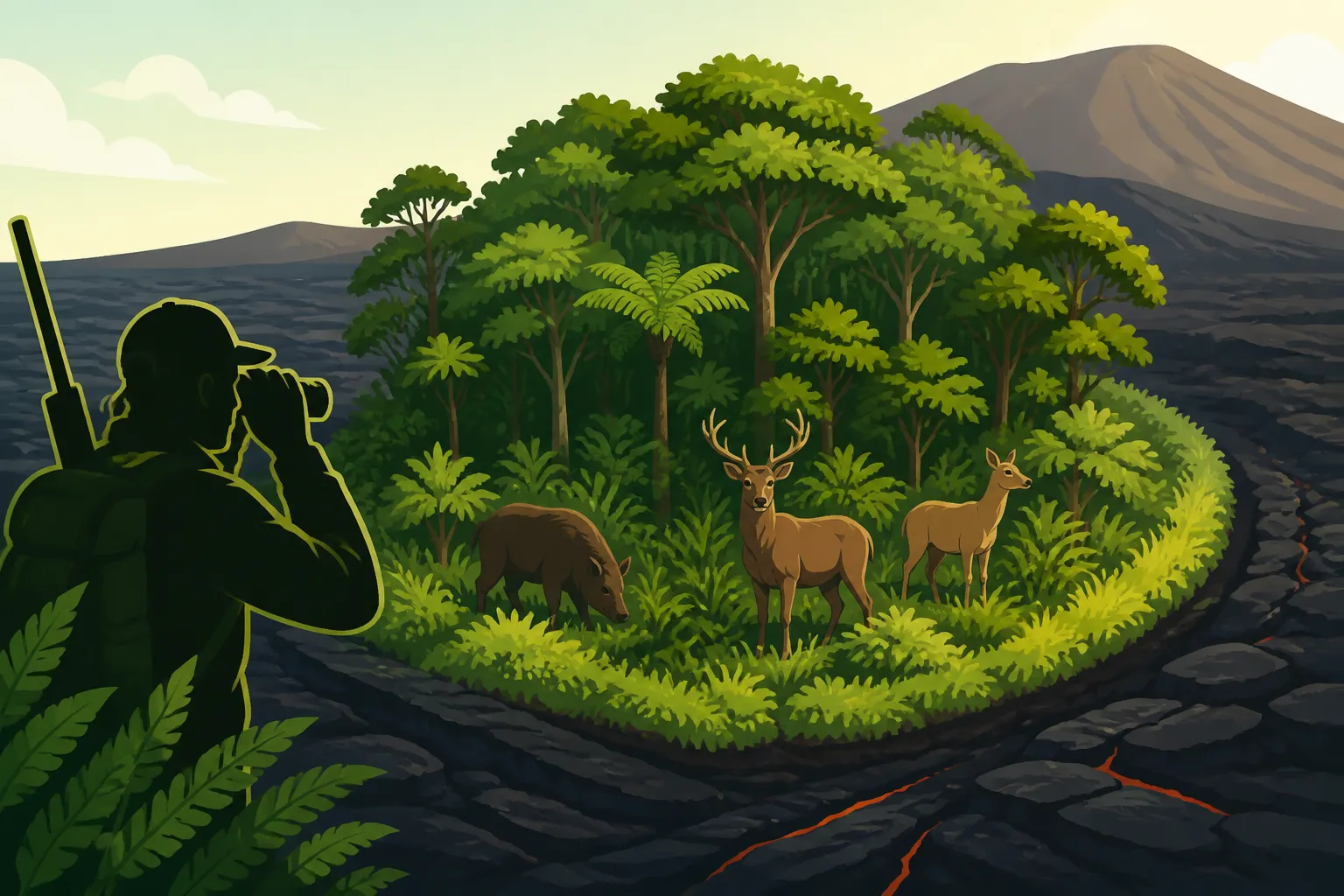
Imagine you're walking across a vast, stark landscape of black, unforgiving lava, a true moonscape under the Hawaiian sun. It's hot, the air shimmers, and there's barely a speck of green in sight. Then, suddenly, rising majestically from the desolate flow, you see it: a verdant island of trees, shrubs, and dense undergrowth, teeming with life. This isn't a mirage; it's a kipuka, and for Hawaii's game animals, it's nothing short of a sanctuary. This guide will take a deep dive into what these incredible natural phenomena are, why they're so vital to the deer, pigs, and goats that call Hawaii home, and how understanding them can make all the difference on your next hunt.
Understanding the Kipuka: An Island of Life Amidst Lava
Kipukas are a quintessential Hawaiian geological feature, born from the very forces that shaped these islands. They are, quite literally, "islands" of older land and vegetation that have been completely encircled and isolated by younger lava flows. When you see one, it's like a time capsule, preserving a snippet of the landscape that existed before the last eruption.
The Geological Genesis of a Kipuka
The formation of a kipuka is a dramatic dance between fire and earth. Imagine a river of molten rock, whether it's the slow, thick, ropy pahoehoe or the jagged, clinkery 'a'a, flowing down a volcano's flank. This lava, hot and destructive, often encounters obstacles: a hill, a ridge, or even a denser patch of forest. Instead of flowing over and consuming everything in its path, the lava sometimes splits and flows around these features. As the lava cools and solidifies, it leaves these untouched "islands" of pre-existing land isolated within the new, barren lava landscape. The scale of a kipuka can vary wildly, from small, brushy mounds a few acres wide to vast expanses of hundreds or even thousands of acres that retain entire mature forests. On the Big Island, especially, you can see these dramatic contrasts everywhere, where ancient `ōhiʻa forests stand defiantly amidst fresh black rock.
Unique Microclimates and Ecosystems
What makes kipukas so incredibly special is how they defy the harshness of their surroundings. While the fresh lava fields are typically devoid of soil, retain little moisture, and are exposed to intense sun and wind, kipukas are the complete opposite. They harbor rich, established soil that has accumulated over centuries, if not millennia. This soil acts like a sponge, holding precious rainwater and allowing a lush canopy of native and introduced vegetation to thrive. The dense foliage creates its own microclimate: shadier, cooler, and significantly more humid than the surrounding lava. This means that within a kipuka, you'll find a bewildering array of plant life, from towering `ōhiʻa and koa trees to a thick understory of ferns, shrubs, and mosses. This biodiversity creates a complex ecosystem, far richer and more inviting than the raw, nutrient-poor lava outside its boundaries. It's an ecological oasis, a vibrant testament to life's persistence against overwhelming odds.
Why Kipukas Are Crucial Sanctuaries for Hawaii's Game
For Hawaii's introduced game animals – the axis deer, feral pigs, and goats – kipukas are more than just pretty patches of green. They are essential life support systems, offering vital resources and refuge that are scarce in the wider, often more challenging Hawaiian landscape.
Shelter, Food, and Water Sources
First and foremost, kipukas are a buffet for game animals. The rich soils and protected microclimates mean a much wider variety of forage is available year-round compared to exposed, dry areas or young lava flows. Deer, in particular, find succulent browse and lush grasses, while Hawaii's Feral Pigs, Island by Island root for tubers, fallen fruits, and invertebrates in the softer kipuka soil. Hawaii's Feral Goats and Why They Matter will browse almost anything, but even they prefer the higher nutritional value found in a kipuka's diverse plant life.
Beyond food, kipukas are critical for water. Their dense canopy and accumulated organic matter mean they retain moisture far better than the surrounding, rapidly draining lava. During Hawaii's dry seasons, especially on the leeward sides of the islands, a kipuka can be one of the only places where animals can find reliable standing water or lush, hydrating vegetation. This combination of shelter from the elements, abundant food, and consistent water makes them irresistible magnets for game, drawing animals in from miles around. Hunters often know that if they can locate a kipuka, they've found a high-probability area for game.
Safe Havens from Predation and Pressure
While Hawaii lacks the large, natural predators found in many mainland hunting grounds, game animals here still face threats, primarily from human hunters. Kipukas offer a unique form of protection. Their often remote locations, coupled with the extremely challenging lava terrain that surrounds them, naturally limit human access. For hunters accustomed to easier walking, traversing jagged 'a'a or slick pahoehoe fields to reach a kipuka can be a significant deterrent.
Animals instinctively learn that these green islands provide excellent cover and a degree of safety. When hunting pressure increases in more accessible areas, or during peak hunting seasons, many game animals will retreat into the dense, often impenetrable interiors of kipukas. Here, the thick vegetation offers superb concealment, making it difficult for hunters to spot or stalk them. It's a natural fortress, allowing animals to rest, feed, and escape detection. This also means that these areas can hold some of the largest, most mature animals that have successfully evaded hunters in more open terrain, adding to their allure for serious hunters. Understanding this behavior is key when you're Hunting Hawaii's Volcanic Terrain and trying to predict where game will be.
Hunting Strategies for Kipuka Environments
Hunting in and around kipukas requires a unique approach, blending careful navigation with specific tactics tailored to these distinct environments. It's not your typical open-country hunt, and those who adapt will find success.
Navigating the Challenging Terrain
The first hurdle when hunting a kipuka is simply getting there. The surrounding lava fields are incredibly rough. Jagged 'a'a can shred boots and skin, while smooth pahoehoe can be deceptively slick, especially if wet or covered in fine volcanic ash. Investing in top-quality, high-ankle hunting boots with stiff soles is not just recommended, it's essential for preventing injury and providing stability. Trekking poles can also be a godsend for balance. Within the kipuka itself, the challenge shifts from abrasive lava to dense, often thorny undergrowth. Expect to push through thick brush, duck under low branches, and navigate tangles of vines.
Before you even step foot in the field, thorough scouting and map work are crucial. Utilize digital mapping apps like GoHunt or OuterSpatial to identify kipukas within your chosen hunting unit. Look for potential access points or "fingers" of lava that might offer a slightly easier approach. Understanding the topography and planning your route meticulously will save you a lot of time and energy, and potentially prevent you from getting lost. Getting to a kipuka is often half the battle, and being prepared for the arduous journey is paramount. You can review Scouting a Hawaii Hunting Unit Before Opening for more details on preparing your hunt.
Stand and Still-Hunting Tactics
Given the density of kipukas, traditional spot-and-stalk hunting can be incredibly difficult, if not impossible, within their confines. Instead, two primary tactics tend to be more effective: stand hunting and still-hunting.
Stand Hunting: This involves positioning yourself strategically near the edges of a kipuka, especially where game trails enter or exit the dense cover. Animals will often move in and out of kipukas during the low light hours of dawn and dusk, heading to or from feeding grounds or water sources. Identifying a well-used trail, setting up downwind (paying close attention to Reading Hawaii's Trade Wind Patterns and thermals, which can be tricky in varied terrain), and patiently waiting can be highly productive. Look for rub marks, fresh tracks, and scat to confirm active game movement. Water holes or seeps just outside the kipuka's edge are prime locations for a stand.
Still-Hunting: For those who prefer to be on the move, still-hunting within a kipuka requires extreme patience and quiet. You'll move at an agonizingly slow pace, taking one or two steps, then stopping for several minutes to glass, listen, and scan every shadow. Look for subtle movements, a flick of an ear, or a patch of hide through the foliage. The key is to blend in, move silently, and maximize your senses. This is particularly effective for pigs, which might be bedded down or quietly feeding in dense cover. When still-hunting, remember that your visibility will be severely limited, so shots will likely be close-range and quick.
Driving or Pushing Kipukas
For a more active approach, particularly with feral pigs or goats, driving a kipuka can be effective, especially if you have a hunting partner or two. This tactic involves one or more hunters (or trained hunting dogs) slowly moving through the kipuka to "push" game out towards another hunter positioned on the opposite side.
With Hunters: This can be done by strategically placing "blockers" downwind at anticipated exit points while one or two "drivers" slowly and noisily move through the kipuka. The drivers should move in a line, maintaining communication, to encourage animals to move forward. This works best in smaller kipukas where you can effectively cover the entire area. Safety is paramount; ensure all hunters know each other's positions at all times.
With Dogs: For Dog and Knife Pig Hunting in Hawaii, kipukas are prime targets. Bay dogs can be sent in to locate and bay pigs, drawing hunters directly to the action. Catch dogs can then move in to secure the animal. The dense cover of a kipuka provides pigs with excellent escape routes and places to make a stand, which is exactly what a well-trained dog team thrives on. If you're considering dog hunting, be fully aware of the Hawaii Dog Hunting Rules and ensure your dogs are accustomed to extremely rough terrain and dense vegetation. This method is highly effective for pigs that would otherwise remain hidden deep within the kipuka's sanctuary.
| Aspect | Kipuka Habitat (Inside) | Surrounding Lava Field (Outside) |
|---|---|---|
| Vegetation | Dense, diverse, mature forest/shrubland | Sparse, pioneer plants, barren rock |
| Soil | Rich, deep, organic | Minimal to none, loose rock and ash |
| Water Retention | High, holds moisture, potential for standing water | Low, drains quickly, very dry |
| Cover for Game | Excellent, dense concealment | Minimal, exposed, nowhere to hide |
| Food Sources | Abundant browse, fruits, roots, insects | Limited, tough, drought-resistant plants |
| Travel for Game | Easy movement within, well-defined trails | Difficult, slow, exposed to view |
| Hunter Access | Difficult to reach, dense interior, limited visibility | Extremely difficult walking, sharp, unstable, exposed |
| Hunting Strategy | Still-hunt, stand-hunt edges, dog drives | Spot-and-stalk at extreme range (if any game visible) |
| Game Behavior | Retreats here under pressure, beds, feeds, waters | Crosses quickly, feeds sparingly, seeks shade/cover |
Conservation and Challenges in Kipuka Habitats
Kipukas, while ecological gems, also represent a complex challenge in Hawaii's ongoing conservation efforts. Their isolation and pristine nature often put them at the forefront of the debate surrounding introduced game animals and native ecosystem protection.
The Double-Edged Sword of Introduced Species
On one hand, kipukas provide critical habitat for game animals like Axis Deer, Hawaii's Signature Big Game, feral pigs, and goats, sustaining populations that offer hunting opportunities. On the other hand, these very animals are introduced species, and their presence, even within these verdant islands, can have significant negative impacts on the unique and often endangered native Hawaiian flora that kipukas sometimes preserve.
What Feral Pigs Do to Hawaii's Forests is a prime example: their rooting behavior can destroy native plant communities, spread invasive weeds, and create wallows that become breeding grounds for mosquitoes, which, in turn, can spread avian malaria to native birds. Similarly, How Goats Cause Erosion in Hawaii is well-documented, as their incessant browsing can strip kipukas of vegetation, especially on steeper slopes, leading to soil loss and further degradation. This creates a delicate balance for land managers: how to manage game animals for hunting while simultaneously protecting the invaluable native biodiversity within these kipukas.
Access Restrictions and Management Efforts
Due to their ecological sensitivity, many kipukas, especially those containing rare or endangered native species, may fall within Natural Area Reserves (NARs) or other protected zones that have strict access restrictions. Hunters must always be diligent in checking the specific regulations for any hunting unit. This means consulting official maps and resources, often available through the Hawaii Department of Land and Natural Resources (DLNR) or apps like GoHunt, to ensure you are not inadvertently trespassing into a closed area. Hawaii Hunting Units and How They Work describes how these boundaries are set.
The DLNR's Division of Forestry and Wildlife (DOFAW) works to manage these areas, sometimes implementing Hawaii's Fenced Conservation Boundaries around kipukas or sensitive areas to exclude ungulates. These fences are designed to allow native plants to recover and thrive, but they also alter game animal movement patterns. Understanding these closures and how they might affect game populations is part of being a responsible hunter. Wildlife managers face the ongoing challenge of balancing the desire for hunting opportunities with the critical need to preserve Hawaii's unique and fragile natural heritage within these extraordinary kipukas.
Ultimately, understanding a kipuka means appreciating its dual nature: a haven for game animals and a fragile stronghold for native Hawaiian ecosystems. As hunters, respecting these unique environments, understanding their challenges, and hunting ethically within their boundaries is crucial for ensuring that these green islands of life continue to thrive amidst the lava.
Disclaimer
This article is for general informational purposes only and does not constitute professional advice. Laws, prices and regulations vary by location and change over time. Consult a qualified professional for guidance on your specific situation.