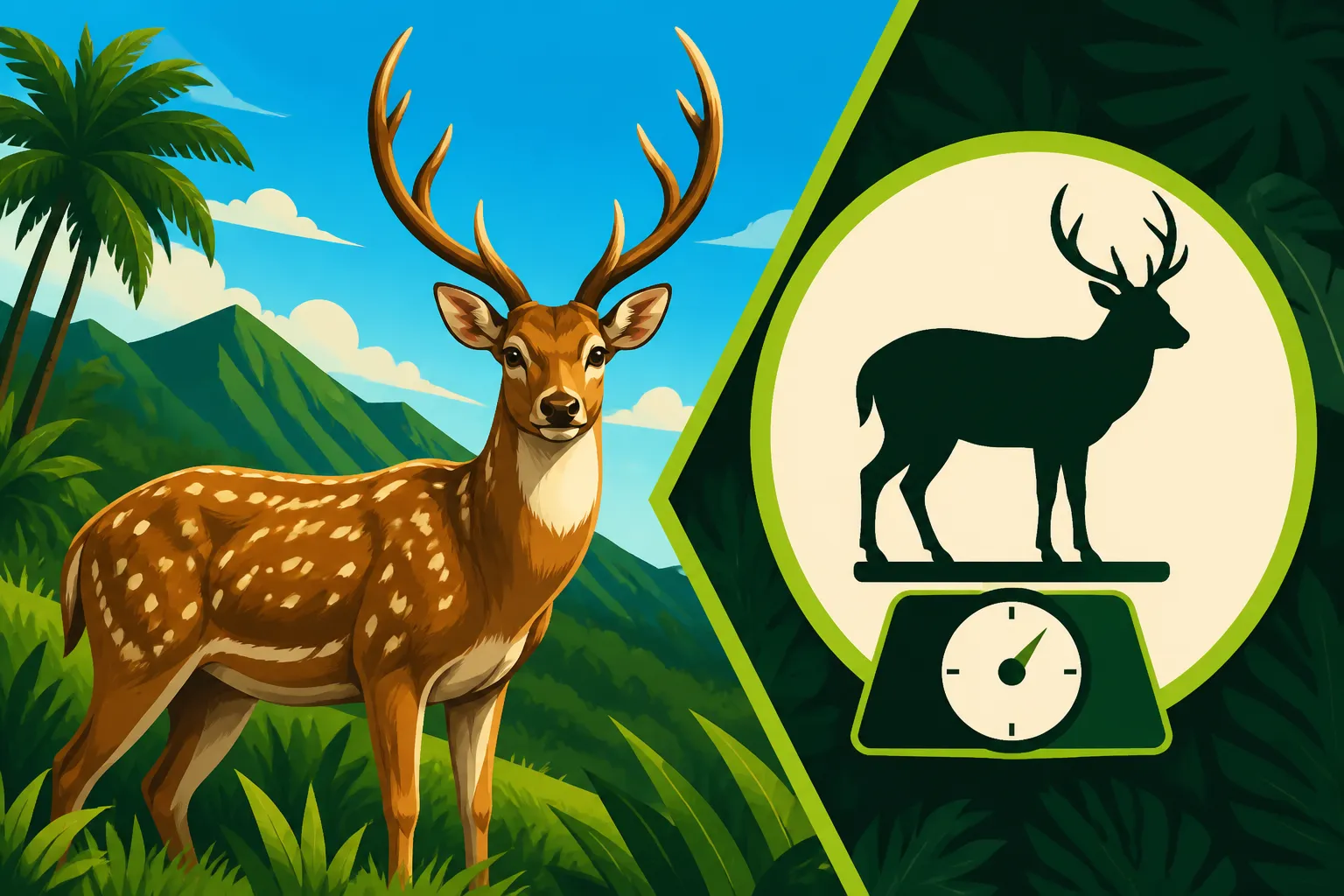
What an Axis Buck Weighs
You’ve spotted a magnificent Axis buck in the golden light of a Hawaii morning, its antlers catching the sun, and your heart is pounding. Beyond the thrill of the hunt, a practical question often weighs on a hunter’s mind: just how much does that animal really weigh? It's not just curiosity; knowing the approximate weight of an Axis buck in Hawaii is crucial for everything from planning your recovery strategy to understanding your meat yield, and it’s a question that can be tougher to answer accurately than you might think. This guide is here to demystify the size of these stunning deer, helping you prepare for the real weight of success.
Understanding Axis Deer Weight Dynamics in Hawaii
Axis deer, or Axis axis, are often lauded for their beautiful spotted coats and impressive antlers, but their robust body size is equally remarkable, especially when considering the challenging Hawaiian terrain they call home. While they're not as massive as a mainland elk or moose, they are substantial animals that demand respect and preparation from hunters.
Average Live Weight for Mature Axis Bucks
When we talk about an Axis buck's weight, we usually refer to its "live weight," which is the animal's total weight before any processing. For a mature Axis buck in Hawaii, you can generally expect a live weight ranging from 150 to 200 pounds, with some truly exceptional individuals pushing beyond that. Does, for comparison, typically weigh less, usually in the 90-130 pound range. This puts them firmly in the medium-to-large deer category, certainly a significant animal to contend with when you're thinking about getting it off the mountain or out of a remote gulch.
It's important to differentiate live weight from field-dressed weight, which we’ll dive into later. The live weight is what the animal carries around, including all its internal organs, blood, and hide. When you’re glassing a herd from a distance, trying to size up a potential target, you’re estimating its live weight. This number dictates the sheer mass you'll eventually be dealing with, affecting how quickly you need to get to it, how many trips you might make, and what kind of recovery gear you'll need.
Factors Influencing Buck Weight on the Islands
Just like any other wild animal, the weight of an Axis buck isn't a fixed number; it's a dynamic figure influenced by a host of environmental and genetic factors specific to the Hawaiian Islands. Understanding these can give you a better idea of what to expect when you're out in the field.
One of the primary drivers of an Axis buck's weight is diet and habitat quality. Islands like Molokai are renowned for producing "Molokai's Big-Bodied Axis Bucks," often attributed to rich forage availability in certain areas, particularly during years of good rainfall. Conversely, bucks found in more arid or overgrazed regions, such as parts of Maui's leeward side or some drier areas on the Big Island, might tend to be on the lighter end of the spectrum. The constant availability of nutritious vegetation, whether it's native grasses, forbs, or agricultural crops they might browse on the edges of farms, directly correlates with an animal's ability to put on muscle and fat. For a deeper dive into what they eat, check out our article on "What Axis Deer Eat on Maui".
Water availability is another critical factor. Hawaii's diverse microclimates mean some areas can be incredibly lush while others are perpetually dry. During prolonged droughts, Axis deer often lose significant body mass as they struggle to find adequate hydration and forage. A buck that has constant access to water sources will generally be healthier and heavier than one that has to travel long distances or rely on less-than-ideal water. Age and genetics also play undeniable roles. Younger bucks are naturally lighter, still growing into their full potential, while older, mature bucks that have survived several seasons are often at their peak weight. Some deer simply have better genetic predispositions for growth, inheriting traits that allow them to gain more mass. Lastly, population density can impact individual animal health. In areas with a high density, like some parts of Maui, competition for food can be fierce, potentially leading to smaller average body sizes compared to areas with lower densities. Our piece on "Lanai's Axis Deer Density Compared to Maui" explores this fascinating dynamic.
Comparing Axis Deer to Other Hawaii Game Species
When you mention "big game" in Hawaii, Axis deer often come up first, and for good reason. Their size and vibrant presence make them a top target for hunters across the islands. But how do they stack up against the other introduced game animals that roam the Hawaiian landscape?
Axis Deer vs. Feral Pigs and Goats
Comparing Axis deer to Hawaii's ubiquitous feral pigs and goats offers a good perspective on their relative size. Feral pigs are arguably the heavyweights of Hawaii's introduced game animals. A mature Hawaii feral boar can easily weigh between 150 to 300 pounds live, with some truly giant island hogs pushing past 400 pounds. Sows are generally smaller, but still substantial. So, while a large Axis buck is a considerable animal, a really big boar can outmass it significantly. Pigs are dense, muscular animals, and their weight often feels concentrated, making them a formidable challenge to move, even after field dressing.
Feral goats, on the other hand, are typically much lighter than Axis deer. A large billy goat might weigh anywhere from 80 to 150 pounds live, with nannies usually in the 50-100 pound range. They are leaner, built for navigating steep, rocky terrain, and don't carry the same kind of body mass as an Axis buck. So, when you're planning a hunt, targeting a goat versus an Axis deer means a very different expectation for the amount of meat you'll be packing out and the physical exertion required for recovery. Both offer exciting hunts, but the scale of the animal is quite different.
Axis Deer vs. Black-Tailed Deer and Mouflon Sheep
Hawaii is home to more than just Axis deer when it comes to cervids and sheep. On Kauai, you'll find Black-tailed deer, and on the Big Island and Lanai, Mouflon sheep. These animals offer a different kind of comparison to the Axis buck.
Black-tailed deer, found exclusively on Kauai, are generally smaller than Axis deer. A mature Black-tailed buck typically weighs between 120 to 180 pounds live, putting them in a similar but often slightly lighter category than an average Axis buck. They are known for their dense body structure and often thrive in the rugged, mountainous terrain of Kauai. While still a good-sized animal, the overall mass you might encounter from a Black-tailed deer will likely be a bit less than a prime Axis buck. For more information, check out "Black-Tailed Deer in Hawaii".
Mouflon sheep, particularly the rams with their impressive curling horns, are another significant game animal. A mature Mouflon ram on the Big Island or Lanai can weigh from 100 to 150 pounds live, placing them generally below the typical weight range of a mature Axis buck. They are built for high-elevation, rugged volcanic landscapes, often being lean and incredibly hardy. While their trophy value often lies in their magnificent horns, their body weight is more comparable to a large feral goat than a robust Axis deer. For a deeper dive into these unique animals, read about "Mouflon Sheep on Hawaii's Volcanoes".
Here's a quick comparison of average live weights for mature males of Hawaii's main big game species:
| Species | Average Live Weight (Mature Male) | Key Characteristics |
|---|---|---|
| Feral Pig | 150 – 300+ lbs | Dense, muscular, often stocky; can exceed 400 lbs in exceptional cases. |
| Axis Deer | 150 – 200 lbs | Elegant, spotted, well-proportioned; known for good venison quality. |
| Black-Tailed Deer | 120 – 180 lbs | Similar to mainland whitetail size, dense build, found only on Kauai. |
| Feral Goat | 80 – 150 lbs | Lean, agile, built for steep terrain; highly variable in size and horn development. |
| Mouflon Sheep (Ram) | 100 – 150 lbs | Hardy, stocky build for high elevations; trophy value often in large, curling horns. |
As you can see, the Axis buck sits comfortably in the middle-to-upper range of Hawaii's big game animals, offering a substantial challenge and a rewarding amount of meat for the successful hunter.
Field Dressing Weight vs. Live Weight
One of the most common points of confusion for new hunters, or even seasoned ones discussing their harvest, is the difference between an animal's live weight and its field-dressed weight. This distinction is critical for practical reasons once you've made a successful shot.
The "Gutted Weight" Reality
When an animal is field-dressed, it means removing all of its internal organs (viscera) as quickly as possible to facilitate cooling and prevent spoilage, especially in Hawaii's often warm and humid climate. This process significantly reduces the animal's weight. On average, you can expect an Axis buck to lose anywhere from 25% to 35% of its live weight once it's been field-dressed. The exact percentage can vary based on the animal's condition, how much it has eaten recently, and the thoroughness of the field dressing.
Let's put that into perspective with a real-world example. Imagine you've shot a magnificent Axis buck that you estimate at 180 pounds live weight. Once you perform a good, clean field-dressing job, that animal is likely to weigh somewhere between 117 and 135 pounds. That's a reduction of 45 to 63 pounds! This substantial difference directly impacts how manageable the carcass is for transport, whether you're dragging it, packing it out in pieces, or loading it onto a game cart or vehicle. For more on this crucial step, see our guide on "Field Dressing Axis Deer in Hawaii Heat".
Why Knowing Field-Dressed Weight Matters for Hunters
Understanding the "gutted weight" is not just an academic exercise; it's a vital piece of information that affects nearly every aspect of your post-kill plan. First and foremost, it impacts your packing out strategy. If you're hunting in a remote gulch or far from a vehicle, knowing that your 180-pound live weight buck will still be over 100 pounds after field dressing means you need to be prepared for a significant pack out. Are you going to bone it out? Do you have multiple strong partners? Is a game cart even an option in that terrain? This knowledge helps you realistically assess the challenge ahead. Check out our detailed article on "Packing Meat Out of a Hawaii Gulch" for practical tips.
Secondly, it's crucial for cooler space and meat processing estimates. Knowing the field-dressed weight gives you a much better idea of how many coolers you'll need to transport the meat and how much actual boneless meat you might yield. For instance, a 120-pound field-dressed Axis buck might yield around 60-80 pounds of boneless meat, depending on bone-in cuts and trim. This helps you communicate effectively with a meat processor or plan your home processing efforts, ensuring you have enough ice and cooler capacity. Companies like GoHunt, which offer resources for planning your trip, often emphasize the importance of these practical considerations to ensure a successful hunt from start to finish. Fast cooling is paramount in Hawaii. We have an excellent resource on "Cooling Meat Fast on a Hawaii Hunt" that’s worth a read.
Estimating Weight in the Field and Trophy Considerations
There’s a real art to estimating an animal’s weight and age in the field, and with Axis deer, it's no different. Before you even pull the trigger, you're making quick calculations, not just about antler size, but about body mass.
Visual Cues for Judging Weight
When you’re peering through your binoculars at an Axis buck, trying to gauge its size, there are several visual cues that experienced hunters look for beyond just the antlers. These can help you estimate its live weight and whether it’s a mature, heavy animal.
Start by looking at the overall body mass and proportion. A truly heavy buck will have a deep chest and a robust, filled-out appearance. Contrast this with a younger buck, which might look lankier, with a more pronounced waistline and less depth to its body. Pay close attention to the neck size. A mature, heavy buck, especially during or after the rut, will often have a significantly thickened neck, appearing almost as wide as its head, sometimes even blending into its shoulders. Younger bucks will have much thinner, more defined necks. Also, observe the belly sag and backline. Older, heavier bucks tend to have a slightly sagging belly and a straighter, more solid backline compared to the more athletic, tucked-up appearance of a younger animal.
Don't forget the leg thickness and how the deer carries itself. A heavier buck will appear more grounded, with thicker legs relative to its body, whereas a lighter, younger buck might seem more spry and delicate. The general impression of power and bulk is what you’re looking for. While no single cue is definitive, combining these observations can give you a surprisingly accurate estimate of a buck’s live weight, helping you decide if it's the animal you're looking for.
Beyond Weight: Trophy Quality and Antler Growth
While body weight is an important measure of an Axis buck's overall health and maturity, it's often not the sole, or even primary, factor for many hunters. For many, the true "trophy" aspect lies in the antler growth and quality. Axis deer are unique in that they can drop and grow antlers year-round, unlike most temperate zone deer which are on a strict seasonal cycle. This means you can find bucks in velvet, hard horn, or even having recently shed at any given time of the year. For an interesting read on this, check out "Why Axis Deer Antlers Drop Year-Round".
A mature Axis buck typically boasts antlers with three points on each side (known as six-points), including the brow tines, bez tines (mid-fork), and terminal tines. What truly makes a trophy, beyond just the number of points, is the length of the main beams, the spread between the antlers, and the mass or circumference of the beams. A buck with long, symmetrical beams, a wide spread, and good mass throughout the antlers is often considered a higher trophy quality, regardless of whether it hits the absolute heaviest weight mark.
It's not uncommon to harvest a buck that might not be the heaviest in the herd but carries a truly exceptional set of antlers. Conversely, a very heavy, old buck might have passed its prime antler growth, or may have broken off a tine during a skirmish. So, while body weight indicates maturity and robustness, the antlers are often the visual representation of success and a story in themselves. Learning to differentiate between these characteristics is part of the challenge and reward of hunting Axis deer. Our guide on "Judging an Axis Buck's Antlers in the Field" can provide even more detail.
Practical Implications for Hunters
Hunting in Hawaii is a unique experience, and the practicalities of a successful hunt, especially concerning an animal as substantial as an Axis buck, deserve careful consideration. The islands' diverse terrain and warm climate add layers of complexity that mainland hunters might not anticipate.
Packing Out Meat and Logistics
So, you've taken down a beautiful Axis buck, and it's laying there in all its glory. Now the real work begins. Packing out meat in Hawaii is often one of the most physically demanding aspects of the hunt. Imagine a 120-pound field-dressed buck in a steep, wet gulch on Maui, or across a sun-baked lava field on the Big Island. This isn't flat, easy terrain. You're dealing with humid conditions, dense vegetation, jagged lava, or slippery mud, all while trying to keep the meat cool and clean.
The strategy for packing out depends heavily on the animal's size, the distance from your vehicle, and the number of people in your hunting party. For an average Axis buck, many hunters opt to bone out the meat and make multiple trips with good quality frame packs. This might mean separating the backstraps, hindquarters, and front shoulders into manageable loads. Dragging a whole animal, even field-dressed, for any significant distance in Hawaii's terrain is often an exercise in futility and exhaustion, not to mention a quick way to compromise the quality of your meat. Companies like GoHunt often advise planning this phase meticulously, as it can make or break the enjoyment and success of your hunt. Be prepared with strong game bags, a sharp knife, and plenty of water for yourself.
Processing and Meat Yield
Once you've got your Axis buck out of the field, the next step is processing the meat. This is where the initial live weight and field-dressed weight come full circle. While a 180-pound live weight buck might field-dress to 120 pounds, the actual boneless meat yield will be even less, typically falling between 50-70% of the field-dressed weight. So, that 120-pound field-dressed buck could yield roughly 60-84 pounds of boneless venison. This yield can vary based on the buck's body condition, the amount of fat, and how closely you trim the meat during butchering.
Knowing this helps you manage expectations for how much meat you'll actually have for your freezer or to share with friends and family. Axis venison is highly prized for its mild flavor and fine grain, making it excellent for a variety of culinary uses, from steaks and roasts to ground meat and jerky. It's often compared favorably to elk or even beef due to its relatively low gamey taste. For more about this, you can read our article "Why Axis Venison Tastes Mild". Many local butchers on Maui, Molokai, or the Big Island specialize in processing game meat, but booking ahead, especially during peak season, is always a good idea. Having an estimate of the field-dressed weight helps them, and you, plan for cuts and packaging.
Final Thoughts on Hawaii Axis Deer
Hunting Axis deer in Hawaii offers a truly unique and challenging experience. From the beautiful spotted hides to the impressive antlers and the delicious venison, these animals represent a significant and rewarding pursuit. Understanding what an Axis buck weighs, how that weight changes through the field dressing process, and the many factors influencing its size, empowers you to be a more prepared, efficient, and successful hunter. It's about respecting the animal, the land, and the effort it takes to bring home your harvest. The physical and logistical planning for handling such a substantial animal in Hawaii’s demanding environment is just as crucial as the shot itself.
Disclaimer
Hunting is an inherently dangerous activity. The information provided in this article is for informational purposes only and does not constitute professional advice. Always prioritize safety, adhere to all local, state, and federal hunting regulations, and consider seeking guidance from experienced professionals or licensed guides. Laws and conditions can change, so always verify the most current regulations with the Hawaii Department of Land and Natural Resources (DLNR) Division of Forestry and Wildlife (DOFAW) before planning any hunting trip.