Cell Service and Communication on a Hawaii Hunt
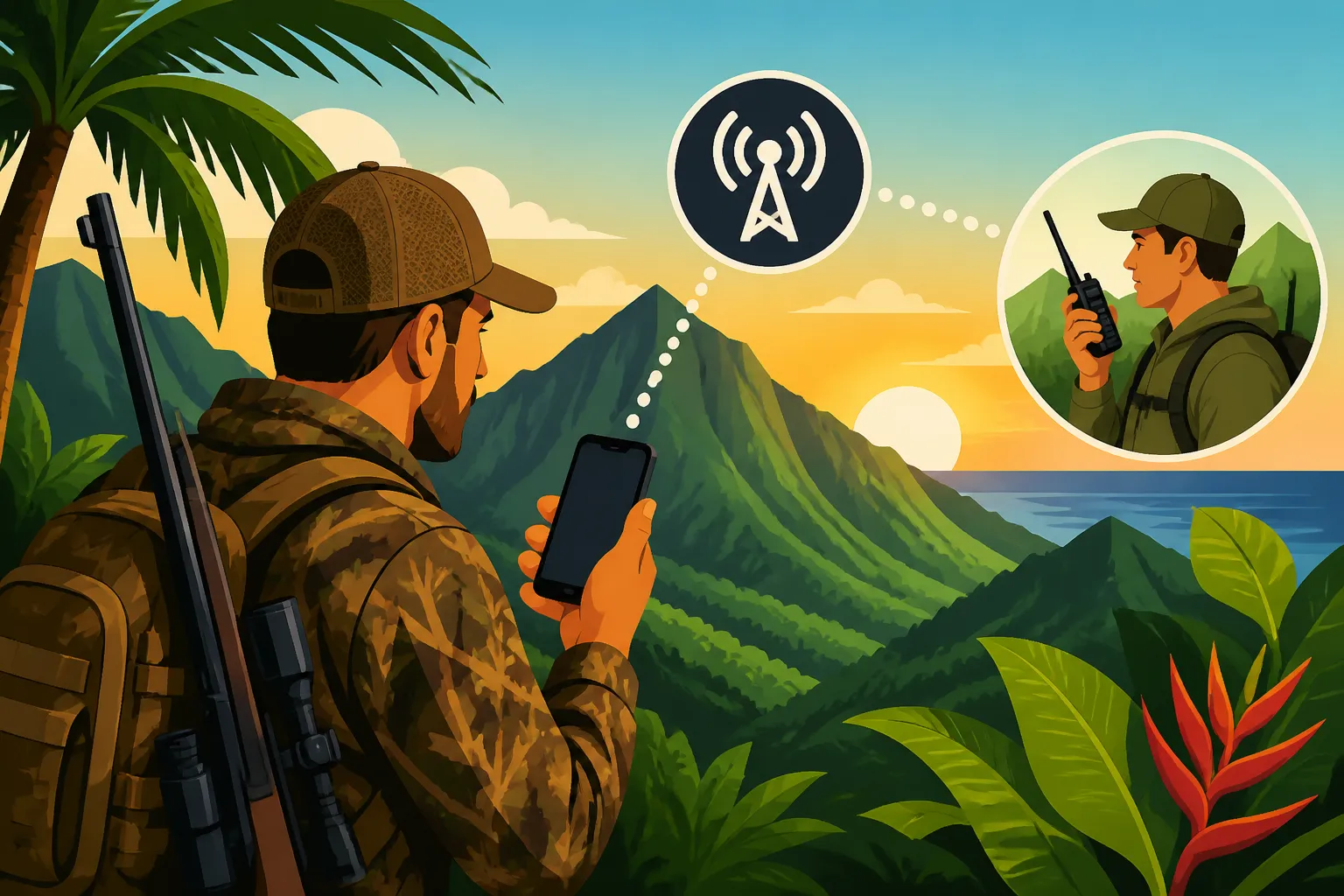
One of the biggest eye-openers for hunters heading into Hawaii's backcountry is just how quickly your cell signal vanishes. You can go from full bars in town to absolute radio silence within minutes, leaving you feeling isolated and potentially unsafe. This guide will walk you through the very real challenges of communication in Hawaii's diverse hunting units and equip you with the knowledge and tools to stay connected, or at least prepared, when your phone becomes just a paperweight.
The Harsh Reality of Hawaii's Cell Service Blackouts
It's a common misconception that because Hawaii is a developed state, you'll have blanket cell coverage. The reality for hunters, however, is dramatically different. Once you venture off the main roads and into the rugged mountains, deep gulches, or remote coastlines that characterize many of our best hunting areas, your phone often becomes useless for calls or texts. This isn't just an inconvenience; it can be a serious safety issue.
Why Coverage Drops Off a Cliff in Hunting Units
Hawaii's unique geography is the primary culprit. Our islands are essentially giant volcanoes, carved by millennia of rain and erosion into incredibly steep valleys, towering cliffs, and dense, undulating terrain. Cell towers, for obvious reasons, tend to be built in populated areas and along major transportation corridors, not nestled in remote kipukas of forest or deep within a lava flow. When you drop into a canyon, or a mountain range blocks the line of sight to a distant tower, your signal strength plummets. Thick, wet rainforests, like those found on the windward sides of many islands, can also absorb signals, creating dead zones even where you might expect some reception.
Imagine you're Hunting Pigs in Hawaii's Rainforest Gulches on the Big Island or pursuing goats along Hunting Goats on a Sea Cliff Safely on Maui. These aren't flat, open plains. You're constantly moving through terrain that will challenge any wireless signal. Even if you briefly catch a bar at a high vantage point, it's often fleeting. Hunters quickly learn to enjoy the peace of disconnectedness, but also to respect its dangers.
The Major Carriers and Their Limits
While most major carriers advertise extensive coverage in Hawaii, those maps often look a lot greener than the reality on the ground in a hunting unit. Their coverage typically focuses on residential areas, tourist spots, and major highways. Once you deviate from these well-trodden paths, especially into designated hunting units, the "coverage" quickly degrades to "no service." It's not uncommon to have one carrier boast better service in, say, Honolulu, while another might have a slight edge on the far reaches of a specific coastline on Molokai, but neither will reliably cover a deep gulch in a remote Hawaii's Hunting Units and How They Work.
Even if your phone indicates a faint signal, it might not be enough to sustain a call or send a message reliably. Data often disappears long before voice calls do. This means that while you might occasionally get a trickle of data on an exposed ridge, don't count on streaming your favorite music or sending high-resolution photos of your harvest. It's more likely you'll be left with nothing but the sounds of the forest.
What Losing Signal Means for Your Hunt
Beyond the frustration of not being able to share your hunting adventure live, losing cell service has tangible implications. Foremost is safety. If you or a hunting partner sustains an injury, gets lost, or encounters unexpected weather, calling for help becomes impossible. Coordination with your hunting group also relies heavily on communication; without it, simple tasks like meeting up or confirming a plan can become complicated and time-consuming.
Furthermore, many of Hawaii's hunting units require hunters to check in and out, either physically at a station or electronically. Without a signal, using apps like OuterSpatial for check-in/out becomes impossible, forcing you to revert to paper methods or rely on pre-arranged plans. This highlights the importance of not just having a backup communication plan but integrating it into every aspect of your hunt planning, from safety to administrative requirements. Losing signal means you need to be entirely self-reliant or have a robust plan B in place.
Essential Communication Tools Beyond Your Cell Phone
Since your cell phone is often unreliable in Hawaii's wilder hunting grounds, having alternative communication methods isn't just a good idea—it's practically a necessity for a safe and successful hunt. These tools can provide vital lifelines when cellular networks fail.
Satellite Messengers and GPS Devices
For true off-grid communication and navigation, satellite communication devices are king. These handheld gadgets leverage global satellite networks, allowing you to send and receive text messages, share your location, and most importantly, trigger an SOS signal to emergency services, even in the most remote areas. Brands offer robust devices that are built to withstand the elements, with long battery lives and intuitive interfaces. They typically require a subscription plan, but the peace of mind they offer is invaluable.
Think about traversing a remote unit on the Big Island, perhaps Hunting Mauna Loa's Upper Slopes or deep within the Kau Forest Reserve. A fall, a sudden weather change, or a misstep could leave you in a bad spot far from any help. With a satellite messenger, you can send a predefined "I'm okay" message to family, or, in a critical situation, activate the SOS function which connects you directly to a 24/7 emergency response center. Many units in Hawaii are so remote that Helicopter Access for Remote Hawaii Hunts is the only realistic way to get out in an emergency, and a satellite device is your best bet for calling that help.
Two-Way Radios (Walkie-Talkies)
For communication within your immediate hunting party over shorter distances, two-way radios, often called walkie-talkies, are incredibly useful. They don't rely on cell towers, so as long as you have line-of-sight or are within their broadcast range, you can communicate instantly. This is particularly handy for coordinating drives, setting up ambushes, or simply staying in touch when you've spread out a bit in dense cover. They are perfect for groups who plan to stay relatively close together while Still-Hunting a Guava Thicket for Pigs or during a game bird hunt where partners might be 100-200 yards apart.
However, their range can be significantly impacted by Hawaii's hilly and forested terrain. A deep gulch or a thick stand of trees can drastically reduce their effective range, sometimes to less than a mile. Always test your radios in similar terrain before relying on them for critical communication. Rechargeable batteries or a supply of spares are also crucial, as a dead radio is as useless as a dead cell phone.
Emergency Whistles, Signal Mirrors, and Old-School Methods
While high-tech gadgets are fantastic, don't underestimate the power of tried-and-true analog methods. An emergency whistle, for instance, can carry much farther than the human voice and requires less energy. It's an excellent way to signal your location to nearby hunting partners if you're out of sight or if you need to alert them to danger. A signal mirror can be used on a sunny day to flash distress signals to aircraft or distant search parties.
Always carry a compass and a physical map of your hunting unit, even if you have digital navigation on your phone or GPS. Batteries die, and electronics can fail. Knowing how to read a map and use a compass is a fundamental skill that every hunter should possess. These simple, inexpensive tools are often overlooked but can be life-saving. Remember, when you're in truly wild country, like much of Hawaii's public hunting land, relying solely on electronics is a gamble you might not want to take.
Planning Your Check-In/Check-Out with DOFAW
Hawaii has strict regulations about checking in and out of public hunting units, often through the Division of Forestry and Wildlife (DOFAW). Many units now utilize the Using the OuterSpatial App to Check In for this purpose, which is convenient when you have cell service. But what happens when you don't? This is where proactive planning is key.
Before heading into a known dead zone, check if the unit has a physical hunter check station where you can sign in and out manually. If not, understand the rules for when cell service is unavailable. It may mean finding a spot with signal before or after your hunt, or notifying DOFAW in advance of your limited communication capabilities. If you're booking a guided trip through a service like BookYourHunt, ensure your outfitter confirms their plan for check-in/out, as they often handle these logistics and have established protocols for remote areas. Always carry a paper copy of your hunting license and any necessary permits, as these might be required for manual check-ins.
Creating a Communication Plan for Your Hunting Group
Effective communication on a Hawaii hunt extends beyond just having the right gear; it's about having a solid plan that everyone understands and commits to. This is especially true when you're tackling challenging terrain and spotty cell service.
Before You Even Leave Home
The groundwork for a safe hunt with good communication starts long before you step foot in the unit. First, always inform a trusted contact who is not with you on the hunt about your itinerary. This should include your specific hunting unit, planned entry and exit points, the dates and times you expect to be out, and when you anticipate checking back in with them. Be overly specific. If you plan to hunt Hunting a Steep Windward Gulch in a particular unit, tell them exactly that. This contact becomes your emergency lifeline. If you don't check in by a pre-arranged time, they know to initiate a search or alert authorities.
Second, if you're hunting with a group, hold a pre-hunt briefing. Discuss everyone's communication devices – who has a satellite messenger, who has two-way radios, and who is bringing a fully charged cell phone for emergency use if a signal is found. Exchange emergency contact numbers among the group and write them down, not just in your phone. Discuss potential scenarios: what if someone gets separated? What if there's an injury? What are the pre-determined hand signals or whistle blasts for different situations? Knowing Emergency Plans on a Remote Hawaii Hunt before you are in a remote situation is paramount.
On the Ground: Daily Check-Ins and Rendezvous Points
Once you're in the field, sticking to your communication plan is vital. Establish specific daily check-in times with your group, even if it's just a quick "all good" on a two-way radio or a visual confirmation. If you're splitting up, designate clear rendezvous points and times. These points should be easily identifiable landmarks on a map, such as a prominent cinder cone, a distinct stream crossing, or a specific old trail junction.
For longer absences or overnight trips, a satellite messenger can be used to send an "I'm okay" message to your home contact at a predetermined time each day. This simple routine can prevent unnecessary worry and allows for early detection if something goes wrong. Always err on the side of caution. If you're planning to hunt a unit like Hunting Hawaii's Kipuka Islands of Forest, which are isolated patches of trees often surrounded by lava, understanding the terrain and having a precise plan for meeting up is crucial due to visibility and limited communication.
What to Do in an Emergency Without Cell Service
When the unexpected happens and you have no cell service, panic is your enemy. This is why a solid emergency protocol is so important.
- Assess the Situation: Is it a medical emergency? Are you lost? Is the weather turning dangerous?
- Stay Calm and Communicate Internally: If with a group, use your two-way radios or pre-arranged signals to gather everyone and discuss the next steps.
- Activate Your Satellite Device (if applicable): If it's a critical situation (e.g., serious injury), activate the SOS function on your satellite messenger. This is your most direct link to professional help.
- Signal for Help: If you don't have a satellite device, use whistles (three short blasts, repeated, is a universal distress signal), signal mirrors, or even build a signal fire (if safe and legal).
- Stay Put (if lost or injured): Often, moving can make things worse. If you're lost, stay in one place to make it easier for searchers. If injured, try to make yourself as comfortable and visible as possible. Your pre-notified contact will trigger the search if you don't check in.
- Seek Higher Ground (for potential signal): As a last resort, if safe to do so and time permits, a slow and careful ascent to the highest nearby point might yield a fleeting cell signal. But don't count on it, and prioritize safety over signal.
Having discussed potential routes and exit strategies during your pre-hunt briefing can also pay dividends. For example, knowing if there's an old jeep trail nearby that could lead to a main road, even if it's a long walk, might be part of your emergency extraction plan. When you're Hunting Hawaii on Foot Without a Truck, your emergency plan needs to be especially robust.
Leveraging Technology for Off-Grid Navigation and Information
While cell service might be elusive, modern technology can still be a huge asset on your Hawaii hunt, especially for navigation and planning, provided you prepare correctly.
Offline Maps for Your Phone
Your smartphone can still be a powerful navigation tool, even without cell service, if you download offline maps before you head into the field. Apps like onX Hunt, Avenza Maps, or even Google Maps allow you to download detailed topographical maps of your hunting area directly to your device. This means your phone's GPS function will still work to show your exact location on the map, mark waypoints, and track your movements, all without needing a cellular signal.
This is absolutely crucial for navigating Hawaii's often confusing terrain, where trails can be overgrown, or thick forest can disorient you. You can pinpoint your location in relation to unit boundaries, property lines, and important features like water sources or ridges. For instance, when you're trying to figure out Reading a Hawaii Unit Boundary Map in the middle of nowhere, having that map on your phone with your little blue dot showing your position is incredibly reassuring. Always remember to fully charge your phone and bring a portable power bank, as GPS usage can drain batteries quickly.
Using Hunt Planning Apps Effectively
Beyond just navigation, hunting apps offer a wealth of information that can be accessed off-grid if you've done your homework. Many apps allow you to mark potential hunting spots, food sources, bedding areas, and trails during your scouting phase. Tools from platforms like GoHunt can help you research units and understand game movements, and while real-time data might require a connection, the foundational information you've saved about, say, Hunting Lanai's Upper Ridgelines or a specific pig wallow, will still be there.
Before your hunt, use these apps to study the terrain, identify possible ingress and egress routes, and mark areas of interest. You can note where you expect to lose signal, or where past hunters have reported good sign. This pre-hunt digital scouting can save you a lot of time and effort once you're on the ground, guiding you even when your phone is otherwise silent.
Charging Solutions for Your Devices
All these fantastic electronic tools are useless if their batteries are dead. Power management is a critical part of off-grid communication and navigation planning.
- Portable Power Banks: These are your best friend. A good quality power bank can fully recharge your smartphone multiple times. Choose one with sufficient capacity for the length of your hunt.
- Solar Chargers: For longer, multi-day trips where you might not have access to a vehicle, small, portable solar panels can trickle-charge your devices. While they might not provide a rapid charge, they can keep your essential electronics alive over an extended period, especially on sunny days.
- Vehicle Chargers: If you have vehicle access, make sure you have appropriate car chargers for all your devices. Even if you're Reaching a Hawaii Unit by 4WD Road, you might park and hike for miles, so topping off batteries whenever possible is a smart move.
Always assume you'll need more power than you think. Bring extra charging cables and test all your charging solutions before you leave home. A fully charged device, even if it has no signal, can still serve as an emergency light source, a compass, or an offline map.
| Communication Method | Best Use Case | Pros | Cons | Power Source |
|---|---|---|---|---|
| Cell Phone (Offline) | Navigation, pre-downloaded info, emergency light | GPS works without signal, vast mapping capabilities | No communication without signal, battery-dependent, easily lost/damaged | Battery (recharge) |
| Satellite Messenger | Emergency SOS, remote 2-way messaging, location share | Global coverage, dedicated emergency button, durable | Requires subscription, initial cost, limited message length, battery-dependent | Battery (recharge) |
| Two-Way Radios | Group communication (short range) | Instant voice comms, no subscription, good for team hunts | Limited range (especially in terrain), line-of-sight dependent, battery-dependent | Battery (recharge) |
| Emergency Whistle/Mirror | Signaling for help, short-range group alerts | No power needed, lightweight, universal signals | Limited range, requires clear visibility (mirror), only one-way communication | None |
| Physical Map & Compass | Primary navigation backup | No power needed, highly reliable, teaches land navigation | Requires user skill, can be damaged by weather, doesn't show real-time location | None |
Disclaimer
This article is for general informational purposes only and does not constitute professional advice. Laws, prices and regulations vary by location and change over time. Consult a qualified professional for guidance on your specific situation.