How Mouflon Reached Hawaii
It’s a truly fascinating thing, isn't it? To look up at the slopes of Mauna Kea or gaze across the dry plains of Lanai, and suddenly spot a majestic Mouflon sheep, a creature whose origins lie thousands of miles away in the Mediterranean. Many hunters, and even just curious folks, often scratch their heads wondering how on earth these wild sheep made their way to the middle of the Pacific Ocean. This guide is going to peel back the layers of history, tracing the intricate journey of Mouflon to the Hawaiian Islands, detailing their introduction, establishment, and the unique role they play in the islands' ecosystem and hunting traditions today.
The Ancestral Roots of Hawaii's Mouflon
Before we dive into their Hawaiian saga, it's crucial to understand where Mouflon originally come from. These aren't just any old wild sheep; they carry a lineage that's deeply intertwined with the very beginnings of domestic livestock. Knowing their true heritage helps us appreciate the resilience and adaptability that allowed them to thrive in such a drastically different environment like Hawaii.
Tracing European and Asiatic Origins
The true Mouflon, Ovis aries musimon in Europe and Ovis aries orientalis in Asia, are widely considered the wild ancestors of all domestic sheep breeds. Their native range stretches across parts of Europe, particularly the islands of Corsica and Sardinia, and extends into Asia Minor and the Middle East. These animals are typically smaller than many domestic sheep, known for their reddish-brown coats, often with a lighter saddle patch, and the impressive, curling horns of the rams. They are creatures of rugged, mountainous terrain, perfectly adapted to navigating steep, rocky landscapes and surviving on sparse vegetation. It's this innate hardiness and ability to exploit challenging habitats that made them, or their feral descendants, appealing candidates for introduction into new environments where other species might struggle.
Imagine trying to introduce a delicate, highly specialized animal into an entirely new ecosystem; it often doesn't end well. But the Mouflon, with its history of adapting to diverse and often harsh environments, had a blueprint for survival. Their success in Hawaii, despite the drastic climate and vegetation differences from their ancestral homes, speaks volumes about their inherent toughness. This adaptability meant they could quickly establish a foothold, feeding on whatever forage was available and escaping predators (which are largely absent in Hawaii's terrestrial ecosystems for ungulates) in the rough terrain.
Distinguishing True Mouflon from Feral Sheep
Now, here’s where it gets a little complicated in Hawaii. When people talk about "sheep" in Hawaii, they often mean one of two things: true Mouflon or feral sheep. While both are hunted, their genetic backgrounds and the specifics of their introduction are quite different. Feral sheep, which have a much longer history in Hawaii, are simply domestic sheep that escaped or were released and reverted to a wild state. They come in a vast array of colors, sizes, and horn shapes, often resembling the various domestic breeds they originated from. You’ll see everything from woolly white sheep to black-and-tan individuals, some with horns, some without. Their genetic purity is, shall we say, a mixed bag.
True Mouflon, on the other hand, are prized for their specific physical characteristics—the classic reddish-brown coat, distinct white saddle patch, and the beautifully spiraled horns of the rams. The Mouflon populations in Hawaii, particularly those on the Big Island and Lanai, are the result of deliberate introductions of animals specifically identified as Mouflon or high-percentage Mouflon hybrids. This distinction is important for hunters, too, as a pure Mouflon ram, with its magnificent horns, is often considered a trophy species, while feral sheep hunts are more often focused on meat or population control. In some areas, these two types have interbred, leading to various Mouflon and Feral Sheep Hybrids, blurring the lines between the two and presenting unique challenges for genetic conservation.
Hawaii's Historical Context for Game Introductions
The introduction of Mouflon wasn't an isolated event; it was part of a much larger pattern of game animal introductions throughout Hawaii's history. Understanding this broader context helps explain why these animals were brought here and what societal values drove these decisions decades, and even centuries, ago.
The Era of Exotic Game Releases
From the late 18th century through the mid-20th century, Hawaii saw a significant influx of non-native species, both intentionally and accidentally. European and American settlers, missionaries, and ranchers brought with them a variety of animals, not just for agriculture but also for sport. These introductions were often driven by a desire to recreate familiar hunting opportunities or to establish new sources of food. Feral pigs, for example, have a history stretching back to Polynesian voyagers, while goats and cattle were introduced by Captain George Vancouver in the late 1700s. These early introductions set a precedent for future game releases, creating a landscape that was rapidly changing from its native, predator-free state.
This period was characterized by a different understanding of ecology and conservation than we have today. The concept of invasive species and their potential devastating impact on delicate island ecosystems was not widely recognized or understood. Instead, the focus was often on economic benefit, agricultural productivity, or simply the enjoyment of hunting. Many introductions were carried out by private landowners or government agencies with the best intentions, believing they were enriching the islands by adding new game animals. This mindset paved the way for the strategic introduction of species like Mouflon, years after other ungulates had already established themselves.
Motivations for Introducing New Species
So, what were the specific drivers behind bringing Mouflon to Hawaii? Primarily, it was for the purpose of sport hunting. As Hawaii’s population grew and tourism developed, there was a recognized potential for game hunting to become a recreational activity and even an economic draw. Mouflon, with their challenging habitat preferences and impressive trophy potential, were seen as a desirable addition to the islands' game animal roster, alongside established populations of axis deer, feral pigs, and goats.
Beyond sport, there was also a school of thought that believed introducing hardy animals could utilize marginal lands or provide a food source. While feral sheep and goats already filled some of these niches, the specific allure of Mouflon, with its "wild" heritage, was distinct. Private ranches and cooperative management areas often spearheaded these efforts, sometimes in conjunction with the territorial or later, state government. The idea was to create sustainable hunting populations that could offer unique experiences for both local and visiting hunters. For those interested in planning their own Hawaiian hunting adventure, resources like Hawaii Game Mammal Seasons and Hawaii's Hunting Units and How They Work become invaluable for understanding where and when these opportunities exist.
The Specific Arrival and Spread of Mouflon in Hawaii
While "sheep" have been in Hawaii for centuries, the specific introduction and establishment of what we now recognize as Mouflon is a more recent and deliberate story, largely centered on the Big Island before expanding elsewhere.
The Initial Release and Adaptation
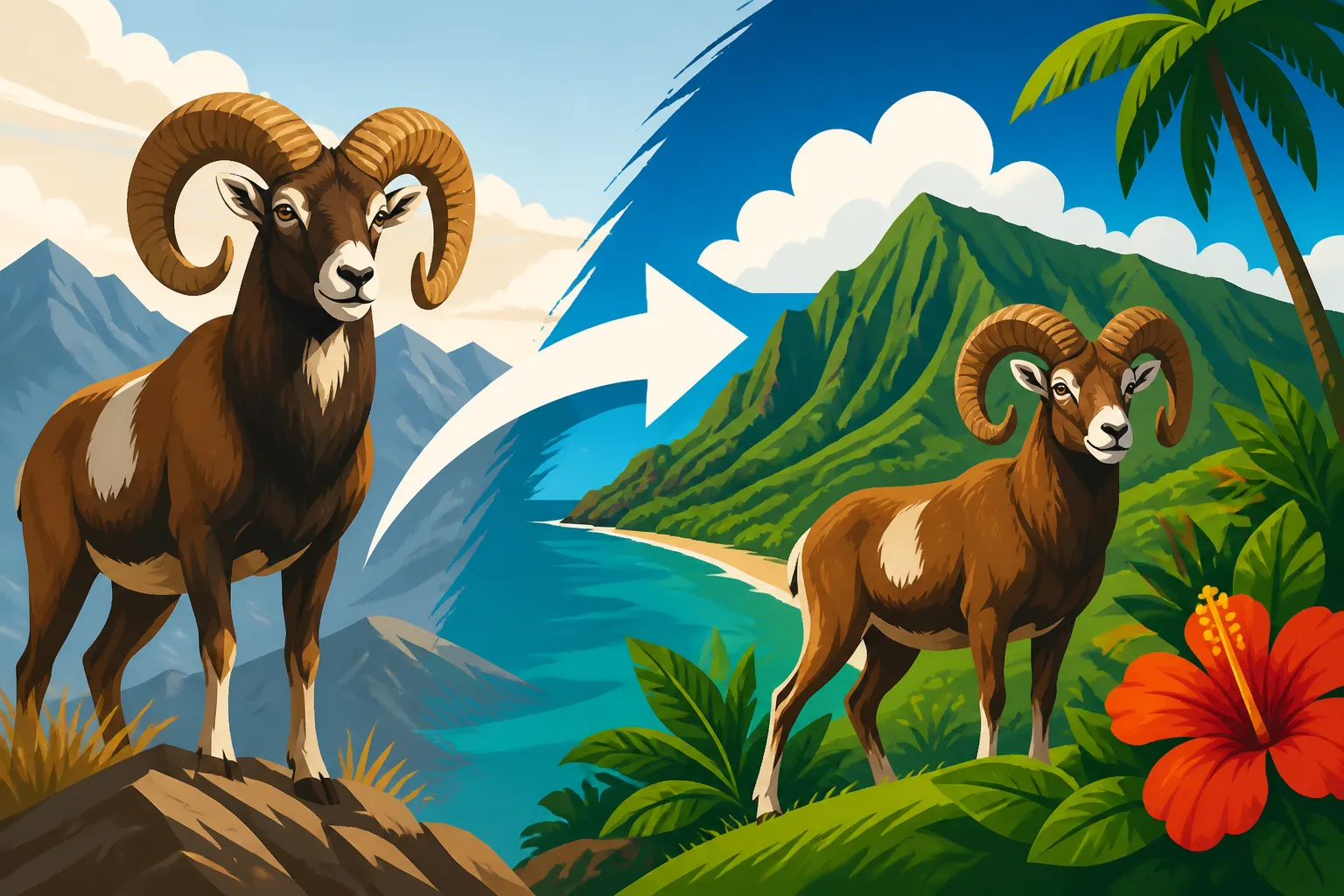
The definitive introduction of European Mouflon into Hawaii occurred in the 1960s. These animals, primarily sourced from game farms on the mainland U.S. that had established populations from their European stock, were brought to Hawaii Island. The specific goal was to establish a wild population for sport hunting. These initial releases were meticulously planned, often involving capturing animals and transporting them by ship or plane to the islands. Early accounts suggest some were released on large private ranch lands, like the expansive Parker Ranch, which historically played a significant role in managing wildlife and land on the Big Island.
The terrain chosen for these releases was often rugged and high-elevation, mirroring the challenging landscapes Mouflon were accustomed to in their native range. The dry, often windswept slopes of Hawaii's volcanoes, particularly Mauna Kea, provided ample space and a relatively undisturbed environment for the sheep to adapt. Their inherent hardiness, as discussed earlier, allowed them to quickly acclimate to the volcanic soils and sparse vegetation of the upper elevations. Unlike some other introduced species that struggled with Hawaii's unique flora, Mouflon proved adept at browsing on the native and non-native plants available, quickly establishing breeding populations.
The Mauna Kea Habitat and Spread
Once established, the Mouflon populations on Hawaii Island began to thrive, primarily expanding across the slopes of Mauna Kea. This vast, high-elevation landscape, characterized by lava flows, cinder cones, and scattered mamane-naio forests, became their primary domain. The challenging conditions, with thin air and often unpredictable weather, paradoxically created an ideal environment for the sheep, as it limited human encroachment and offered ample escape routes. Hunters today know that chasing Mouflon on Hawaii's Highest Slopes is no easy feat, demanding physical fitness and expert navigation.
From these core release areas, the Mouflon population spread, inhabiting various public hunting units managed by the Department of Land and Natural Resources (DLNR), Division of Forestry and Wildlife (DOFAW). These units, such as Unit A on Mauna Kea or the Puu Waawaa Wildlife Sanctuary, became prime areas for hunting. In particular, the mauka (mountain) regions offered sufficient food and cover. Over the decades, Mouflon have become an iconic part of the Big Island's high country, a testament to their successful adaptation to an environment far removed from their ancestral Mediterranean islands. Today, when you venture into these remote areas, you're stepping into a landscape profoundly shaped by the choices made over half a century ago.
Mouflon on Other Hawaiian Islands: Lanai's Unique Case
While the Big Island holds the largest and most established Mouflon population, other islands also have their own stories regarding the presence, or absence, of these unique sheep. Lanai, in particular, stands out for its concerted effort to establish a Mouflon population for specific hunting purposes.
Lanai's Mouflon Population History
Lanai, known for its extensive axis deer herds, also hosts a significant Mouflon population that has a slightly different origin story than the Big Island's. In the 1970s, a deliberate effort was made to introduce Mouflon to Lanai, primarily from the thriving herds on Hawaii Island. The goal was again to diversify hunting opportunities on the island, creating a premier destination for both axis deer and Mouflon. The introduction was a success, and the sheep adapted well to Lanai's dry, rugged landscape, particularly the central and western uplands.
Hunting on Lanai, including for Mouflon, is often managed through a lottery system due to the island's smaller size and the desire to control hunter pressure. This ensures sustainable populations and a quality hunting experience. A hunt for Lanai's Mouflon Archery Season requires careful planning and a bit of luck in the draw, often managed through platforms like GoHunt that help hunters navigate the application process. These sheep are now well-integrated into the island's ecosystem, providing a challenging pursuit for hunters who manage to draw a tag. The presence of both axis deer and Mouflon on Lanai makes it a dual-species hunting paradise for many, albeit one that requires adherence to strict permit regulations.
Molokai and Maui's Absence
Interestingly, while Mouflon have thrived on Hawaii Island and Lanai, they are notably absent as established, huntable populations on other major islands like Maui and Molokai. This isn't for lack of trying in some historical instances, but stable populations never truly took hold or were intentionally managed out. Maui, for instance, has a strong population of feral goats and, more famously, axis deer, which have become a primary game species. The lack of Mouflon on Maui might be attributed to various factors, including the type of habitat available, existing competition from other ungulates, or simply a lack of sustained introduction efforts in areas conducive to their long-term survival.
Similarly, Molokai, while also having axis deer and feral pigs, does not host a Mouflon population. The island's unique terrain and land management history might have played a role. This highlights that while Mouflon are hardy, their successful establishment isn't guaranteed; it depends on a complex interplay of habitat suitability, initial population strength, and ongoing management (or lack thereof). The focus on other game animals, or perhaps different conservation priorities, simply meant that Mouflon never became a fixture on these islands, making Hawaii Island and Lanai truly unique for sheep hunters in the archipelago.
Ecological Footprint and Management of Mouflon
Like all introduced species in Hawaii, Mouflon have left an undeniable mark on the islands' delicate ecosystems. Their presence necessitates ongoing management efforts, which often rely heavily on regulated hunting to balance conservation goals with recreational opportunities.
Impact on Native Flora and Fauna
Mouflon, being browsers and grazers, exert pressure on native vegetation, especially in the high-elevation ecosystems they inhabit. On Mauna Kea, for example, their presence has significantly impacted the mamane-naio forest, a critical habitat for the endangered palila bird. The sheep browse on mamane seedlings and bark, hindering forest regeneration and reducing food sources for the palila. This ecological conflict has led to decades of debate and legal battles, resulting in mandates for feral ungulate control in certain critical habitat zones. The unique native flora of Hawaii evolved without large terrestrial herbivores, making them particularly vulnerable to the feeding habits of introduced sheep and goats.
Beyond direct browsing, ungulates like Mouflon can contribute to soil erosion, especially on steep slopes and during heavy rains, as their hooves disturb the soil and reduce ground cover. This erosion can, in turn, affect water quality and further degrade habitats. The competition for forage with other introduced species, such as feral goats and cattle (where they still exist), also adds to the overall pressure on the land. Understanding these impacts is crucial for appreciating why the management of Mouflon populations is not just about providing hunting opportunities, but also about protecting Hawaii's irreplaceable natural heritage.
Conservation Efforts and Mouflon Management
Given their ecological impact, the management of Mouflon populations in Hawaii is a complex balancing act. DOFAW, along with private landowners and conservation groups, implements various strategies to control population numbers, particularly in sensitive areas. Regulated hunting is a primary tool, as it provides a recreational outlet while helping to manage animal numbers. Hunters who engage in Mouflon Sheep Hunting on Hawaii Island or on Lanai play an important role in these conservation efforts, essentially acting as part of the management strategy.
Conservation efforts also include fencing off critical habitats to exclude ungulates and allow native vegetation to recover. These fenced enclosures, while controversial among some hunters, are vital for protecting endangered species and their habitats. Aerial control measures, such as helicopter-based shooting, are sometimes employed in very remote or inaccessible areas where ground hunting is not feasible or effective enough to reach population targets. The goal is often to reduce Mouflon numbers in specific zones to allow native plant communities to rebound, creating a mosaic landscape where both native ecosystems and game animals can coexist, albeit with ongoing human intervention. Navigating these various land designations and regulations requires careful attention, and resources like GoHunt can be instrumental in identifying public access and specific hunting unit rules.
Mouflon's Role in Hawaii's Hunting Culture
Despite the ecological challenges, Mouflon have carved out a unique and esteemed place within Hawaii's hunting culture. For many, a Mouflon hunt represents the pinnacle of big game hunting in the islands, offering a demanding and rewarding experience unlike any other.
The Thrill of a Mauna Kea Mouflon Hunt
Hunting Mouflon on the slopes of Mauna Kea is widely considered one of Hawaii's most challenging and sought-after big game pursuits. The elevation alone, with hunts often taking place between 6,000 and 10,000 feet, tests a hunter's physical endurance. The terrain is rugged, characterized by sharp lava fields, steep cinder cones, and often dense, scattered mamane-naio forests. The weather can be unpredictable, shifting rapidly from clear skies to thick fog, rain, or even snow, adding another layer of difficulty. It’s an adventure that requires careful preparation, the right gear, and a solid understanding of Hunting Hawaii's Volcanic Terrain.
Spotting a Mouflon ram, especially one with a magnificent full curl, in this vast landscape is a testament to patience and glassing skills. The sheep are wary and blend surprisingly well into their surroundings. Once spotted, a stalk can be grueling, involving long ascents, navigating treacherous footing, and playing the wind in shifting thermals. The reward, however, is immense: a beautiful animal, excellent venison, and the profound satisfaction of overcoming some of the most challenging hunting conditions in the world. It’s an experience that truly connects you with the raw, untamed spirit of Hawaii's high country.
Permits, Tags, and Access for Mouflon
For hunters looking to pursue Mouflon in Hawaii, understanding the permit and tag system is paramount. On Hawaii Island, Mouflon are typically managed through either open public hunting seasons in certain Game Management Areas (GMAs) or through special drawn hunts. The season dates and specific rules vary by unit and can change year to year, so staying updated through the DOFAW website or platforms like GoHunt is essential. Generally, hunters will need a valid Hawaii Hunting Licenses and What They Cost, a Wildlife Conservation Stamp, and potentially specific permit-tags for the unit and season they intend to hunt.
On Lanai, Mouflon hunting is almost exclusively conducted through a highly competitive lottery system for limited tags. These draws require applications well in advance, and success is not guaranteed. Non-residents face higher fees and often tighter restrictions, making careful planning even more crucial. Regardless of the island, hunters are required to check in and out of hunting units, either at physical check stations or through digital apps like OuterSpatial, and to correctly tag their harvested animal. Knowing How Hawaii's Permit-Tag System Works is crucial to ensure a legal and ethical hunt, respecting both the regulations and the animals. This meticulous approach to hunting reflects the islands' commitment to managing these unique game species sustainably for future generations.
Table: Key Mouflon and Sheep Introductions in Hawaii
| Island | Species/Type | Primary Introduction Period | Original Source (General) | Primary Motivation | Current Status/Hunting | Ecological Impact Notes |
|---|---|---|---|---|---|---|
| Hawaii | Feral Sheep | Late 1700s – Early 1800s | Domestic Sheep (European) | Food, Agriculture | Huntable, often mixed genetics | Significant browsing on native flora, erosion |
| Hawaii | European Mouflon | 1960s | Mainland Game Farms | Sport Hunting | Huntable, strong populations | Pressure on mamane-naio forests, palila habitat |
| Lanai | European Mouflon | 1970s | Hawaii Island Mouflon | Sport Hunting | Huntable, drawn hunt system | Browsing on dryland forests, competition with Axis Deer |
| Maui | Feral Sheep/Goats | Late 1700s – Early 1800s | Domestic Sheep (European) | Food, Agriculture | Feral Goats common, sheep less so | Erosion, impact on native plant communities |
| Molokai | Feral Goats | Late 1700s – Early 1800s | Domestic Goats (European) | Food, Agriculture | Huntable | Erosion, severe impact on native vegetation |
| Kauai | Feral Goats | Late 1700s – Early 1800s | Domestic Goats (European) | Food, Agriculture | Huntable | Erosion, impact on coastal and canyon flora |
Disclaimer
Please remember that hunting regulations in Hawaii can change. Always consult the most current Hawaii Department of Land and Natural Resources (DLNR) Division of Forestry and Wildlife (DOFAW) regulations before planning any hunt. This guide is for informational purposes only and does not supersede official state regulations.