Hunting the Puu Anahulu Game Management Area
When you dream of hunting in Hawaii, images of lush, green rainforests often come to mind, but the Big Island offers incredible diversity, including vast, dry landscapes that hold some fantastic opportunities. One such area, the Puu Anahulu Game Management Area (GMA), can be a real head-scratcher for first-timers or even seasoned hunters if they’re not prepared for its unique challenges. This guide is going to walk you through everything you need to know to successfully navigate and hunt this truly special Big Island unit, from understanding its terrain and game to the nitty-gritty of permits and tactics.
Understanding the Puu Anahulu Game Management Area
Puu Anahulu, located on the leeward (dry) side of Hawaii Island, is a sprawling public hunting area that offers a stark contrast to the wet, windward forests. It's an area defined by its recent volcanic history, rugged lava flows, and sparse, arid vegetation. This isn't your typical mainland deer woods; it's a test of endurance, observation, and adaptability.
Location and Unique Landscape
The Puu Anahulu GMA stretches across the lower slopes of Mauna Kea and Mauna Loa, primarily on the Kona side of the island. Imagine miles of undulating terrain, dotted with cinder cones and vast expanses of older, weathered lava. The vegetation largely consists of kiawe, haole koa, fountain grass, and scattered pockets of more native dryland forest species. It’s open country, often brutally hot and windy, with limited natural water sources. This landscape demands keen eyes and a willingness to walk. You might find yourself glassing across miles of broken ground, searching for movement where the black lava meets the dry, tan grass. The elevation can vary quite a bit within the unit, adding to the topographic complexity and requiring hunters to consider thermals and wind shifts.
Primary Game Species in Puu Anahulu
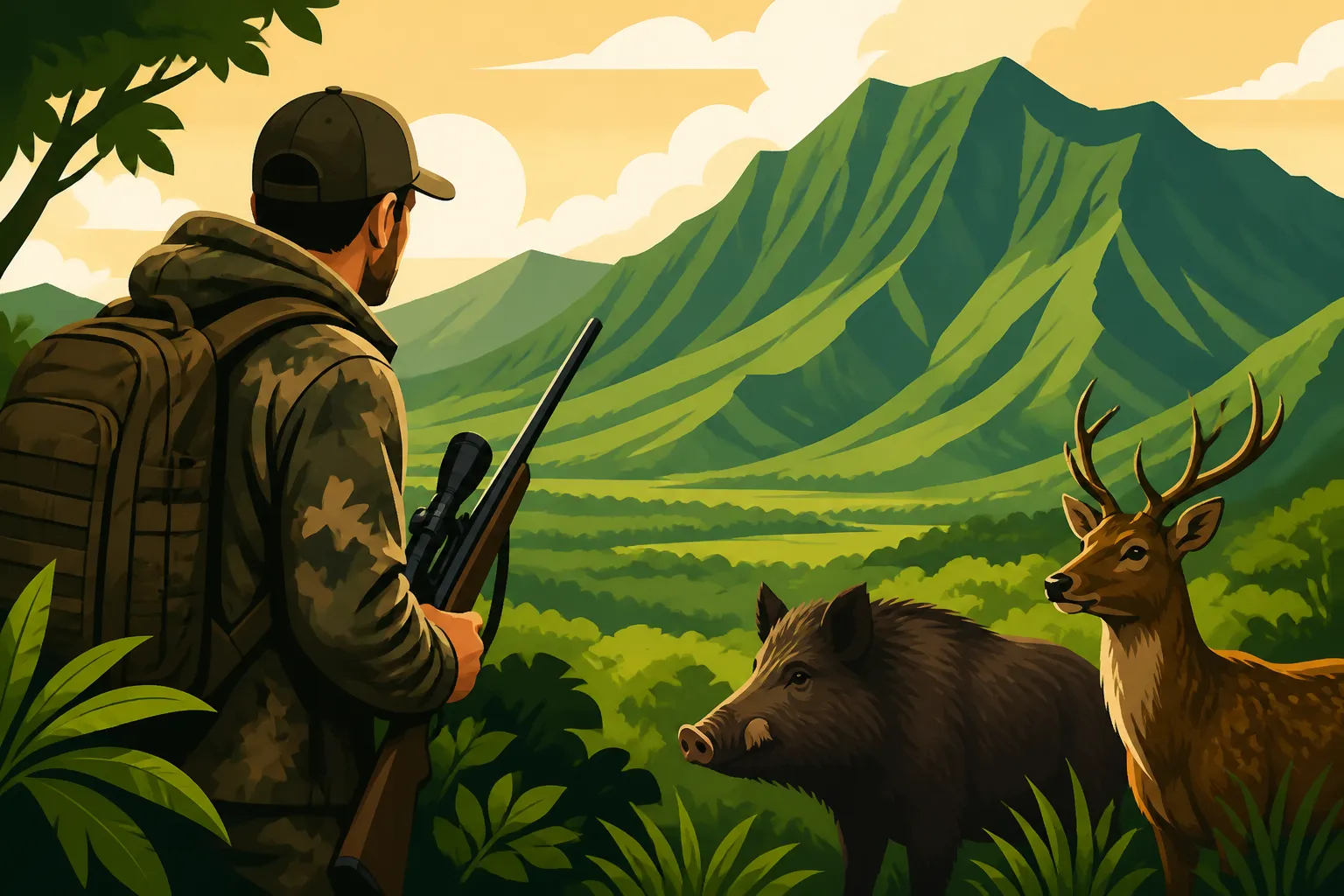
Puu Anahulu is renowned for its diverse big game populations, particularly Axis deer, feral sheep, and feral goats. Each species presents its own unique hunting challenge within this environment.
- Axis Deer: The star of the show for many hunters, Axis deer thrive in this dry, open habitat. They were introduced to Hawaii and have done incredibly well on several islands, including parts of the Big Island. Their spotted coats blend surprisingly well with the dappled light under kiawe trees or against a backdrop of parched grass and lava rock. You'll often find them browsing on grasses and shrubs, especially during the cooler hours of the day. Their rut can occur almost any time of year, which means you might encounter hard-horned bucks or velvet-antlered deer depending on when you hunt. For more about this fantastic animal, check out Axis Deer, Hawaii's Signature Big Game.
- Feral Sheep: These aren't just any sheep; many are hybrids of European Mouflon and various domestic sheep breeds, resulting in a hardy animal with impressive horns. They often frequent the higher, rockier sections of the GMA, especially around the cinder cones, where they can escape the heat and find browse. These sheep are notoriously wary, and their ability to blend into the lava fields makes them incredibly challenging to spot and stalk. The genetics are fascinating, and you can learn more about them in Hunting Hawaii's Feral Sheep on the Big Island.
- Feral Goats: Agile and tough, feral goats are perfectly adapted to the rugged terrain of Puu Anahulu. They can be found everywhere from the kiawe flats to the steepest lava flows and canyon edges. Goats are constantly on the move, browsing on whatever vegetation they can find. They often form large herds, and a watchful nanny can quickly alert the entire group to your presence. Patience and careful glassing are key when hunting these intelligent animals. If you're keen on goats, Hunting Hawaii's Feral Goats provides more insights.
Planning Your Puu Anahulu Hunt
Hunting in Hawaii is a little different from the mainland, and Puu Anahulu is no exception. Proper planning and understanding the regulatory landscape are paramount to a successful trip.
Seasons, Permits, and Regulations
Like most Hawaii public hunting units, Puu Anahulu operates under specific seasonal rules and often requires a permit-tag system. These details can change year to year, so your first step should always be to check the latest announcements from the Hawaii Department of Land and Natural Resources (DLNR), Division of Forestry and Wildlife (DOFAW). They publish annual hunt announcements that detail open seasons, bag limits, and specific unit rules.
Typically, Puu Anahulu might have designated archery, muzzleloader, and rifle seasons for different species, or sometimes a combination. Access is usually through a lottery drawing system for certain seasons, while others might be first-come, first-served with over-the-counter permits. It's crucial to understand How Hawaii's Permit-Tag System Works before you even think about stepping foot in the unit. The platform GoHunt can be a valuable resource for tracking application deadlines and understanding the nuances of Hawaii's draw system, though you'll still need to refer to official DOFAW documents.
Here’s a general overview of what you might need:
- Hawaii Hunting License: This is your foundational requirement. Whether you're a resident or nonresident, you'll need to purchase one annually. Read up on Hawaii Hunting Licenses and What They Cost for details.
- Permit-Tag: For Axis deer, sheep, and goats in Puu Anahulu, you'll almost certainly need a specific permit-tag for each animal you intend to harvest. These are often limited and obtained through a lottery.
- Hunter Education: If you're new to hunting in Hawaii or haven't completed a hunter education course, you'll need to satisfy this requirement.
Always double-check the legal weapon types for each season within Puu Anahulu. Some seasons might be archery-only, while others allow rifles.
Accessing the Unit and Check-In Procedures
Puu Anahulu has several designated access points, often off the main highways like Mamalahoa Highway (Route 190) or the Saddle Road (Route 200). Most of these access roads are unpaved, rough, and definitely require a high-clearance 4WD vehicle, especially after any rain. Don't underestimate Hawaii's "unpaved" roads; they can quickly turn into axle-breaking nightmares.
One of the unique aspects of public land hunting in Hawaii is the mandatory check-in and check-out procedure. Before you start your hunt, you must physically check in at a designated hunter check station or use the online OuterSpatial app. This process registers your entry into the unit, helps DOFAW track hunter effort, and ensures your safety. Forgetting to check out can lead to serious concern and even fines. To learn more about this process, refer to Checking In and Out of Hawaii Hunting Units. Make sure you have the app downloaded and are familiar with it, especially since cell service can be spotty in the more remote parts of Puu Anahulu.
Strategies and Gear for Puu Anahulu
Hunting Puu Anahulu requires a blend of physical fitness, keen observation skills, and the right gear. It's a challenging environment, but incredibly rewarding.
Spot-and-Stalk Tactics in Open Country
Puu Anahulu is prime spot-and-stalk territory. The open nature of the terrain means you'll spend a lot of time behind binoculars and spotting scopes.
- Glassing: Get to a high point before first light and use good optics to meticulously scan the landscape. Look for patches of contrasting color, horizontal lines that break up the vertical vegetation, or the flick of an ear. Axis deer often feed in the more open areas during early morning and late afternoon, while sheep and goats might be higher up on rocky outcrops or moving through the lava fields. Patience here is crucial. Learning to glass effectively in Hawaii's diverse terrain is covered in Spot-and-Stalk Axis Deer in Hawaii.
- Wind and Thermals: The Big Island's dry side can have tricky winds. Trade winds generally blow from the northeast, but local thermals will shift as the sun heats the ground, often blowing up in the morning and down in the evening. Always be mindful of your scent cone, especially when stalking animals like Axis deer with their keen sense of smell. Hunting Downwind in Hawaii's Shifting Thermals is a great resource here.
- Slow Movement: Once you spot an animal, the stalk can be long and arduous. Use the terrain – lava ridges, kiawe thickets, cinder cones – to your advantage for cover. Move slowly, deliberately, and be prepared to crawl. The ground can be crunchy with dry leaves and brittle lava rock, so quiet movement is essential.
Importance of Water Sources
In Puu Anahulu's dry environment, water is life, and it's also a major draw for game animals. While natural sources are scarce, any permanent water feature, whether a small seeping spring, a stock tank, or even a low spot that holds rainwater, will attract animals.
- Scouting for Water: Before your hunt, study maps and aerial imagery. Look for any depressions or areas marked as potential water sources. This is where
onX Huntbecomes invaluable; you can mark potential water locations and plan your routes around them. - Hunting Near Water: During the hotter, drier months, animals will definitely concentrate around water sources. Set up downwind and watch these areas during dawn and dusk. Just be respectful of any private land boundaries that might surround water tanks; always verify land ownership using
onX Huntor similar tools. You can find more specific advice on this in Hunting a Water Source in Dry Hawaii Country.
Essential Gear for Puu Anahulu
Your gear choices can make or break a Puu Anahulu hunt.
| Category | Item | Importance in Puu Anahulu |
|---|---|---|
| Footwear | Sturdy, high-ankle hiking boots | Protection from sharp lava rock, thorns, and uneven ground. Must be broken in! |
| Optics | High-quality binoculars (10×42 or 12×50) | Essential for glassing vast, open country. A spotting scope is a huge plus. |
| Hydration | Hydration pack or multiple water bottles | You will need more water than you think. Water and Heat Planning for a Hawaii Hunt is vital reading. |
| Sun Protection | Wide-brimmed hat, sunglasses, sunscreen | Constant sun exposure can be brutal. |
| Navigation | GPS device or smartphone with onX Hunt app |
Crucial for unit boundaries, marking game, and finding your way in vast, featureless areas. |
| Clothing | Lightweight, breathable layers | Temperatures swing. Start cool, add layers for chilly mornings, shed for hot midday. Camo optional, but earthy tones help. |
| First Aid | Comprehensive kit | For cuts, scrapes from thorns and lava, blisters. |
| Knife/Game Bags | Sharp knife, sturdy game bags | For field dressing your animal quickly in the heat. Essential for Cooling Meat Fast on a Hawaii Hunt. |
Overcoming Challenges and Maximizing Success
Puu Anahulu is beautiful but can be unforgiving. Acknowledging and preparing for its challenges will significantly increase your chances of success and enjoyment.
Battling the Heat and Thirst
The dry leeward side of Hawaii Island is hot. Period. Even in winter, midday temperatures can soar, especially when hiking across black lava that absorbs and radiates heat. Dehydration is a serious threat.
- Hydrate Constantly: Start hydrating days before your hunt. Carry at least a gallon of water per person per day, maybe more. Electrolyte drinks can help replenish essential salts lost through sweat.
- Hunt Smart: Focus your intense hunting efforts on the cooler parts of the day – early morning and late afternoon. Use the midday heat for glassing from a shaded spot (if you can find one) or for long, slow stalks where game might be bedded in cover.
- Emergency Water: Consider carrying a small, lightweight water filter or purification tablets as a backup for extreme emergencies, although reliable water sources are rare.
Navigating Rough Terrain and Dense Thickets
The terrain in Puu Anahulu is challenging, a mix of rough a'a and pahoehoe lava flows, interspersed with dusty trails and surprisingly dense thickets of kiawe.
- Footing: Always watch your step. A twisted ankle on remote lava can turn a great day into a dangerous emergency. Hiking poles can be a lifesaver for stability.
- Thorns: Kiawe trees are covered in formidable thorns that can puncture boots, pants, and skin. Wear durable pants and gaiters to protect your lower legs. Avoid crashing through thickets; try to find game trails or openings.
- Staying Found: The rolling hills and uniform vegetation can make it easy to get disoriented. Always trust your GPS. Use the
onX Huntapp to drop waypoints frequently, especially if you're venturing far from known roads. Knowing Reading a Hawaii Unit Boundary Map and having it on your device is non-negotiable.
Interpreting Game Sign and Behavior
Understanding what the animals are doing can give you a significant edge.
- Axis Deer Sign: Look for fresh tracks around water sources or dusty trails. Droppings can indicate recent activity. Pay attention to rub lines on small trees or shrubs, especially if you're hunting during a time when bucks might be actively marking territory. Reading Axis Deer Sign in Dry Country offers more specific tips.
- Goat and Sheep Sign: These animals often leave distinct tracks and droppings in rocky areas. Goats will browse higher on bushes, and you might see rubbed areas where they’ve scratched against rocks or small trees.
- Bedding Areas: During the hottest parts of the day, all three species will seek shade and cover. Look for sheltered pockets under kiawe trees, dense brush, or even in lava tubes or overhangs. These can be excellent spots for a midday stalk.
After the Kill: Meat Care in Hawaii's Climate
Once you've successfully harvested an animal, the clock starts ticking. Hawaii's heat and humidity mean meat can spoil very quickly.
- Rapid Field Dressing: Get the animal field dressed immediately. Remove all internal organs to allow the carcass to cool as fast as possible.
- Skinning and Quartering: If possible, skin and quarter the animal on the spot, especially if it's a larger Axis deer. This allows more surface area to cool. Have plenty of game bags.
- Cooling: Get the meat out of the sun and into coolers with ice as soon as humanly possible. This is where Cooling Meat Fast on a Hawaii Hunt comes into play – packing extra ice and knowing your extraction route is crucial. Many hunters will bring large coolers filled with ice in their truck, ready for immediate transfer.
Remember, Puu Anahulu is a challenging but incredibly rewarding place to hunt. With diligent preparation, respect for the land, and a good dose of perseverance, you might just find yourself packing out a truly memorable Hawaii trophy.
Disclaimer
This article is for general informational purposes only and does not constitute professional advice. Laws, prices and regulations vary by location and change over time. Consult a qualified professional for guidance on your specific situation.