Why Fences Change Where Animals Go
If you've spent any time hunting in Hawaii, you know the islands' diverse terrain throws plenty of curveballs. Just when you think you've got an animal patterned, a seemingly random fence can pop up, throwing a wrench into your plans and making you wonder why the game animals you've been watching are suddenly nowhere to be found, or, conversely, concentrated in an unexpected spot. Understanding how these fences influence everything from daily movements to long-term population distribution is absolutely crucial for a successful hunt here in the islands.
The Unexpected Impact of Fences on Wildlife Movement
It might seem obvious that a fence stops an animal, but the reality is far more nuanced and complex, especially in Hawaii's unique ecosystems. Fences here aren't just lines on a map; they're dynamic barriers that drastically reshape the landscape for our game animals, leading to consequences that hunters need to grasp.
Fences as Physical Barriers
Imagine you're stalking a group of Axis deer in the dry, kiawe-studded flats of Maui, tracking them towards a known water source. Suddenly, you hit an old, rusting barbed-wire fence that wasn't on the map you quickly glanced at, and the deer are nowhere to be seen on your side. These physical barriers, whether they're ancient lava rock walls, forgotten strands of barbed wire from a century-old ranch, or modern, purpose-built conservation fences, fundamentally alter how animals move across the landscape. They might block traditional migratory routes that animals have used for generations, preventing access to seasonal forage or vital watering holes. For a big-bodied Axis deer, even a sturdy five-strand fence can be a challenge to jump, especially if there's dense undergrowth on the other side. Feral pigs, on the other hand, are masters of finding or creating weak points, often rooting under fences or squeezing through small gaps. Goats, agile and determined, will often navigate cliff faces and seemingly impenetrable terrain only to be stymied by a well-placed fence along a ridge. When animals hit these impenetrable lines, they don't just disappear; they're forced to re-route, often pushing them into areas where hunting pressure is higher or resources are scarcer. This can lead to unexpected concentrations of animals along fence lines, or, conversely, areas becoming entirely devoid of certain species if their necessary resources are cut off.
Altered Foraging and Watering Patterns
The impact of fences extends far beyond just stopping an animal in its tracks. These barriers directly interrupt an animal's ability to forage and access water, two of the most critical elements for survival. Consider a deep gulch on the Big Island that historically provided lush, green forage for pigs and goats during the dry season, accessible from either side. If a new conservation fence is installed along one rim, suddenly a significant portion of that feeding ground might become inaccessible to animals on the other side. They are then forced to seek out less ideal forage, perhaps overgrazing areas that remain accessible, leading to resource depletion and increased competition.
Similarly, access to water is paramount in Hawaii's often arid leeward regions. An old cattle fence, while seemingly innocuous, might cut off a traditional trail leading to a small, hidden spring or a seasonal catchment. Animals like Axis deer, especially during extended dry spells, rely heavily on these consistent water sources. If their path is blocked, they must expend more energy seeking out alternative, potentially more distant, or less reliable water. This stress can impact their health, body condition, and even breeding success. For hunters, understanding these altered patterns means recognizing that where you used to find animals might no longer be the case. You might need to scout new water sources or look for signs of increased browsing pressure along the newly accessible side of a fence. Paying attention to these changes can give you a significant advantage, helping you anticipate where game will be moving to find food and water. This is particularly important when considering areas for Hunting a Water Source in Dry Hawaii Country.
Behavioral Shifts and Hunting Implications
The presence of fences doesn't just change where animals go; it fundamentally alters how they behave, which has profound implications for hunters trying to anticipate their movements and reactions. These behavioral shifts are a direct response to the disruption of their natural instincts and established routines.
Changes in Herd Dynamics and Social Structure
When a fence cuts through a previously open landscape, it can fragment existing herds, especially for social animals like Axis deer or Mouflon sheep. Imagine a large Axis deer herd on Molokai that traditionally roamed vast tracts of land. A new fence might split that herd, separating family groups, young bucks from older, dominant ones, or even isolating pregnant does. This fragmentation can lead to increased stress, as animals might struggle to reunite or establish new social orders in confined spaces. For example, a dominant buck might find his territory suddenly halved, forcing him into conflict with other bucks over reduced resources or access to does.
Over time, this can lead to smaller, more stressed herds with altered breeding patterns. Animals in these confined areas might become more vigilant, reacting more quickly to perceived threats because their escape routes are limited. They may move more cautiously, sticking to thicker cover closer to the fence, or develop predictable patterns of movement along the barrier. Hunters who typically rely on understanding large herd movements might find themselves tracking smaller, more erratic groups. Observing these changes, sometimes with the aid of tools like GoHunt's detailed maps, is key to adapting your Spot-and-Stalk Tactics on Open Country or even your approach to Reading Axis Deer Sign in Dry Country.
New Habitat Utilization and Pressure Zones
Fences inevitably create distinct habitat zones: the areas where animals are restricted and the areas from which they are excluded. On the restricted side, you often see increased pressure on vegetation. Animals might overgraze certain plant species, leading to changes in the plant community and even soil erosion, especially on steep slopes. They might also begin to utilize plant species they previously ignored due to lack of other options. For instance, feral goats, if confined to a smaller area, might strip bark from trees they normally wouldn't touch, or pigs might intensify rooting in specific areas, creating more distinct mud wallows.
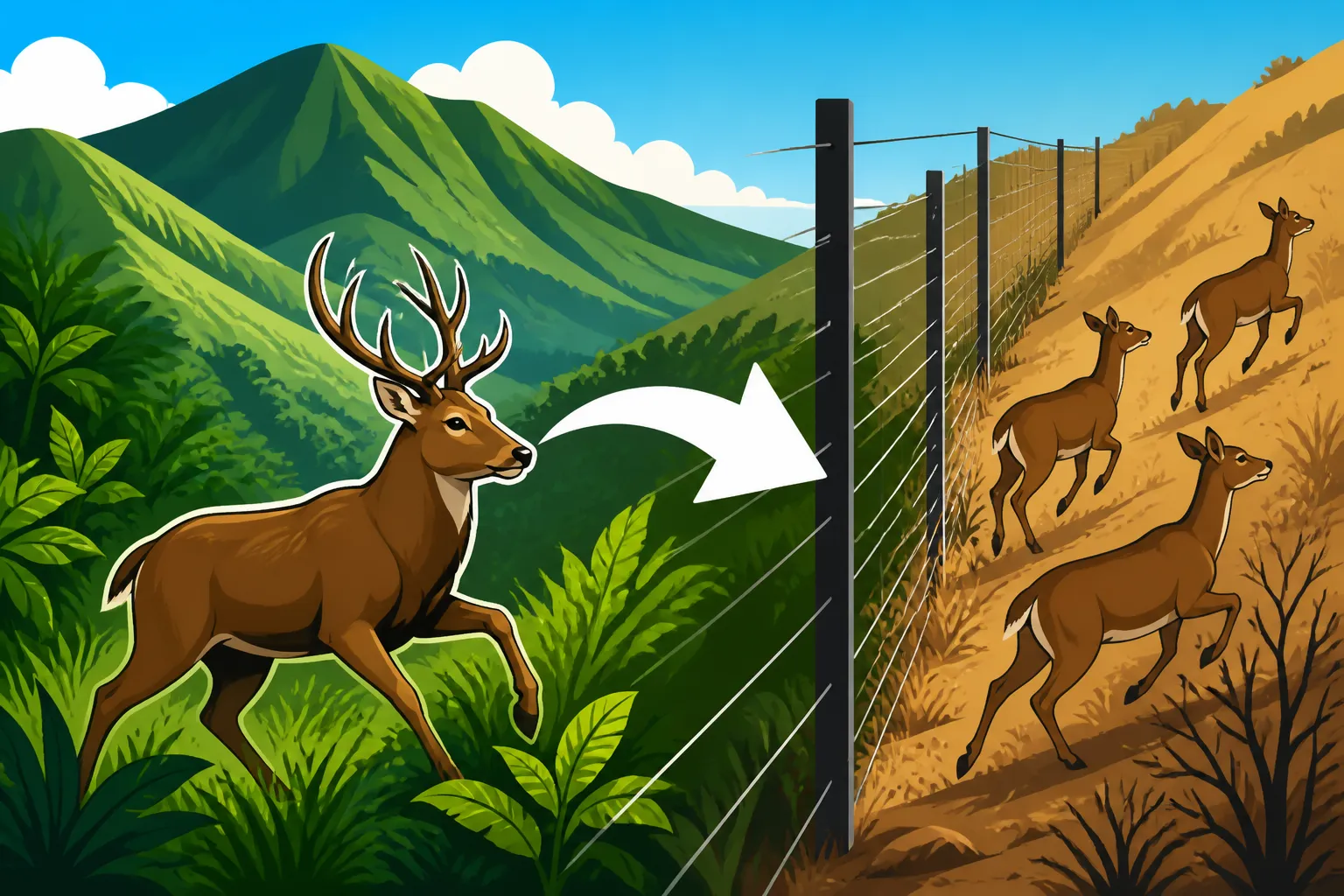
Conversely, on the excluded side of a conservation fence, vegetation might begin to recover, with native plants slowly regenerating without constant browsing or rooting pressure. This creates a stark contrast, an ecological "before and after" picture. For hunters, the areas just inside the fence on the restricted side become "pressure zones." Animals here might be more numerous, but also significantly warier, having adapted to constant human presence or the stress of confinement. They might bed in the thickest cover right along the fence line, knowing it's their last resort. Understanding these pressure zones means adjusting your strategy: perhaps moving slower, being more patient, or focusing on early morning and late evening movements when animals are more likely to be active despite the pressure. Recognizing these new patterns of habitat use, whether in a Hunting a Kiawe Flat for Axis Deer or a dense Hunting a Strawberry Guava Thicket, becomes essential for success.
Understanding Fence Types and Their Permeability
Not all fences are created equal, and understanding the different types you'll encounter in Hawaii is key to predicting how game animals will interact with them. From ancient remnants to modern marvels of conservation engineering, each fence presents a different challenge to wildlife and, by extension, to the hunter.
Ranch Fences, Barbed Wire, and Stock Fencing
Across the Hawaiian Islands, you'll encounter a variety of traditional ranch and agricultural fences. Many of these are older, often a mix of wooden posts and barbed wire, sometimes supplemented by lava rock walls. These fences were primarily designed to contain livestock like cattle or horses, not necessarily to be impervious to agile game animals.
- Barbed Wire Fences: These are common along old ranch lands and unit boundaries. A well-maintained multi-strand barbed wire fence can deter many animals, especially if it's tall and taut. However, Axis deer, particularly younger animals, will often jump them if they feel sufficient pressure. Feral pigs are notorious for finding weak spots, rooting under or through existing gaps, or even bending wires down over time to create a passage. Goats, with their exceptional climbing ability, might find ways to navigate over collapsed sections or squeeze through wider gaps. The key is that these fences often have signs of animal crossings – strands of hair caught on barbs, freshly dug holes beneath, or worn paths alongside.
- Woven Wire/Stock Fencing: Less common than barbed wire in remote hunting units but present near active ranching operations, woven wire (or "hog wire") offers a more solid barrier. It's much harder for pigs to root under and can be a significant obstacle for deer. However, if the fence isn't regularly maintained, sagging sections or rusted-out holes can become entry points.
- Lava Rock Walls: These historic structures, often centuries old, crisscross many parts of the Big Island and Maui. While formidable, they are rarely animal-proof. Pigs will often use existing gaps or areas where the rocks have collapsed. Goats will scramble right over them, using the uneven surface as natural footholds. Deer might leap over lower sections, especially if pressured. These walls often serve as natural travel corridors along their length, with animals walking on top or parallel to them.
Recognizing these fence types helps you anticipate animal behavior. An old, dilapidated barbed-wire fence might be a funnel for pigs, while a solid woven-wire fence might mean you need to find an access point for the deer further down the line. Keep an eye out for What a Hawaii Ranch Lease Costs if you're thinking about private land access that might have these types of fences.
Conservation and Exclusion Fences
In stark contrast to traditional ranch fences are the modern, high-tech conservation and exclusion fences. These are typically erected by organizations like the Hawaii Department of Land and Natural Resources (DLNR) or various Watershed Partnerships (e.g., Maui Nui Makai, Three Mountain Alliance) specifically to exclude invasive ungulates – pigs, goats, sheep, and deer – from sensitive native forest ecosystems.
- Design: These fences are often much taller (6-8 feet), made of fine-mesh woven wire that prevents even small pigs from squeezing through, and often topped with an outrigger or electrified wire to deter climbing. The base is usually buried deep or tightly sealed to prevent rooting underneath. They are incredibly effective.
- Impact on Game: For a hunter, these fences represent a hard boundary. Animals simply cannot get through them. This means that if you're hunting an area adjacent to such a fence, you can be almost certain that game animals will be concentrated up to that boundary, but not beyond it. It creates a definitive edge to their habitat.
- Hunting Strategy: Hunting near these fences requires a different approach. You'll often find concentrated animal sign right along the fence line, as animals traverse parallel to it, looking for ways around or simply being funneled by its presence. This can create excellent ambush points or areas for Still-Hunting Pigs in Hawaii's Wet Forest, but also means the animals in these corridors are often extremely wary due to constant pressure. It's vital to respect these boundaries, as crossing them is often illegal and trespasses into highly sensitive conservation areas. Understanding
Hawaii's Fenced Conservation Boundariesis paramount for ethical and legal hunting.
| Fence Type | Primary Purpose | Typical Height | Material | Primary Animals Deterred | Hunter Considerations |
|---|---|---|---|---|---|
| Barbed Wire | Livestock containment | 3-5 feet | Steel wire (often rusted) | Less effective for most | Look for crawl points, hair snags; animals may jump or squeeze. Often delineate old property. |
| Woven Wire/Stock | Livestock, agriculture | 4-6 feet | Galvanized steel mesh | Pigs, some deer | More robust; look for bent sections, rooted areas. Can funnel animals along its length. |
| Lava Rock Walls | Historic property, stock | 2-4 feet | Volcanic rock | Few | Animals often walk on/along; good ambush points in breaks or natural funnels. |
| Conservation/Exclusion | Wildlife exclusion | 6-8+ feet | Fine-mesh steel, often electric | All ungulates | Hard boundary; animals concentrate along it. Strict no-crossing rules. Highly effective. |
Navigating Fenced Terrain as a Hunter
Understanding the types of fences and their impact is one thing; actually using that knowledge effectively in the field is another. Hawaii's hunting units are a patchwork of public, private, and conservation lands, often delineated by various fences. Being proficient at reading the landscape, including its man-made barriers, can make or break your hunt.
Scouting and Interpreting Fence Line Sign
The first step to successfully hunting in fenced terrain is thorough scouting, both before you even leave your couch and once you're on the ground. Modern tools have revolutionized this aspect of hunting. Before your trip, leverage digital mapping applications like onX Hunt. These platforms often show property lines, public land boundaries, and sometimes even old ranch roads and trails that might correspond to fence lines. They can show you Using onX for Hawaii Land Status and give you a huge leg up in understanding the layout of your chosen unit.
Once in the field, treat every fence line as a potential intelligence goldmine. Animals, especially those that are regularly pressured, will often use fences as travel corridors or escape routes. Look for:
- Rub Marks: Especially for Axis deer and Mouflon, rubs on fence posts or low-hanging branches along a fence indicate travel.
- Tracks: Animals will often leave clear tracks where they've crossed under or squeezed through a fence, or where they've walked parallel to it. Muddy sections near a fence are prime locations.
- Hair: Strands of hair caught on barbed wire or rough fence posts are a dead giveaway that animals are using that spot to cross.
- Droppings: Concentrations of scat along a fence indicate a regular travel path or bedding area.
- Wallows/Rooting: For pigs, signs of rooting or fresh wallows near a fence suggest they are using that boundary extensively, especially if it leads to a water source or thick cover.
By meticulously scouting these fence lines, you can identify natural funnels, common crossing points, and areas where animals are concentrating. This intelligence helps you predict movement, set up ambushes, or plan your stalks more effectively. Remember, animals will typically take the path of least resistance, and that often means exploiting weaknesses in a fence or following its edge. For areas with Hunting Hawaii's Kipuka Islands of Forest, fences often play a critical role in how animals move between these forest patches.
Ethical and Legal Considerations at Unit Boundaries
Hawaii's hunting landscape demands a high level of responsibility and awareness regarding unit boundaries and private land. Many public hunting units, particularly those managed by DOFAW (Division of Forestry and Wildlife), share borders with private ranches, conservation easements, or even residential areas. These boundaries are almost always marked by fences of some kind.
- Know Your Boundaries: It is your responsibility as a hunter to know exactly where you are at all times. Using a reliable GPS device with updated land ownership maps is not just helpful; it's practically mandatory. Checking In and Out of Hawaii Hunting Units is a basic requirement, but truly understanding where those units begin and end, especially when a fence forms the boundary, is critical. The OuterSpatial app, often used for check-ins, can also help visually with boundaries.
- Trespass Laws: Crossing a fence onto private property without explicit permission is trespassing, a serious offense with significant penalties. Even if an animal you've shot crosses a fence onto private land, you cannot pursue it without permission from the landowner. This can be one of the most frustrating scenarios in hunting, but respecting property rights is paramount. Understanding Hawaii Trespass and Closed Area Rules before you hunt is absolutely essential.
- Conservation Fences: As discussed, conservation fences protect highly sensitive native ecosystems. These areas are almost always off-limits to hunting and often for public access in general. Crossing one of these fences, even accidentally, is a violation of environmental protection laws and can result in severe fines.
Always err on the side of caution. If you're unsure if a fence marks a private property line or a conservation area, assume it does and do not cross. This commitment to ethical and legal hunting not only protects you from legal trouble but also ensures a positive relationship between hunters and landowners, which is vital for the future of hunting in Hawaii.
Disclaimer
Please remember that hunting regulations, unit boundaries, and land access rules in Hawaii can change. Always consult the most current Hawaii Department of Land and Natural Resources (DLNR), Division of Forestry and Wildlife (DOFAW) regulations and maps before planning any hunt. This guide is for informational purposes only and should not replace official government resources.