How Black-Tailed Deer Differ From Axis
For hunters eyeing the unique opportunities Hawaii offers, it can sometimes be a little confusing to distinguish between the different deer species roaming these islands. While many dream of chasing the spotted beauty of an Axis deer, the rugged terrain of Kauai holds a different challenge altogether: the Black-tailed deer. This guide will walk you through the distinct characteristics, behaviors, and hunting considerations for both, ensuring you're well-prepared for whichever Hawaiian adventure calls to you.
The Distinctive Deer of Hawaii: Black-Tailed vs. Axis
When we talk about deer hunting in Hawaii, we’re primarily focusing on two very different animals, each with its own story, habitat, and set of challenges for the hunter. It's not just a matter of different names; these are genuinely distinct species that demand different approaches and expectations. Understanding these foundational differences is paramount before you even think about packing your gear or applying for a permit. You might hear people lump "deer" together, but the reality on the ground, or rather, in the jungle and drylands, is far more nuanced.
A Tale of Two Islands and Their Deer
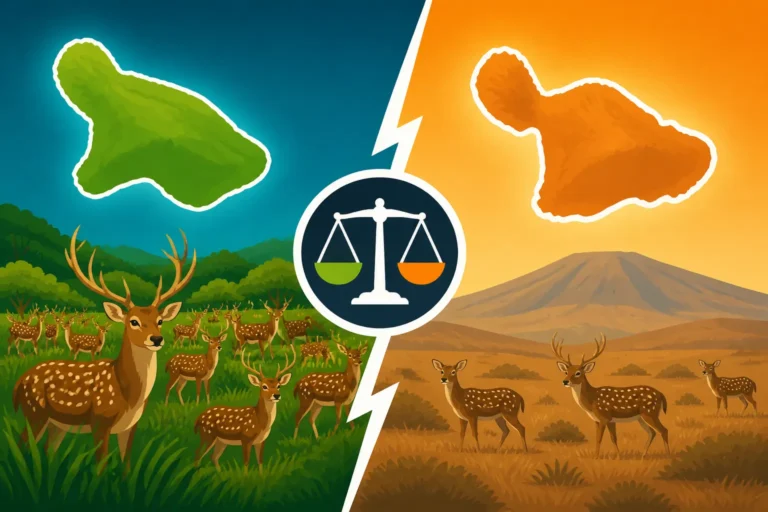
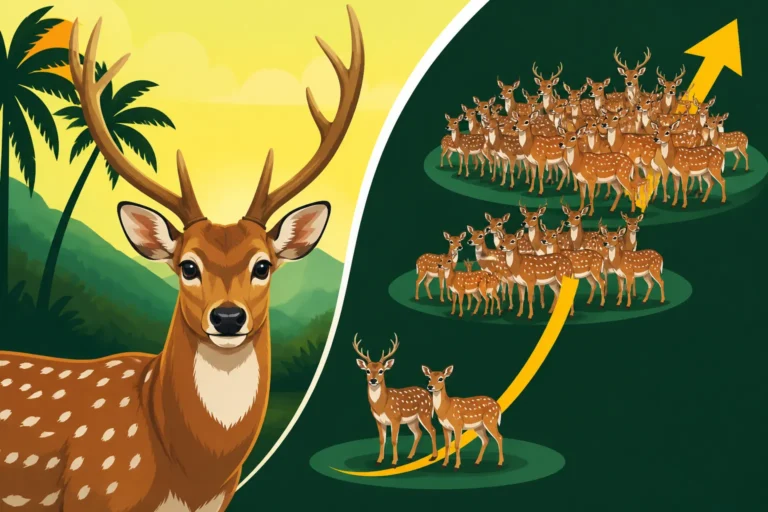
The most significant distinction between Black-tailed deer and Axis deer in Hawaii comes down to geography. Simply put, these two species do not coexist on the same major islands. Axis deer, the more widespread and famous of the two, are found predominantly on Maui, Molokai, and Lanai, and in smaller, less established populations on Hawaii Island. These are the deer you've likely seen in breathtaking photos, dotting open fields or disappearing into kiawe thickets. Their introduction history is linked to gifts and releases for game sport, with populations flourishing in the drier leeward landscapes.
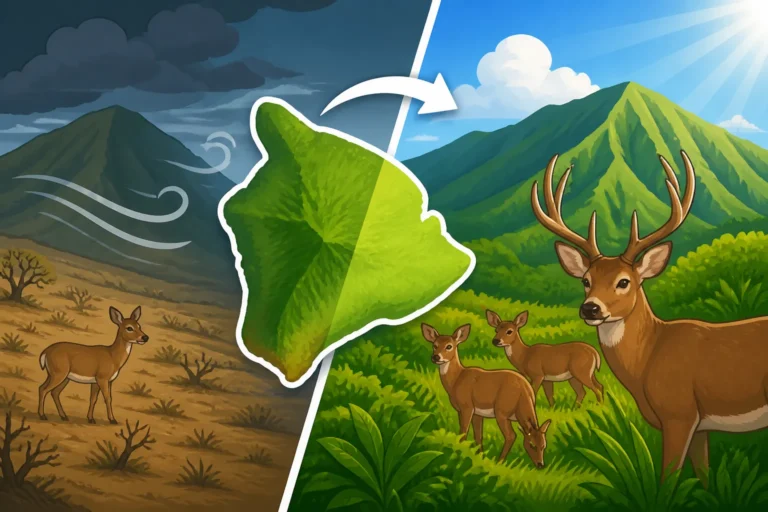
In stark contrast, the Black-tailed deer in Hawaii are exclusively found on the island of Kauai. These aren't the same Black-tailed deer you might find in the Pacific Northwest of the mainland; they are a subspecies known as Columbian Black-tailed deer. They were introduced to Kauai over a century ago and have adapted to the island's unique and often incredibly dense, wet, and rugged environment. Hunting for them often means navigating deep canyons and thick rainforests, a completely different experience than what you'd encounter on the drier, more open terrain favored by Axis deer.
Why the Distinction Matters to Hunters
For the hunter, knowing these differences isn't just trivia; it profoundly impacts every aspect of your trip. From where you fly into, to the type of clothing and gear you pack, to the very hunting methods you employ, everything shifts depending on which deer you're after. If your heart is set on a majestic Axis buck, heading to Kauai will lead to disappointment. Conversely, if you want the challenge of a true jungle hunt for a wary blacktail, Maui isn't your destination. Hunting Kauai's black-tailed deer will be a very different experience than Hunting Maui's Year-Round Axis Deer Units.
Beyond location, understanding the species helps set realistic expectations for success rates, the physical demands of the hunt, and even the flavor and quality of the meat you'll harvest. The rules and regulations, the specific hunting units, and the available seasons, which you can often find on resources like GoHunt, are also tailored to these distinct populations. So, before you even begin to plan, make sure you know which island, and therefore which deer, is calling your name.
Physical Traits: Spotting the Differences in the Field
While both are technically "deer," a seasoned hunter or even a keen observer can immediately tell the Black-tailed deer apart from the Axis deer. These differences go beyond just size and extend to their unique coat patterns and antler growth. Knowing what to look for can prevent misidentification in the field, which is especially important where specific tags apply.
Size, Build, and Overall Stature
Axis deer, or Chital, are generally larger and more imposing than Kauai's Black-tailed deer. An mature Axis buck can weigh significantly more than a blacktail, with some exceptional specimens pushing well over 200 pounds on the hoof, especially on islands like Molokai where they tend to grow particularly large. They have a more graceful, slender build, long legs, and a fairly long neck, giving them an elegant appearance. Their body shape is often described as resembling a small elk more than a typical whitetail or mule deer.
Kauai's Black-tailed deer, on the other hand, are much smaller and stockier, more akin to a smaller version of mainland Black-tailed deer. An adult Black-tailed buck typically weighs in the range of 100 to 150 pounds, with some larger individuals perhaps nudging 170 pounds. They have a compact body, shorter legs, and a more robust, "deer-like" build that helps them navigate the incredibly dense undergrowth of Kauai's forests. Their overall demeanor often appears more cautious and secretive, fitting their dense jungle habitat. What a Kauai Black-Tailed Deer Weighs is a good indicator of the physical challenge.
Coat Coloration and Distinctive Markings
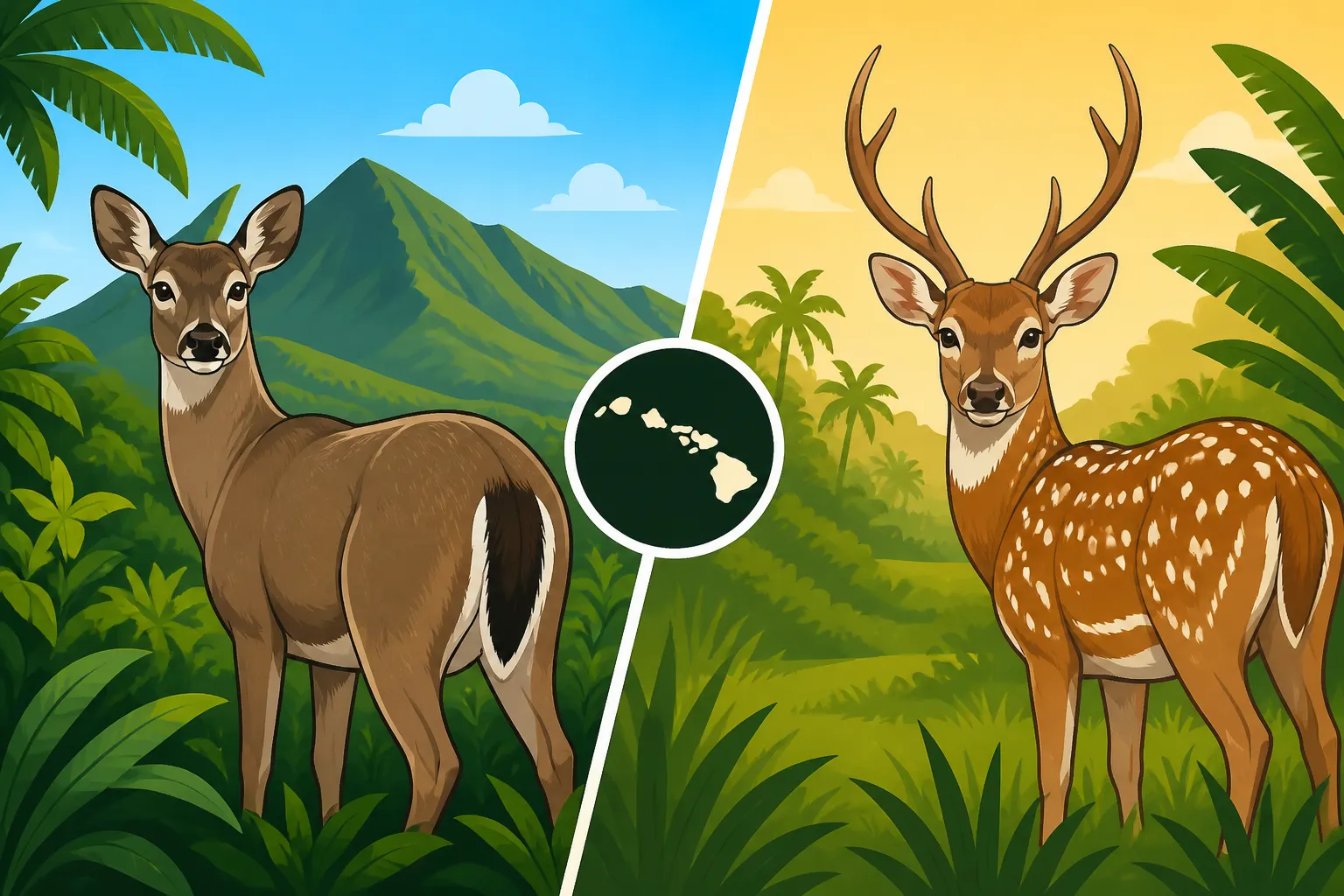
Here's where the most striking visual difference lies. Axis deer are famous for their vibrant, reddish-brown coat adorned with prominent white spots arranged in horizontal rows along their flanks. These spots remain year-round, giving them a distinctive and beautiful appearance. They also typically have a white patch on their throat and a dark stripe running down their spine. Their belly and inner legs are usually white. This spotted coat provides excellent camouflage in the dappled sunlight of their preferred open and semi-open habitats.
Black-tailed deer, conversely, have a much plainer, more uniform coat. Their summer coat is typically reddish-brown, shifting to a grayish-brown in winter. They lack the distinct white spots of the Axis deer. Their most defining features are, as their name suggests, their tail. It's usually dark brown or black on top and white underneath, which they often flag when alarmed. They have a white rump patch that is often visible when they flee, a characteristic shared with their mule deer relatives. You might also notice a darker patch on their forehead and a lighter muzzle area. How Black-Tailed Deer Differ From Axis most obviously in their coloration.
Antler Characteristics: Form and Function
The antlers of these two deer species are also quite different, reflecting their evolutionary paths and habitat adaptations. Axis deer bucks grow impressive, long, sweeping antlers that are typically three-tined on each side (a main beam, a brow tine, and a back tine). These antlers grow upwards and outwards, often reaching significant lengths, sometimes over 30 inches. They have a rough, corrugated texture and are shed and regrown year-round, meaning you can find Axis deer in hard horn, velvet, or even shed status at any time of year. This asynchronous shedding is unique among deer.
Black-tailed deer, being a subspecies of mule deer, typically grow antlers that fork repeatedly. Instead of a single main beam with tines branching off, their antlers tend to split into two, and then each of those splits again, creating a "forked" appearance. A mature Black-tailed buck usually has antlers with two or three points on each side, though larger, more complex racks can occur. Their antlers are generally smaller and less massive than those of a mature Axis buck. They also follow a more traditional seasonal shedding cycle, typically losing their antlers in late winter or early spring and regrowing them over the summer.
Habitat, Behavior, and Lifestyle
Beyond their looks, Axis deer and Black-tailed deer have evolved to thrive in very different Hawaiian environments, leading to distinct behavioral patterns that hunters must understand. These differences influence everything from their daily routines to how they interact with their environment and each other.
Preferred Terrain and Geographical Range
Axis deer are primarily creatures of the dry, open, or semi-open country found on the leeward sides of Maui, Molokai, and Lanai. You'll often find them grazing in expansive pastures, kiawe forests, or along the edges of agricultural lands. They thrive in areas with scattered brush, rolling hills, and access to water sources in arid conditions. This preference for more open ground makes glassing and spot-and-stalk tactics highly effective when Hunting Maui's Upcountry Axis Deer or on Lanai's more exposed units. They can also be found in slightly denser, more humid forests, but generally favor areas that allow them to see and be seen.
Kauai's Black-tailed deer, by contrast, are masters of the dense, wet, and rugged mountainous terrain that characterizes much of their island home. They inhabit the deep, verdant canyons, thick rainforests, and brush-choked hillsides of places like Kokee and the Waimea Canyon. These deer are incredibly elusive, preferring to stay hidden within the thick cover. Their habitat is often steep, slippery, and overgrown, making for an extremely challenging hunt. Access can be difficult, often requiring extensive hiking through formidable landscapes. Hunting the Waimea Canyon Rim for Deer requires physical conditioning and an understanding of navigating truly wild, untamed country.
Dietary Habits and Foraging Strategies
Both deer species are primarily herbivores, but their specific diets reflect their differing habitats. Axis deer are grazers and browsers, readily feeding on grasses, forbs, and the leaves and fruits of various trees and shrubs found in drier environments. They are particularly fond of young, succulent growth and often target areas where rain has recently spurred new vegetation. In agricultural areas, they can become significant pests, foraging on crops like pineapple and corn. Their broad diet allows them to adapt to fluctuations in food availability in their often-arid homes, making Hunting a Kiawe Flat for Axis Deer or near agricultural boundaries common.
Black-tailed deer on Kauai, living in a wetter, more tropical environment, primarily browse on a wide variety of native and introduced shrubs, ferns, and forbs. They are highly adaptable and will consume whatever palatable vegetation is available in their dense habitat. Their diet often includes plants like guava, ʻōhiʻa lehua, and various understory species. Because their environment provides an abundance of cover and food, they often don't need to travel as far or be as exposed as Axis deer to find sustenance. This can make them harder to pattern, as they have fewer predictable feeding areas in the vastness of the forest.
Social Dynamics and Rutting Patterns
Axis deer are highly social animals and often live in large, distinct herds. You'll frequently see groups composed of adult females (does) and their young, with mature bucks either in bachelor groups or joining the does during the rut. Their social structure means that when you find one Axis deer, you often find many, making them quite visible in open country. What's truly unique about Axis deer in Hawaii is their rutting pattern: it's not seasonal. Bucks can be in rut at any time of the year, leading to fawns being born year-round and varying antler conditions on bucks simultaneously. This continuous cycle means there isn't a single "best" time to hunt a rutting buck, though peaks in activity can occur. Why Axis Deer Rut Timing Is Different is one of the biggest learning curves for mainland hunters.
Kauai's Black-tailed deer, like their mainland cousins, tend to be more solitary or live in smaller family groups. Bucks often separate from the does outside of the breeding season. Their preference for thick cover also means that seeing large herds is rare; they tend to move discreetly through the undergrowth. Their rut, unlike the Axis deer, is seasonal, typically occurring in the fall, which creates a more predictable window for targeting bucks focused on breeding. This seasonal rut means that hunters can plan around specific times when bucks are more active and less cautious, though finding them in the dense foliage remains a significant challenge.
Hunting Strategies and Expectations
The inherent differences between Axis and Black-tailed deer necessitate entirely different hunting strategies, gear choices, and mental preparations. What works for one will almost certainly fail for the other, underscoring the importance of knowing your quarry.
Approaching the Hunt: Methods and Mindset
Hunting Axis deer in Hawaii often involves a lot of glassing and Spot-and-Stalk Tactics on Open Country. Because they frequent more open terrain, especially on Maui and Lanai, hunters spend significant time with binoculars or spotting scopes, searching for herds or lone bucks. Once spotted, a careful stalk, often over dry, crunchy ground or through thorny kiawe, is usually required to get within shooting range. Long-range shooting skills can be beneficial, as shots over 200 yards are not uncommon. Patience, keen observation, and the ability to move silently and strategically are key. Hunting Axis Deer at First Light in Hawaii can be incredibly productive, as they are often out feeding before the day heats up.
Hunting Black-tailed deer on Kauai is a completely different ballgame. Forget wide-open vistas; this is a dense-cover, close-quarters affair. It's often referred to as still-hunting or still-hunting combined with slow, deliberate pushes through the jungle. Stealth is paramount, as visibility can be severely limited, often to just a few yards. Hunters move slowly, stopping frequently to listen and observe, looking for a flick of an ear or a patch of hair. Success often hinges on intercepting a deer moving between bedding and feeding areas or jumping a deer from its bed. Shots are typically at much closer ranges, and quick target acquisition in thick brush is essential. It's a physically demanding hunt, requiring stamina, perseverance, and a comfort with navigating extremely rough and wet terrain.
Seasonality, Regulations, and Access Considerations
The seasons and regulations for hunting Black-tailed deer and Axis deer vary significantly by island and species. For Axis deer, hunts are available on Maui, Molokai, and Lanai, often with specific drawn hunt periods, archery seasons, and sometimes year-round opportunities in certain units. Lanai, in particular, has a well-known drawn hunt for Axis deer. You’ll need to secure the correct licenses and permits, which can often be managed through online systems like those provided by GoHunt. Hawaii Game Mammal Seasons provides a broad overview, but specific unit regulations are crucial.
For Black-tailed deer, hunting is limited to Kauai. These hunts are generally seasonal and often occur on specific weekends within designated public hunting units. Access to these units can sometimes be challenging, requiring hiking into remote areas. Like Axis deer, you'll need a valid Hawaii hunting license and any required permits for the specific unit and season. It's critical to check the Hawaii Department of Land and Natural Resources (DLNR) Division of Forestry and Wildlife (DOFAW) website or GoHunt well in advance for current season dates, bag limits, and any special drawing requirements. Kauai Black-Tailed Deer Season Dates are something every hunter needs to confirm.
Here's a quick comparison of the two deer:
| Feature | Axis Deer (Chital) | Black-Tailed Deer (Columbian) |
|---|---|---|
| Primary Islands | Maui, Molokai, Lanai (some Hawaii Island) | Kauai Only |
| Adult Weight (Bucks) | 150-250+ lbs (Molokai often largest) | 100-170 lbs |
| Coat Coloration | Reddish-brown with prominent white spots year-round | Reddish-brown (summer), grayish-brown (winter), no spots |
| Tail | Long, brown with white underside, often flicked when alarmed | Dark brown/black on top, white underside; often flagged |
| Antler Growth | Upward-sweeping, typically 3 points per side; asynchronous shedding (year-round) | Forked antlers, usually 2-3 points per side; seasonal shedding (fall rut) |
| Typical Habitat | Dry, open plains, kiawe forests, pasture edges | Dense rainforests, deep canyons, brush-choked slopes |
| Social Behavior | Highly social, often in large herds | More solitary or small family groups, elusive in thick cover |
| Rutting Season | Aseasonal (year-round), though peaks can occur | Seasonal (typically fall) |
| Common Hunting Method | Spot-and-stalk, still-hunting in open areas | Still-hunting, slow drives, close-quarters tracking |
| Physical Demands | Moderate to High (stalking in heat, varied terrain) | High to Extreme (steep, wet, thick jungle, challenging footing) |
Meat Quality and Trophy Potential
Both species offer fantastic table fare, but their reputations differ slightly. Axis venison is widely regarded as one of the finest venison meats available anywhere. It's known for its mild, delicate flavor, low fat content, and fine grain, with none of the "gamey" taste that some associate with other deer species. This makes Why Axis Venison Tastes Mild a popular choice for many, and it’s highly sought after by local chefs and restaurants. Proper field care in Hawaii's heat is crucial to maintain this quality.
Black-tailed deer meat is also excellent, lean, and flavorful, though perhaps not as universally acclaimed for its mildness as Axis deer. It's still a high-quality wild game meat, and with proper handling, it makes for delicious meals. The challenge of the hunt often makes the reward of the meat even sweeter. From a trophy perspective, a large Axis buck with long, symmetrical antlers is a highly prized trophy. Their impressive racks are a testament to their striking beauty. Black-tailed deer, while smaller in body and antler, offer a different kind of trophy; a heavy-antlered Kauai buck taken from the dense jungle is a hard-earned and deeply satisfying achievement, representing the ultimate success against a truly wild and elusive animal in a rugged environment. Judging an Axis Buck's Antlers in the Field requires an eye for their unique growth patterns, just as appreciating a Black-tailed buck means understanding the challenges of their specific habitat.
Regardless of which deer you pursue, the hunt in Hawaii will be an unforgettable experience, connecting you to the land, its challenges, and its unique wildlife.
Disclaimer
This article is for general informational purposes only and does not constitute professional advice. Laws, prices and regulations vary by location and change over time. Consult a qualified professional for guidance on your specific situation.