Hawaii Road Access and 4WD Requirements
One of the biggest surprises for hunters visiting Hawaii, or even local hunters new to certain areas, is just how challenging simply getting to a hunting unit can be. You might picture pristine paved roads, but the reality often involves bone-jarring, rutted tracks, mud so deep it swallows tires, or sharp lava fields that threaten to shred your sidewalls. Understanding Hawaii's road access and four-wheel-drive (4WD) requirements isn't just a convenience; it's absolutely crucial for a successful — and safe — hunting trip. This guide will walk you through what to expect and how to prepare.
The Harsh Realities of Hawaii's Hunting Roads
Forget what you know about forest service roads on the mainland. Hawaii's hunting access routes are a breed apart, constantly battling the forces of nature that shape our islands. Rain, volcanic activity, and relentless erosion conspire to turn what might once have been a passable track into an impassable obstacle course.
Why "Road" Doesn't Always Mean Paved
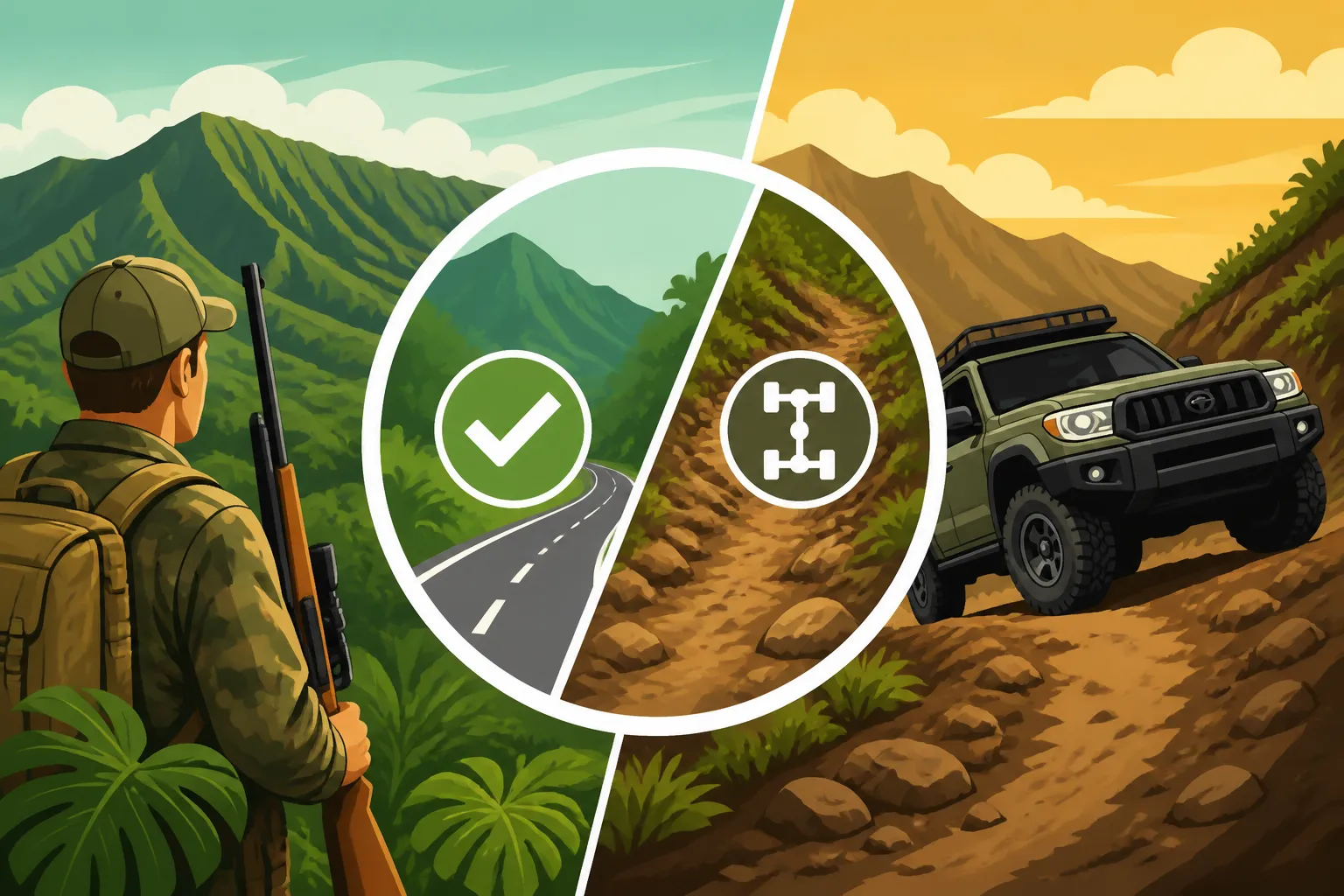
When the Division of Forestry and Wildlife (DOFAW) or a private landowner describes a "hunting road," it rarely conjures images of smooth asphalt. More often than not, you're looking at unimproved dirt tracks, old cane haul roads, ranch roads, or even trails carved out by decades of vehicle use and subsequent neglect. These aren't built for speed or comfort. They're built out of necessity, and their condition can change dramatically literally overnight due to heavy rain, landslides, or even new lava flows.
Imagine planning a hunt on the Big Island, perhaps near the Mauna Kea slopes. You pull up a map, see a road leading right into the unit, and think you're all set with your rental SUV. What you find when you get there might be a rocky path that quickly degrades into a field of loose cinders and sharp basalt, or a muddy two-track requiring high clearance and aggressive tires. That "road" might only be passable by a lifted 4×4 with locking differentials. It’s a common pitfall, and one that can easily cut a hunt short before it even begins.
The Unpredictable Nature of Volcanic and Rainforest Terrain
Hawaii's geology and climate play a massive role in road conditions. On the Big Island, you'll encounter vast stretches of a'a and pahoehoe lava that are incredibly abrasive and unforgiving on tires and suspension. These areas are often dry, dusty, and hot, and the roads are simply cut through the flow, leaving sharp edges everywhere. You might be Walking Rough Lava Without Wrecking Your Boots, but your tires have it even worse.
Conversely, head to the windward side of any island, especially into areas like the Hilo Forest Reserve or Maui's Makawao Forest Reserve, and you're immediately dealing with rainforest conditions. Here, the challenge isn't sharp rocks, but constant moisture. Roads turn into slick mud bogs, often with deep ruts that can high-center a vehicle in seconds. Steep ascents and descents become treacherous slides. Even a light rain can transform a passable road into a soup, and the vegetation quickly encroaches, making visibility tricky. These conditions are a major reason why many hunters choose Hunting Pigs in Hawaii's Wet Forest areas on foot, even if a "road" technically exists nearby.
Understanding Public Land Vehicle Regulations
Hawaii's public hunting units, managed by DOFAW, have very specific rules about vehicle access. These rules are in place not just for hunter safety, but also to protect sensitive ecosystems from erosion and disturbance. Ignorance of these rules is no excuse, and violations can lead to hefty fines or even loss of hunting privileges.
Designated 4WD Roads vs. Foot-Access Only Trails
It's critical to understand that not all tracks or trails within a hunting unit are open to vehicles. Many areas are designated "foot access only" to reduce pressure on game, minimize environmental impact, or simply because the terrain is genuinely too dangerous for vehicles. You might spot a promising game trail, but if it's not marked as a vehicle access road on your map, assume it's off-limits to anything with an engine. Often, physical barriers like locked gates or large rocks clearly denote these transitions. Always consult the official DOFAW maps for the specific unit you plan to hunt. A tool like onX Hunt can be incredibly valuable here, as it often shows public/private boundaries and designated access points, though it's always wise to cross-reference with current DOFAW regulations.
For example, many sections of the Puu Waawaa Game Management Area on Hawaii Island have strict rules about where vehicles can and cannot go, with many interior areas reserved for foot traffic. This helps maintain the integrity of the habitat for Hunting Mouflon at Puu Waawaa. Similarly, parts of Kauai's backcountry that hold Black-Tailed Deer Hunting in Hawaii might only be accessible by hiking in, rather than driving.
The Role of Permits and Check-In Stations for Vehicle Access
Access to many public hunting units, particularly those requiring a permit-tag for game mammals, involves a check-in and check-out process. This isn't just about reporting your presence; it's often tied directly to vehicle access. At check stations, whether physical or virtual (like through the OuterSpatial app), you might be given specific instructions or gates to access certain roads. Some units may even require a special vehicle permit in addition to your hunting license and game tags, explicitly stating where you can drive.
Consider the requirements for Checking In and Out of Hawaii Hunting Units. This process ensures accountability and helps DOFAW monitor usage. If you're driving into a unit that has a designated check station, always assume there will be specific rules about vehicle registration, parking, and which roads are open. For example, some gates might be unlocked only on specific hunting days, or require a combination provided at check-in. Failing to properly check in or adhering to vehicle access rules can invalidate your hunt and lead to penalties, not to mention potentially getting your vehicle stuck in a closed or dangerous area.
Island-Specific Road Challenges for Hunters
While general challenges exist across the state, each island presents its own unique set of road access hurdles that hunters must be prepared for. These are not always obvious from a map and often require local knowledge or thorough scouting.
Navigating the Big Island's Diverse Backcountry Roads
The Big Island, being the largest and geologically youngest, offers the most varied and often extreme road conditions. You could be driving on old sugar cane roads on the Hamakua Coast – often muddy, overgrown, and prone to washouts – and then, within an hour's drive, find yourself on the lava-strewn tracks of the Mauna Kea/Mauna Loa slopes. These high-elevation areas are known for their rough, rocky, and often unmaintained tracks that traverse Hunting Hawaii's High Elevation Alpine Ground. Vehicles often contend with sharp volcanic rock, deep ruts, and slippery cinder fields. During dry spells, dust can be a major issue, reducing visibility and coating everything. When it rains, volcanic ash and cinder can turn into a thick, sticky mud.
In the Kau Forest Reserve, for instance, you'll encounter much wetter conditions, with red earth turning to slick clay. If you're planning to hunt in areas like Puu Anahulu or Kaohe, it's crucial to understand that even "main" access roads can be severely degraded. Hunting Hawaii's Volcanic Terrain requires not just a capable 4WD, but often knowing how to drive it through challenging conditions.
Maui Nui's Rugged Access: Maui, Lanai, and Molokai
Maui, Lanai, and Molokai share similar challenges, particularly concerning axis deer habitat. Many prime Axis Deer Hunting in Hawaii areas are on private ranches or public lands accessible via long, unmaintained dirt roads that crisscross dry, kiawe-studded flats and steep, eroded hillsides. On Maui, for example, the Kahikinui area presents a maze of rocky, dusty tracks, some with significant ruts and washouts, especially after any rain. Hunting Maui's Year-Round Axis Deer Units often means dealing with these conditions regularly.
Lanai's access roads for public hunting units, particularly on the interior plateaus and dry western slopes, are notoriously rough. While the island is small, the roads can be a serious test for any vehicle. Expect deep ruts, loose rock, and thorny kiawe branches that can scratch paint and puncture tires. The same applies to Molokai, where remote areas and access to private lands often involve traversing very old, poorly maintained roads. Getting to some of the best Hunting Molokai's Axis Deer Country can feel like an expedition in itself, requiring a truly capable vehicle and careful driving.
Kauai and Oahu: Steep Ridges and Wet Gulches
Kauai and Oahu, with their older, deeply eroded volcanic landscapes, present challenges centered around steep topography and dense, wet vegetation. On Kauai, access to Black-Tailed Deer Hunting in Hawaii often means traversing incredibly steep and winding dirt roads that cling to canyon rims or dive into deep gulches. The famous Waimea Canyon area has numerous tracks, but many are only suitable for high-clearance 4WD vehicles and can become extremely slippery and dangerous with even light rain. Think mud, roots, and narrow passages with steep drop-offs. Hunting Goats in Hawaii's Canyon Country on Kauai frequently involves navigating these treacherous roads to reach remote trailheads.
Oahu's public hunting units, often located on the steep slopes and ridgelines of the Waianae and Koolau ranges, also demand robust 4WD access. Roads here are often clay-based, quickly turning into slick, boggy conditions when wet. Overgrown vegetation is a constant battle, with branches scratching vehicles and limiting visibility. Access to areas like the Makua-Keaau Reserve or Ewa Forest Reserve may involve narrow, twisting roads with limited turnaround points, making backing up an unwelcome necessity if you encounter an impassable section.
Equipping Your 4WD for a Hawaii Hunting Adventure
It's not enough to just have a 4WD vehicle; it needs to be properly equipped and in good working order to handle the unique demands of Hawaii's hunting roads. Skipping these preparations is a recipe for getting stuck, damaging your vehicle, or worse, being stranded in a remote area without cell service.
Essential Recovery Gear and Safety Practices
Driving Hawaii's hunting roads means preparing for the inevitable: getting stuck. Even experienced off-roaders can find themselves in a pickle. At a minimum, your 4WD vehicle should carry:
- Recovery strap/tow rope: A good quality, kinetic recovery strap is invaluable for self-recovery or getting a pull from another vehicle.
- Shovel: A stout, military-style shovel or compact off-road shovel is a lifesaver for digging out tires or building up ramps.
- Tire repair kit and air compressor: Punctures are common. A plug kit and portable air compressor can patch a hole and reinflate a tire, potentially saving your hunt.
- Jack and lug wrench: Ensure your jack can lift your vehicle high enough in soft terrain, and that you have the right tools for your specific lug nuts.
- Tire deflator/gauge: Being able to air down your tires (to 15-20 psi) dramatically improves traction on soft sand, mud, and sharp rock. Don't forget to reinflate when you hit pavement.
- Basic tool kit: Wrenches, pliers, screwdrivers for minor repairs.
- First-aid kit: Accidents happen, and remote areas mean long response times.
- Extra water and food: Enough for an overnight stay, just in case.
- Communication device: A satellite messenger or GPS tracker is highly recommended, as No Cell Signal on a Hawaii Hunt is very common in backcountry units.
Always tell someone your hunting plan, including your route and expected return time. Drive slowly, especially when you don't know the road ahead. Scout on foot if necessary. If a puddle or mud bog looks too deep, it probably is. And never drive alone into truly remote areas without another vehicle.
Vehicle Maintenance and Pre-Hunt Checks
Before heading out, give your 4WD a thorough once-over. This isn't just about avoiding a breakdown; it's about making sure your vehicle can withstand the abuse of Hawaii's terrain.
- Tires: Ensure you have robust all-terrain (AT) or mud-terrain (MT) tires with good tread, and check their pressure. Carry a full-size spare, not just a donut, and make sure it's in good condition and properly inflated.
- Fluids: Check oil, coolant, brake fluid, and differential fluid levels. Overheating is a real concern when crawling in low gear.
- Brakes: Ensure your brakes are in excellent condition, especially for steep descents.
- Suspension: Examine shocks, springs, and bushings for any signs of wear or damage. Rough roads will punish a weak suspension.
- Undercarriage: Inspect for loose skid plates, exhaust damage, or anything that could snag on rocks or stumps.
- Lights: Make sure all lights, including fog lights and reverse lights, are working. You never know when you might be driving out in the dark.
- Fuel: Start with a full tank. Many units are far from gas stations, and 4WD driving consumes more fuel.
For non-residents traveling to hunt, consider renting a dedicated off-road vehicle from a local company, rather than relying on a standard rental car that might not be allowed off-pavement anyway, or wouldn't stand a chance against the terrain.
Staying Informed About Road Closures and Access Changes
Nothing is more frustrating than driving hours to a hunting unit only to find the access road closed. Hawaii's dynamic environment means road conditions and access rules can change rapidly. Staying current is paramount.
How DOFAW Communicates Changes
The primary source for information on road closures, gate changes, and access restrictions is the Hawaii Department of Land and Natural Resources (DLNR), Division of Forestry and Wildlife (DOFAW). They typically post announcements and updates on their website. It's crucial to check the specific island and unit pages frequently, especially in the weeks leading up to your hunt. These notices often detail emergency closures, scheduled maintenance, or changes in access hours.
Sometimes, a specific gate might be locked, or a road section impassable, due to a recent storm or ongoing land management activities. The signs on the ground at the unit entrance are always the final word, but getting advance notice can save you a wasted trip. Where DOFAW Posts Season Announcements is a resource you should bookmark and check religiously. Don't rely solely on old maps or information from past trips, as conditions are rarely static here.
Using Technology to Verify Access (onX Hunt, GoHunt)
In today's world, technology can be a hunter's best friend for navigating complex land access. While official DOFAW notices are king, apps like onX Hunt and even GoHunt can offer valuable supplementary information.
onX Hunt is particularly useful for visualizing public and private land boundaries, which are often poorly marked on the ground in Hawaii. It can display roads and trails, sometimes with details on their designation (e.g., 4WD access, foot access). While onX's road data for Hawaii's public hunting units isn't always perfect or fully up-to-date with real-time closures, it provides an excellent base layer for planning and navigation. You can see potential access points, anticipate terrain changes, and identify areas where public roads transition to private property. This helps you understand Hawaii Trespass and Closed Area Rules and avoid accidentally straying into no-go zones.
Similarly, other online resources, including forums or social media groups dedicated to Hawaii hunting, can offer anecdotal, real-time updates from local hunters. However, always take unofficial information with a grain of salt and cross-reference with official DOFAW sources. Using a combination of official notices and these powerful mapping tools gives you the best chance of successful navigation.
Beyond the Road: Alternative Access for Remote Units
Sometimes, even the most capable 4WD can't get you where you need to go, or a unit simply doesn't have vehicle access. In these cases, hunters need to be prepared for alternative methods to reach their desired hunting grounds.
Walking In to Remote Units
Many of Hawaii's most rewarding hunting experiences come after a long walk. Numerous units, or significant portions of them, are designated foot-access only, or the existing "roads" are so degraded that walking is the only practical option. This is especially true for deep gulches, steep mountain ridges, or remote sections of rainforest. Walking In to a Remote Hawaii Unit requires a different kind of preparation, focusing on physical fitness, proper hydration, durable footwear suitable for various terrains (lava, mud, steep grades), and a solid navigation plan.
When you're hoofing it, every ounce in your pack counts. You'll need lighter gear, efficient packing strategies, and a realistic assessment of how far you can comfortably and safely travel on foot, especially when you factor in packing out an animal. Consider the terrain – a 3-mile walk in a relatively flat, dry area is vastly different from a 3-mile walk through a dense, wet, and steep gulch. Sometimes, a short drive to a trailhead followed by a long hike is the only way to escape the crowds and find undisturbed game.
Helicopter Access as a High-Cost Option
For the truly adventurous, or for those targeting incredibly remote and otherwise inaccessible areas, helicopter access is a unique option in Hawaii. This is not for the faint of heart or light of wallet, but it does open up vast tracts of untouched backcountry that few others will ever see. Helicopter operators often work with hunters to drop them off and pick them up in designated remote landing zones, allowing access to pristine areas for species like pigs or goats.
This approach requires meticulous planning, strict adherence to weight limits, and clear communication with the pilot and outfitter. It's often employed for multi-day hunts where packing out meat would be impossible on foot. While a costly endeavor, it can provide unparalleled access and a truly wild Hawaii hunting experience. However, always confirm that helicopter drop-offs are permitted in your chosen unit, as not all areas allow this type of access. Helicopter Access for Remote Hawaii Hunts is a specialized tool, but it's part of the diverse landscape of Hawaii hunting.
Hawaii Hunting Access Road Comparison
| Road Type | Typical Condition | Required Vehicle | Common Terrain | Key Challenges |
|---|---|---|---|---|
| Paved | Rare in units, usually approach roads | Any | Coastal, main thoroughfares | Limited direct unit access |
| Maintained Dirt | Graded periodically, passable when dry | High-Clearance 2WD/AWD | Ranch roads, dry leeward areas | Dust, ruts after rain, unannounced closures |
| Unimproved 4WD | Deep ruts, rocks, mud, washouts, overgrown | Lifted 4WD with AT/MT tires | Volcanic fields, wet forests, steep hillsides | High-centering, punctures, getting stuck, erosion |
| Foot Access Only | Narrow trails, dense brush, extremely steep | N/A (hiking) | Deep gulches, remote ridges, conservation areas | Physical exertion, navigation, packing out meat |
| Old Cane/Ranch | Variable, often overgrown, potentially locked gates | 4WD | Agricultural fringes, private leases | Trespassing, unpredictable conditions, mud |
Disclaimer
This article is for general informational purposes only and does not constitute professional advice. Laws, prices and regulations vary by location and change over time. Consult a qualified professional for guidance on your specific situation.